My soul goes out in a longing to touch the skirt of the dim distance.
O Great Beyond, O the keen call of thy flute!
I forget, I ever forget, that I have no wings to fly, that I am bound in this spot evermore.
–Rabindranath Tagore, The Gardener (1915)
Sunday morning. I am going to keep it simple. Just and image, a few words, and a song. To be honest, I am not sure that I see any of this triad having any connection with one another. I probably could make a case that they do if I wanted to spend enough time weaving a story out of cowpies and hot air.
I am too tired to do that this morning. I am sure that I will be weaving new stories soon enough. I have more than enough cowpies and hot air to share.
I do have to make one observation. Writing that last bit, I noticed that cowpieis such a nicer sounding word than bullshit. Cowpie sounds like something you might buy at an Amish farmstand.
“I tried some of that cowpie and it is yummy!”
Sounds like something you can’t get enough of. You wouldn’t say that with bullshit. With bullshit, you’ve always had your fill and don’t want any more.
Sorry for pointing that out this morning. You probably didn’t need to hear that.
Moving on. If you made it this far, you’ve seen the image of my painting and read the passage from Tagore. Without further ado, here is this week’s Sunday Morning Music. It’s a lovely duet from Irish singers Lisa Hannigan and Loah, who teamed up for a performance of Hannigan’s song, Undertow, that is an absolute favorite of mine. This their version of the Bob Dylan classic, Girl from the North Country, performed at the stately residence of the US Ambassador to Ireland in 2021. as part of a celebration of Dylan’s music on his 80th birthday.
It is delicate and lushly harmonious, just the ticket for a cold, dark Sunday Morning. Makes me feel bad for bringing up cowpies…
Time will say nothing but I told you so, Time only knows the price we have to pay; If I could tell you I would let you know.
If we should weep when clowns put on their show, If we should stumble when musicians play, Time will say nothing but I told you so.
–-W.H. Auden, If I Could Tell You (1940)
Just a day or two more of painting before I begin prepping my work for this year’s Little Gems show at the West End Gallery. This group represents the first real effort I’ve put forth since my diagnosis in the fall. It felt good to get back into the mindspace I occupy when painting, though it took a while longer than I hoped to get there. But at least I remembered how to get there and finally made it in.
Mission accomplished.
I am kind of sad about having to leave that mindspace, even for a short time, in order to prep this work. Once you’re in that space, you don’t want to risk not being able to get back to it again.
Feels kind of like Dorothy getting whisked away to Oz, not sure she’ll ever make it back to Kansas. Don’t know if that is a good analogy. Wouldn’t you prefer the vivid color and beauty of Oz to the stark, monochromatic landscape of the Kansas depicted in the film?
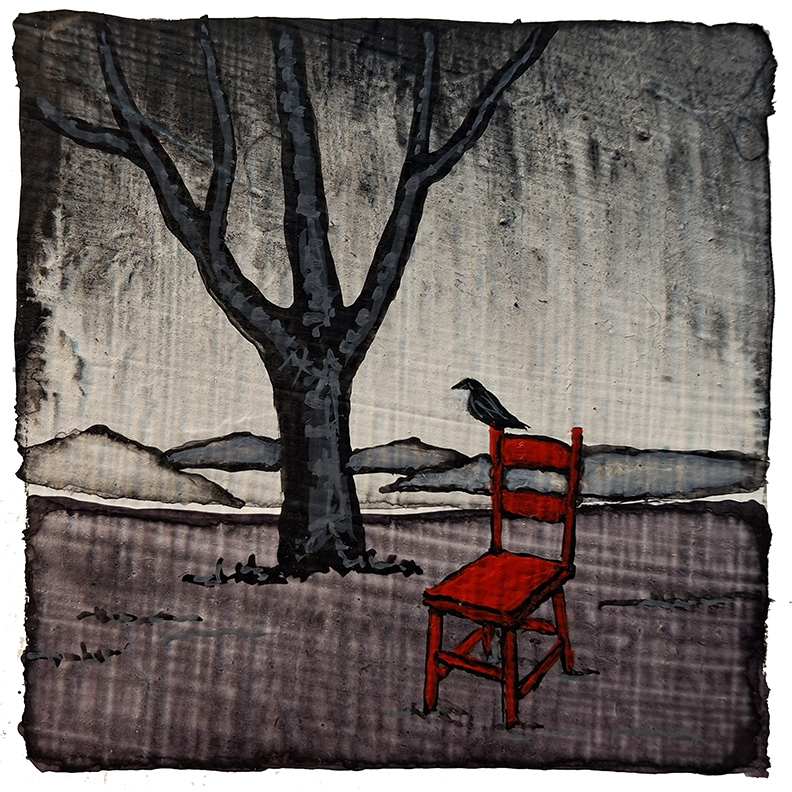
I don’t know about that. There are days when I am happy with either. That’s apparent in the group of new small work for this show. It’s a mix of both colorful work and work done in tones of gray and black, like the tiny piece shown at the top, Overseer.
There’s something in this little gem’s feel and tone that reminded me of a poem from W.H. Auden, If I Could Tell You. I came across a fine video with a reading of it by Tom O’Bedlam, whose readings I have featured here a number of times in the past.
Take a look if you are so inclined. I would stay but I have to get going or that ballon heading back to Kansas will leave without me. Or is it going to Oz this time?
Who knows? Not me, that’s for damn sure.
The annual Little Gems exhibit at the West End Gallery in Corning, NY opens Friday, February 6, with an Opening Reception that runs from 5-7 PM.
The first point he wishes to make is that in order to be a scientist, an artist, a doctor, a lawyer, or what-have-you, one has first to be a human being.”
–W.H. Auden, in Introduction to The Star Thrower by Loren Eisley
One must think like a hero to behave like a merely decent human being.
–May Sarton, Journal of a Solitude (1973)
As one studies these preconditions, one becomes saddened by the ease with which human potentiality can be destroyed or repressed, so that a fully-human person can seem like a miracle, so improbable a happening as to be awe-inspiring. And simultaneously one is heartened by the fact that self-actualizing persons do in fact exist, that they are therefore possible, that the gauntlet of dangers can be run, that the finish line can be crossed.
–Abraham Maslow, Motivation and Personality (1954)
The way I see it now, we are all people. We’re all out there, eating and drinking and sleeping and working and procreating and doing all kinds of things that people do– and probably a lot of things we shouldn’t be doing. Most of it is done by habit and without much thought.
We are people, after all.
But then there are also human beings. Still people. But the title of human being denotes something beyond the flesh and blood biology we all share.
It comes in the form of the connection we display for all others– both human beings and people.
In the concern and compassion we hold for people other than ourselves.
In the understanding that we are but small parts of an immense world and universe.
In that serving and helping others is both a duty and a joy.
In knowing that love is ultimately the most powerful force in this world, much more so than hate.
I could go on and on, listing things such as caring, compassion, open-mindedness, thoughtfulness, and so on.
I think however, if I had to put it into one word, empathy might be at the top of any list of what it takes to move from people to human being. The ability and willingness to see yourself in others is at the core of what it takes to be a human being. That entails recognizing and understanding their pains and fears, in looking beyond the surface to the context of who they truly are and what has shaped their lives, so that you can allow them a space in which they can feel comfortable and safe.
Empathy might well serve as a one-word credo for Human Beings.
I have told students and wannabe artists in the past that one of the primary requisites for becoming an artist is to be a complete person, a Human Being. To develop an understanding and care for the world.
I don’t know that I am qualified to say who is and is not a Human Being. I would like to think I am a Human Being but maybe I am just one of the deluded people. I’ve witnessed too many people in that category in recent years, people who have little empathy or care for the hurt or misfortune of others. People who think that life is just a matter of grabbing and grabbing more even if it comes at the expense of others. Even if it comes from lying, cheating, and stealing.
The I-got-mine-and-don’t-give-a-damn-what-happens-to-you-or-anyone-elsecrowd.
It’s hard for me to see these people as human beings. That is a truly awful sentence and maybe I am wrong in even thinking it, let alone writing it down. Don’t get me wrong, I see them as people and want no harm to befall them. In most cases, I even wish them well so long their success doesn’t include harming, hindering, or excluding others.
I just think they have squandered or, at least, neglected their inborn potential as human beings.
And that is a shameful loss for the world because it needs all the Human Beings it can get right now.
Way too many people and not nearly enough Human Beings.
Some people who see may say I am being intolerant and judgmental or divisive. Hardly the actions of a Human Being. Maybe they are right. I don’t know. However, I will say that many people who do awful, nasty, and divisive things often defend themselves against criticism by saying that those who point out the wrongs being perpetrated by them are being intolerant.
Human Beings have tolerant hearts but tolerating the intolerable is never acceptable.
Hear that, people?
Here’s a song from the late great John Prine that is right in this groove. This is Some Humans Ain’t Human.
By failing to read or listen to poets, society dooms itself to inferior modes of articulation, those of the politician, the salesman, or the charlatan. In other words, it forfeits its own evolutionary potential. For what distinguishes us from the rest of the animal kingdom is precisely the gift of speech. Poetry is not a form of entertainment and in a certain sense not even a form of art, but it is our anthropological, genetic goal. Our evolutionary, linguistic beacon.
–Joseph Brodsky, opening remarks as United States Poet Laureate, October 1991
I think that Joseph Brodsky, the late Soviet-exiled poet who went on to become the US Poet Laureate, is spot on with the comments above. Poetry, and all the arts, represents our highest form of articulation and connects us with the underlying rhythm, melody, and grace of the universe, drawing us closer to our highest potential. Art in its truest form serves as a unifying force, a voice of and for all people.
I think that the embrace and expanse of the arts — or the neglect or rejection of it– can be a true barometer of a nation’s progress and potential. I think of the controlling regime in this country at this moment and I ask myself a number of questions.
What and where is its poetry?
What art, music, or literature defines and expresses the hopes of all its citizens?
Where is its beauty, its grace?
I haven’t found an answer to any of these thus far. That doesn’t mean there is not an answer that might shatter my whole hypothesis. But nothing jumps out to this inquiring observer. It is a regime that sees any artform expressing a desire for the unity and freedom of all people as being a hostile action.
It has no poetry. No music. No art. No literature. No theater. No dance. No humor.
It seems to exist as a culture without culture.
And that is a society that is not healthy, one that cannot last for too long, let alone aspire to empire.
Okay, that’s all I want to say right now. There’s certainly more that could be said but that is the crux of what I needed to say this morning.
Let’s have some music.
This song has been in my head in recent days, and I’ve been waiting for a chance to share it. It is from the great Mavis Staples‘ new album, Sad and Beautiful World. I shared the title track not too long ago. This song is Beautiful Strangers. It has a poetry, grace, strength, and courage that fits the post and this moment.
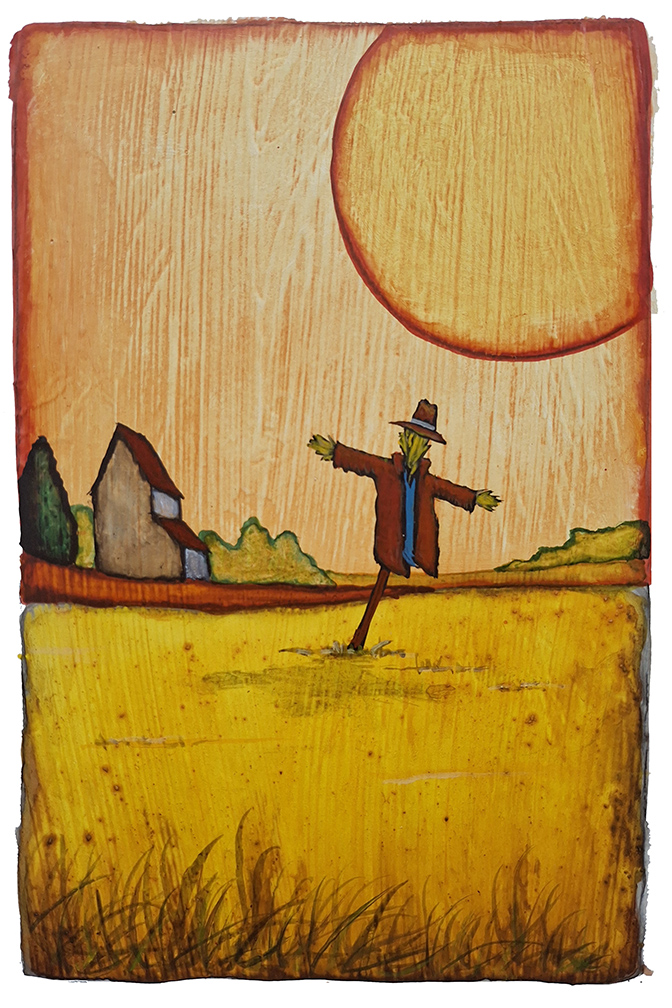
The Scarecrow’s Daydream– Coming to West End Gallery
I strongly wish for what I faintly hope; like the daydreams of melancholy men, I think and think in things impossible, yet love to wander in that golden maze.
–John Dryden, The Rival Ladies (1693)
I’ve been steadily working in the past week or so. I mentioned earlier that it felt awkward, that the mental and physical processes were really rusty and way out of sync. This past week has been like boot camp, even more so because I am primarily working with the transparent acrylic inks with which I began my career. It is more of a watercolor-based process though mine has a few quirks of its own.
Though it felt rocky at first, I have been pleased with the results thus far and am feeling the inklings of that old feeling where one piece creates the inspiration and opening for another. It is the beginning of a groove. I’ve been there and recognize it. And am excited to find it still nearby.
This inspiration that pushes toward the groove might come in the form of a color appearing that has slipped from the front of my mind, one that has special properties of its own even though it doesn’t seem far removed from other shades of the same color. Or it might be an element or form you have eased away from or only employ once in a while.
When these things appear it’s like running into an old friend and realizing after a few minutes how much you enjoyed their company and have missed them.
I’ve ran into a few old friends this past week or so. It’s a good feeling to not be alone out there on that empty painting surface. Their input is invaluable to me.
One of the new pieces is the small painting at the top, 4″ by 6″ on paper, that is going to be included in the annual Little Gemsshow at the West End Gallery that opens on February 6. The Little Gems show, which is now one of the most highly anticipated shows of the year for the West End, began in 1995. That first show also marked the first public showing of my work. I’ve been fortunate to show new small work in all the shows through the 30+ years and in this, its 32nd edition, I am once again a happy participant.
Like some of the colors and forms I mentioned above, the Little Gems show is like an old friend.
And this year, perhaps more than ever, I am even more glad to have such an old friend.
This painting is titled The Scarecrow’s Daydream. There is a yellow in the field that is one of those old friends, one that thrilled me when I saw it again for such a long time. It is a mixture of a couple of yellow shades, a bit of red, and sepia. When it works– it sometimes does not– it bangs the gong loudly for me. I don’t exactly know what that means, it just sounded good when I wrote it. I guess I could have simply said I really like the color. But that’s not how I roll, is it?
The Scarecrow is another old friend that periodically returns. I am still trying to understand what it is about scarecrows that holds my fascination. Maybe it stems from Ray Bolger‘s character in the Wizard of Oz? There’s something in that affable, kind character singing If I Only Had Brainthat connected deeply with me as a kid.
There was also an episode of The Wonderful World of Disney from 1964 that sticks firmly in my memory. It was titled The Scarecrow of Romney Marsh and was about a group of Brits rebelling against the onerous taxation of King George III in 1763. They are led by Dr. Syn who dons a scarecrow outfit to terrorize the British troops. The song and imagery of its opening shown below are another scarecrow figure that is embedded in my mind.
There is something enigmatic in the form a scarecrow as an avatar for a human being. It’s like a primal form of robotics where we create a figure in our own image to do tasks for us. Yet, because they have our somewhat human form, we begin to attach more human qualities to them than we first intended. They sometimes end up scaring us as much, if not more, than the crows.
There’s probably a lesson or commentary in there somewhere about our relationship with advanced robotics and the unintended consequences of AI but it will have to wait its turn on another day.
As for the daydreaming scarecrow here, I do see it as being analogous to the human experience of mindlessly biding time, tethered in time and place. That sounds somewhat sad and melancholic and I suppose there is an element of that in it. But there is also something beyond that in it for me. While we do spend an ample portion of our lives doing sometimes mundane and mindless tasks, like that scarecrow in that field, there is something in the scarecrow here that is almost celebratory and appreciative for having the opportunity to simply serve a purpose and play a part, however small it might seem, in the human drama.
That’s all we can ask for ourselves, isn’t it?
Now get out of my field. Shoo! I got work to do and daydreams to think on. You heard me– git!
I learned that courage was not the absence of fear, but the triumph over it. The brave man is not he who does not feel afraid, but he who conquers that fear.
–Nelson Mandela, Long Walk to Freedom (1995)
What is courage?
There are plenty of definitions, but the short answer is that it is doing what needs to be done– the right thing in most cases — even though you are scared and have much to lose by doing so.
We are living in a precarious and dangerous time that has been brought about by a lack of courage by those who have professed to be leading and representing us. And we the public went along for the ride for too long. The lack of courage in our leaders became our own. It was easy just to glide along, not having to rock the boat. As a result, we are in a serious deficit of courage in this country at the moment. What courage we once had had become slack and weak, like a muscle that has not been used for a very long time.
Unfortunately, or perhaps tragically, it has brought us to a point where courage is needed more than any time most of us have ever known in our lifetimes.
I am encouraged by the recent stirrings of newly awakened courage among the public in response to the atrocities being perpetrated on the American public and the rest of the world by the criminal organization that has taken over our government. It is a matter of courage begetting courage. The courage of others inspires other to act courageously.
Encouragement– courage is right here in the word.
This moment raises so many questions on the nature of our courage.
Can we muster enough courage to push back and stop the tides of tyranny?
Do we ever really know if we inherently possess the courage we’re going to need? Is it already placed within us, something written into our DNA that we can call on when needed? Or is courage something apart from us, a quality that is called to us when circumstances and time and place align? Or is it something we slowly attain with use and repetition, like the muscles I referenced above?
I don’t know the answers to these questions. Not even sure they can be answered by those with much more intelligence and wisdom than me.
I do know that I have been both. More cowardly than courageous, actually.
I should give you examples, but I won’t. Mainly because I am not sure anything I’ve ever done qualifies as courage.
And while there is doubt about my acts of courage, I won’t list my acts of cowardice because there is absolutely no doubt on that account. The shame and humiliation that comes with one’s own cowardice is an unmistakable stench that lingers with you. Plus, there are too many examples from which to choose.
Can you blame anyone for not wanting to list those times when they have been craven cowards?
Do we ever even know whether we have been courageous? Not all acts of courage are easily recognized or lauded whereas cowardice for some often comes with that stink I mentioned above. People eventually notice the coward.
Can a lifelong coward suddenly transform into a bastion of courage? Or are we forever labeled one or the other? Or is it as playwright Jean Anouilh wrote in his 1959 award-winning play Becket:
Until the day of his death, no man can be sure of his courage.
Lots of questions without answers. Maybe this is how the cowardly avoid facing their fears. It’s worked for me on the past.
But maybe as Anouilh infers, so long as each of us walk this earth, there is still time for any person to see the light and change their final label from cowardly to courageous.
I sure hope so. Who wants to be known as a coward for all eternity?
That’s just plain bad karma to carry with you for the rest of time.
Here’s a performance of a song that has been dogging my thoughts over the past several months. It’s a cover from several years ago of the 2003 song from the White Stripes, Seven Nation Army. This version is from Postmodern Jukebox featuring the mega-talented Haley Reinhart. They have transformed this generational rock anthem whose bassline is chanted endlessly in football stadiums around the country into a New Orleans-style funeral dirge. Haley Reinhart’s performance here is extraordinary. The subtle choreography of her gestures and facial expression along with her vocal range and the ease with which she belts out the words make this a tour-de-force.
And that is what we need right now, a tour-de-force, one that a seven-nation army can’t hold back. Let us all be encouraged.
I am going to try to share an older piece every Monday. I say try because I may simply forget to continue the series at some point or it might run out of steam. It’s happened with me before. Like the old line from Robert Burns: The best laid plans of mice and men often go awry.
But for now, I will try to keep it going.
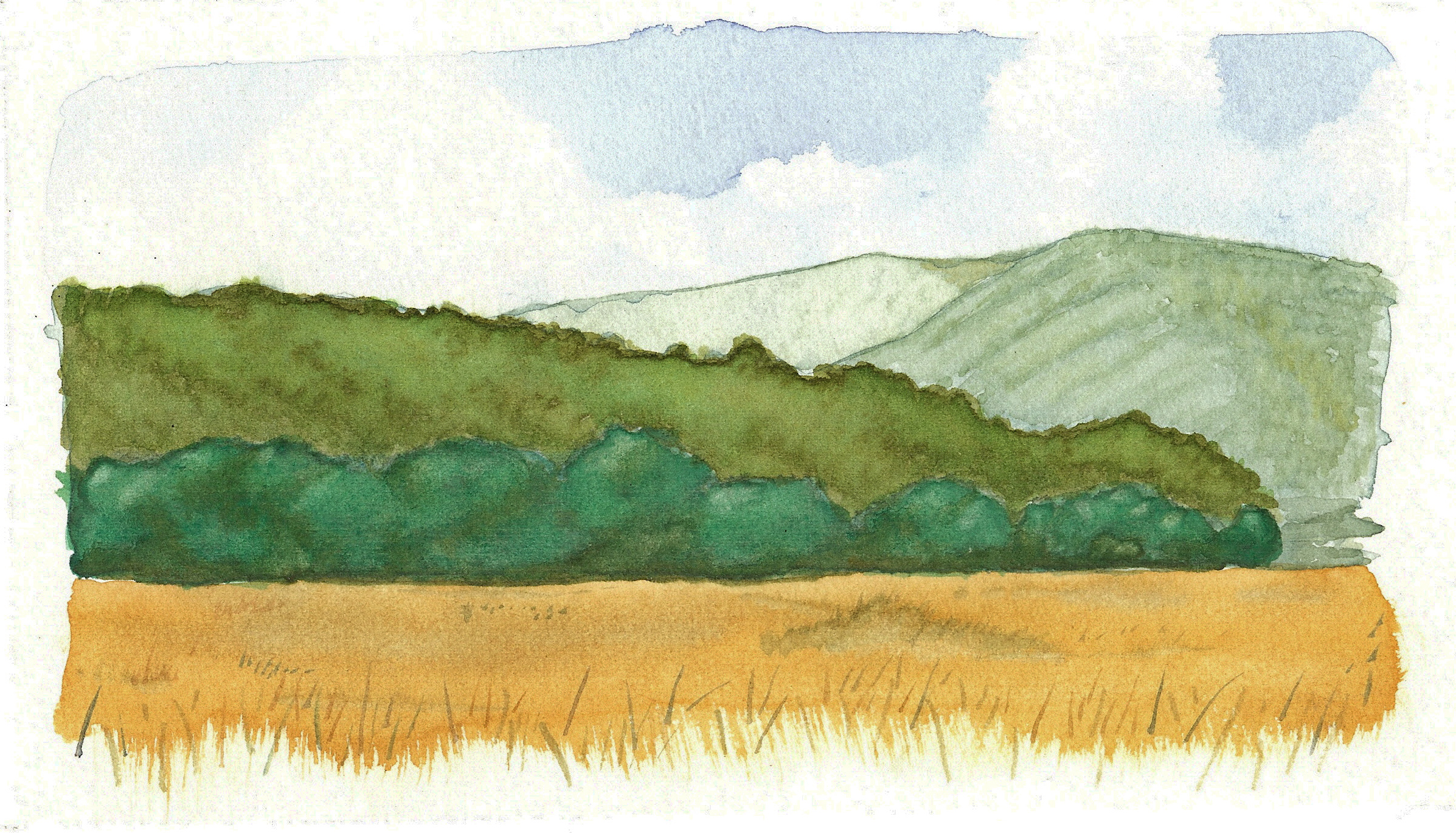
This small painting, Summerfield, from 1994 has been a favorite in recent years for me. To be fair, I liked it when it was painted. However, I was just finding my voice at around the same time, transitioning to a more personalized style and process that would better speak for me.
This piece represented that period in my development where I was still trying to make work that was comparable to others. It’s a period most artists go through, when the work of others serves as gauge against which they can compare and gauge their progress. It’s helpful and sometimes satisfying as you approach what you consider an acceptable level of ability. You begin to feel as though you’re part of the club.
But for some there comes a point where you sense that this is not the path for you. You realize that you don’t really want to be in the club, however prestigious that club might be. You don’t want to be compared to the others in the club, don’t want to be limited by the constraints of the rules of the club, some of which felt arbitrary.
If I felt that the sky should be red or the fields purple, why should I not paint them in those colors?
This piece was one of the last pieces where I was still thinking about joining the club. Maybe the last one actually. I never signed it, nor do I believe I have ever shown it publicly even though the progress and quality it showed pleased me greatly.
It just didn’t seem to fit into where I saw my work going at the time.
But over the years it has become a favorite, always bringing a warm feeling when I come across it. Its sense of place and time resonates with me. Perhaps more now than when I painted in over 30 years ago.
I no longer see it as an echo of someone else. I view it as a helpful stop along the way where I was deciding which way to go.
More than that, I simply appreciate it now for what it is in front of me.
Much like Camus’ words at the top, it doesn’t seem to be trying to be what it is not.
It has its own sense of being. It just is what it is.
And though it took time to come to this recognition, I like what it is.
Here’s a song that came on while I was writing this. Its tone seemed so perfect for the feeling I was getting from Summerfield that I can’t resist sharing it. This is Blue Skiesfrom Tom Waits. It’s a stark contrast to his The Earth Died Screamingthat I included in a post a few days back.
This is one of his earlier songs so maybe this is his Summerfield?
Who knows?
Doesn’t matter. It just is what it is. And that is all I need to know.
On the Sunday morning sidewalks Wishing, Lord, that I was stoned Cause there’s something in a Sunday That makes a body feel alone And there’s nothin’ short of dyin’ Half as lonesome as the sound On the sleepin’ city sidewalks Sunday mornin’ comin’ down
==Kris Kristofferson, Sunday Morning Coming Down
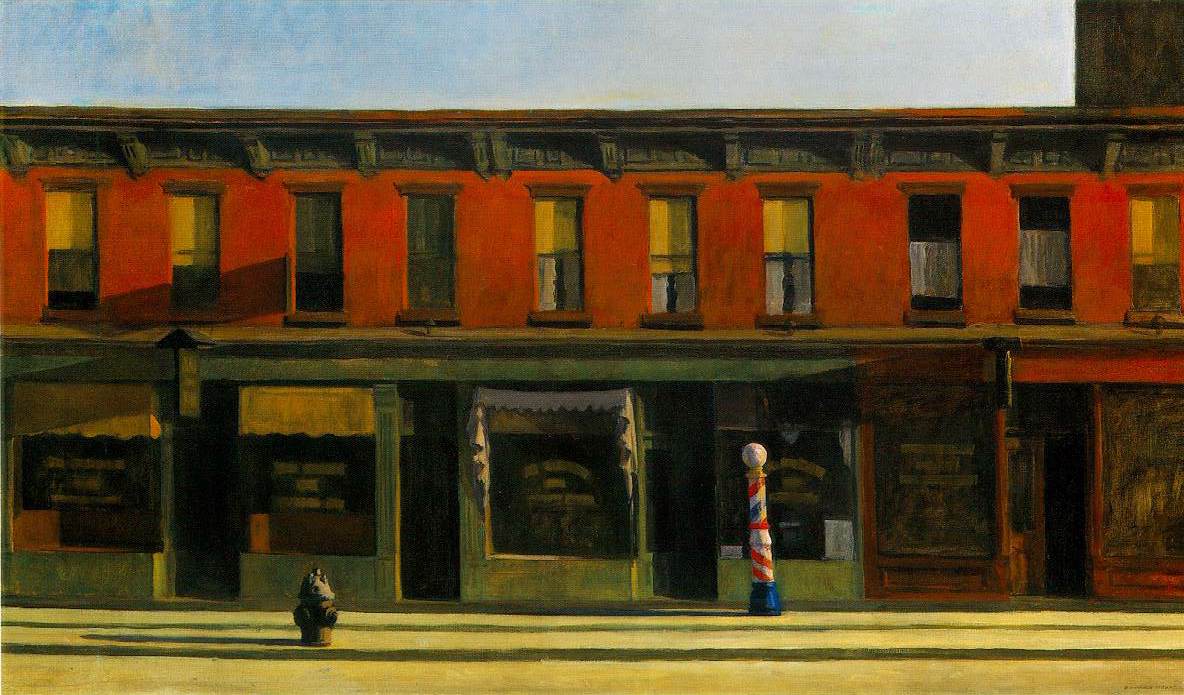
Another Sunday morning. Coming into the studio early this morning. I was struck by the need to hear Johnny Cash sing Kris Kristofferson‘s Sunday Morning Coming Down.
It just felt like one of those Sundays. One of those days that have the feeling of that song aa well as that of the Edward Hopper painting above, one of my favorites by him. It has a quietness tinged with melancholy. It is filled with a bright sunlight that doesn’t sanitize or wash away the shadows but only serves to highlight the sadness that covers everything like a fine coat of dust.
It has the feel of the calm before the storm. Or maybe after.
It represents those Sunday mornings in the past when the world seems to be shifting radically or has shifted for me, and I am trying to come to terms with the change. Mornings when the realization sets in of something lost or beliefs shattered.
I’ve known those Sunday mornings.
This morning has that same sort of feeling.
Not going to go into why this might be. With the madness taking place in this country coupled with dealing with the cancer while still trying to be a productive painter, there are a lot of obvious choices.
Let’s leave it there. On these Sunday mornings such as this, all you can do is gather yourself up in its quietness and try to steady yourself so that you can carry on.
Put on your cleanest dirty shirt, wash your face, comb your hair and stumble out the door to meet the day. I took some liberties with the song’s words since I didn’t shave this morning. To be honest, I didn’t wash my face yet. And I guess I didn’t comb my hair either. But you get the gist.
For this Sunday Morning Music here’s that song. Something solid to hold to this morning. This is a live version from Johnny Cash that I very much like. I think it’s the fact you can see him sweat, that this guy is working to please and connect with that audience. It has a sense of vulnerability and authenticity to it that certainly connects the song to me– a dirty-faced, unshaven, wild and white-haired older guy sitting in the dark on an ominously dead still Sunday morning.
What wisdom can you find that is greater than kindness?
-Jean-Jacques Rousseau, Emile (1762)
I thought that I’d take a bit of a break from the dark clouds that are milling around outside and share a post from a number of years back that emphasized one of the better, if not the best, traits available to us humans: kindness. For many folks it sometimes feels as though it has become a rare bird these days. So much so that when it does make an appearance it takes your breath away in wonder.
I’ve been extremely fortunate to have seen this rare bird several times over the years.
Running this older short post turned out to be not so simple. It featured the quote above and attributed it to the wonderful artist Henri Rousseau, a favorite of mine. It seemed right at the time this post originally ran but now something seemed off. I began to question when and where Henri Rousseau uttered or wrote this. At the time it originally ran I sometimes made the mistake of blindly trusting what the Google machine and the internet as a whole told me.
Someone out there had to be doing the due diligence in verifying these things, right?
Well, over the years I have learned from such incidents that this is not the case. Sometimes– often actually– wrong info is adopted as fact by a wide swath of the internet. As a result, I have begun to try to locate and verify the source of the quotes and passages I use here.
Looking at this quote this morning, I decided I better do that due diligence. Took a mere minute to discover that the quote was not from the French painter Rousseau but was instead from a book by the 18th century Swiss philosopher Jean-Jacques Rousseau, who was a leading light in the Age of Enlightenment and had a huge influence on modern thought. His writings on the social contract between the people and government had a great effect on Thomas Jefferson as he wrote the Declaration of Independence.
I would have liked to believe it was Henri Rousseau’s thought. It seems like something he might have said, based on the feel I get from his work. There’s a kind of inherent kindness in it. But it makes more sense that it comes from the great philosopher.
That kindness in itself is a form of wisdom is surely a philosophical concept.
Anyway, my break, where all I wanted to do was share some Rousseau paintings that I love, turned into this.
Oh, well, that’s the way the cookie crumbles.
Please don’t ask me where that phrase comes from or who said it first, though I think it was Plato.
Or Groucho.
We’ll let that one go for today. That would be the kind thing to do.
Here’s a song, (What’s So Funny ‘Bout?) Peace, Love, and Understanding, that was a hit in 1979 for Elvis Costello. While I love that version, I also love the original from Nick Lowe who wrote and recorded the song in 1974. This is a more recent performance from Lowe. It has a gentleness and quietness that differs from the original, having more the feel of the wisdom of which Rousseau wrote. He is accompanied here by Los Straitjackets adorned as always in their Mexican wrestling masks. They have been around for a very long time and are an instrumental group that primarily plays surf rock. Fun stuff.
When they must despair, men will always prefer kneeling to standing. It is their cowardice, their fatigue that aspires to salvation, their incapacity to embrace comfortlessness and in it find the justification of pride. Shame on the man who dies escorted to his grave by the miserable hopes that have kept him alive.”
— Emil Cioran, The Trouble with Being Born (1973)
I started putting this together yesterday while watching the furor grow over the ICE shooting of Renee Good in Minnesota. I debated writing let alone sharing this post since I espouse the idea of maintaining hope in much of my work and writing. I use the word hope a lot. Probably too much. It emerges reflexively and without thought now, taking away much of whatever power it holds.
And hope has some power. It is a noble concept, one that has helped many people through trying and dangerous times. But there are times when hope fails and even hinders the chances of survival. We sometimes hold on to hope like it is some sort of lifesaver keeping us from drowning, believing that if we simply hold on, someone else will come along and rescue us.
Recent history has shown us that is not always the case. Sometimes those who come along are not going to attempt to rescue you. Sometimes they are there to finish the job they started, as we bob helplessly on the waves.
Those are the times when hope be abandoned, along with the idea that there is someone else to come to our aid. Hope must be replaced with thought, action, and the will to overcome. This moment seems like an inflection point, one that brings us closer abandoning the hope that the checks and balances, guardrails, and legal constraints that serve as the lifesaver of hope to which we cling so desperately.
It is a time to rely on the power of hopelessness.
I know that sounds awful and darkly depressing. Well, these are deeply dark and depressing times.
I debated using the passage above from the 20th century Romanian philosopher Emil Cioran, who is known for a brutal pessimism and cynicism towards man that borders on total misanthropy. I can only read snippets of his work without wanting to open a vein though while I am repulsed, I sometimes finding myself laughing. For example, from the same book as the passage above comes this dark thought:
“Sometines I wish I were a cannibal – less for the pleasure of eating someone than for the pleasure of vomiting him.”
But in this book Cioran puts forth the idea of the belief in hopelessness as a sort of religion. And for this moment, that is how I am beginning to view it.
Below is a post from 2020, in the final year of trump’s first term at the beginning of the pandemic. Good times. It is about the power of hopelessness. It might even be our superpower if we can come to better understand what every authoritarian/fascist regime has failed to recognize: that the hopelessness and desperation they create makes their repressed citizens take risks and actions that would seem unthinkable in normal circumstances, that desperate times make for desperate actions.
Hopelessness is the seed of courage.
From 2020:
“The Americans have no sense of doom, none whatever. They do not recognize doom when they see it.”
― James Baldwin, Giovanni’s Room
At the bottom of the moods swings that occupy my waking days and dreaming nights as of late. In the studio at 5:30 this morning, a Tom Waits song playing with huge clunking beats and his coarse, smoke burnt voice yelling over it all, And the earth died screaming/While I lay dreaming…
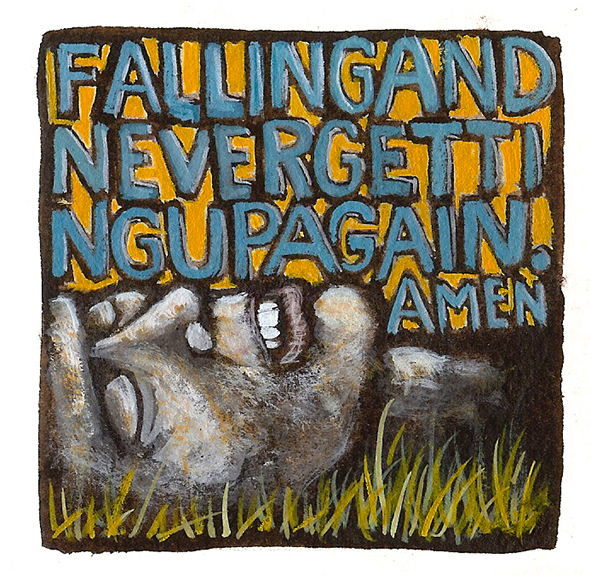
Shuffling through things, trying to find something to hold on to and I come across this little painting at the top, one that I quickly did years ago for my eyes only. Never meant to be shared, just a private reminder to myself of those days when the dark crows of doom have gathered around my door. Meant to keep me aware of the signs that appear when these crows are coming back, to remind me of the immense fatigue and sense of doom they bring with them so that I might be able to stay clear of them this time.
To avoid hopelessness.
But sometimes hopelessness cannot be avoided.
If you have been at a point without hope, you know there are only two outcomes: to succumb to the doom or fight. You realize that hope, at that point, has become your enemy, a distraction that weakens your resolve and keeps you from being fully engaged in the battle.
Hope is a tool used by agents of doom, to tyrants and despots who tie themselves to religions that keep the masses passive with promises of better days ahead and in lives after this one on earth. Hope makes you look forward when you need to be only in the here and now. Hope makes you sloppy and inattentive, willing to surrender to nearly the same terms and conditions– and often worse– that have brought you to this point.
Hope is a promise unfulfilled, a wish without action.
No, in times of doom, hopelessness is your greatest ally.
Hopelessness demands action.
Hopelessness is the greatest agent of change.
Hopelessness is fearless, with nothing left to lose.
I wasn’t planning on writing this this morning. God, I want to be cheery and optimistic and, dare I say, hopeful. I have always preached hope on this blog but that was in times when I thought the future was still a bright sky, not a dark and foreboding one like the one I see now, where the storm clouds have been amassing for the last four years. I’ve watched them gather but hope made me think it would somehow resolve without me engaging, that the sky would brighten of its own accord.
But I was wrong to trust hope. I can’t turn to hope this morning.
No, I am looking to hopelessness as my savior. I’ve have sometimes visited that abject blackness down where hopelessness dwells and it has always sent me back upwards. It has invariably set me in action and stiffened my resolve. It has made me realize that this life is a precious thing that is worth fighting for, against all hope.
Against all hope. I never thought about that term before, though I have used it on more than one occasion. I think we are at that point, where we must struggle against all hope with hopelessness as our great ally.
So, for the time being, I am setting hope aside. Oh, I’ll hope you’re doing well and staying safe because I want us all to have a brighter future at some point soon. But I will not depend on hope or trust that it will bring that desired future.





 Redtree Times