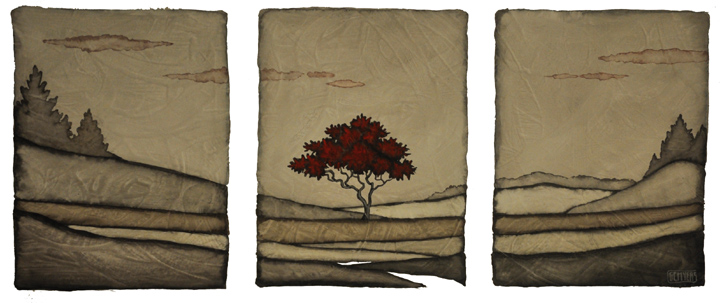
This is a small triptych that I recently completed. I’ve done several triptychs over the years and really enjoy the challenge of composing the three separate panels into one cohesive piece. There are obstacles to overcome in order to make the overall piece work well in attracting and holding the viewer’s attention over the width of the painting.
This piece, done in the gray style with a dash of red that I’ve used a bit year, has panels that each measure approximately 4 1/2″ by 6″. The smaller panels change the way I view each panel in composing this. When doing a larger triptych, I try to make each panel completely autonomous, meaning that each panel has to stand alone as a painting. Each has to have its own focal point and be complete as a self-contained scene. However, with the smaller size of the panels I drop that criteria somewhat because the width of vision for the viewer is already condensed. The side panels still are complete but they have little in the way of focal points in themself.
The overall feel for this piece has a real sense of completion. The attention is all funneled to the central panel and while the side panels may not be exciting as individual paintings, they have a feeling of rightness in the whole.
I’ll be working on a larger triptych soon, perhaps with non-symetrical panels which changes again the way the composition comes together. I will probably opt for color in the larger piece. Maybe not. Who knows?
 Redtree Times
Every time I see one of your “gray paintings”, I like the effect more.
This one is particularly evocative for me – the slash of white in the middle panel calls up the last snow patches that lingered at the end of my Iowa winters. The painting seems to capture that briefest of moments between winter and spring – I really like it.
Thanks for your evocation.
Love your triptychs because they emphasize for me how your paintings are looking through “windows” to the outside. Strangely enough, however, I did not like that effect when those windows were shown explicitly in your show at the Principle Gallery a few years ago.
That’s interesting. Perhaps the illusion of the window is far stronger than seeing an actual window. The illusion allows the viewer to create his own idea of the interior environment, built on his own experience.