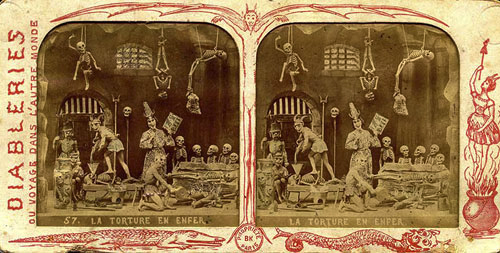
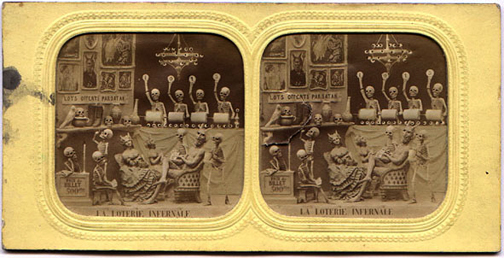
 I came across these photographic oddities and thought they would be fitting in this week that ends with Halloween. The stereoscope was invented in Paris in 1850 and became a worldwide sensation over the next decade. In 1861, a series of 72 of these stereoscopic photos were printed anonymously in Paris that consisted of macabre scenes of Satan and various aspects of Hell. Called Les Diableries, these plates were a drastic turn away from the often mundane photos seen in early stereoscopes and were quite the hit in 1860’s Paris.
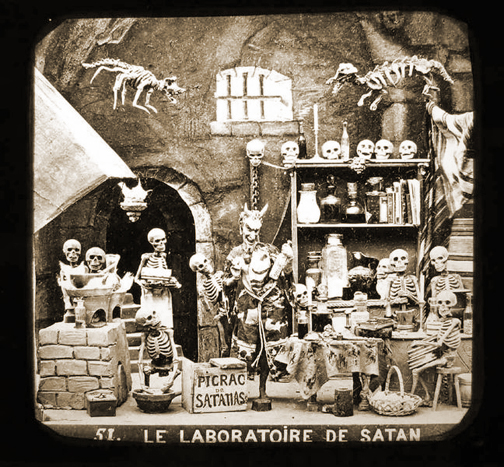
The photos remained anonymous in that time because they were viewed as politically satiric of the French government of the time, the Second Empire under Napoleon III. To openly chide the Emperor at that time could bring dire consequences but the images circulated freely, nonetheless. I think they are a remarkable set of images from that time and I can imagine how they must have resonated in the minds of people who weren’t exposed to the mind-boggling array of imagery that we often experience in a single day in our time.
 Redtree Times
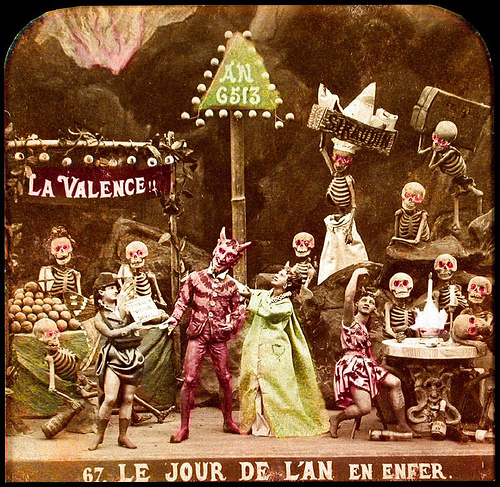
I can’t help but wonder about the significance of the year 6513 in picture #67, “New Year’s Day in Hell”. Perhaps it’s just an arbitrary date in the far distant future, meant to suggest eternity.
I was also reminded of Ray Harryhausen’s stop-motion special effects in the 1963 movie, “Jason and the Argonauts”, in which the hero battles seven skeletons. According to Wikipedia, the four-minute sequence took more than four months to produce.
Yes, now that you mention it, these do bring those scenes from the film to mind. The sight of those skeletons swarming against the Argonauts was pretty thrilling in the days before computer generated effects. I can’t imagine the tedium of spending four months on one four minute scene.
These are wonderful! Their history as political satire is delicious, but I confess: I’m a child of my age and the first association I made was with the cover art for my favorite Jerry Garcia collection.
Friend of the Devil catches something of the cozy familiarity with death that’s so much a part of the culture here. It may be Halloween, but it’s also dia de los Muertos, with all that entails. Some families carve pumpkins, some make sugar skulls and have picnics in cemeteries. What’s not to like? 😉
Ah, the lost art of cover art. Today’s iPod generation doesn’t know what it’s missing. And I think I may be beginning to understand GC Myers’ interest in creating paintings of a particular size. LP album cover artists had a 12-inch square “canvas” to work with. Coincidentally, the NY Times just reported the death of S. Neil Fujita, a graphic designer who, in his own words, “was the first to use painters, photographers and illustrators to do artwork on album covers.”
And, of course, that’s Botticelli’s “Venus” holding the rose (from the cover of “American Beauty”?).
I’m sorry to say I didn’t know much about Mr. Fujita but I knew his work very well. His cover for Brubeck’s “Time Out” has been on this blog and comes immediately to mind whenever Brubeck’s name comes up. And his Godfather cover design became engrained in the design psyche of the 70’s.
Also, the cover for the Dead album shown here was one of my favorites, among many. Wonderful color and design.