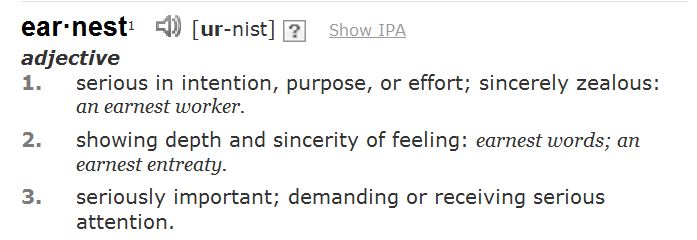
 I was recently contacted by someone who had found my work online and had been following it for a while now. They commented that they liked the honesty in my work and noted that I seemed like an earnest person and painter. I was kind of taken aback by the word earnest. I mean, I thought I knew what it meant but I had never been called earnest and was not sure if it was indeed the compliment intended. But upon checking an online dictionary and discovering that there was no hidden meaning, nothing derisive, I decided that it was indeed a compliment.
I should be proud to be called earnest.
But this also made me think about how we are perceived by others. I somewhat know how my work is perceived, online and in the galleries. At least, I think I do. But personally, do I truly know how I am perceived as an individual? Do we ever know? We may know what people feel comfortable in saying about us to our faces but do we ever get the full view, especially from those who might not see us in a favorable light?
Is the person in the mirror that we see the same person that the outer world sees?
I suppose the answer should be that it doesn’t matter, that we should simply live in a way where we can look in the mirror without guilt or remorse for our actions. If we can do that, what the outer thinks is moot.
So, I proudly carry the word earnest with me now, as a doctor might wear his PhD.
Signed– GC Myers, Earnest Painter.
 Redtree Times
As referenced in your title, blame Oscar Wilde’s farcical play for that undeserved inference 😉
Similarly, I have heard John Feinstein speak out several times in interviews and his books against applying the adjective “journeyman” to professional athletes, who are really good at their sport but will not be remembered after their careers are over. Guys who earn millions of dollars during their career on the PGA tour while winning only one non-major tournament.
But what is wrong with being “only” a journeyman? In trade unions, you enter as an apprentice, then qualify as a journeyman, and rarely attain the title of master. In view of the historical use of the word, I think being described as a journeyman should be a compliment. Perhaps, Feinstein thinks that pro athletes should be lauded as part of the 1% of celebrities instead of being relegated to the 99% of the population who aspire to being competent in their vocation? Seems disrespectful of the skilled worker.
Signed- Gary T, PhD, journeyman patent attorney
Yes, I think your comment jibes with some of my posts about painters that I admire who never attained the same status or enduring legacies as a select few of their peers. I suppose they would qualify as journeymen, as well.
I have a Baseball Encyclopedia that lists the stats of every player who played in any game at the major league level since the advent of the first league in the 1870’s. It’s pages are filled with players who played 1 or 2 games in the majors and were never heard of again. That might seem sad on some levels but to me it only points out how good they actually were and how fortunate they were in simply making it to that level. More importantly, it shows how thin that line is between the competent, such as a journeyman might be comsidered, and greatness. Perhaps it is only a difference of temperment or discipline or simple good luck that separates the two.
Thanks, Gary!
.