Feeds:
Posts
Comments

Archive for April, 2023

The Creative Urge

GC Myers- The Restless Edge

The Restless Edge– Available through the West End Gallery


The pursuit of science is more than the pursuit of understanding. It is driven by the creative urge, the urge to construct a vision, a map, a picture of the world that gives the world a little more beauty and coherence than it had before.

–John Archibald Wheeler, Geons, Black Holes, and Quantum Foam: A Life in Physics, 1998


I know that the quote above is primarily concerned with science since it comes from John Archibald Wheeler, the late (1911-2008) theoretical physicist who was a superstar in his field, responsible for originating terms such as Black Holes and Wormholes.

But as he points out, scientific pursuit is not unlike other endeavors that begin with the creative urge. I very much like his description of the driving need behind the creative urge: to construct a vision, a map, a picture of the world that gives the world a little more beauty and coherence than it had before.

Actually, the first thing that came to mind after reading his words was that the creative urge is a survival skill.

Art and every other thing brought into being by this desire to create ultimately aid in our survival. It provides insight and tangible evidence of the purpose and meaning of our lives in a world that constantly challenges our understanding of it.

The creative urge has been perhaps the dominant survival skill in my life. Without it, I have no idea what my life might be now. Or if I would still even exist. The creative urge has saved my life more than once.

I have no doubt that it will continue to do so.

It’s a powerful force. I urge you all to construct, as Wheeler said, your own vision, map and picture of the world. It might well provide you with better understanding of this world for yourself and others.

That being said, here’s a Nick Lowe classic, When I Write the Book.

Now get out of here– I have a creative urge that needs to be fed.


Read Full Post »

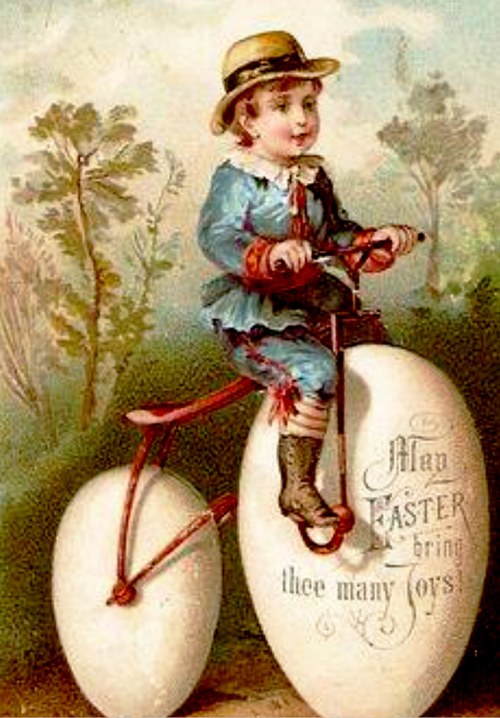
easter 3Not your typical Easter egg, I suppose. Most definitely different than the brightly colored eggs of my youth. I don’t recall any topless young women on any of the Easter cards back then. 

Maybe I was just looking in the wrong places.

Back then I never knew much about the origin of the egg in the Easter tradition. Never gave it much thought at all. But there is a story behind that iconic egg. Like the rabbit which has come to symbolize Easter as well, the egg stems from the pagan Easter festival which celebrated both as symbols of fertility and the emerging new life of spring. The coloring of the eggs, done in earliest times by boiling the eggs with flowers petals, also symbolized the budding colors of spring.

For the Christians part, the egg also had a part in their tradition. There is a legend that states that Caesar summoned Mary Magdalene before him after the crucifixion of Jesus, and upon hearing her claims that Jesus had been resurrected is claimed to have said, pointing at a nearby basket of eggs, “Christ has not risen, no more than that egg is red.”  At that point, the eggs supposedly turned red. Many orthodox Christians traditionally color their eggs red to symbolize this story as well as the sacrificial blood of Christ.

There’s also a pragmatic part to the story of the Easter egg. The festival of Lent, the 40 days prior to Easter that symbolize Jesus’ 40 days spent fasting in the desert, had long had a prohibition on all meats and animal by-products including milk and eggs. This created quite a surplus of eggs which would have gone to waste in those days long before modern refrigeration without their preservation by boiling.

Now, where the topless lady in that Victorian era card at the top falls into the story, I have not a clue.

The Victorians certainly had unusual tastes in their greeting cards. I’ve shared some in the past here but some of the ones below have me scratching my head. That last one with the bunnies riding on chickens behind a sword wielding Rabbit General raise a lot of questions.

Hmm. 

For this Sunday morning music, I opted to not play an Easter song. I usually play a bit of gospel music from Sam Cooke or Mahalia Jackson. But here is a gospel tinged song from the great Sister Rosetta Tharpe. Here’s her This Little Light of Mine.

Rockin’ good way to start your Sunday.


Victorian Easter Egg 1Victorian Easter Egg 2Victorian Easter Egg 3Victorian Easter Egg 4Victorian Easter Egg 5Victorian Easter Egg 6Victorian Easter Egg 7

Read Full Post »

The West Wind

GC Myers- Navigating Chaos  2022

Navigating Chaos– At the Principle Gallery


It’s a warm wind, the west wind, full of birds’ cries;
I never hear the west wind but tears are in my eyes.
For it comes from the west lands, the old brown hills,
And April’s in the west wind, and daffodils.

–John Masefield, The West Wind 


I can see the painting at the top fitting well with the tone of the times, as we try to find our way through the current storms of craziness that seem to batter us from all sides. To keep it simple for this morning, I thought I would pair it with a poem, The West Wind, from poet John Masefield from his 1902 collection Salt-Water Ballads.

In it, the West Wind is the voice of home and things familiar calling out to a weary sailor at sea. This idea of wanting to make our way past the perils of storm and disconnectedness to return to some simple form of stability, security, and warmth probably describes the desires of most of us in this moment. 

I’m including the entire poem at the bottom. I am also including a reading of it taken from a radio program, The Big Show, in 1951. Lots of legends involved here. Actress Tallulah Bankhead introduces the poem which is performed by Ethel Barrymore. The background music is a composition written by her brother, Lionel Barrymore, who was a talented musician as well as an extraordinary actor. 

Safe voyage to you…


The West Wind

It’s a warm wind, the west wind, full of birds’ cries;
I never hear the west wind but tears are in my eyes.
For it comes from the west lands, the old brown hills,
And April’s in the west wind, and daffodils.

It’s a fine land, the west land, for hearts as tired as mine,
Apple orchards blossom there, and the air’s like wine.
There is cool green grass there, where men may lie at rest,
And the thrushes are in song there, fluting from the nest.

“Will you not come home, brother? you have been long away,
It’s April, and blossom time, and white is the spray;
And bright is the sun, brother, and warm is the rain, —
Will you not come home, brother, home to us again?

The young corn is green, brother, where the rabbits run,
It’s blue sky, and white clouds, and warm rain and sun.
It’s song to a man’s soul, brother, fire to a man’s brain,
To hear the wild bees and see the merry spring again.

Larks are singing in the west, brother, above the green wheat,
So will ye not come home, brother, and rest your tired feet?
I’ve a balm for bruised hearts, brother, sleep for aching eyes,”
Says the warm wind, the west wind, full of birds’ cries.

It’s the white road westwards is the road I must tread
To the green grass, the cool grass, and rest for heart and head,
To the violets and the brown brooks and the thrushes’ song,
In the fine land, the west land, the land where I belong.

Read Full Post »

Caution

caution


Not every action or emotion however admits of the observance of a due mean. Indeed the very names of some directly imply evil, for instance malice, shamelessness, envy, and, of actions, adultery, theft, murder. All these and similar actions and feelings are blamed as being bad in themselves; it is not the excess or deficiency of them that we blame. It is impossible therefore ever to go right in regard to them – one must always be wrong.

–Aristotle, The Nicomachean Ethics


I heard the protesters loudly chanting “Shame, Shame” yesterday during the disgraceful session yesterday in Tennessee that saw two young black state representatives expelled from the legislature for their participation in a protest against gun violence in the wake of the recent school shooting there. During the protest in question, according to law enforcement, there were no arrests, no violence, no property damage.

The two expelled representatives were Justin Jones and Justin Pearson. Remember those names. They spoke with great passion and eloquence. Both were impressive and are destined to leave their mark on this country. A third participating representative, Gloria Johnson, who was equally impressive, survived the expulsion vote. This was due no doubt, as Johnson pointed out, to the color of her skin. She is a white woman.

I think that says everything that needs to be said about the purpose of this proceeding.

The protesters’ chant was very powerful. The crowd was predominately young and to hear them berate the Republicans of the state house in such a way was effective and moving.

Or it should have been.

But I immediately remembered that we now live in a time and a country where shame has lost all its power to affect behavior.

And we are seeing firsthand evidence in states like Tennessee, Florida and others that the shameless abuse of power is not to be taken lightly. It is not just bad judgement. It is something more than that. It is a political/cultural mania that is paving the way for even more shameless political extremism.

And that leads to places where we should not be willing to venture.

Word of caution: Pay attention. We are on an edge and the shameless have no concern about pulling us all down that slippery slope.

I repeat that I take no pleasure in writing these types of posts. But there are times and occurrences that demand all our eyes and ears. Full participation.

Here’s Bob Marley and his song Caution. Take it from Bob. He warns us that the road we’re on is slippery and we’re in danger of tumbling down.


https://youtu.be/CDod1HUdL6E

Read Full Post »

Eden+Ahbez+and+Cowboy+Jack+Patton+circa+1949

eden ahbez with Cowboy Jack Patton, circa 1949


There was a boy
A very strange enchanted boy
They say he wandered very far, very far
Over land and sea
A little shy
And sad of eye
But very wise was he
And then one day
A magic day he passed my way
And while we spoken of many things
Fools and kings
This he said to me
The greatest thing you’ll ever learn
Is just to love and be loved in returm
The greatest thing you’ll ever learn
Is just to love and be loved in return

Nature Boy, eden ahbez


Sometimes when you look behind something that’s been in front of you for years you find out things you would have never imagined otherwise. Such was the case with the song, Nature Boy. From the lyrics above, it seems like such a simple song but there is much more to it beneath the surface–as it often is with many simple things.

Nature Boy, as recorded by the great Nat King Cole, has long been one of my favorite songs. It has a wonderful haunting melody and tells the story of a “strange enchanted boy” and his search to find love. It had a sort of mystical feel to me when I first heard it as kid in the 60’s. It still does. That feel made the song an oddity in the world of popular music in 1948 when Nat King Cole recorded it and had a huge hit with it, staying at #1 on the charts for eight weeks.

I was going to just have a short post and put up a YouTube video of Cole’s version but in doing so I saw the name of the songwriter, eden ahbez, and was intrigued, perhaps by the lack of capitalization in his name. Doing a little research, I came across some photos of him such as the one at the top, from the late 40’s sitting with Cowboy Jack Patton (who wrote the song Ghost Riders in the Sky) and a spaniel of some sort. I’ll let you figure out who is who in the photo. The long hair and attire of ahbez seemed really out of place for me in thinking of 1948 so I read on.

eden ahbezeden ahbez was a real one-of-a-kind character in the world of music and in general. You could probably guess that from the name which he adopted and wrote only in lower case letters. He adopted the name later in life and said that he chose to use only lower case letters for his name because only the words God and Infinity deserved  capitalization.

Born in Brooklyn in 1908, he was orphaned and was placed as a child on one of the Orphan Trains of that era, a program that took orphans from the crowded eastern cities to foster homes in the Midwest. He ended up in Kansas and was raised there, later becoming a pianist and band leader in Kansas City before heading to the Los Angeles area n 1941. It was there that he became involved with the health food movement of that time and let his hair grow.

He is regarded as the first hippie by many, a long-haired and bearded wanderer who crisscrossed the country on foot, wearing robes and sandals, maintained a vegetarian lifestyle and slept out under the stars. In fact, when Nature Boy hit the charts he and his wife were living under the first L on the Hollywood sign, which stoked a bit of a media frenzy around ahbez. He worked in and frequented a vegetarian restaurant (that’s where he met Cowboy Jack Patton, another interesting character) in 1940’s Los Angeles whose German owners preached the gospel of natural and raw foods. Their followers became known as the Nature Boys.

Not really what I was expecting from a pop songwriter in 1940’s LA. ahbez died in 1995 from injuries sustained in an auto accident. He was 87. His was a truly unique life, just waiting for a biographer to tell the story, and reading the little I discovered makes me find the song even more interesting. Hope you’ll do the same now that you know a bit more about eden ahbez


I first posted the article above back in 2009. I’ve ran it a couple of times since, adding versions of Nature Boy from a variety of artists. I came across a version I hadn’t heard before and thought it might be worth sharing along with eden ahbez’s original take on the song. The newer version is from the Swedish a cappella group, The Real Group.

It’s a lovely version of a lovely and elegantly simple song–and a fine way to start the day.


Read Full Post »

Happy


GC Myers- Monde Parfait

Monde Parfait— Now at Principle Gallery

Clap along if you believe that happiness is the truth…

Happy, Pharell Williams


This is not meant to be commentary on the happenings of the past day.

Okay, maybe it is.

Actually, I wasn’t going to post anything today. I’ve posted something every day here for at least a couple of months and figured that skipping a day wouldn’t be such a bad thing.

But I came across the video below from Postmodern Jukebox of an alternate version of Happy, the Pharrell Williams mega-hit, performed by Swedish jazz musician/multi-instrumentalist/dancer Gunhild Carling. I have shared a different video of her performing once before and had seen this video before but seeing it this morning made me smile.

Made me happy. And it’s a good day to be at least a little happy.

Besides, who doesn’t want to see Gunhild play three trumpets at one time, tap-dance and move seamlessly from instrument to instrument during the song? 10 different instruments in all, including the bagpipes. I’ve been reading a bit about vaudeville lately and this would no doubt have been a big hit back in the day.

See for yourself. Hope it makes you at least a little happy.


Read Full Post »

The Welcome Tree

GC Myers-  The Welcome Tree

The Welcome Tree— Coming to Principle Gallery, Alexandria, VA


No farther will I travel: once again
My brethren I will see, and that fair plain
Where I and song were born. There fresh-voiced youth
Will pour my strains with all the early truth
Which now abides not in my voice and hands,
But only in the soul, the will that stands
Helpless to move. My tribe remembering Will cry,
“‘Tis he!” and run to greet me, welcoming.

–George Eliot,  The Legend of Jubal (1869)


The new painting at the top is part of my annual June show at the Principle Gallery in Alexandria, VA. This year’s show is called Passages which refers to both the actual movement into the painting as well as the phases of our lives through which we all pass. This painting, titled The Welcome Tree, falls neatly into those categories.

For me, it represents the idealized memory of home we sometimes carry with us, the thought that somewhere there is a place where you belong. A place with people who instantly recognize and welcome you as one of their own.

Much like the lines above from the epic poem from George Eliot, The Legend of Jubal. It is her version of the story of Jubal, a minor biblical figure who is only mentioned once, who is considered by some to be the inventor of music. Jubal, a descendent of the murderer Cain, is portrayed in Eliot’s long poem as a roaming artist who invents music then sets out to explore the world for inspiration for new songs. In the process, he spreads music and melody wherever he travels. Years pass and as his renown grows, Jubal dreams of a homecoming, as the lines above indicate.

This painting might well represent that imagined and hoped for reunification with his early home and family.

In Eliot’s poem, Jubal returns home to find that he is now revered and worshipped as a god there for his gift of music. Unfortunately, he is now old and nobody recognizes him. He is seen as a sacrilegious imposter and beaten to death by those he once thought would be embracing him.

Of course, I am not representing this part of Jubal’s tale in my painting. But maybe that’s the danger that comes in dwelling in idealized memories. Perhaps Jubal’s fate is one of the reasons that many folks through the years have said that you can’t go home again.

But that doesn’t keep us from keeping those fantasies of coming home and being embraced in our minds. There might be some comfort in that even though the rationalizing part of our mind tells us it cannot ever happen.

I chose the title The Welcome Tree because I have come to see the Red Tree that marks so many of my paintings as a symbol of welcoming. It is often the first thing that the viewer latches onto and serves as a kind of welcome mat into the painting. Often, though the painting might seem to be about the Red Tree itself, the real meaning is contained in the other parts of the piece– the color, the textures, the composition, etc. All the things that create mood and carry feeling.

I think that’s the case here though I like to think of it as a personal tip of the hat in recognition of the importance the Red Tree has had in my work over the past quarter century, It has been a boon companion.

Here’s a song on the subject of going home from the late, who I believe was underappreciated in his lifetime, singer/songwriter Jimmy LaFave. Here’s his song Going Home.


Read Full Post »

Vincent Van Gogh Wheat Field in Rain 1889

Vincent Van Gogh- Wheat Field in the Rain,1889


If you work diligently… without saying to yourself beforehand, ‘I want to make this or that,’ if you work as though you were making a pair of shoes, without artistic preoccupation, you will not always find you do well. But the days you least expect it, you will find a subject which holds its own with the work of those who have gone before.

-Vincent Van Gogh


I really just wanted to show these two Van Gogh paintings that feature the falling rain as part of the overall composition. I recently have been particularly interested in seeking out lesser known Van Gogh paintings. There is something quite exciting about these more obscure pieces, something that fills in the blanks between the better-known work.

But beyond that, the sentiment above from Van Gogh really resonates with me. Sometimes it seems as though those paintings which you aim at with all your greatest effort fall flat while on those days when you have little idea of where the work will go, something special emerges quite unexpectedly.

It is those days and those paintings that you crave as an artist. Oh, it is gratifying to create work that you feel is well within your body of work. That is to say, work which follows a path you have trod upon many times before. These paths are well trod because they offer the artist the fastest route to their artistic voice. And it is in that voice that originality resides. As writer Vladimir Nabokov pointed out: Artistic originality has only its own self to copy.

But to have those days where the work created takes you to new places that surprise you– well, that is beyond gratification. It has an almost religious aspect, like a confirmation of one’s belief in something greater.

But those days are often rare and come without a hint of what might emerge. Sitting here now, I don’t know if today will be one of those days. But just knowing that it is in the realm of possibility makes me anxious to get at it.

Enjoy the Van Goghs. I am going to move into my day and work with the diligence of which Van Gogh wrote.

[This is an edited and updated version of a blog post that ran in 2015. I have added a video of Van Gogh’s lesser known works. I think there is something to be gained in examining the entirety of an artist’s works, not just the highlights. It allows you to see how their style and vision forms, how they pick and choose those techniques and subjects that become a bigger part of their voice. And the one’s they discard. Always interesting to see.]


Vincent Van Gogh-Landscape at Auvers in the Rain 1890

Vincent Van Gogh- Landscape at Auvers in the Rain


Read Full Post »

Satellite of Love

GC Myers- Reaching Out sm

Reaching Out– At the Principle Gallery


Let’s get my incantation right:
“I wish I may, I wish I might”
Give earth another satellite.

— Robert Frost, A-Wishing Well, 1959


Hadn’t come across this poem before this morning. Frost’s cranky lobbying for another moon (or many more moons) in the sky made me chuckle which is always a good thing on an early Sunday morning. Plus, it was somewhat in line with the song I wanted to play this morning. I am not going to put up the whole poem here but its ends with this reassurance (?):

I am assured at any rate
Man’s practically inexterminate.
Someday I must go into that.
There’s always been an Ararat
Where someone, someone else begat
To start the world all over at.

The poem was written as a Christmas greeting in 1959. You can see and read the poem in its original form by clicking here.

That brings us to this Sunday’s morning music. It’s an old Lou Reed song covered by the Ukulele Orchestra of Great Britain who have appeared here a few times over the years. I always enjoy their takes on certain songs. This is their version of Satellite of Love.


Read Full Post »

The Fools of April

Tarot Fool


The first of April is the day we remember what we are the other 364 days of the year.

– Mark Twain


Wish I had something pithy to say here or some goofy word prank to pull on you. However, I don’t.

Never been big on April Fools antics. Kind of like the alcoholic who doesn’t drink on New Year’s Eve.

Like Mr. Twain says, there is ample proof of my being a fool over the other 364 days of the year.

On a day that demands it, not being a fool appeals to my contrarian nature which is, in itself, foolish.

Just can’t get away from it, I guess.

Here’s a classic from Aretha that speaks to the day. Pay attention to the lyrics. They remind me of the ardent followers (another way of saying cult members) of a certain someone in the news. Hopefully that chain is being broken and they can return to being fools in other ways.

Like the rest of us.


Read Full Post »

« Newer Posts