Elan Vital– Now at Principle Gallery, Alexandria, VA
I know of no more encouraging fact than the unquestionable ability of man to elevate his life by a conscious effort.
–Henry David Thoreau, Walden, 1854
Don’t get this wrong– I am still on a hiatus from doing this blog. This is a mere aberration. A Janis Joplin favorite came on this morning and it just felt like it needed to be shared. So, here it is.
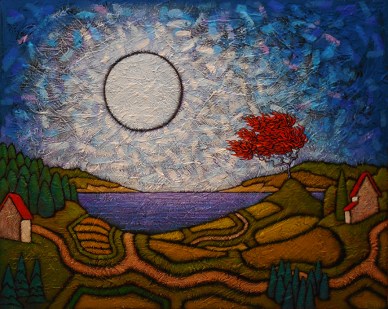
The Welcome Tree–At the Principle Gallery, Alexandria, VA
No farther will I travel: once again My brethren I will see, and that fair plain Where I and song were born. There fresh-voiced youth Will pour my strains with all the early truth Which now abides not in my voice and hands, But only in the soul, the will that stands Helpless to move. My tribe remembering Will cry, “‘Tis he!” and run to greet me, welcoming.
–George Eliot, The Legend of Jubal (1869)
I am still on a short hiatus but thought I’d briefly return for Sunday Morning Music along with an updated rerun of this post from just a few months ago that is about a new painting that is part of my annual June show at the Principle Gallery in Alexandria, VA. This year’s show is called Passages which refers to both the actual movement into the painting as well as the phases of our lives through which we all pass. This painting, titled The Welcome Tree, falls neatly into those categories.
For me, it represents the idealized memory of home we sometimes carry with us, the thought that somewhere there is a place where you belong. A place with people who instantly recognize and embrace you as one of their own.
A place much like that described in the lines above from the epic poem from George Eliot, The Legend of Jubal. It is her version of the story of Jubal, a minor biblical figure who is only mentioned once, who is considered by some to be the inventor of music. Jubal, a descendent of the murderer Cain, is portrayed in Eliot’s long poem as a roaming artist who invents music then sets out to explore the world for inspiration for new songs. In the process, he spreads music and melody wherever he travels. Years pass and as his renown grows, Jubal dreams of a homecoming, as the lines above indicate.
This painting might well represent that warmly imagined and hoped for reunification with his early home and family.
In Eliot’s poem, Jubal returns home to find that he is now revered and worshipped as a god there for his gift of music. Unfortunately, he is now old and nobody recognizes him. He is seen as a sacrilegious imposter and beaten to death by those he once thought would be embracing him.
Of course, I am not representing this part of Jubal’s tale in my painting. But maybe that’s the danger that comes in dwelling in idealized memories. Perhaps Jubal’s fate is one of the reasons that many folks through the years have said that you can’t go home again. As Thomas Wolfe noted in his book You Can’t Go Home Again:
You can’t go back home to your family, back home to your childhood … back home to a young man’s dreams of glory and of fame … back home to places in the country, back home to the old forms and systems of things which once seemed everlasting, but which are changing all the time – back home to the escapes of Time and Memory.
But that doesn’t keep us from keeping those fantasies of coming home and being embraced in our minds. There might be some comfort in that fantasy even though the rationalizing part of our mind tells us it cannot ever happen.
Maybe we should not try to dwell in that mythical home of the past but instead carry home with us, appreciating those who welcome and embrace us as we are in the here and now.
I chose the title The Welcome Tree because I have come to see the Red Tree that marks so many of my paintings as a symbol of welcoming. It is often the first thing that the viewer latches onto and serves as a kind of welcome mat into the painting. Often, though the painting might seem to be about the Red Tree itself, the real meaning is contained in the other parts of the piece– the color, the textures, the composition, etc. All the things that create mood and carry feeling.
I think that’s the case here though I like to think of it as a personal tip of the hat in recognition of the importance the Red Tree has had in my work over the past quarter century. This simple tree has been my boon companion.
For this week’s Sunday Morning Music, here’s a lovely cover of a favorite song. The song is from David Byrne and the Talking Heads, This Must Be the Place (Naive Melody). This version is from Andrew Bird playing with the Lumineers. It fits this painting for me this morning.
To say that man is a compound of strength and weakness, light and darkness, smallness and greatness, is not to indict him, it is to define him.
–Denis Diderot, Pensées Philosophiques (1746)
I think I am going to take some time off from writing this blog for at least a few days. Maybe more. I am feeling a bit shaded. Opaque and not willing to be as open as I need to be in this context.
If I can’t write with the same degree of openness and expression that I find in my painting, this becomes difficult and feels pointless. And that’s what it has become in recent weeks. I feel out of rhythm in many ways and need some time to get my timing back.
And it will come back. Probably sooner than later. I haven’t learned a lot in this life, but I know the value of patience when this psychic arrythmia comes around. Just recognizing and understanding how it works often expedite its passing.
So, let me sign off for a bit with this song from Lyle Lovett off his wonderful album Pontiac. This is Simple Song.
Know whence you came.If you know whence you came, there is really nolimit to where you can go.
— James Baldwin, My Dungeon Shook / A Letter to My Nephew, 1962
Juneteenth Day. Though the Emancipation Proclamation officially went into law on January 1, 1863, it took the advance of the Union troops into the furthest reaches of the Confederate South to enforce and put it into effect. At Galveston, Texas, on June 19th,1865, two and a half years after the Proclamation, Union Major General Gordon Granger proclaimed freedom for the enslaved people of Texas. This was the origin of the holiday.
As we all know, it has not been easy sailing in the intervening 150-some years. But it is our history and as James Baldwin points out above, you can’t make progress without knowing where you have been. Knowing one’s history, no matter how painful it might be, is the route to freedom. And nobody is free unless all are free.
Here’s to greater progress for our collective future.
Below, is a recording of the letter, My Dungeon Shook, that James Baldwin wrote to his young nephew in late 1962. It is a remarkable letter. The last three paragraphs are powerful and on the nose, speaking to the underlying reasons for the current spate of racism that infects this country. You can listen but if you would rather read it, you can do so via a PDF at this link.
Near the end of the letter, Baldwin quotes a line from an old gospel song, Free At Last:
The very time I thought I was lost, my dungeon shook and my chains fell off
I am also including a version of that song from Sam Cooke and the Soul Stirrers. I don’t believe they use this great line in their iteration of the song but hey, it’s Sam Cooke and that’s more than good enough for me.
Be the silent watcher of your thoughts and behavior. You are beneath the thinker. You are the stillness beneath the mental noise. You are the love and joy beneath the pain.
— Eckhart Tolle
This has been a down week for me, as is often the case in the weeks after a show. I’ve addressed this here before so I am not going into it now, especially since I am typing this awkwardly on my phone. Still having issues with my computer but seem to be gaining on it.
That being the case, I am being concise this morning and am going to share my Sunday Morning Music then get the heck out of Dodge. The song is one I played here last year. It’s Funky Destination and his Soopasoul version of The Inside Man.
I think it’s just the right sound to climb– or dance– my way out of a down week. Hope it does the same for you.
The influence of fine scenery, the presence of mountains, appeases our irritations and elevates our friendships.
–Ralph Waldo Emerson
Computer on the fritz this morning which has made for some irritating last few hours. Hoping that Emerson’s words ring true this morning.
On the fritz?– Going to have to look that term up when I get this thing straightened out.
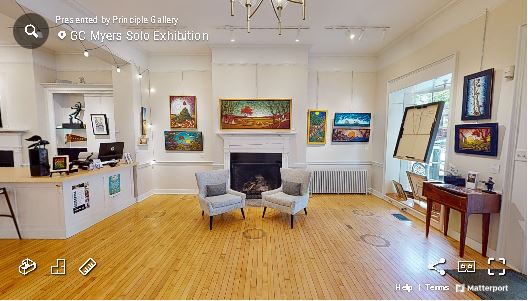
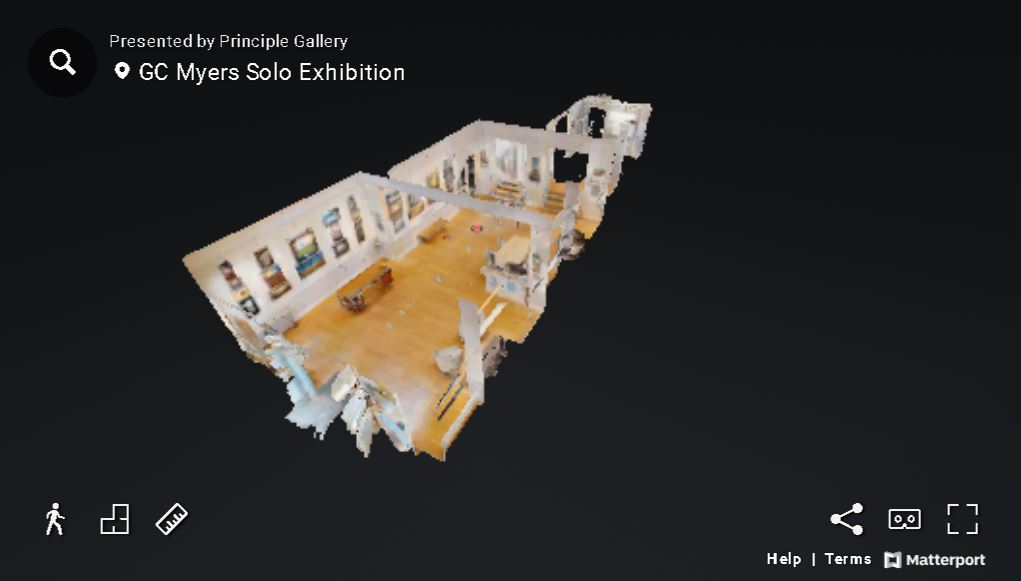
In the meantime, if you would like take a walk through my show, Passages, now hanging at the Principle Gallery follow this link to the exhibit page where you can take a virtual tour of the gallery space. It’s always interesting to see the work in space to get a better idea of size.
Okay, back to the irritation. Hopefully, for a very short time…
Listen to Mustn’ts, child, listen to the Don’ts. Listen to the Shouldn’ts, the Impossibles, the Won’ts. Listen to the Never Haves, then listen close to me. Anything can happen, child, Anything can be.
–Shel Silverstein
Why do we so often set limits on ourselves? Is it because of fear? Laziness? An unwillingness to venture outside of that which we know and have already experienced? A lack of confidence or courage?
Is it a case of thinking it better to have never tried rather than having to face potential failure?
There are a multitude of other reasons for this self-limitation. I think we all have our reasons for our own stagnancy, for not taking risks, for not attempting to reach those bigger desires we hold inside.
Are they valid reasons?
I can’t say for anyone other than myself. And for myself, I know they are just excuses in the hopes of avoiding having to face the regret of not having tried.
I know those regrets firsthand and despise them. They are worse than failure. They make me want to go bigger and bigger, to venture further out from the shore.
And I will.
Actually, this is my normal pep talk that comes in that depressing lull that normally comes after a show. I’ve written about it before. This precipitous fall in mood in the aftermath of a show happens to a lot of artists. The goal that was there before has been reached and all that remains is the question of what the next destination will be and whether you should even attempt to reach it.
Luckily for me, for the past 20+ years I have had my July West End Gallery show immediately in front of me after my June Principle Gallery exhibit. It doesn’t give me time to mope too much. Not that I don’t, for at least a while, especially during this week immediately after the show opening.
Having that next destination set makes this week easier to endure. It also makes me want to blast much larger and bolder with my work because in the end, it is the work and not the show that is the destination.
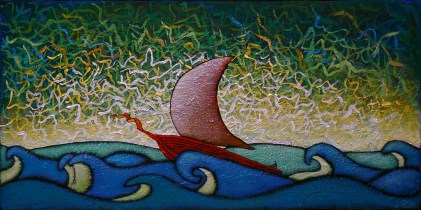
Pep talk done. Mission accomplished. I want to get back to work so get on your own goddamn boat and get out of here. I got my destination and you got your’s.
The crows like to insist that a single crow is enough to destroy heaven. This is without doubt, but it says nothing about heaven, because heaven is just another way of saying: the impossibility of crows.
–-Franz Kafka, The Zürau Aphorisms, #32
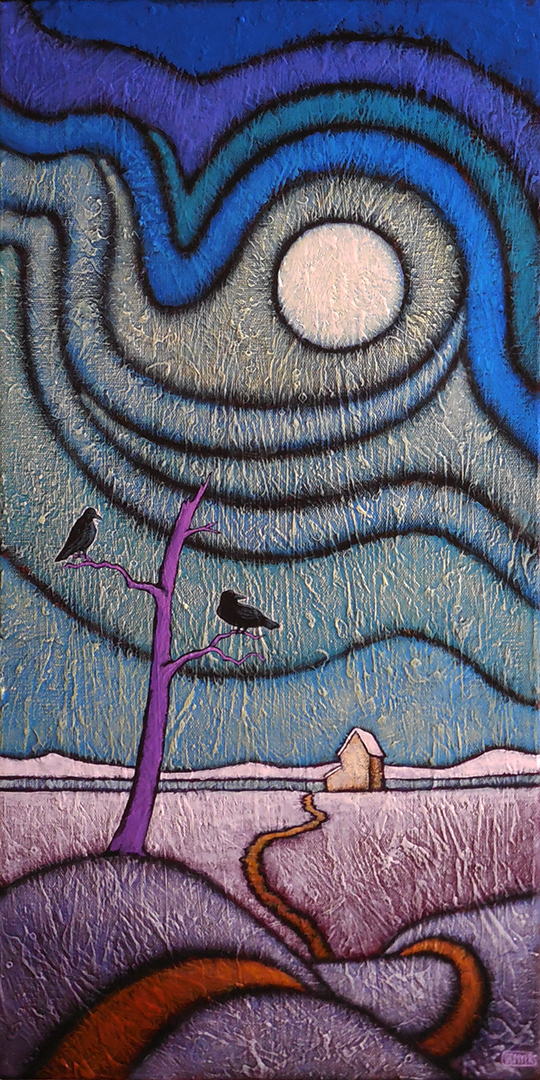
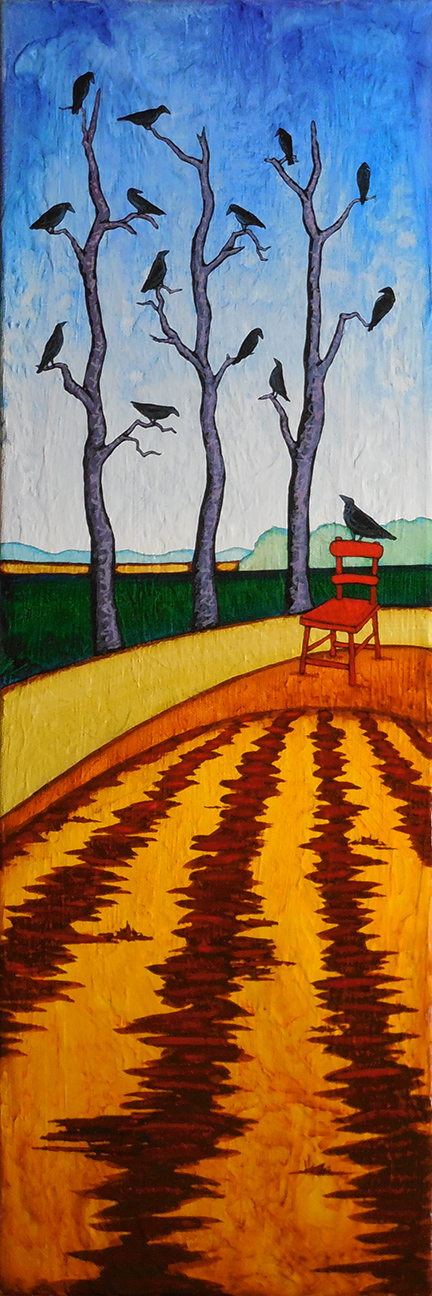
The Impossibility of Crows– Now at Principle Gallery
This morning, I am taking the unusual step of rerunning a blogpost that ran only six weeks ago. This is mainly because I screwed up the story and reasoning behind the painting mentioned here while at the Principle Gallery opening this past weekend. Felt like it needed to be posted again.
When I finished this new painting that is headed to the Principle Gallery for my annual solo show there in June, I thought of the above aphorism from Franz Kafka. It’s sometimes eludes my understanding when I come across it and it takes me several moments to recall the logic it holds.
Basically, at least in my reading of it, it declares that crows know that since they have always been the targets of hatred and scorn among humans, they are not part of heaven as constituted by humans. Therefore, they know they could not exist in that realm. Thus, if one crow were to appear in heaven it would destroy the very illusion of heaven that humans had constructed.
Now, I know nothing of heaven — don’t even have an opinion on the reality of its existence– so I can’t speak on it with any certainty. I am also a longtime fan of crows, believing them to possess an intelligence and consciousness that we have long misunderstood.
But I know they have also historically been vilified by most people so the idea that they would be excluded from the average conception of heaven makes sense to me. So, the idea of a crow suddenly appearing in heaven being a calamitous event makes sense as well.
In real world terms, anytime we hold a belief that denies the existence of others, we are creating a world — a heaven, if you will– that is ripe to be upended when those whose existence we deny show themselves to be.
I think this could be applied to the past and current cultural wars surrounding the civil rights of minority groups. There are those who wish to deny the existence of these groups, to exclude them from the deniers’ concept of what the world should be. When it is proven that they do in fact exist and are present in this world, it creates a sense that the world — their conceived heaven — is in the midst of being destroyed.
Ultimately, I find myself both understanding and questioning this aphorism. First of all, I wouldn’t want to have a heaven that didn’t include crows or for that matter, any other creature or being. Just as I wouldn’t want a world without the full variety of people that make up this world.
Because who’s to say that I might not appear as a crow in the eyes of others? Couldn’t we all be the crows in some way in this exercise?
Like I said, I don’t know if there is a heaven. But I do know there is the here and now and, in the absence of a heaven, we need to make of it what we can. For all– crows included.
I am calling this new 24″ by 8″ canvas The Impossibility of Crows. Maybe it should be called The Possibility of Crows? After all, it shows what could be considered an idyllic landscape complete with crows.
I am subbing in a different song for this re-run. Here’s Diana Krall and her very fine take on Joni Mitchell’s Black Crow.
Dawn’s Return— Included in Passages at Principle Gallery
I met a young man on the skeleton coast He was out of his feet and pale as a ghost I asked him his name – he said Lazarus, man I’ve come to your country from a faraway land I can’t quite remember the last time I was on shore Coulda been twelve years – it coulda been more But I’ve seen tribulation and it staggered my mind And I just don’t remember what I came here to find
It’s wind on the ocean, rain on the land Three drops of water and one grain of sand I’ll tell you the story as quick as I can I’ve got nothing but time, I’m Lazarus Man
— Terry Callier, Lazarus Man
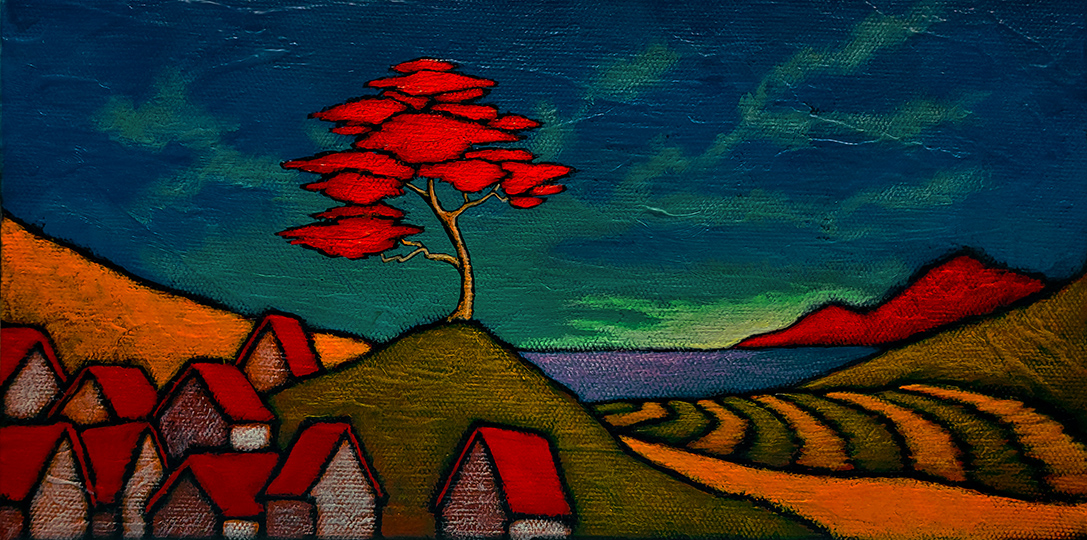
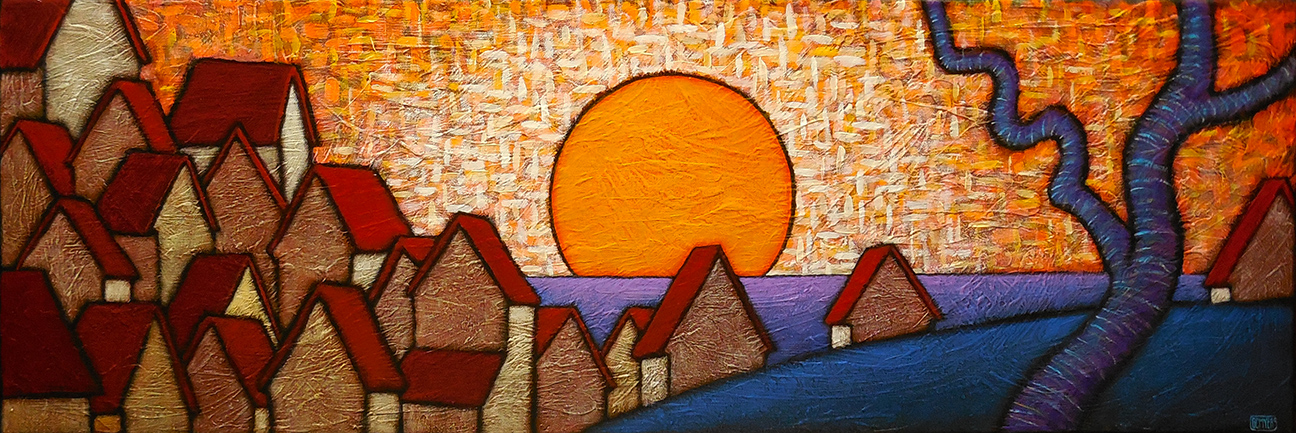
I was looking for a song to accompany the new smaller painting at the top, Dawn’s Return, which is part of my current show at the Principle Gallery and came across a song and an artist with which I was not acquainted.
The song was Lazarus Man and the artist was Terry Callier.
I first heard the song as performed by TomJones in a recent video and he, of course, blasted it with his voice’s big sound. Good stuff, good enough to make me want to see where the song originated. That’s where I first came across Terry Callier.
Callier had an interesting career that didn’t follow the usual arc. In the short time it took to look him up this morning, I have seen him described as a jazz guitarist, a folk singer, a psychedelic jazz artist, soul singer, and a mystic. He had a small degree of recognition in the 60’s and 70’s then dropped out of sight for nearly 20 years.
Like the Lazarus Man of his song, his career was resurrected after several musical groups discovered his early work and integrated it in their works. The spotlight found him once more and he took advantage, releasing a new album, Timepeace, in 1998. It garnered some attention and was given the United Nations’ Time For Peace award for outstanding artistic achievement contributing to world peace.
He spent the rest of life, until his death from cancer at the age of 67 in 2012, recording and touring around the globe. He was the Lazarus Man.
I have liked everything of his I have heard this morning and regret not having taken notice of him earlier. Below is a performance of Lazarus Man from Terry Callier as well as the Tom Jones version. Though sonically different, the song’s power remains the same.
To compose our character is our duty, not to compose books, and to win, not battles and provinces, but order and tranquility in our conduct. Our great and glorious masterpiece is to live appropriately. All other things, ruling, hoarding, building, are only little appendages and props, at most.
—Michel de Montaigne, Essays, 1588
Our great and glorious masterpiece is to live appropriately…
The passage above is from the influential French philosopher Michel de Montaigne (1533-1592) is from his final essay, Of Experience.
As is the case with so many things of consequence, the task he sets before us– to live with order and tranquility– seems simple yet is difficult to achieve.
Simplicity is always harder to achieve than one might think. In life and in art.
That’s it for today. Any more would be too much.
Here’s a version of the great Beatles song Across the Universe that I like from Rufus Wainwright. Seems to fit the morning.




 Redtree Times