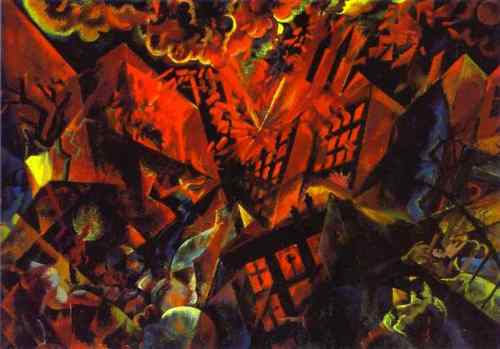
George Grosz- Explosion, 1917
The war was a mirror; it reflected man’s every virtue and every vice, and if you looked closely, like an artist at his drawings, it showed up both with unusual clarity.
–George Grosz, Autobiography (1893-1959)
I was watching and listening to the reports from Israel yesterday. There were anecdotal stories that were filled with horrific details of death along with amazing stories of survival. As artist George Grosz wrote above, the best and worst of man.
This conflict feels like a massive expansion from the same motivating forces that have created similar death and destruction in Ukraine for the last 18 months. The news reports are often accompanied by videos of huge explosions in the night sky that color the atmosphere in the colors of war and apocalypse– black and red and deep yellows and orange. After a while, it feels overwhelming. I am reminded by these images of artist George Grosz whose powerful work filled with those same colors of war reflected his WW I experience as a German soldier.
Below is a post from back in 2011 about the effect of this work.
From 2011:
I woke up in the dark this morning after a fitful night of sleep filled with horrible dreams. I don’t want to go into the details but they were awful and constant, each sweeping from desperate scene into yet another. Dark and tinged in deep colors of black and red. Hopeless in the scope of their finality and, though I am hesitant to use the word, there was a sense of apocalypse.
I was shaken. I’ve had many horrifying dreams over the years but they seldom felt so vast and desperately final.
 As I trudged down to pick up my newspaper, I tried to sort out these dreams in order to find an equivalence in imagery that I know that captured in some way the feel of these dreams. As I neared the studio the dark paintings of George Grosz done in Germany in the years before World War I came to mind. They were forebodingly dark and angry and just the overall look of them made me think of the darkest corners of man’s mind. The red tones and the way they filled the picture plane along with the chaotic nature of the compositions brought to mind the nightmarish feel of my dreams.
 Grosz’s work changed over the years, especially after fleeing Hitler’s Germany, moving to the New York in the 1930’s where he lived until the late 1950’s when he returned to Berlin, dying there in 1959. His American work is often considered the weakest of his career, less biting and more esoteric. There were exceptions during the war such as 1944’s Cain, Or Hitler in Hell, shown here, which reverts back to the colors and nightmare feel of his early work. Very powerful work that may not sooth one’s soul but rather documents the darker aspects of human existence.
I don’t know if my own nightmares have an effect on my work. Perhaps they come out in work that seems the antithesis of them, work that seeks to calm and assure. Even so, I believe they are there in the background somewhere.
I don’t really know to be honest. I do know that I want to put last night’s visions behind me. To that end, I think I should get to work and let my nightmares only dwell in the work of Grosz for now.
Below is more of the work of George Grosz along with a video of his work set to violinist Andre Rieu playing a selection from The Merry Widow, which gives the whole thing a lighter tone than one would expect.


 Redtree Times