The war was a mirror; it reflected man’s every virtue and every vice, and if you looked closely, like an artist at his drawings, it showed up both with unusual clarity.
–George Grosz, Autobiography (1893-1959)
I was watching and listening to the reports from Israel yesterday. There were anecdotal stories that were filled with horrific details of death along with amazing stories of survival. As artist George Grosz wrote above, the best and worst of man.
This conflict feels like a massive expansion from the same motivating forces that have created similar death and destruction in Ukraine for the last 18 months. The news reports are often accompanied by videos of huge explosions in the night sky that color the atmosphere in the colors of war and apocalypse– black and red and deep yellows and orange. After a while, it feels overwhelming. I am reminded by these images of artist George Grosz whose powerful work filled with those same colors of war reflected his WW I experience as a German soldier.
Below is a post from back in 2011 about the effect of this work.
From 2011:
I woke up in the dark this morning after a fitful night of sleep filled with horrible dreams. I don’t want to go into the details but they were awful and constant, each sweeping from desperate scene into yet another. Dark and tinged in deep colors of black and red. Hopeless in the scope of their finality and, though I am hesitant to use the word, there was a sense of apocalypse.
I was shaken. I’ve had many horrifying dreams over the years but they seldom felt so vast and desperately final.
As I trudged down to pick up my newspaper, I tried to sort out these dreams in order to find an equivalence in imagery that I know that captured in some way the feel of these dreams. As I neared the studio the dark paintings of George Grosz done in Germany in the years before World War I came to mind. They were forebodingly dark and angry and just the overall look of them made me think of the darkest corners of man’s mind. The red tones and the way they filled the picture plane along with the chaotic nature of the compositions brought to mind the nightmarish feel of my dreams.
Grosz’s work changed over the years, especially after fleeing Hitler’s Germany, moving to the New York in the 1930’s where he lived until the late 1950’s when he returned to Berlin, dying there in 1959. His American work is often considered the weakest of his career, less biting and more esoteric. There were exceptions during the war such as 1944’s Cain, Or Hitler in Hell, shown here, which reverts back to the colors and nightmare feel of his early work. Very powerful work that may not sooth one’s soul but rather documents the darker aspects of human existence.
I don’t know if my own nightmares have an effect on my work. Perhaps they come out in work that seems the antithesis of them, work that seeks to calm and assure. Even so, I believe they are there in the background somewhere.
I don’t really know to be honest. I do know that I want to put last night’s visions behind me. To that end, I think I should get to work and let my nightmares only dwell in the work of Grosz for now.
Below is more of the work of George Grosz along with a video of his work set to violinist Andre Rieu playing a selection from The Merry Widow, which gives the whole thing a lighter tone than one would expect.
Centre of equal daughters, equal sons, All, all alike endear’d, grown, ungrown, young or old, Strong, ample, fair, enduring, capable, rich, Perennial with the Earth, with Freedom, Law and Love, A grand, sane, towering, seated Mother, Chair’d in the adamant of Time.
— Walt Whitman, 1888
Not that it matters, but the photo of poet Walt Whitman at the top was taken by the famous painter Thomas Eakins in 1891 while his painting of Whitman on the right was completed in 1887. Just wanted to get that info out of the way.
Whitman and his belief in the power of democracy and equality has played a role in my life for a long time. Thought I’d share the only known recording of his voice, from a wax recording of his reading of his poem America. The recording only contains the first four lines of the short six-line poem leaving off one of my favorite of his phrases, the last line: Chair’d in the adamant of Time. He is basically declaring that so long as America remains a country of Freedom, Fairness and Justice for all, it shall remain as the grand, sane, towering, seated Mother as it has often been perceived by the rest of the world. I like that he portrays the country in the matriarchal sense.
It takes less than a minute to listen to Whitman’s reading. It’s interesting to hear his voice, especially the emphasis he places on some words, such as ample. To my ear, it reminds me of the voice of actor Lionel Barrymore, also a longtime favorite of mine.
So, maybe it is Uncle Walt and maybe it isn’t. Maybe the reading itself doesn’t matter so long as we understand the message in his words, be it Whitman or an actor, especially at this point in time.
To those who pay attention, the question of whether we can remain that country of Equality, Fairness and Justice for All remains up in the air at the moment. We struggle against powerful forces that seek to define equality, freedom, and fairness in terms that they define that benefit the few, not the many. Hopefully, enough of us can recognize the motives moving these forces and take a stand to defend an America that would make Uncle Walt proud.
It is the glory and good of Art That Art remains the one way possible Of speaking truth,—to mouths like mine, at least.
–Robert Browning, The Ring and the Book (1868-69)
The events of recent times, here and abroad, have me questioning the meaning and value of truth. It seems like we have entered an era in which every word and action is dissected, parsed, decontextualized, twisted in all directions, and ran through a gauntlet of algorithms that leave one wondering if any truth can endure and overcome such strain.
Are there still universal truths and, if so, will we be able to continue to recognize these truths going forward?
That’s a big question with most likely no concrete answers and probably an unfair question to ask in this early Monday morning.
Unfortunately, it’s the kind of question that sometimes wakes me up at 4:30 AM, making my mind immediately begin racing.
I have spent the last 25 or so years trying to make some sort of sense of this world through my work, to reveal even the smallest bit of truth that speaks to a universal audience. These questions about what truth now means make me wonder whether the truths that I have known are still real, are still durable enough to persist.
One may never know. I guess the best we can do is to keep speaking the truth as we know it and hope that its reality will allow it to survive the tests it will surely face.
Man, this week feels like a bear already and it’s not even 7 AM!
Let’s listen to the great and underappreciated jazz harpist Dorothy Ashby with a tune that lines up with today’s thoughts. It’s called TruthSpoken Here from her 1969 album, Dorothy’s Harp.
Little blue, be my shelter Be my cradle, be my womb Be my boat, be my river Be the stillness of the moon If I could, I’d go with you To a place I never knew In your eyes, so dark and open There’s a light that leads me back to you
—Jacob Collier, Little Blue
What a time.
What a world.
It all seems out of rhythm, in vast disharmony. The hatred, anger, and inhumanity that is taking place– how can one make sense of such things? How can one maintain balance in a world so out of balance?
We can put our heads in the sand to ignore it or try to rationalize it away by saying that it’s been this way for thousands of years, that it’s simply part of our nature. But that doesn’t make it right. Doesn’t bring even the slightest reassurance or comfort, even to someone who is far removed and insulated from the horrors of the moment.
I wish I had answers for you. Or for myself. Of course, I don’t have any.
Probably the best we can do is not to accept it, to not let the hatred and disregard for life seep into our own lives. To be kind and tolerant of others we come across. To do no harm.
Maybe we can create tiny ripples of humanity in a vast and turbulent ocean of inhumanity. Maybe we can still the waters.
Hmm…
For this Sunday Morning Music break, here’s a song from Jacob Collier with a performance that is all about harmony. Lovely tune in an unlovely moment. A tiny ripple.
Technique does not constitute art. Nor is it a vague, fuzzy romantic quality known as beauty, remote from the realities of everyday life. It is the depth and intensity of an artist’s experience that are the first importance in art.
–Grant Wood
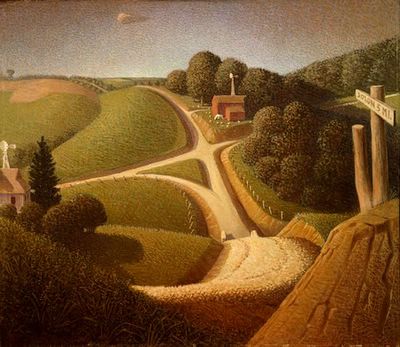
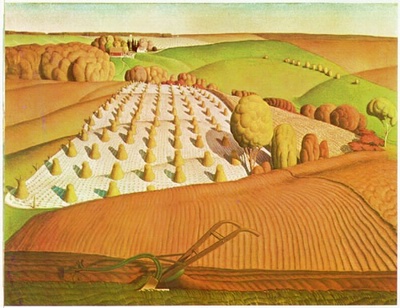
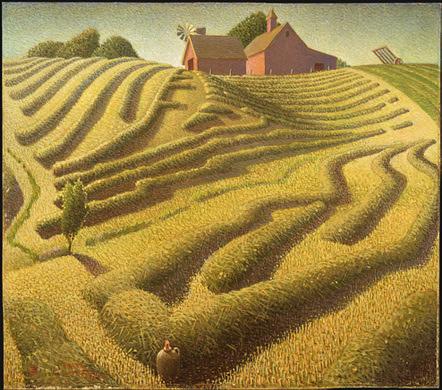
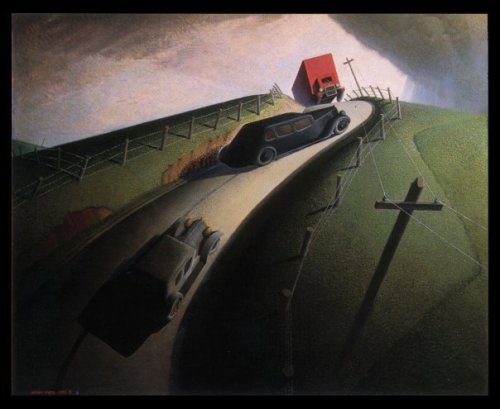
I am featuring the quote above from Grant Wood (1891-1942) mainly because I just want to show off a couple of my favorite pieces of his work. But his words resonate for me as well.
I sometimes speak or write of the different processes I employ in my work. They are important tools in conveying whatever constitutes the emotional message of a piece. Hopefully, they create an image that has some form of aesthetic beauty as well. But, as Wood points out, they are secondary to the emotional input from the artist that has been formed by experiencing and observing the world around them.
That’s a message I have passed on to students and student groups I’ve spoken with in the past. It is important to learn all sorts of technique and to hone the abilities of your craft. But more it is even more important to educate yourself– to learn, read, listen, observe, and feel the world around them with intensity, all with the goal of making oneself a more complete human being.
That is the thing that moves work from craft to art.
I believe that might be what Mr. Wood was saying.
Anyway, let’s look at his work while listening to a tune dedicated to and titled for Grant Wood at the bottom from the Turtle Island String Quartet. Good stuff.
If your determination is fixed, I do not counsel you to despair. Few things are impossible to diligence and skill. Great works are performed not by strength, but perseverance.
–Samuel Johnson, The Prince of Abissinia, 1759
I have mentioned here a number of times that this time of the year I sometimes go through my old work done before I was showing my work publicly. Most of the time I go through work that was beginning to show signs of what was to become whatever style I might have. I can see where things are heading in many of these pieces.
Early Attempt- 1993
But yesterday, I went through a bin of old work that I have been avoiding for a long time. It contained a lot of my very earliest attempts, done in the months after I was injured in a fall from a ladder back in 1993. These first attempts were done with old airbrush paints and a brush pushed into the cast surrounding my shattered wrist. I don’t know what even prompted me to do this outside of a nagging, almost panicky need to express myself that was feeling restrained by the injuries I was nursing.
I had to do something.
Going through the work, most on paper or paper canvas, was sheer agony at times. Oh, there were glimmers of what might come later but some was just painful to take in. Much of it was muddy and dull and some just plain terrible to behold.
Looking at them, all I could think was what in god’s name made me want to keep moving forward from that point? I sure couldn’t see it.
What was in this work that was telling me to keep at it? Why go on?
I can’t answer that question. Maybe it was, as I said, just a need to express myself even if it wasn’t as graceful and satisfying as I would like. Maybe even in these awful attempts there was still something, a small step forward, I could see then but can’t recall now. Maybe it was like stumbling through a maze in absolute darkness and seeing a tiny firefly go around a corner in the blackness ahead. Enough to make you go ahead just a little more.
The interesting thing here is that I had no idea where the maze was leading. I enjoyed looking at paintings and other forms of art but had no notions of making art my livelihood or career. Never even thought it was a possibility. Maybe I sensed I was at a turning point in my life and this would be a way to document it so that I could look at it later in order to make sense of the moment.
I don’t know.
But something made me persevere. Something made me want to continue so that eventually the single firefly ahead of me in the maze became a glowing torch that almost demanded that I forge ahead.
I am showing three of those pieces from the first months after I was injured in September of 1993. They aren’t great, not even very good though they are among the best from this earliest group of work. Not a high bar to clear. Like much of my work even now, they just came as they were, unplanned and unmodeled. I just made a first mark and soon after, they appeared.
Maybe I am a fool to show them. Why would an artist show their weakest work, the kind of stuff that most artists either hide away forever or destroy? I can’t answer that except to say that maybe they were the fireflies I needed.
Whatever the case, I feel a sense of gratitude to these early pieces that gave me what I needed in the moment. And maybe they simply bought me more time to grow, more time to listen to and develop my own voice.
And that’s a lot.
Here’s a song, Time, in that vein from 1970 from Edwin Starr. You most likely will remember him for his classic tune War with a line anyone who lived in that era knows so well: War! What is it good for? Absolutely nothing! I didn’t know much of his work at the time outside of War but everything I have come across over the years from Edwin Starr has been like finding a hidden treasure. This is one of those.
Dance me to your beauty with a burning violin Dance me through the panic ’til I’m gathered safely in Lift me like an olive branch and be my homeward dove Dance me to the end of love Dance me to the end of love
–Leonard Cohen, Dance Me to the End of Love
I was looking at the painting above, Tango, yesterday in my studio. It was a piece that was sold back in 1999 but came back to me in 2015 when I found it online as part of an estate sale from a deceased collector in central Virginia. It was a favorite of mine when it was painted and getting it back was exciting. It was a thrill to see that it was just as I had remembered it and maybe even better. I wrote about regaining this piece and two others from that sale on this blog back in 2015.
But looking at it yesterday, I was suddenly hooked by a detail I hadn’t noticed before. In the first gap between the entwined trees there is what appears to me to be a miniature version of the basic composition, with the green of the hills separated from the golden yellow of the fields by the white gap. This was pretty much the basis of most of my paintings from that time.
It’s a small thing and not one that detracts at all from the overall feel of the painting. But I now find myself immediately going to that small detail and finding a bit of delight in it. It feels like there is a small window into the inner world of the intimacy between the two trees.
This little detail adds a degree of pleasure to my enjoyment in this painting. Part of the tango we do with art we love. We find small bits and details within that enthrall us and make that piece even more special in our eyes. I can generally find some such small detail in any piece of my own and in the works from others that speak to me.
Like a secret softly whispered in the ear…
Here’s a video set to a Leonard Cohen song that very much is in the spirit of this painting. This is DanceMe to the End of Love.
When you vote in clowns, a circus is sure to follow.
And what a circus we are seeing from the GOP in the House of Republicans. Wow.
They made it evident that they were clowns from day one but it was mainly in their clownish performances as soloists or in small troupes. Yesterday, the whole group of clowns showed up (in what I imagine was the world’s largest clown car) and the circus was on. McCarthy was voted out as Speaker of the House and the first act of the new temporary head clown was to shut everything down and go into recess for a week.
That’s probably a good thing. They can’t do as much damage when they’re not there.
These are not serious people. They have no interest in governing or advocating for real people, only in performing for money.
These bad clowns reminded me of a blog post from back in 2015 about some other bad clowns.
From 2015:
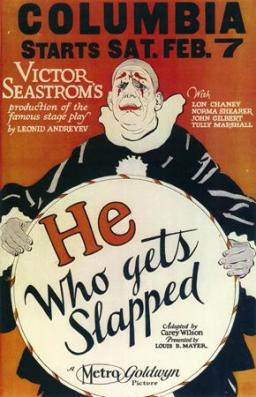
I found myself awake late one night this past week watching a film I’d seen a couple of times before. It was He Who Gets Slapped, a silent film from 1924 which was the first film made by the then new movie studio MGM. It stars the great Lon Chaney in a pretty grim and tragic story (it is based on a Russian play after all) that is sometimes hard to watch and hard to turn away from at the same time. On this particular night I couldn’t look away.
The basic premise is that Chaney plays a brilliant scientist who is screwed over by a wealthy man who steals both his ideas and his wife, humiliating him before a crowd of the foremost scientists who laugh at him.
This humiliation spurs him to retreat and become a clown called He whose act is to be masochistically slapped by an entire troop of clowns, his pain sparking the laughter of the crowd night after night. Of course, it ends with a bit of wonderful revenge as the rich guy gets his just rewards but it is by no means a happy ending or a feel-good film.
But a great film it is.
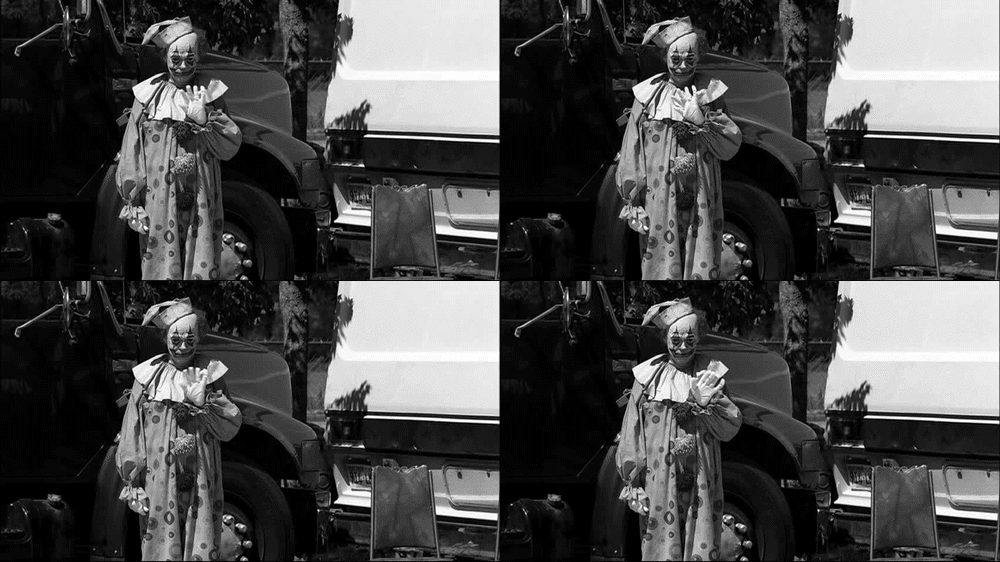
The imagery of the clowns in the film is quite remarkable and haunting. Whenever I see this film or Chaney’s other dark clown classic, Laugh, Clown, Laugh, (it was on immediately after He but I couldn’t take that much pain in one sitting) I am not surprised that many people have coulrophobia, the fear of clowns.
It made me perform a quick search for some GIFs with clowns to share. Putting them together was quite creepy. Try to have a great day after taking a gander at these joy makers.
Pieter Bruegel the Elder- Hunters in the Snow (Winter) 1565
Because the world is so faithless, I go my way in mourning.
—Pieter Bruegel
From 2009:
I am totally in awe of the work of Pieter Bruegel the Elder, the patriarch of the great Flemish family of painters. There are so many paintings of his that I could show that would be equal to those I chose for this post but I find these particular pieces striking. There is great richness and depth as well as a tremendous warmth in his colors. I always feel enveloped in his paintings as though they wrap around me like a blanket, particularly his peasant pieces.
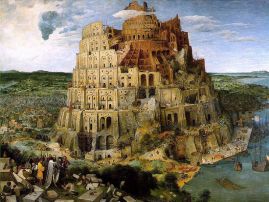
Pieter Bruegel- Tower of Babel
This piece here on the right depicting the Tower of Babel has always excited my imagination beyond the actual biblical story. I’m always reminded of the Gormenghast Trilogy from Mervyn Peake when I see this image and wonder if it had any influence when he was formulating the story for his novels. The scale of the building and the way it dominates the composition is breathtaking. The shape of the tower and the manner in which it dominates the composition has shown up in some of my paintings in the form of a tower-like hill.
Pieter Bruegel- The Fall of the Rebel Angels
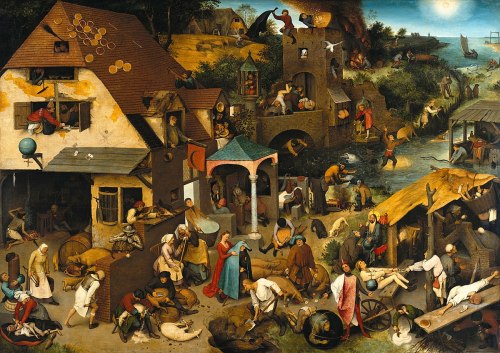
His earlier allegorical works seem to have been heavily influenced by Hieronymous Bosch and have incredible energy. He had an ability to take multitudes of forms and scenarios and bring them together in a way that had great rhythm, lending almost an abstract quality to the overall scene. I find these paintings quite beautiful despite their sometimes jolting imagery. This work was an influence on my later Multitudes work that was comprised of masses of faces.
I could look at his work for hours and find new details to focus on, new dimensions to coopt and explore in my own work. Even writing this short post is taking a long time because I just want to stop and look at his work. I find it truly inspiring and wonder how it will find its way into my own work someday. Somehow. Maybe…
I am replaying this blog entry from 2009 (with a couple of new comments in italics that give examples of how Bruegel’s work has been an influence) because I had a comment at Saturday’s Gallery Talk from another artist who said that my work reminded him of Bruegel and some other Flemish and Dutch painters. It kind of left me gobsmacked because I didn’t necessarily see it myself. But thinking about it later, his work certainly was an influence and could easily show itself to another’s eyes.
Pieter Brueghel- Landscape with the Fall of Icarus,
At the Gallery Talk on Saturday at the Principle Gallery, we talked about process though it ended up being a much briefer explanation than some in the audience might have desired. I have posted the description below of one of the process for one of my paintings from 2011, followed by a short video showing its evolution from start to finish, a couple of times over the years. I thought it might be a good time to revisit it as there are many new readers who may not be familiar with how my work comes together.
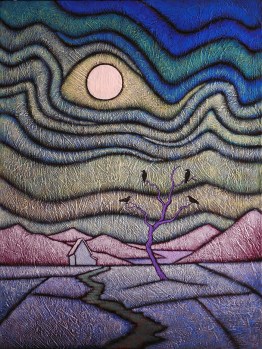
I paint in two distinctly different processes, one that I call reductive and the other additive. The reductive is a liquid process where I put puddles of paint on the surface then remove much of it. This process leaves the dark edges that define much of this more transparent work. The process shown here is my additive process, with layer after layer of paint being built up. The colors end up being denser nad more opaque than those in the reductive process. Here’s what I wrote in January of 2011 along with a video at the bottom that shows a timelapse evolution of the painting:
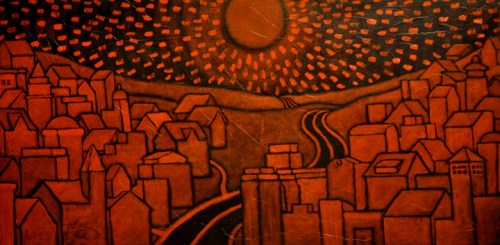
I worked on a new piece the last couple of days, a large canvas that is 24″ by 48″. I had already gessoed the canvas with a distinct texture and applied a layer of black paint. I had vague ideas of where I thought the painting might go from a composition standpoint but knew that this was only a starting point in my mind. Like most of my paintings, the finished product is often drastically different than what I imagined at the beginning. As I paint, each bit of paint dictates the next move and if I don’t try to force in something that goes against these subtle directions given to me by the paint the piece usually has an organic feel, a natural rhythm in the way the different elements go together. A cohesion of sorts.
Knowing I wanted to use a cityscape in this piece, I started in the bottom left, slowly building the city with geometric forms and rooflines in a red oxide paint that I use to block in my composition. I prefer using the red oxide because it gives a warmth under the layers paint to come that shows through in small bits that are almost undetectable at a quick glance.
At this point I still am unsure where the painting is going. I have thoughts of filling the canvas completely with the cityscape with the smallest view of the sky through the buildings but am not married to this idea. The paint isn’t telling me enough yet to know. But it has told me that I want a path of some sort- a street or canal- through the composition. I make room for one near the center before starting on the right side with the buildings there. I go back and forth between the right and left sides as I build the city, constantly stepping back to give it a good look from a distance to assess its progress and direction.
At a point where the city is nearing the halfway point on filling the canvas, I decide I want this piece to be less about the cityscape and more about how it opens to the open sky beyond it. I extend the road that started at the bottom and twist it upward, terminating it at a bend in what will be now a field beyond the city edge. The sky, though still empty, is pushing me ahead, out of the city. The piece has become about a sense of escape, taking the street from the cityscape and heading upward on it towards the open fields and sky. Painting faster now, another field with a bit of the road appearing is finished beyond the first lower field. I have created a cradle in the landscape for the sky to which I now turn my brush.
There’s a certain symmetry at work here and I decide I want the central focus of a sun in this composition. I roughly block in a round form, letting it break beyond the upper edge of the canvas. I pay little attention to the size of this sun except in its relationship to the composition below it. My suns and moons are often out of proportion to reality but it doesn’t matter to me so long as it translates properly in the context of the painting. If it works well, it isn’t even noticed.
I finish blocking in the sky with the red oxide, radiating the strokes away from the sun, and step back. [The video below basically begins at this point in the process] The piece has began to come alive for me and I can start to see where it is going. The color is starting to fill in in my mind and I can see a final version there. This is usually a very exciting time in the process for me, especially if a piece has a certain vitality. I sense it here and am propelled forward now, quickly attacking the sky with many, many brushstrokes of multiple colors. working from dark to light.
There are layers of a violet color in different shades that are almost completely obscured by subsequent layers. I could probably leave out these violet layers but the tiny shards that do barely show add a great depth to the flavor of the painting for me and to leave them out would weaken the piece in a way.
I have painted several hours on the sky now and still have a ways to go before it reaches where I see it in my mind. There are no shortcuts now. Just the process of getting to that final visualized point. But it’s dinnertime and my day is now done. I pick up and step back to give it one final look before I head out into the darkness. This is where the painting is at this point, where I will start soon after I post this:
In the blog post with the final version I then wrote:
Above is the tentatively finished version of the painting I started earlier this week, a 24″ by 48″ canvas that I am considering calling Escape Route. I showed the first few steps of the painting process on this blog two days ago, ending with the sky being near finished and the composition blocked in. I’m not going to go into all the steps and decisions that went into completing this piece. Instead, I put together a short film that shows the painting evolving to the finished product.
I will say that the final version is much different in many ways than I first envisioned with the first strokes of red oxide that went on the canvas. Each subsequent bit of color, each line that appeared, altered the vision in my head just a bit, evolving the piece constantly until the very end of the process. Even the last part, where I inserted the treeline that appears on the farthest ridge, was not seen in my mind until just before the decision to proceed with them was made. I decided to go with this treeline to create a final barrier for the road to break past on its way upward toward the sky. A final moment of escape.
This painting has given me a great sense of satisfaction after finishing it. I spent much of the late afternoon yesterday just looking at it and taking it in. I don’t know if it will translate as well on the computer screen but this piece has substantial size at 24″ by 48″ which gives great weight to the blocks of color from the buildings and the light from the sky. There is a sense of completeness here that I could only struggle to explain, but as I said, brings me great satisfaction. I feel as though the evolved painting has exceeded what I imagined when I first started this piece. While I can’t fully explain that, it is all I can hope for from my work.
I will spend some more time over the next several weeks looking at this painting, determining if anything should be tweaked or altered. A highlight added here, a line made crisper there. But as it stands, it feels as thought it has taken on its own life and I will probably leave it alone as it is.
And here’s the video, only about a minute long, that shows how the piece came about.
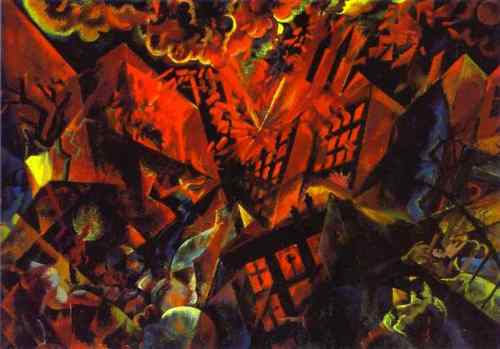
 As I trudged down to pick up my newspaper, I tried to sort out these dreams in order to find an equivalence in imagery that I know that captured in some way the feel of these dreams. As I neared the studio the dark paintings of George Grosz done in Germany in the years before World War I came to mind. They were forebodingly dark and angry and just the overall look of them made me think of the darkest corners of man’s mind. The red tones and the way they filled the picture plane along with the chaotic nature of the compositions brought to mind the nightmarish feel of my dreams.
 Grosz’s work changed over the years, especially after fleeing Hitler’s Germany, moving to the New York in the 1930’s where he lived until the late 1950’s when he returned to Berlin, dying there in 1959. His American work is often considered the weakest of his career, less biting and more esoteric. There were exceptions during the war such as 1944’s Cain, Or Hitler in Hell, shown here, which reverts back to the colors and nightmare feel of his early work. Very powerful work that may not sooth one’s soul but rather documents the darker aspects of human existence.






 But looking at it yesterday, I was suddenly hooked by a detail I hadn’t noticed before. In the first gap between the entwined trees there is what appears to me to be a miniature version of the basic composition, with the green of the hills separated from the golden yellow of the fields by the white gap. This was pretty much the basis of most of my paintings from that time.
 From 2015:
  But a great film it is.







 Redtree Times