Feeds:
Posts
Comments

Archive for November, 2023

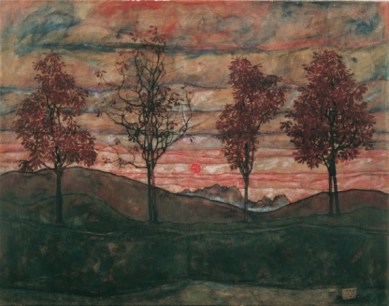
Schiele Vier Baume

Egon Schiele- Vier Baume ( Four Trees)


I must see new things and investigate them. I want to taste dark water and see crackling trees and wild winds.

–Egon Schiele


There was a John Mellencamp album from 1990, Big Daddy, that had a song with the line:” Henry sent a postcard from a better place…”  There’s something in that line that has stuck in my memory far more than the original song. In my head, the line transformed into a simple send me postcards from better place and always comes to mind when I receive a postcard from friends or family. I thought of it yesterday when I received this postcard from a friend that I know through my paintings who now lives in Slovakia.

It’s an image of the painting Vier Baume (shown above) from the great Austrian painter Egon Schiele whose work has always captivated me. He saw it while visiting the Belvedere Museum in Vienna and it reminded him of my paintings, joking that this Schiele guy must have been influenced by GC Myers. His mother, a lovely woman who I know and who was visiting with him there, added the line, “If only he’d thought to put a red chair in the tree!”  Gave me a chuckle.

One of the great perks of doing my job is having my work connect with people and have them tell me of how they are reminded of this at different times in their travels. I posted a photo here last year that was given to me at a gallery talk by a man who was on a boat off the coast of Venezuela when he spotted a tiny island with a single twisted tree atop it.  It reminded him of one of my paintings and he was kind enough to snap a photo of it for me. 

These little gestures mean an awful lot to me as small validations of the strength and voice of the work. When I’m painting in the solitude of my studio, I can only hope that the piece I’m at work on will have such an impact to make someone far removed think of it beyond the moment when they actually see it.  There’s something oddly comforting to me in this thought. 

Perhaps the postcards sent are because these folks view my painting as a sort of postcard from a better place?

Who knows?


I thought I’d revive this post from back in 2011 to share a couple of other “postcards from better places” that grace my studio courtesy of some friends who saw something out there in the world that reminded them of my work. They are my little treasures. I can’t tell you how often my eyes fall on these pieces, making me smile. The Red Tree on the left is courtesy of Stacy Spier and Jeff Snyder while the piece on the right with the bare tree with the furrowed rows in the foreground is from Stevan Knapp.

Don’t know that these images do them justice. Believe me when I say that they have great impact for me.

Below them is the song, Theo and Weird Henry, from John Mellencamp referred to in the original post.


Read Full Post »

GC Myers  Radiance and Shadow

Radiance and Shadow


And now here is my secret, a very simple secret: it is only with the heart that one can see rightly, what is essential is invisible to the eye.

Antoine de Saint-Exupery, The Little Prince


I have long held the belief that art is about revelation, about making the invisible visible.

Creating the intangibles such as hope and wonder. Or awe or a sense of belonging or of self-empowerment or so many other feelings and emotions. Revealing these unseen intangibles is what art can and should do.

It’s a lofty and often evasive goal. The harder one tries specifically to do just that, to create these intangibles, the further one moves from that goal.

In my experience, it only happens when you can release yourself into the work, letting your mind focus on each element in each moment. Finding the rhythm and voice, one individual moment at a time. One stroke, one line, leads to the next and if you allow yourself to follow the guidance being given by what is in front of you, slowly the gap between the visible and the invisible closes, that gap suddenly filled with an emotion, a feeling that gives voice to the work.

This particular painting, Radiance and Shadow, fits into that idea for me, filling me with the wonder I get from a full moon’s light on a snow-covered landscape. The way the light is cast on the reflective snow creates a sense of something new in the familiar. The scene you’ve witnessed day after day takes on a different feel, filled with a paradoxical sense of mystery and revelation that comes from new shadows and new light.

You can almost sense the quiet as all sound is hushed and absorbed by the snow. It’s a quiet that reminds you of the stillness that you imagine your ancestors knew well in earlier times when there was less extraneous sound in world with fewer people and machines. And from that quiet a feeling of peacefulness and security arises to accompany that initial sense of wonder.

And suddenly the simple arrangement of paint and lines and shapes becomes something more. Complete and a thing unto itself. The intangible made tangible.

And that in itself becomes a wonder to me…


This post first ran again about this time six years back. I changed out the painting at the top for one that now hangs in my studio. I am also adding a piece of music that fits the tone of this post and the painting. It is titled Quietude. It was written by harpist/composer Carlos Salzedo (1885-1961) and is performed here by Judy Loman.


Read Full Post »

GC Myers- Blaze  2014

GC Myers- Blaze, 2014


In everyone’s life, at some time, our inner fire goes out. It is then burst into flame by an encounter with another human being. We should all be thankful for those people who rekindle the inner spirit.

–Albert Schweitzer, Memoirs of Childhood and Youth (1925)


I was looking at the painting above, Blaze, here in the studio the other day. I do that quite often with this particular piece, probably more than any painting that has returned to me after spending time out in the galleries.

It has a life force that seems to speak to me as clearly and directly as any piece. I guess that shouldn’t come as a surprise since it is my painting.

It should speak clearly and directly to me, right?

Well, not necessarily. As I have pointed out before, every painting takes on its own spirit and even though they originate within me, they sometimes end up dwelling well beyond me. I don’t know that I can explain that in a coherent fashion. It’s more gut feeling than intellectual thought. Hard to explain one’s gut feelings.

I’ve shared this 2014 painting a couple of times here before and each time have included the words above from Albert Schweitzer. It occurred to me that this painting might in some way act as a surrogate for those people who have rekindled my own inner spirit, as Schweitzer put it.

Maybe that is the thing within it that so draws me to it?

Maybe. I don’t know.

I also came across another passage from Schweitzer that might apply here as well:

All art speaks in signs and symbols. No one can explain how it happens that the artist can waken to life in us the existence that he has seen and lives through. No artistic speech is the adequate expression of what it represents; its vital force comes from what is unspoken in it.

Hmm. Something to think about.

Here’s a song that might adequately fill out today’s triad of word, image and music. The song is way beyond adequate, a favorite that I’ve played a few times over the years. Here’s Higher Ground from the great Stevie Wonder.

It’s sure to rekindle your fire. How could it not, with a chorus like this:

I’m so darn glad He let me try it again‘Cause my last time on earth, I lived a whole world of sinI’m so glad that I know more than I knew thenGonna keep on tryin’‘Til I reach my highest ground

Now, get out of here. Go find your own higher ground…


Read Full Post »

Cleanup In Aisle 6

GC Myers- Imitatio

Imitatio – At the West End Gallery


“… Mr. Bankman-Fried said: “I’m very skeptical of books. I don’t want to say no book is ever worth reading, but I actually do believe something pretty close to that.” He didn’t like movies, either.

It’s impossible to read the sad saga of Mr. Bankman-Fried without thinking he, and many of those around him, would have been better off if they had spent less time at math camp and more time in English class. Sometimes in books, the characters find their moral compass; in the best books, the reader does, too.”

–David Streitfeld, NY Times, Sam Bankman-Fried’s Wild Rise and Abrupt Crash, Nov. 3, 2023


I had several questions come up yesterday that I thought deserved a couple of minutes this morning. A little Monday morning cleanup, if you will.

The first came from an article in the NY Times that gave an outline of the crash of crypto-criminal Sam Bankman-Fried. It was the paragraphs above that caught my eye and gave rise to a question. The writer of the article, David Streitfeld, noted Bankman-Fried’s skepticism of books and that perhaps a better grounding in literature might have established a higher level for his moral compass.

My first question was about Bankman-Fried’s use of the word skepticism. Does he simply not believe in the passing down biographies and stories and such things? Is he just not a fan of the written word?

It irked me enough to grab those paragraphs from the article. I certainly agreed that Bankman-Fried would have benefitted from more time with literature than with the video games that occupied much of his time. I established whatever my moral compass is now and learned many of the lessons of the world that I carry with me from my reading as a child and young adult. Without it, I would be a much different person.

But this article also made me wonder about one’s moral compass.

What is the driving force or objective behind any one person’s moral compass?

It seems that many people’s moral compasses today are driven by self-interest, whatever it takes to get what they want. It’s a very Machiavellian example with the ends justifying the means. I guess you could lump this in with money and power as the drivers of this moral compass.

Others are driven by expedience, in not taking a stance on anything of principle unless it is absolutely necessary. Keep your head down and try to simply ignore the greater outer world.

Some are driven by altruism, wanting to help others. Others by a love of family and friends. Others by a sense of justice. I am sure you or I can come up with a lot more if we take the time.

The question is: What drives your moral compass?

I would imagine that we all have some of each of those above at some given time and circumstance. Maybe that’s the healthy thing here, to have a moral compass with many diverse parts that serve the whole without one becoming too dominant.

For example, we need to have a bit that is self-serving in order to survive and an expedient bit that blocks out some of the things in this world that we cannot control. But we also need a bit of altruism so that we might care for and help others even though they might be unknown to us if only to make the world a bit better. And we need a moral compass based on family and friends so that we can serve as loyal caretakers for those relationships.

One final bit of cleanup, in reference to yesterday’s post, where I wrote about how people would resist a safe remedy for hatred because they have come to view their hatred as a treasured part of their being. It made me think about how those with great belief often have an equal amount of disbelief. The certainty with which they hold to each of these polar opposites leaves little room for any uncertainty or questioning. There is little gray area in which to explore or find new ground. Little nuance, dealing only in absolute terms.

It made me ask myself: What is greater, my sense of belief or disbelief?

I don’t know that there is a right answer. Maybe it varies based on whatever it applies to. Or maybe it can be equal so long as one’s belief/disbelief is based in evidence and facts. Not a belief/disbelief based on only what and how one wants things to be or a blind certainty devoid of facts and evidence.

Of course, I am just spouting now. Turning the clocks back this weekend has me up even earlier than normal and my mind is racing when it might be sleeping.

And this is what you get. Not much of a cleanup. Actually, it might be even more of a mess.

So sorry.

Ah, what else to do on an early Monday morning?

Read Full Post »

None of Us Are Free


GC Myers, Faces Off sm

Faces Off, 2019

“A sickness known as hate. Not a virus, not a microbe, not a germ — but a sickness nonetheless, highly contagious, deadly in its effects. Don’t look for it in the Twilight Zone — look for it in a mirror. Look for it before the light goes out altogether.”

–Rod Serling, Twilight Zone, I Am the Night, 1964


It’s hard to witness, let alone fathom, the level of hatred being displayed around the world at the moment. In every corner of the globe there seems to be a surge of deadly vitriol directed at whatever group represents The Other in that particular place.

It very much feels like the hatred that Rod Serling‘s narrator described as a contagious sickness of at the end of a 1964 Twilight Zone episode has become a true global epidemic.

A pandemic of hatred that makes the Covid virus pale in comparison.

What can be done to end it or even slow its spread?

I surely don’t know and if there is a person who can one day come up with a workable solution, they will be rightly celebrated as the greatest person to ever tread this earth. In my opinion, for what it’s worth, it won’t come from religious figures or politicians or billionaire industrialists or technocrats. They’ve already tried to shape the world to their designs for thousands of years and have little progress to show in the way of alleviating the hatred that engulfs us. In fact, they have seemed to have made the divisions between the various peoples of the planet even deeper and wider.

I think that if a consortium of scientists from around the world were to miraculously discover a single gene within all of us that controlled our hatred and were able to easily remove it without harming us in any way, I don’t believe we would even accept that solution. Too many of have come to covet this sickness, to view it as a treasure, the thing that brings meaning, however twisted and destructive it is, to their lives. These people would gladly keep the infection alive.

I wish I had the answer. I wish you had the answer. I wish anyone anywhere had a way of ridding of us of this sickness that is hatred. Because, like the horrible infection it is, it destroys all things it touches.

Nothing good is born of hatred nor has it ever been. Hatred’s only creation is more hatred. It is a purely destructive force that holds us all captive. So much time and effort is spent in both carrying out this hatred and in fighting against it that many efforts that might enrich the lives of all are swept aside and ignored altogether. Perhaps never to come to fruition.

Just another side effect of the illness.

Until we find an antidote of some sort, none of us are free from the reach of that sickness.

Let’s end it on that line. That brings us to this week’s Sunday Morning Music. The song is None of Us Are Free. It was written in 1993 by the renowned songwriting team of Barry Mann and Cynthia Weil along with Brenda Russell for Ray Charles. The song was later recorded in 2002 by Solomon Burke, a great version that I shared here a couple of years back. But the original below is wonderful, featuring a great horn section and backup vocals along with guitar work from Eric Clapton in a time when the sickness had not yet fully affected him.

Maybe art and music and literature will inoculate us? I don’t know but it can’t hurt…


Read Full Post »

Style Is Character, Again

Georgia O'Keeffe Sky Above Clouds IV

Georgia O’Keeffe- Sky Above Clouds IV, 1965


I recall an August afternoon in Chicago in 1973 when I took my daughter, then seven, to see what Georgia O’Keeffe had done with where she had been. One of the vast O’Keeffe ‘Sky Above Clouds’ canvases floated over the back stairs in the Chicago Art Institute that day, dominating what seemed to be several stories of empty light, and my daughter looked at it once, ran to the landing, and kept on looking. “Who drew it,” she whispered after a while. I told her. “I need to talk to her,” she said finally.

My daughter was making, that day in Chicago, an entirely unconscious but quite basic assumption about people and
the work they do. She was assuming that the glory she saw in the work reflected a glory in its maker, that the painting was the painter as the poem is the poet, that every choice one made alone– every word chosen or rejected, every brush stroke laid down or not laid down– betrayed one’s character. Style is character.

— Joan Didion, Georgia O’Keeffe


This anecdote opens the essay Georgia O’Keeffe that is included in author Joan Didion‘s 1979 book of essays, The White Album. I can only imagine the awe and wonder in the eyes of her daughter along with the many questions it inspired, on seeing O’Keeffe’s huge painting– it’s 8 feet high by 24 feet wide!– in a large open space.

It raises an interesting question: Is style character?

That’s a tough question. I am not positive it holds true for all artists across the spectrum of artistic disciplines but, for the most part, I would like to believe this is true if the style of the artist is genuine and true to their self.

Determining what is genuine and what is contrivance is another question.

I think the reaction of Didion’s daughter is one reliable indicator of authenticity. There is something about the reaction of a child to art that I trust implicitly. Their perception is still unclouded and intuitive and they usually don’t yet feel the need to categorize or rate everything that they come across. They have an ability to see things clearly that I sometimes think we lose in adulthood.

They just react on a gut level, quickly and decisively, to some inner intuitive cues.

In my experience, I generally am most pleased with my own work when it catches the eye or mind of a child. It’s perhaps the purest form of validation, letting me know that the work speaks on a visceral, emotional level.

But is this, the style that speaks to that child, character?

I can’t say for sure. I know a number of artists for which this holds true and I believe it is true in my own case.

Or at least I want to believe that. A person can’t attest to their own authenticity without some form of bias. That puts it out of my hands.

But I hope so. My intention for my work has always been to be transparent and open, for it to be an expression of my character, for better or worse. It is work that is meant to communicate. Or so I hope.

I don’t know that an artist’s work can ever fully mask the strengths or deficiencies contained in their character. Nor should they.

For myself, I am okay with that. I am willing to be judged because I know that few will be as critical of my work and my character as myself.

As Georgia O’Keeffe said:

To create one’s world in any of the arts takes courage.

And don’t we all aspire to have courage?


Running a little behind this morning and something led me to this post from just a couple of years back. Felt right this morning. I’ve added a Dan Fogelberg song, Bones in the Sky, which is about O’Keeffe and her work. It includes plenty images of her paintings as well as many photos of her taken by her husband, the influential photographer Alfred Stieglitz.


Read Full Post »

GC Myers- Offered to the Wind 2022

Offered to the Wind— Now at West End Gallery


Boychick, wake up! Be something! Make your life something good. For the love of an old man who sees in your young days his new life, for such love take the world in your two hands and make it like new. Go out and fight so life shouldn’t be printed on dollar bills.

–Clifford Odets, Awake and Sing! (1935)


Starting every morning here in the studio is pretty much the same. And not.

I walked into the studio around 5 AM this morning. About my regular time, I guess.  It was chilly, about 34°, as I trudged across the path between the house and my studio with leaves crunching under my feet. The three feral cats met me about halfway across, all wanting their heads rubbed first. We proceeded as a group into the garage for First Breakfast and more rubs and purring. The cold makes it more comfortable for both them and me as it means that the sometimes-intrusive raccoons are not as active. All as usual for this time of the year.

Then I left them to head into the studio to give Hobo, my studio cat, another onetime feral who we figure is about 18 years old now, her medications and feed her. She greets me with her usual purrs and meows. All as usual.

Coffee and tea– I drink both first thing in the morning– are prepared and I head into the painting area. I usually flip on some music or watch the news as I begin to figure out what I am going to write. This is sometimes where things bog down.

But flipping on the TV, I notice that TCM is playing Shake! Otis at Monterey which is a film of his legendary 1967 performance at Monterey Pop Festival. I turned it over to it and am greeted with his opening number, Shake!

Wow.

I’ve seen this performance many times before but at 5:30 AM in the dark stillness of my studio, its frenetic pace felt like a shot of adrenaline directly into my heart. Made me giddy and eager to start the day. To get something done. To shake off the cobwebs and make something of the day. Get out of the little dull rut I’ve been feeling in recent days and push myself. Jump on this rocking rhythm and ride it, maybe start a new and bigger project.

Just move.

Wake it up and shake it up.

Thanks, Otis. I needed that.

Take a couple of minutes to watch Otis then get out of here. Go wake and shake on your own time. You’re stifling me.

And stay off my lawn…


Read Full Post »

Penelope’s Song

GC Myers-- Penelope

Penelope— Now at the West End Gallery


Now that the time has comeSoon gone is the dayThere upon some distant shoreYou’ll hear me say
Long as the day in the summer timeDeep as the wine dark seaI’ll keep your heart with mine‘Til you come to me…

–Loreena McKennitt, Penelope’s Song


I have employed Penelope, from Homer’s Odyssey, as the subject of several paintings over the years, including the one here at the top. It is a smaller piece, 6″ by 12″ on canvas, now at the West End Gallery.

As a refresher, Penelope was the queen and wife of Odysseus, king of Ithaca. In the tale, Penelope waited for ten years for Odysseus to return from the Trojan War, the span of time, of course, that was the period that comprises the tale of the Odyssey.

Penelope waited constantly during this time, forever looking out over the sea and scanning the horizon for Odysseus’ ship. During this time, she was urged by more than hundred suitors to select a new husband. She would put them off by saying she would not do so until she finished weaving the burial shroud for Odysseus’ elderly father, Laertes. Cunningly, she would weave each day then unravel her day’s work each night so that the shroud never seemed to progress.

There’s more to the story than this, of course. But it is the image of the aching Penelope looking out from Ithaca that has always stuck with me. I often see it in pieces such as this. Maybe having that story engraved in my mind makes that so. Not sure. but it can’t hurt.

Here’s a song from singer/songwriter Loreena McKennitt about just this subject. This is Penelope’s Song.


Read Full Post »

questions for ourselves

GC Myers- The Questioning sm

GC Myers- The Questioning


Always the beautiful answer who asks a more beautiful question

–E.E. CUMMINGS, 1938, Introduction to Collected Poems


I had a conversation yesterday about the nature of questions. Things like: Why do we ask questions? Can we expect answers? And is the answer– if there is one— ultimately as important as the question itself? Or does simply asking a question create the possibility for an answer? Or more questions?

I often ask questions without having any answers so this line of questioning intrigued me greatly.

Predictably, I had no concrete answers. In fact, it spurned more questions in me. I went seeking early this morning for something that might help organize that conversation in my mind and came across the line above from the late poet E.E. Cummings. It felt like a bit of an epiphany:

Always the beautiful answer who asks a more beautiful question

Could it be that perhaps we ourselves are the answer to our questions?

My stock response to that is: I don’t know.

And I’m okay with that. The fact that I am asking questions means that I still care enough to live and seek. And in the end, that is all that matters, the engine that drives us.

That line was the final line in an introduction that Cummings wrote for his 1938 Collected Works. I read the rest of the essay and found it as equally compelling as that final line, though that line was the perfect bow to put on the package.

So much of it spoke to that conversation yesterday as well as to my own personal seeking. There was a short paragraph that felt as though it was written for me about those things that concern me:

Miracles are to come. With you I leave a remembrance of miracles: they are somebody who can love and who shall be continually reborn, a human being; somebody who said to those near him, when his fingers would not hold a brush “tie it to my hand”

I have shared Cummings’ introduction below. I found it a fascinating read. It might not be so for mostpeople but for ourselves, we understand, don’t we?

How could I not end on a question?


I N T R O D U C T I O N  

The poems to come are for you and for me and are not for mostpeople– it’s no use trying to pretend that mostpeople and ourselves are alike. Mostpeople have less in common with ourselves than the squarerootofminusone. You and I are human beings; mostpeople are snobs. Take the matter of being born. What does being born mean to mostpeople? Catastrophe unmitigated. Socialrevolution. The cultured aristocrat yanked out of his hyperexclusively ultravoluptuous superpalazzo,and dumped into an incredibly vulgar detentioncamp swarming with every conceivable species of undesirable organism. Mostpeople fancy a guaranteed birthproof safetysuit of nondestructible selflessness. If mostpeople were to be born twice they’d improbably call it dying–

you and I are not snobs. We can never be born enough. We are human beings;for whom birth is a supremely welcome mystery, the mystery of growing: which happens only and whenever we are faithful to ourselves. You and I wear the dangerous looseness of doom and find it becoming. Life, for eternal us, is now’and now is much too busy being a little more than everything to seem anything, catastrophic included.

Life, for mostpeople, simply isn’t. Take the socalled standardofliving. What do mostpeople mean by “living”? They don’t mean living. They mean the latest and closest plural approximation to singular prenatal passivity which science, in its finite but unbounded wisdom, has succeeded in selling their wives. If science could fail, a mountain’s a mammal. Mostpeople’s wives could spot a genuine delusion of embryonic omnipotence immediately and will accept no substitutes.

-luckily for us,a mountain is a mammal. The plusorminus movie to end moving, the strictly scientific parlourgame of real unreality,the tyranny conceived in misconception and dedicated to the proposition that every man is a woman and any woman is a king, hasn’t a wheel to stand on. What their synthetic not to mention transparent majesty, mrsandmr collective foetus, would improbably call a ghost is walking. He isn’t a undream of anaesthetized impersons, or a cosmic comfortstation,or a transcedentally sterilized lookiesoundiefeelietastiesmellie. He is a healthily complex, a naturally homogenous,citizen of immorality. The now of his each pitying free imperfect gesture, his any birth of breathing, insults perfected inframortally milleniums of slavishness. He is a little more than everything, he is democracy; he is alive: he is ourselves.

Miracles are to come. With you I leave a remembrance of miracles: they are somebody who can love and who shall be continually reborn, a human being; somebody who said to those near him, when his fingers would not hold a brush “tie it to my hand”–

nothing proving or sick or partial. Nothing false, nothing difficult or easy or small or colossal. Nothing ordinary or extraordinary, nothing emptied or filled, real or unreal; nothing feeble and known or clumsy and guessed. Everywhere tints childrening, innocent spontaneaous, true. Nowhere possibly what flesh and impossibly such a garden, but actually flowers which breasts are among the very mouths of light. Nothing believed or doubted; brain over heart, surface: nowhere hating or to fear; shadow, mind without soul. Only how measureless cool flames of making; only each other building always distinct selves of mutual entirely opening; only alive. Never the murdered finalities of wherewhen and yesno, impotent nongames of wrongright and rightwrong; never to gain or pause, never the soft adventure of undoom, greedy anguishes and cringing ecstasies of inexistence; never to rest and never to have; only to grow.

Always the beautiful answer who asks a more beautiful question

E.E. CUMMINGS, 1938, Collected Poems

Read Full Post »
« Newer Posts