Feeds:
Posts
Comments

Archive for December, 2023

Victorian 1 Christmas Santa and Christmas Pudding


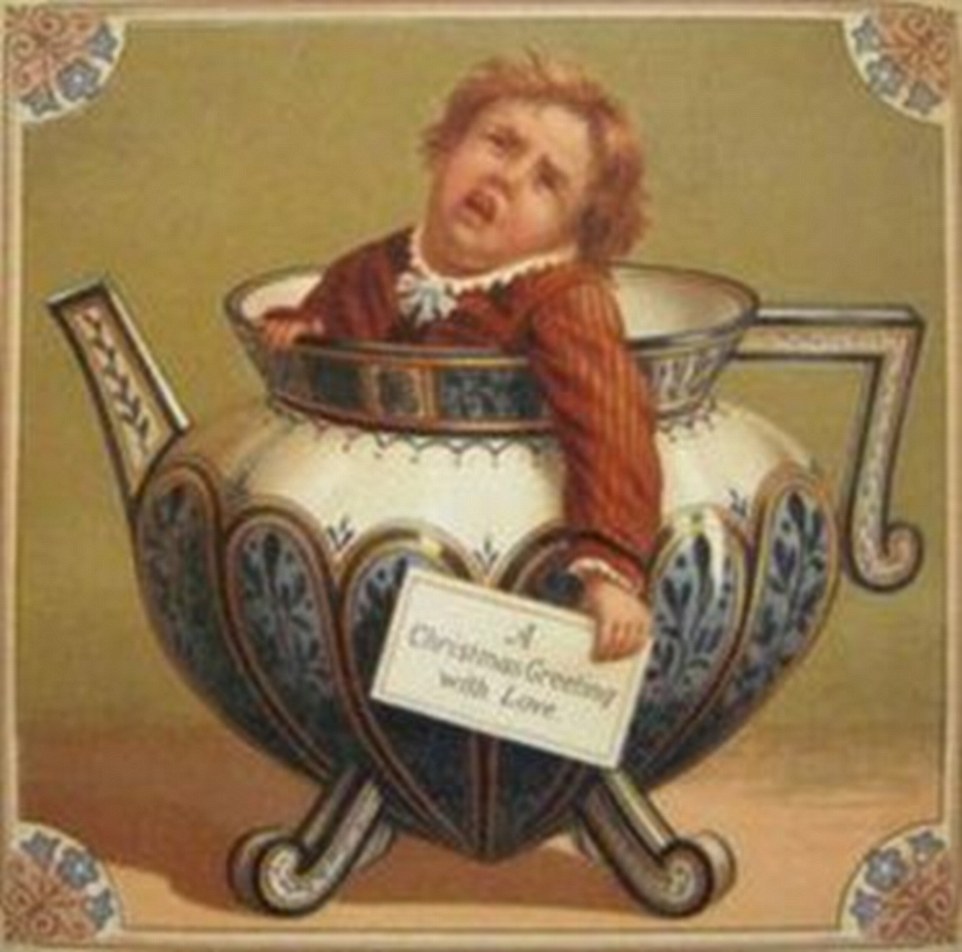
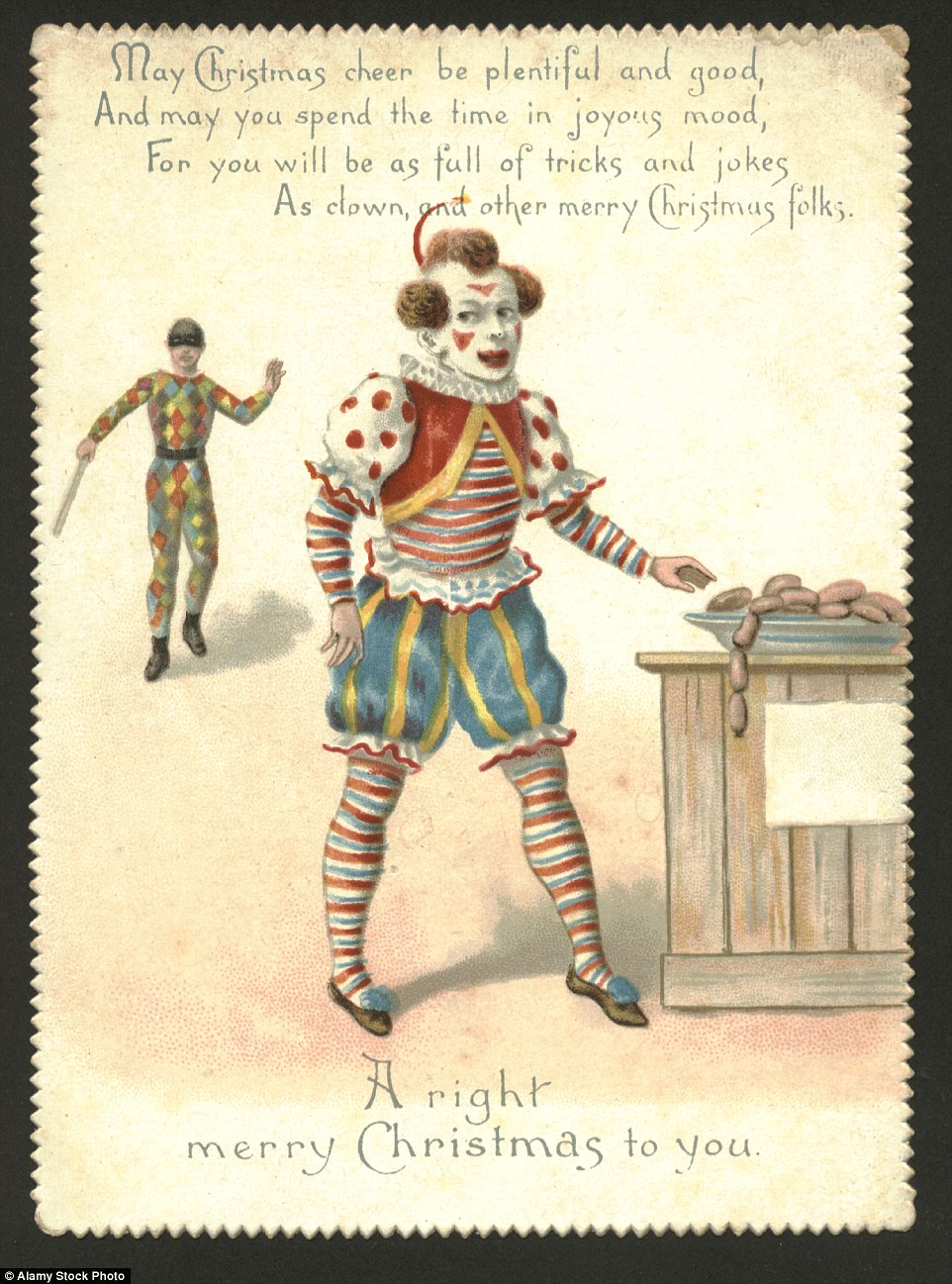
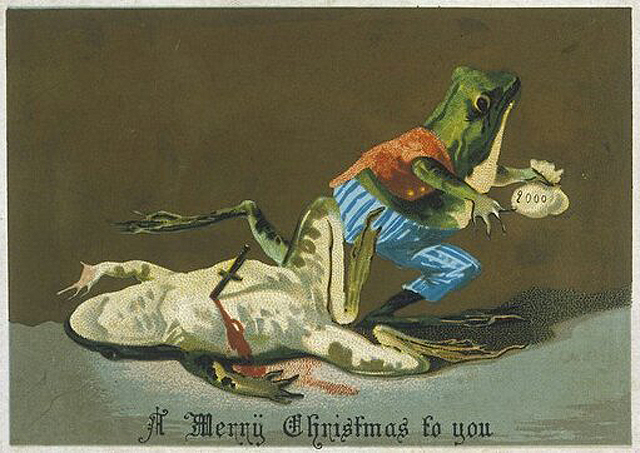
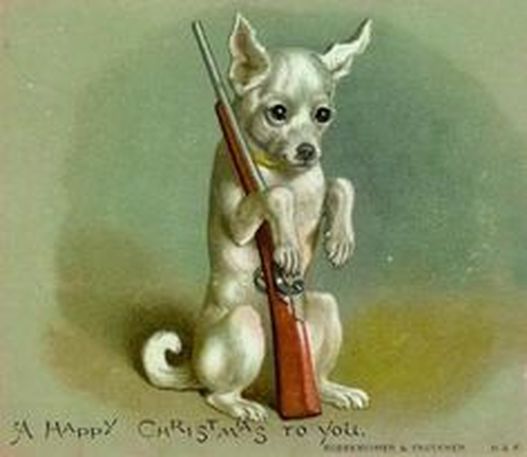
I shared some vintage ads a few weeks back that showed Santa enjoying a smoke and an adult beverage or two. It reminded me f a post from a number of years back that shared a group of odd Victorian Christmas images. Those Victorians had a darker and weirder sense of humor than we give them credit for. At least, I think it was a sense of humor. It was often definitely weird, with creepy clowns, distraught children in china teapots, walking root vegetables and roasted rats.

I won’t even try to explain the murderous, thieving frog or the gun-toting Chihuahua.

I think my favorite is the first one below with the polar bear mauling a skater under the heading ” A Happy Christmas ” with ” A Hearty Welcome” under it.  I get that way about the holidays sometimes myself.

So, if you think we’re living in a strange time, take comfort in knowing that it was equally weird 125 years ago. Now get out of here or I’ll let my polar bear out of the shed.

Git!


Children attacking a large pudding on a Christmas card. Date: circa 1890s

Roasted Rat for Christmas

Read Full Post »

A Found Harmonium

GC Myers- Desire's Passage sm

Desire’s Passage– At Principle Gallery


Happiness is not a matter of intensity but of balance and order and rhythm and harmony.

–Thomas Merton, No Man is an Island (1955)


Some mornings I need to be electrified or kick-started into motion. I guess that would qualify as a sort of intensity as referred to in the words above from the estimable Thomas Merton. And as he points out, those mornings seldom bring any more satisfaction than those when I find myself in a state of calm and harmony.

So, for this morning, I am going to keep it simple. Minimalist, as it were. Just Merton’s observation, a painting from the current Small Works exhibit at the Principle Gallery and a song selection for this week’s Sunday Morning Music.

The song is Music For a Found Harmonium from the Penguin Cafe Orchestra, who are considered an avant-pop group whose music is often called minimalist which fits today’s theme. This song was composed in the early 1980’s when guitarist/band leader Simon Jeffes was staying in Kyoto after the  band’s tour of Japan in 1982. He came across an abandoned harmonium (a pump organ where air produced either by a foot or hand bellows moves over the reeds of the organ) on the street and moved it into the apartment in which he was staying. He often experimented with it during his time there and this piece resulted, reflecting his enchantment with his time in Kyoto. This tune has been used in a number of films, most notably in Napoleon Dynamite.

A harmonious way to start your Sunday.


Read Full Post »

Zenith of Power


9923150 Zenith

Zenith— At Principle Gallery, Alexandria VA

Man, if he compare himself with all that he can see, is at the zenith of power; but if he compare himself with all that he can conceive, he is at the nadir of weakness.

–Charles Caleb Colton, Remarks on the Talents of Lord Byron and the Tendencies of Don Juan, 1823


I came across aphorism above from Chares Caleb Colton and it got me thinking. Not that it is pertinent to my thoughts here, but Colton (17801832) was one of those interesting British eccentrics of the 19th century. He was a cleric, a writer, an art gallerist, a high-stakes gambler, and a wine collector.

His words at the top made me think about how we perceive our own strengths and weaknesses. How much power do we really have? Is our strength as mighty as we sometimes perceive it, especially when we often only see as far as the wall of the bubble in which we exist?

Probably not.

If we extend our realm beyond our bubble of familiarity, we often discover our true significance. Or should I say, insignificance.

I guess it’s just another way of putting the big fish in a little pond versus a small fish in a big pond thing. Except I believe we need to have the experience of both. We need to feel strong and powerful in some way just to know that we are necessary. But at the same time, we need to recognize our limitations and smallness in the greater scheme of things.

It’s that balancing of these two worlds, our little and big ponds, that we really need. We need to feel big and small at once. Proud and humble in equal amounts.

Whoa, Nellie! Have to pull on the reins and bring this old horse to a stop. I started this without any real thought as to where it was going and now I am afraid my original riff is at peril of running wild.

I want to get off right here before I get too far from where I’d hoped I’d end up which was in pointing out that our power and weakness is at the mercy of the amount of love we produce, give, and receive in our worlds, be they little or big ponds. Love is the zenith of all power.

I guess I should have just written that.

Oh, well. That’s what you get when you read someone else’s journals– ramblings, half-baked thoughts and half-witticisms.

Let’s end today with a favorite song, Love Reign O’er Me, from Quadrophenia from The Who. I thought I had played this video here before but I guess I was mistaken. It is a rendition from tenor Alfie Boe with Royal Philharmonica Orchestra and the London Oriana Choir. Pretty powerful stuff. Zenith-level.


Read Full Post »

Gaudete Season

Bruegel, Pieter the Elder- Hunters in the Snow (Winter) 1565

Pieter Brueghel the Elder- Hunters in the Snow (Winter) 1565


Darkness stalks the hunters,
Slowly sliding down,
Falling in beating rings and soft diagonals.
Lodged in the vague vast valley the village sleeps.

–Joseph Langland, Hunters in the Snow: Brueghel


I was looking for a medieval image of a scene in snow that would fit a piece of medieval seasonal music. In this instance, or most any other for that matter, you can’t go wrong with a painting from Pieter Bruegel the Elder. The Flemish painter, who lived from around 1525 until 1569, has long been a favorite of mine with the gorgeous colors of his peasant scenes as well as their elaborate and harmonious composition.

This is one of the more famous of the 45 or so known remaining paintings from Bruegel, titled The Hunters in the Snow from 1565. The contrasting darkness of the trees and the hunting party against the lightness of the snow and the atmosphere just make this piece memorable for me. It is of its time but it feels as though you could step into it, be part of it. It’s a feast for the eyes.

The piece of music I wanted this to accompany is Gaudete, a well-known piece that comes from the 16th century which means that it, like the Bruegel painting, are not really medieval since that period ended with the 15th century. But both feel as though they have that medieval feel and, besides, Gaudete is based on truly medieval Latin lyrics. The song is a Christmas carol that opens with the line Gaudete, gaudete! Christus est natus which translates to Rejoice, rejoice! Christ is born. Gaudete is Latin for rejoice. While I do not practice any particular religion, this is a beautiful piece of music and a wonderful expression of the meaning of the season.

There are all sorts of performances of this song out there. Steeleye Span, the British folk/rock group, had a minor hit in the UK with this song in the 1970’s, and it has been performed by many choral groups. I like the version below from Choir of Clare College Cambridge and London Cello Orchestra. It’s probably the drum backing that does it for me but regardless, it’s still a wonderful recording.


This post has run here a couple of times over the past decade. For this posting, I have added the last verse of the poem Hunters in the Snow: Brueghel from the late American poet Joseph Langland.


Read Full Post »

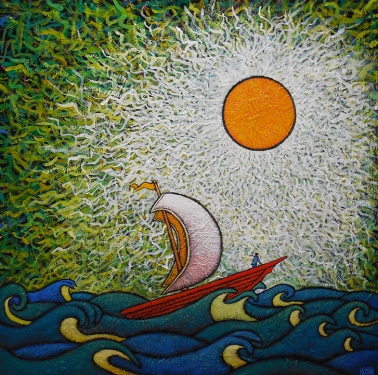
Dance With Waves

GC Myers- Navigating Chaos  2022

Navigating Chaos– At West End Gallery


You have discovered the spiritual universe. Many others have discovered this same world, but each must make the discovery for himself. You are going to have a lot of joy sailing around this world of yours. Don’t fight the opinions of others, or waste your time arguing over these things. Follow the inward gleam of your consciousness and you will arrive.

–Ernest Holmes, This Thing Called You, 1948


This is one of those posts where one leg of my desired triad of image, word and music appears first, inspiring a search for the other two.

For today it was a piece of music that I came across yesterday. It was piece of music called Dance With Waves performed by Tunisian composer/ oud player Anouar Brahem. It came on a station I was listening to yesterday and captivated me with its buoyant pulse. Made me feel like I was bobbing on waves, lightly riding the rhythm of a much greater force.

Not sure that the other two legs hold up today’s triad but it doesn’t really matter. They work on their own, I guess. For your information, Ernest Holmes was a writer of the American New Thought movement, a pseudo-religious/metaphysical movement that goes back to the early 19th century. I don’t know much about it but from my brief look it seems to have many of the same Deist beliefs espoused by some of the Founding Fathers or of the Transcendentalist movement that inspired Ralph Waldo Emerson. It doesn’t have a real doctrine or dogma and encompasses much of the philosophy and wisdom that has come down from ancient cultures around the world.

Interesting to consider. And for the purpose of today’s post, it works for me, as does the painting at the top, Navigating Chaos.

Give a listen and find out for yourself. Here’s Anouar Brahem.


Read Full Post »

Vertical Mysticism


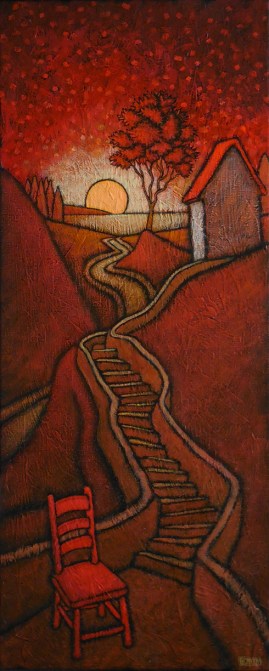
Mystic's Way- Coming to West End Gallery

Mystic’s Way- Coming to West End Gallery

Miracles in mysticism don’t occupy such an important place. It’s metaphor, for the peasants, for the crowds, to impress people. What does mysticism really mean? It means the way to attain knowledge. It’s close to philosophy, except in philosophy you go horizontally while in mysticism you go vertically. You plunge into it. Philosophy is a slow process of logic and logical discourse: A bringing B bringing C and so forth. In mysticism you can jump from A to Z. But the ultimate objective is the same. It’s knowledge. It’s truth.

–Elie Wiesel, Elie Wiesel: Conversations, 2002


I showed this new painting several weeks ago as a work in progress. It has hung around here for that time and I would periodically put it back  on the easel to make a few adjustments. Nothing drastic, just a little more light inserted here and a bit more red there. Small and subtle changes but changes nonetheless.

The one aspect that didn’t change for me was the feeling of the painting. I originally called it Mystic’s Way early into its progress. There was something in the tone and color of it that spoke to me of some mystic pondering or longing. Maybe it was the Red Chair and its placement. I can’t quite put my finger on what it is about this piece that inspired the title. But it stuck and still feels right for me.

After the piece was finished, I came across a passage from a 1984 interview from the Paris Review with author Elie Wiesel. I immediately saw how this painting visually articulated his words for me.

The Red Chair can be viewed as the starting point, the spot where the mystic or philosopher begins their search for knowledge or truth, symbolized here by the rising sun on the distant horizon. The philosopher follows a path that takes him up the steps, past the Red Roofed house and the ever-vigilant Red Tree, alongside the stream and across the water. A logical and direct path. A to B to C and so on.

The mystic transcends those steps of logic and jumps, as Wiesel says, from A to Z. It is as though the mystic sees the destination and moves through the air in an ethereal manner, unhindered by the need for absolute logic, to get to that destination.

I think I can see Wiesel’s definition in this painting. Even its orientation replicates the vertical path that Wiesel describes for mysticism.

Neither manner of getting there is right or wrong, better or worse. They are simply different ways of attaining truth and knowledge.

I guess either is better than just staying in that Red Chair with your back to everything…

Here’s a song that feels right for this post. It’s River Man from British singer/songwriter Nick Drake. Drake died in 1974 from an overdose of antidepressants at the age of 26. His work never achieved widespread acclaim in his lifetime but in the years since he has been a major influence on a generation of musical artists incuding R.E.M., the Black Crowes and many others. The song Life in a Northern Town from Dream Academy is written about and dedicated to Drake. The river his River Man may have been watching over may well be the body of water in this painting.

Who knows?


PS- This painting, Mystic’s Way, 10″ by 25″ on canvas, will be making its mystical journey to the West End Gallery in the next day or two.


Read Full Post »

I Felt…

GC Myers- The Enlightenment sm

The Enlightenment— At the Principle Gallery


I felt before I thought…

–Jean-Jacques Rousseau, Confessions, 1782


I came across the short line above today from one of the leading lights and philosopher of the Enlightenment, Jean-Jacques Rousseau, and it immediately stopped me. I first thought of something I sometimes speak about in my gallery talks, about how I try to not think when paint, how I want my reactions that take place on the canvas to be emotionally based.

I have always felt that thinking turns to cleverness in art. And while that is not a bad thing in itself, cleverness is a poor substitute for emotion. Cleverness is a contrivance while emotion is unadulteratedly real.

You feel what you feel.

It is the state in which a child lives. They purely react only to how and what they feel. But at a certain point, a change occurs and thinking enters the equation. We think about how we should react, about fitting in with those around us. We think about how our reaction will be perceived by others. We think of what is socially acceptable and what is not. The world becomes different in many ways. More self-conscious and less spontaneous.

Not a good formula for art.

When does that change occur? When do we go from that childlike state of first feeling things emotionally to one where we think about what we feel before allowing ourselves to react?

I don’t know exactly. It most likely differs for each of us. Some of us remain children throughout our lives. I wish I could say if that was a good or bad thing, but I can’t. I can think of examples where remaining a child is bad (the pure selfishness of children, for example) and others where it is a good thing. The sense of wonder and the feeling of newness one senses in most everything.

I guess what I am saying is that I am, in my work, hoping for that feeling of pure emotional reaction. Free of thought and all subjective criteria.

Sounds kind of lofty, doesn’t it? Kind of sounds like bullshit, right?

And maybe it is. After all, part of being a child is their pure belief in myths– Santa, the Easter Bunny, The Tooth Fairy, etc. Maybe we need to believe a little BS if it gets us to where we need to be.

Okay, enough for now. Wasn’t planning on writing this at all. It just fell out so I better read this before I click it into existence as I have a feeling there are all sorts of contradictions and failures of logic within it. But then again, maybe I won’t read it. Maybe it’s better to just let it fly without thinking it over too much.

Yeah, that’s the ticket.

Below is the rest of Rousseau’s thought from his posthumously published autobiography. It says a lot about how reading as a child impacts our ability to feel emotionally. I think a lot of us can relate to that:

 I felt before I thought: this is the common lot of humanity. I experienced it more than others. I do not know what I did until I was five or six years old. I do not know how I learned to read; I only remember my earliest reading, and the effect it had upon me; from that time I date my uninterrupted self-consciousness. My mother had left some romances behind her, which my father and I began to read after supper. At first it was only a question of practising me in reading by the aid of amusing books; but soon the interest became so lively, that we used to read in turns without stopping, and spent whole nights in this occupation. We were unable to leave off until the volume was finished. Sometimes, my father, hearing the swallows begin to twitter in the early morning, would say, quite ashamed, ‘Let us go to bed; I am more of a child than yourself.’ In a short time I acquired, by this dangerous method, not only extreme facility in reading and understanding what I read, but a knowledge of the passions that was unique in a child of my age. I had no idea of things in themselves, although all the feelings of actual life were already known to me. I had conceived nothing, but felt everything. These confused emotions, which I felt one after the other, certainly did not warp the reasoning powers which I did not as yet possess; but they shaped them in me of a peculiar stamp, and gave me odd and romantic notions of human life, of which experience and reflection have never been able wholly to cure me.

Read Full Post »

Rouault, Revisited

Georges Rouault -Christ in the Suburbs 1920-24

Georges Rouault -Christ in the Suburbs


Anyone can revolt. It is more difficult silently to obey our own inner promptings, and to spend our lives finding sincere and fitting means of expression for our temperament and our gifts.

Georges Rouault


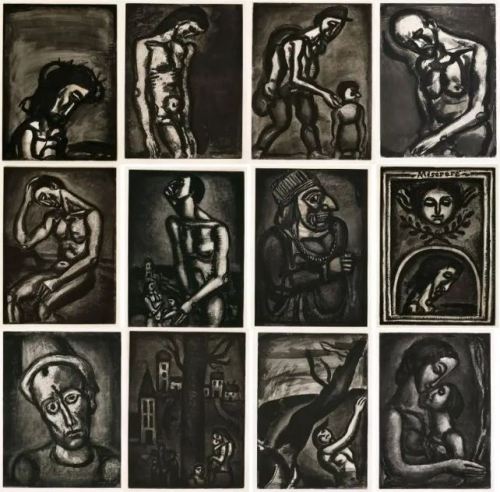
I’ve been a big fan of French painter/printmaker Georges Rouault  (1871-1958) from the moment many years ago when I stumbled across a copy of Miserere, a book of his deeply expressionistic etchings. The title translates as Mercy and it contained raw and expressive work that dealt with deeply personal and religious themes along with those inner promptingsas he calls them in the quote above. It was a work that was very influential on my early Exiles series.

His entrance into the world of art was serving, at the age of fourteen, as an apprentice glass painter and restorer which shows itself in his mature work which resembles leaded glass windows with its dark dividing lines and glowing colors that feel sometimes as though they are lit from behind with the light shining through. Both are qualities that excited me and made me want to emulate in my own work. Not to mention the purity a of the emotional feeling throughout.

Now, if only I can obey my own inner promptings…


The section above is a replay of a blog entry that ran back in 2017. In the interim, I came across some of Rouault’s other writings. He wrote of being an artist in a way with which I easily identified. For example, in his 1947 album of work, Stella Vespertina, he wrote:

The painter who loves his art is ruler in his own kingdom, even if he be in Lilliput and a Lilliputian himself. He transforms a kitchen maid into a fairy, and a great lady into a brothel matron, if he wants to and sees them so, for he is a seer. His vision includes everything that is alive in the past.

This idea of being ruler over one’s own kingdom as an artist has always been a huge attraction to this profession for me. To be able to set the rules, to discard convention, to put the world in order as I see it and answer to only my vision– these were all things that drew me in. And it didn’t matter that it might be a tiny, insignificant kingdom ruled by a tiny, insignificant king– it was mine.

Rouault also wrote in Stella Vespertina:

The conscience of an artist worthy of the name is like an incurable disease which causes him endless torment but occasionally fills him with silent joy…

Like the passage about the artist’s Lilliputian kingdom, it rang true. Though I love what I do, it is often frustrating and tormenting and certainly never as easy as it might seem. But it is in those moments of silent joy, as he puts it, that there is the ultimate reward. A sense of completion.

And also in Stella Vespertina:

The old masters are perfect and admirable examples, on condition that we remember that the spirit gives life and the letter kills, and that even the best pastiche is inferior to the harmonious stammering or incoherence of a child trying to speak.

He is basically saying that even the most perfectly crafted piece of art can sometimes lack the life and spirit found in those imperfect aspects of our world, those things and moments that give our lives depth and meaning.

I don’t think I can add to that except to say that I am glad to have stumbled across Rouault those many years ago in an old book store.


Georges Rouault Sunset 1937

Georges Rouault- Sunset, 1937


Georges Roualt Automne ou Nazareth

Georges Roualt – Automne ou Nazareth

georges rouault- landscape with large trees

Georges Rouault — Landscape with Large Trees

georges rouault- landscape with large trees

Georges Rouault — Landscape with Large Trees

Georges Rouault Misere Images

Georges Rouault – Miserere Images


Georges Rouault Three Clowns

Georges Rouault -Three Clowns


Georges Rouault The Old King

Georges Rouault- The Old King, 1936


Read Full Post »

Bluefire

GC Myers- Bluefire sm

Bluefire— Small Works show at Principle Gallery


Where rose the mountains, there to him were friends;
Where rolled the ocean, thereon was his home;
Where a blue sky, and glowing clime, extends,
He had the passion and the power to roam.

–Lord Byron, Childe Harold’s Pilgrimage


Have some things that I need to get done so I am just going to share this week’s Sunday Morning Music. I wanted something to fill out the triad of the new painting at the top, Bluefire, and the verse from Lord Byron and his Childe Harold’s Pilgrimage.

I was going to use the old Bob Dylan song, It’s All Over Now Baby Blue. I have shared the Them/Van Morrison version here in the past which I consider the best of all the many covers of the song. I came across a version from The Byrds that I liked very much and planned on sharing it. However, it also made me think that their song Eight Miles High from 1966 might better suit this triad. Actually, I hadn’t heard it in quite a while and wanted to hear that intro again and the harmonies within it.

I have to run so I leave it to you. Listen, if you want, and when you leave please don’t slam the door. I am working, after all. So, without further ado, here it is.


Read Full Post »

GC Myers-The Fulfillment

The Fulfillment– Soon at West End Gallery


I slept and dreamt
that life was joy.
I awoke and saw
that life was duty.
I worked — and behold,
duty was joy.

–Rabindranath Tagore


When I first read the short poem above from the great poet and philosopher Rabindranath Tagore some time ago, it struck a chord with me. It so simply put across, in just a few lines, an observation that takes most of us a lifetime to realize. That is, if we ever do realize it.

Duty was joy.

But what is duty? Is it in being a good parent? A faithful spouse and a loyal friend? Is it in what we do to make a living? Or is it in being decent and caring human being?

Perhaps, it is how our lives touch the lives of others? Could that be a duty?

I don’t know for sure. Most likely, duty and joy is not a one size fits all proposition.

My own feeling is that duty is much like having a purpose, a reason for living. I remember reading Holocaust survivor Viktor Frankl‘s transcendent book, Man’s Search For Meaning, which described his time in the Auschwitz death camp. He observed that those who were able to survive the horror of that place were those who somehow had a purpose for their life, who saw a future that they needed to reach ahead for. This purpose, even a modest one, often gave them the drive needed for survival, creating a path forward for them.

In the year after being liberated from Auschwitz, Frankl gave a series of lectures that were the basis for his book. In one, Frankl spoke of Tagore’s poem and that final line: Duty was joy:

So, life is somehow duty, a single, huge obligation. And there is certainly joy in life too, but it cannot be pursued, cannot be “willed into being” as joy; rather, it must arise spontaneously, and in fact, it does arise spontaneously, just as an outcome may arise: Happiness should not, must not, and can never be a goal, but only an outcome; the outcome of the fulfillment of that which in Tagore’s poem is called duty… All human striving for happiness, in this sense, is doomed to failure as luck can only fall into one’s lap but can never be hunted down.

In short, lasting joy and happiness cannot be pursued as a goal on their own, without a responsibility to some higher purpose.

I am writing this because sometimes I need to be reminded of this. I have been struggling at times recently in the studio, seemingly fighting with myself to find something that just doesn’t seem to be there. The harder I tried to find it, the further away it seemed. It was like I was looking for something to quell my anxieties and bring me some form of easy happiness. To bring me effortless joy.

I should have known better. Yesterday, I just put down my head and worked without thinking about the end result. I focused solely on my purpose in each moment, the task at hand. Concentrating on doing small and simple things with thought and care was my duty, as it were. As the day went on, my burden felt lessened and I began to feel joy in the work, joy in small aspects that I had been overlooking in prior days.

It was a satisfying day, one that left me feeling that I had moved in some way toward fulfilling a purpose. It may not be a grand, earth-shaking purpose but it doesn’t need to be. It is mine. My purpose. My duty.

And that is enough to bring me a bit of joy.


The post above ran here three years ago, in early 2020. It has become one of my most popular posts, getting quite a few views every day. I often go back and read it again just for the reminder it offers. In doing so recently, the words of Viktor Frankl stating that happiness and joy are the outcomes of the fulfillment of one’s duty stuck in my mind and turned into the title for the new small painting at the top, The Fulfillment, which will be at the West End Gallery later this coming week. 

Read Full Post »

« Newer Posts - Older Posts »