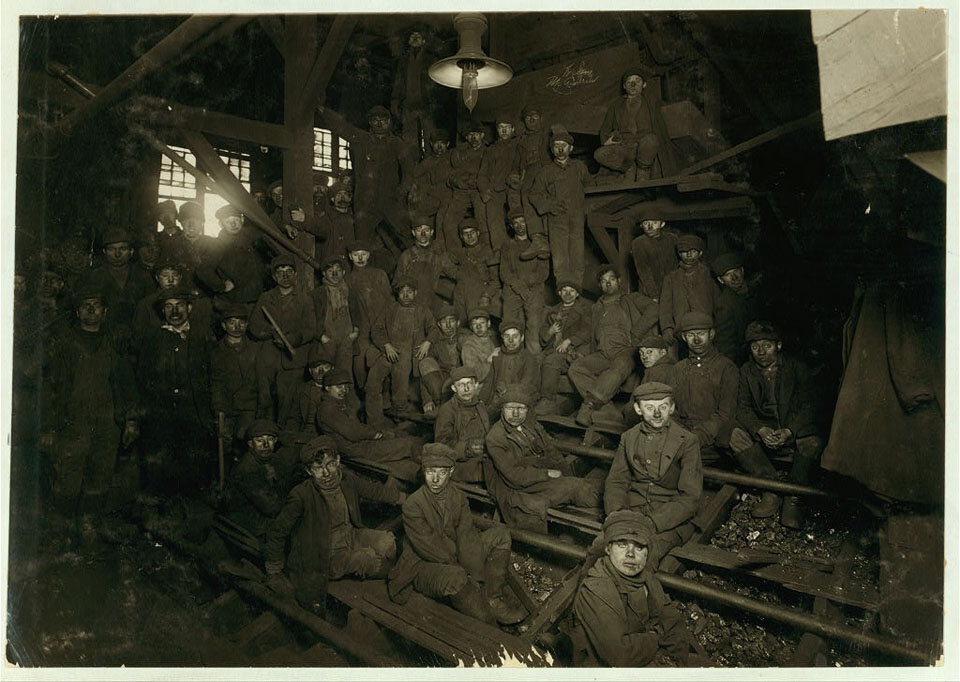
Noon hour in the Ewen Breaker, Pennsylvania Coal Co. / Lewis Hine
It’s such a little song it don’t compare
With all your big ones you hear everywhere
But when it dawns way in the back of your mind
The big ones are made up of the little kind
Union song, union battled
All added up won us all what we got now
— I Guess I Planted, Woody Guthrie lyrics/ Billy Bragg/Wilco
Yet another Labor Day.
I consider myself a workingman. A laborer. Always have. Most of my jobs have required physical labor, even this one. I was maybe 20 years old when I was classified as a Skilled Laborer– a Lead Candy Cook– at the old A&P food processing plant here in Horseheads. I became a Teamsters Union steward for my department around then and saw firsthand the effect the benefits and protections a labor union provides can have on working people.
Maybe that’s why I get a bit defensive about the meaning and background of Labor Day. If you ask someone what the holiday represents, they will generally say that it is symbolic end of summer. A last picnic. One last real summer weekend at the lake or shore. If you push them harder, they might finally say that it honors the workers of this country.
But it was created to celebrate the American Labor Movement, those unions and organizers that brought about all of the changes that Dr. King pointed in his 1965 speech before the AFL-CIO:
The labor movement was the principal force that transformed misery and despair into hope and progress. Out of its bold struggles, economic and social reform gave birth to unemployment insurance, old-age pensions, government relief for the destitute and, above all, new wage levels that meant not mere survival but a tolerable life. The captains of industry did not lead this transformation; they resisted it until they were overcome. When in the thirties the wave of union organization crested over the nation, it carried to secure shores not only itself but the whole society.
Fair wages, a shorter workday, a safer workplace, pensions, unemployment insurance, health insurance, vacations, maternity leave, paid holidays such as today– all of these things came from the hard and dangerous efforts of union organizers.
As King points out, the owners– the captains of industry or job creators as we fawningly call them now— did not agree willingly to these changes.
Hardly.
No, they fought with every resource at their disposal including the influence they bought from politicians and the use of intimidation and violence. The history of the labor movement is littered with bodies of workers killed in skirmishes with the hired thugs of the owners.
Every step of progress throughout our history has been opposed by those in power. But progress and change has always come thanks to the efforts of people like those brave folks in the labor movement.
The use of children in the workforce was another thing that was ultimately changed by the labor movement. It’s hard to believe that the scenes shown here in the famed photos of photographer and social reformer Lewis Hine took place just over a hundred years ago in the coal mines of eastern Pennsylvania. Harder yet to believe is that federal labor laws for child labor were not fully enacted until 1938. Earlier attempts at legislation by congress in 1916 and 1922 had been challenged in court by industry and were deemed unconstitutional.
 Imagine your child (or your nephew or grandchild) at age 12. Imagine them spending 10 or 12 or even 14 hours a day, six days a week in one of the breaker rooms of a coal mine like the one shown here on the right. Hunched over in the gritty dust of the coal, they picked the coal for differing sizes and to sort out impurities. Imagine the men who are shown in the photo with sticks poking your child, perhaps kicking him to speed him up. Imagine all of this for seven and a half cents per hour.
There were no schoolbooks for these kids. No soccer or Little League. No violin practices. No college prep or videogames. Just a future filled with misery and drudgery and most likely a black lung.
Try to imagine that.
And think that it was all taking place less than a hundred years ago and it ended because of the labor unions and the brave and conscientious people who fought for them.
I know there are problems that arose in the unions over time. They are not perfect by any means. Like all things human, they are susceptible to corruption and selfishness.
But that doesn’t take away from the incredible progress that labor unions provided for our nation’s workers which gave us the most prosperous times in our history. Despite their shortcomings, the idea of workers uniting to have one strong voice is as important now as it was a century ago. Perhaps even more now that corporate world’s political power is enormous and the wealth which buys it is concentrated at the very top at historic levels. In fact, child labor is back on the table for many job creators once more with a major political party advocating for it.
So, celebrate the day at the shore or in a picnic. Have a great day. But take one single moment and think of those kids in those Pennsylvania mines or in those southern mills and the union organizers who battled and bled for much of what you have if you’re in the working class, people who toil every day with little if any recognition, trying to merely live their lives. They raise their kids, they pay their bills, and they simply try to just get along without bothering anyone or being bothered.
They are the people who built this country. They built our infrastructure– the roads, bridges, railroads, power lines along with the schools and factories. They worked in the fields and in the foundries and factories and manned the trains and trucks that brought the products to market. Moreover, these are the people who consumed the products that were made, moved and marketed here.
These were the people who created the wealth of this nation.
I know that this is sounding like a spiel for the 99% of us and against the 1%. Maybe it is. I have gotten so tired of hearing about the job creators and how they must be protected and coddled when very few are pointing out that the great wealth that these few possess came from the sweat and pocketbooks of the many. They didn’t create jobs out of sheer benevolence, for the good of the people. They hire because these employees make even more money for them. They are mere capital investments that produce great returns and once the great returns go away, so do the jobs.
Now don’t get me wrong. It seems that when anybody makes the case for more equality of wealth, they are branded as being anti-capitalist and anti-business. Or communist or socialist which is the preferred nomenclature these days by right-wing political candidates and online trolls.
This is not the case at all.
The greatness of this country comes from this opportunity to succeed in a huge way, to take an idea or an innovation and set the world on fire with it.
You should be rewarded richly.
But remember it comes from the people. Unless you have the people who can afford to buy your product or idea, unless you have the infrastructure these people built to carry that product to these buyers, unless you have the fire fighters and police to protect your homes and offices, an efficient health system to keep people alive, and clean air to breath and clear water to drink, it will never happen.
You can be a hero to many by being a job creator but you must take some responsibility for the everyday heroes who have made you wealthy, probably beyond anything most of these working folks can fathom. It is part of the unwritten contract of our land.
It is only fair.
And that is all the working class has ever asked for–fairness.
After all, though you might be a job creator, they are the true wealth creators.
Okay, I got my spiel out. It’s a mashup of a couple of posts from the past. I’ve added a song from one of my very favorite albums, Mermaid Avenue, from the collaboration of Billy Bragg and Wilco. This is the album where they added music and vocals to unrecorded Woody Guthrie lyrics. Great stuff. Many are pro-labor, which is no surprise to anyone who knows anything about Woody Guthrie. This song, I Guess I Planted, is about the collective power of a union.
How big things are made up of many little things.
 Redtree Times
Leave a comment