And suddenly you know: It’s time to start something new and trust the magic of beginnings.
― Meister Eckhart
The magic of beginnings…
That is such an elegant phrase. Poetic. Leave it to Meister Eckhart, the 13th century German theologian/philosopher/mystic who has appeared here in the past.
The advantage of these using these short maxims is that they can often possess meanings apart from those that were intended by the original speaker. Meister Eckhart was most likely talking about some sort of religious awakening or changing one’s life in a positive manner.
I don’t really know.
But I am pretty sure that the meaning I attach to his adage might divert from his own.
For me, the message in it rings true in regards to going back to look at work from when I was first painting, when I was just gaining a toehold on whatever direction my painting might go or what form it might take. It was a time of finding voice, as I have said many times here.
It was also a time that possessed the magic of beginnings.
It’s that time when there is a blank slate before you and you are standing there with the few tools that you have brought with you– your own experiences, your observations of the world, some desire to create something of your own, an affinity for the visual, and maybe a little time spent doodling in the columns of newspapers and journals.
But beyond these things, you are a clueless, empty vessel. Everything is new. Every day is at least one new lesson learned. Each new piece has some sort of revelation, pointing out those things that resonate and those things that most definitely do not.
Every new stroke or color was an epiphany, like discovering the “open sesame” that unlocked the door that opened to new and wide horizons of possibility.
It truly felt like magic at the time.
Now, it still feels like magic– at times. Sometimes I find myself feeling like the wizened old magician who has pulled his rabbit out of his hat day after day for twenty five years. Yeah, it’s still a great trick for those who haven’t seen it before but it has lost the thrill for the magician, has lost that excitement that came with first learning that trick, on first wanting to display his newfound feats of magic to a crowd.
So, I sometimes go back and look at these old pieces from that time, those pieces that represent the magic of beginnings for me. And I almost always find something that I have lost over time, a small thing that somehow was set aside through a conscious choice or simply forgotten.
And finding these little things reignites that magic that came in the beginning. It changes my perspective, allows me to get out of the ruts of time that have been blocking my vision.
There is inevitably something from these forays into the past that I bring back with me to the present. A reminder to do something a bit different than the way I have fallen into the habit of doing it over a long period of time. Maybe even something as basic as how I start each new painting. These old pieces may not be gems in their own rights but they have raw material whose potential I can use.
But more importantly, they have the magic of beginnings within them.
And that is what I am seeking anew…
I’ve been working on some new things recently and have at moments felt that magic of beginnings that I wrote of a few years back. Thought it was a good morning to revisit that post from early 2021.
“Guitars pine for the fingers of Bill Mize, who makes them weep, sing and roll around like a cat at his feet. Thumpin’ good acoustic majesty.”
– WDVX , Knoxville. TN
This is one of those fortunate and rare Sunday mornings when I get to share some great music that has a little bit of my own work connected with it. The other day I received a box in the mail with a bunch of CDs from guitarist Bill Mize, who had contacted me months ago about the possibility of using one of my paintings for his newest album. It didn’t take long, after listening to his music and seeing all he’s accomplished, for me to agree to his request. I loved his music and was highly impressed by his resume.
Bill is a past winner of the National Fingerstyle Guitar Competition at The Walnut Valley Festival in Winfield, Kansas. Guitar Player Magazine has labeled this event the “U.S. Open of guitar competitions.” Bill received a GRAMMY Award for his collaboration with musician and storyteller David Holt on the recording Stellaluna and has been featured on the popular guitar compilations “Windham Hill Guitar Sampler” by Windham Hill Records and “Masters of the Acoustic Guitar” by NaradaRecords. In 2009, Bill’s music appeared in the Ken Burns documentary “The National Parks: America’s Best Idea.”Mel Bay Productions transcribed Mize’s second CD, “Tender Explorations,” into a songbook, and his original compositions have been transcribed for Fingerstyle Guitar and Acoustic Guitar magazines.
His new album is titled The Southwindand features a balance of Bill’s own compositions and his arrangements of tunes from others, which is a mix of traditional songs and the work of well-known songwriters. For example, there are Bill’s reworkings of old favorites such as Shenandoah and Lonesome Valley (a favorite of mine) as well as Dolly Parton’s Light of the Clear Blue Morning and Dan Fogelberg’s Old Tennessee.
It’s a really satisfying group of work, showing off Bill’s considerable talents as both a player and composer. Just plain good stuff, which if you read this blog on a regular basis, is the highest praise for me. The album also plays into my own mindset for my work. I painted with it playing yesterday and found that it was the perfect accompaniment. It was like riding on a light breeze. I guess The Southwind is an appropriate title.
I should also note that Beth Bramhall, Bill’s wife, played on this album and arranged the song He’s Gone Away. Beth is a pianist/accordionist and an Emmy Award winning composer. Lots of talent in that family. There’s a good interview with both of them online that gives you a lot more insight.
The painting that was used for the album cover is from 2008 and my Archaeologyseries. It is titled Archaeology: A New Wind. I am really pleased at how it works for the cover.
So, for this week’s Sunday Morning Music here’s a track from the album, written and performed by Bill Mize. This is Advize the Wize.
I am totally confident not that the world will get better, but that we should not give up the game before all the cards have been played. The metaphor is deliberate; life is a gamble. Not to play is to foreclose any chance of winning. To play, to act, is to create at least a possibility of changing the world.
–Howard Zinn, A Power Governments Cannot Suppress
Complacency never really serves us well. It’s not the same as patience, where you bide your time until you take action. It’s more like biding your time with no plan or intention for taking action.
It’s a settling for things as they are, even when the circumstances are not completely to our liking. Staying put when you should be moving on. Or using the Howard Zinn metaphor above, throwing your cards in on every hand without even looking at them, never daring to risk anything. You may not lose much this way, but you will never know if you have thrown in an unbeatable hand.
That certainly is true in art. I often say that my greatest challenge is in creating excitement in myself with my work. But sometimes even though I find a level of excitement in something, I get a nagging feeling that if I pushed myself, dared myself a bit more, that I might attain an even greater level of excitement.
I go through this all the time and beat myself for not taking that next step forward, for not taking action.
And in this season of presidential politics, the same is true for political participation. As a nation, we face the most important and far-reaching election of our lifetimes. Certainly, of mine. We are at a point that determines who and what we are as a nation. We are as close to being an autocracy, oligarchy, kakistocracy, idiocracy, or whatever you want to call the fresh hell being offered by the lying, grifting, criminal ex-president*** who has served as an agent of chaos for much too long now.
It boggles my mind how many of us refuse to make the effort to vote, let alone studying the issues and forming an informed opinion. I can’t fathom not taking an interest in something that could ultimately affect so many aspects of our lives, possibly for generations to come.
Come on, people. Get in the game. If you don’t play, you can’t win– and you still can lose.
Imagination does not breed insanity. Exactly what does breed insanity is reason. Poets do not go mad; but chess-players do. Mathematicians go mad, and cashiers; but creative artists very seldom. I am not, as will be seen, in any sense attacking logic: I only say that this danger does lie in logic, not in imagination. Artistic paternity is as wholesome as physical paternity. Moreover, it is worthy of remark that when a poet really was morbid it was commonly because he had some weak spot of rationality on his brain. Poe, for instance, really was morbid; not because he was poetical, but because he was specially analytical. Even chess was too poetical for him; he disliked chess because it was full of knights and castles, like a poem. He avowedly preferred the black discs of draughts, because they were more like the mere black dots on a diagram. Perhaps the strongest case of all is this: that only one great English poet went mad, Cowper. And he was definitely driven mad by logic, by the ugly and alien logic of predestination. Poetry was not the disease, but the medicine; poetry partly kept him in health.
–G.K. Chesterton, Orthodoxy (1908)
I found the passage above from G.K. Chesterton interesting. There were a couple of things in this short excerpt from his book, Orthodoxy, that caught my eye. I liked the idea that creativity and imagination serve as some sort of protection against insanity.
I sure hope so.
Basically, when a creative artist comes across something challenging what they believe to be logical, it doesn’t stop their progress. They find or create a way around whatever barrier is created by this conflict in logic. Maybe even create a new form of logic or imagine a better situation beyond what is in front of them, one to which they can see a path.
That makes sense to me.
It also made me look up Edgar Allen Poe’s short treatiseon his dislike of chess and his preference for checkers. As Chesterton pointed out, Poe appears a bit too analytical, too stringently logical. Hardly poetic.
But I did like his final thoughts on 18th century poet William Cowper, who struggled with depression and mental health issues throughout his life and was placed in an insane asylum for periods of time. It was his struggles with logic that bedeviled his mind and poetry that kept him alive.
Art and imagination can do that. It has that power.
The whole thing reminded me of a favorite passage from the 1858 book The Autocrat of the Breakfast Table from Oliver Wendell Holmes, Sr., the popular poet/philosopher of the time and father to the famed Supreme Court justice of the same name. This passage always makes me both think and chuckle:
Insanity is often the logic of an accurate mind overtasked. Good mental machinery ought to break its own wheels and levers, if anything is thrust among them suddenly which tends to stop them or reverse their motion. A weak mind does not accumulate force enough to hurt itself; stupidity often saves a man from going mad.
Makes me thankful for art and my own stupidity. Without it, I might go crazy.
I don’t know if solitude is for everybody. Some people might look at the painting above with a little discomfort, seeing only isolation and loneliness in it. But for myself, it represents a total freedom of the self, one that allows one’s absolute truth to emerge. A freedom that allows one to experience clear glimpses of our connection with all being.
The lines above from Byron’s Childe Harold’s Pilgrimage express this feeling well. Alone on a shore, one can begin to hear and converse with nature. The lap and roar of the sea becomes language as does the light of the sun and moon as it sifts through clouds above. It is in these conversations that we come to better understand that we are both small and large, insignificant yet integral.
Of course, this is not a practical matter for most of us. I have my own little island of solitude here in my studio but am not isolated. My regular life has me out in the world, interacting with people on a semi-regular basis. But knowing that I will soon be back on my island where the only conversation taking place is in myself steadies me on those occasions.
Hermann Hesse put it well in the excerpt below from his book, Reflections. He mentions it as being a way of bitter suffering. I suppose initially, for those who have been always in the society of others and seldom alone, this may be the case when faced with solitude. But, as he points out, when you get past that discomfort, the rewards of solitude are rapturous.
We must become so alone, so utterly alone, that we withdraw into our innermost self. It is a way of bitter suffering. But then our solitude is overcome, we are no longer alone, for we find that our innermost self is the spirit, that it is God, the indivisible. And suddenly we find ourselves in the midst of the world, yet undisturbed by its multiplicity, for our innermost soul we know ourselves to be one with all being.
― Hermann Hesse, Reflections
This post is from about five years. I read it this morning and it fit my mood and the painting above so well that I thought I’d rerun it. I had to laugh reading the original because it said I interacted with the public on a regular basis. This was pre-pandemic, of course. In the intervening years I have withdrawn even more. Moved my island a little further from the shore, to put it another way. I ended up changing that to interacting on a semi-regular basis. In five more years I might change that to on a rare occasion. or once in a blue moon. Who knows?
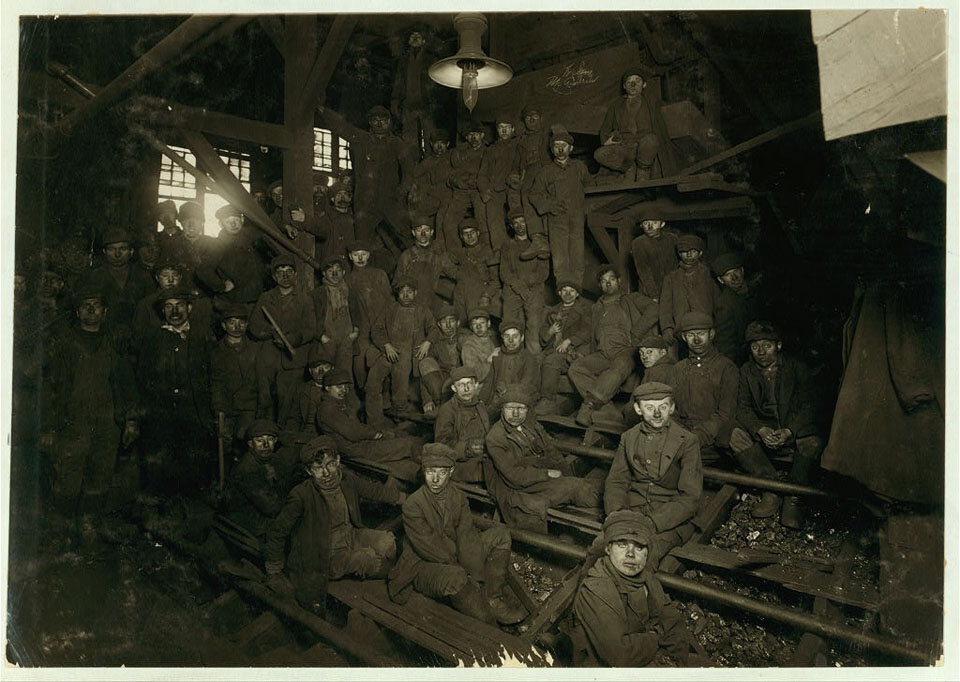
Noon hour in the Ewen Breaker, Pennsylvania Coal Co. / Lewis Hine
It’s such a little song it don’t compare With all your big ones you hear everywhere But when it dawns way in the back of your mind The big ones are made up of the little kind
Union song, union battled All added up won us all what we got now
— I Guess I Planted, Woody Guthrie lyrics/ Billy Bragg/Wilco
Yet another Labor Day.
I consider myself a workingman. A laborer. Always have. Most of my jobs have required physical labor, even this one. I was maybe 20 years old when I was classified as a Skilled Laborer– a Lead Candy Cook– at the old A&P food processing plant here in Horseheads. I became a Teamsters Union steward for my department around then and saw firsthand the effect the benefits and protections a labor union provides can have on working people.
Maybe that’s why I get a bit defensive about the meaning and background of Labor Day. If you ask someone what the holiday represents, they will generally say that it is symbolic end of summer. A last picnic. One last real summer weekend at the lake or shore. If you push them harder, they might finally say that it honors the workers of this country.
But it was created to celebrate the American Labor Movement, those unions and organizers that brought about all of the changes that Dr. King pointed in his 1965 speech before the AFL-CIO:
The labor movement was the principal force that transformed misery and despair into hope and progress. Out of its bold struggles, economic and social reform gave birth to unemployment insurance, old-age pensions, government relief for the destitute and, above all, new wage levels that meant not mere survival but a tolerable life. The captains of industry did not lead this transformation; they resisted it until they were overcome. When in the thirties the wave of union organization crested over the nation, it carried to secure shores not only itself but the whole society.
Fair wages, a shorter workday, a safer workplace, pensions, unemployment insurance, health insurance, vacations, maternity leave, paid holidays such as today– all of these things came from the hard and dangerous efforts of union organizers.
As King points out, the owners– the captains of industry or job creators as we fawningly call them now— did not agree willingly to these changes.
Hardly.
No, they fought with every resource at their disposal including the influence they bought from politicians and the use of intimidation and violence. The history of the labor movement is littered with bodies of workers killed in skirmishes with the hired thugs of the owners.
Every step of progress throughout our history has been opposed by those in power. But progress and change has always come thanks to the efforts of people like those brave folks in the labor movement.
The use of children in the workforce was another thing that was ultimately changed by the labor movement. It’s hard to believe that the scenes shown here in the famed photos of photographer and social reformer Lewis Hine took place just over a hundred years ago in the coal mines of eastern Pennsylvania. Harder yet to believe is that federal labor laws for child labor were not fully enacted until 1938. Earlier attempts at legislation by congress in 1916 and 1922 had been challenged in court by industry and were deemed unconstitutional.
Imagine your child (or your nephew or grandchild) at age 12. Imagine them spending 10 or 12 or even 14 hours a day, six days a week in one of the breaker rooms of a coal mine like the one shown here on the right. Hunched over in the gritty dust of the coal, they picked the coal for differing sizes and to sort out impurities. Imagine the men who are shown in the photo with sticks poking your child, perhaps kicking him to speed him up. Imagine all of this for seven and a half cents per hour.
There were no schoolbooks for these kids. No soccer or Little League. No violin practices. No college prep or videogames. Just a future filled with misery and drudgery and most likely a black lung.
Try to imagine that.
And think that it was all taking place less than a hundred years ago and it ended because of the labor unions and the brave and conscientious people who fought for them.
I know there are problems that arose in the unions over time. They are not perfect by any means. Like all things human, they are susceptible to corruption and selfishness.
But that doesn’t take away from the incredible progress that labor unions provided for our nation’s workers which gave us the most prosperous times in our history. Despite their shortcomings, the idea of workers uniting to have one strong voice is as important now as it was a century ago. Perhaps even more now that corporate world’s political power is enormous and the wealth which buys it is concentrated at the very top at historic levels. In fact, child labor is back on the table for many job creators once more with a major political party advocating for it.
So, celebrate the day at the shore or in a picnic. Have a great day. But take one single moment and think of those kids in those Pennsylvania mines or in those southern mills and the union organizers who battled and bled for much of what you have if you’re in the working class, people who toil every day with little if any recognition, trying to merely live their lives. They raise their kids, they pay their bills, and they simply try to just get along without bothering anyone or being bothered.
They are the people who built this country. They built our infrastructure– the roads, bridges, railroads, power lines along with the schools and factories. They worked in the fields and in the foundries and factories and manned the trains and trucks that brought the products to market. Moreover, these are the people who consumed the products that were made, moved and marketed here.
These were the people who created the wealth of this nation.
I know that this is sounding like a spiel for the 99% of us and against the 1%. Maybe it is. I have gotten so tired of hearing about the job creators and how they must be protected and coddled when very few are pointing out that the great wealth that these few possess came from the sweat and pocketbooks of the many. They didn’t create jobs out of sheer benevolence, for the good of the people. They hire because these employees make even more money for them. They are mere capital investments that produce great returns and once the great returns go away, so do the jobs.
Now don’t get me wrong. It seems that when anybody makes the case for more equality of wealth, they are branded as being anti-capitalist and anti-business. Or communist or socialist which is the preferred nomenclature these days by right-wing political candidates and online trolls.
This is not the case at all.
The greatness of this country comes from this opportunity to succeed in a huge way, to take an idea or an innovation and set the world on fire with it.
You should be rewarded richly.
But remember it comes from the people. Unless you have the people who can afford to buy your product or idea, unless you have the infrastructure these people built to carry that product to these buyers, unless you have the fire fighters and police to protect your homes and offices, an efficient health system to keep people alive, and clean air to breath and clear water to drink, it will never happen.
You can be a hero to many by being a job creator but you must take some responsibility for the everyday heroes who have made you wealthy, probably beyond anything most of these working folks can fathom. It is part of the unwritten contract of our land.
It is only fair.
And that is all the working class has ever asked for–fairness.
After all, though you might be a job creator, they are the true wealth creators.
Okay, I got my spiel out. It’s a mashup of a couple of posts from the past. I’ve added a song from one of my very favorite albums, Mermaid Avenue, from the collaboration of Billy Bragg and Wilco. This is the album where they added music and vocals to unrecorded Woody Guthrie lyrics. Great stuff. Many are pro-labor, which is no surprise to anyone who knows anything about Woody Guthrie. This song, I Guess I Planted, is about the collective power of a union.
For summer there, bear in mind, is a loitering gossip, that only begins to talk of leaving when September rises to go.
–George Washington Cable, The Grandissimes: A Story of Creole Life (1880)
Ah, September is here, at last.
I have expressed my dislike of August here a number of times over the years. There has often been a grimness in its heat and humidity that always seemed to align itself with some of the lower moments in my life. I dread the month each year but made a conscious effort this year to not mention my distaste for August as it seemed to proceed in a way that was not too awful.
It actually felt a little, how do I say this–good? Well, better than most of the Augusts that I have endured in the 60-some years I can remember on this planet.
Good feels odd coming out of my mouth.
However, even with a relatively upbeat August, it feels better moving into September. There is a cool mist in the air this morning that foretells even cooler mornings to come. Maple leaves are beginning to show a slight change of color and a few leaves have fallen to the ground already.
My internal clock seems to slow a bit with the coming of September. I don’t feel quite so pushed or anxious. Oh, the angst is still there but it moves a bit slower and is a little less aggressive. More manageable.
It has become a tradition here that on each year on this first day of September that I play a very favorite song of mine, September Song. It’s a classic from the American songbook, written in the late 1930’s by Kurt Weill and Maxwell Anderson for the Broadway musical, Knickerbocker Holiday. It has been recorded by scores of singers over the past century. I have shared performances of it by Ella Fitzgerald, Sarah Vaughan, Willie Nelson and several others on this date on this blog. I have never shared the Frank Sinatra version for some unknown reason. It just seemed to get pushed a side since I am such a fan of the versions from the three mentioned above. But Sinatra’s version is a great one as well. It comes from 1965 when he was about 50 years, just entering the autumn of his life much like the subject of the song, (which was Peter Stuyvesant, by the way.) Sinatra was at his creative peak when he recorded this which makes for a great version.
So, for the first Sunday Morning Music of this September, here’s Sinatra and his rendition of September Song.


 Imagine your child (or your nephew or grandchild) at age 12. Imagine them spending 10 or 12 or even 14 hours a day, six days a week in one of the breaker rooms of a coal mine like the one shown here on the right. Hunched over in the gritty dust of the coal, they picked the coal for differing sizes and to sort out impurities. Imagine the men who are shown in the photo with sticks poking your child, perhaps kicking him to speed him up. Imagine all of this for seven and a half cents per hour.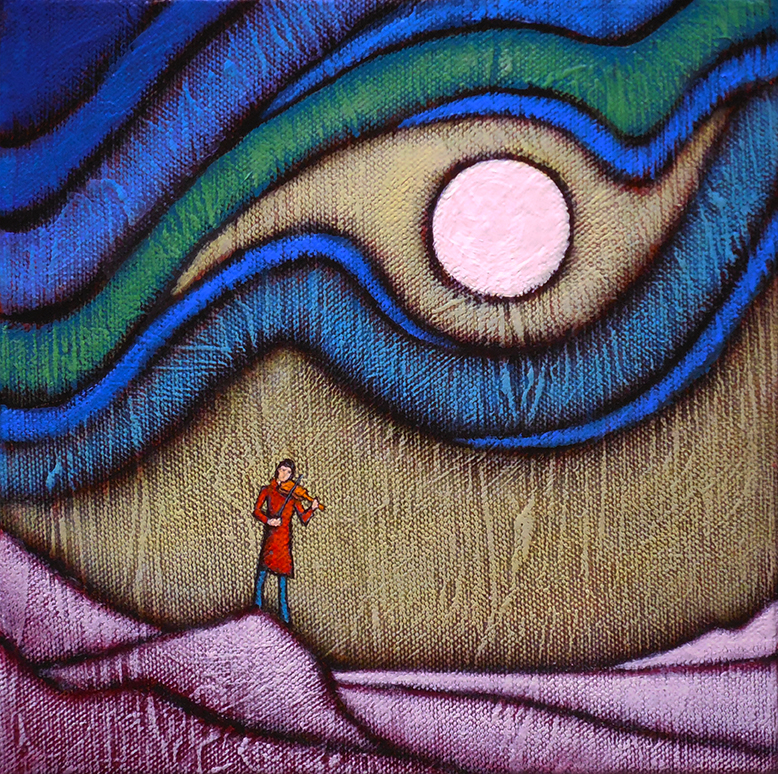
 Redtree Times