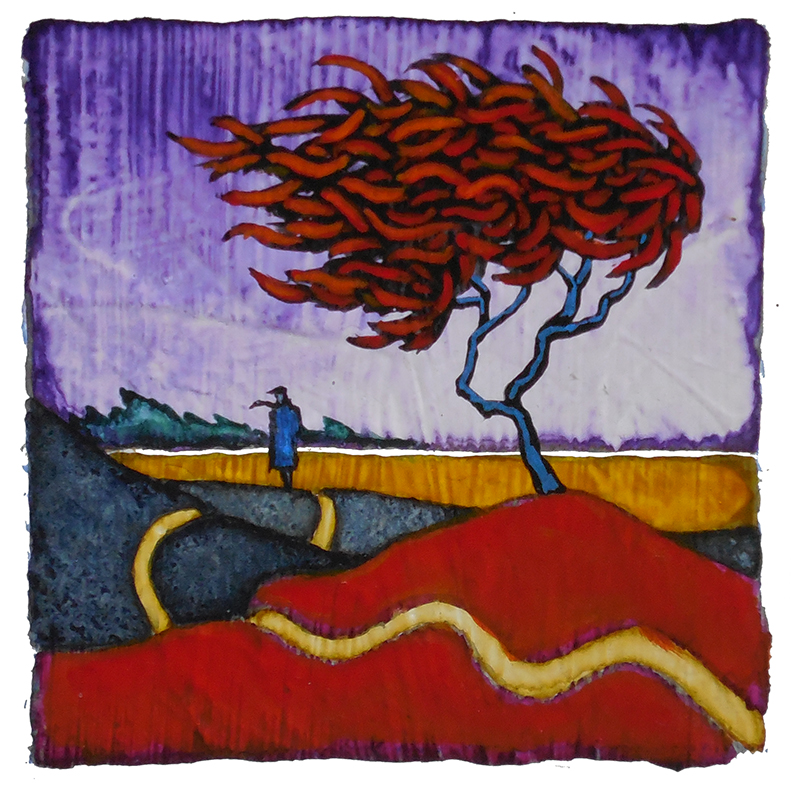
The Resistance– At West End Gallery
We have been silent witnesses of evil deeds: we have been drenched by many storms; we have learnt the arts of equivocation and pretense; experience has made us suspicious of others and kept us from being truthful and open; intolerable conflicts have worn us down and even made us cynical. Are we still of any use? What we shall need is not geniuses, or cynics, or misanthropes, or clever tacticians, but plain, honest, straightforward men. Will our inward power of resistance be strong enough, and our honesty with ourselves remorseless enough, for us to find our way back to simplicity and straightforwardness?
–Dietrich Bonhoeffer, Letters and Papers from Prison
I see this new painting, The Resistance, as being about the willingness to stand one’s ground when the prevailing winds bellow against, trying to force you in a direction in which you do not want to go. You can read that interpretation as being political, topical, or merely symbolic of one holding tight to their principles. It’s a painting, ostensibly a piece of art, so that’s up to you.
Whatever the case, it’s a little piece that speaks loudly for me which is why I had not hesitation in coupling it with the words at the top from Dietrich Boenhoeffer. He and his writings, especially his posthumous Letter and Papers from Prison, are the subject of what has easily been my most popular blog post, On Stupidity.
Dietrich Boenhoeffer (1906-1945) was a German pastor and theological writer who stood in direct opposition to the Nazi regime and spoke out against its programs of eugenics, euthanasia, and genocide. He fled Germany and had an opportunity to stay in the US in the late 1930’s, safe from the reach of the Nazis. But after only two weeks in NYC, he insisted on returning, believing that if he were to rebuild the German church in the war’s aftermath, he must endure the conflict with its people. In June of 1939, he returned and joined the German resistance to Hitler and Naziism.
He was imprisoned in a German prison in 1943 and later transferred to a concentration camp. He was implicated in a plot to assassinate Hitler in April of 1945 and was sentenced to death after a court martial trial in which there were no witnesses, evidence or any form of defense provided for him. He was hanged in the final days of the war. The legacy of his courage and the strength of his resistance are still celebrated around the free world today.
As I said, this painting may represent that sort of resistance for you. You might well just see it as simply being about a strong wind blowing against a person and a tree. Or you might be a bit of a contrarian (as I am) and see it as a symbol of not being swayed by popular opinion as symbolized by the wind’s effect here. Or you might expand that reading of this painting and see it in an existential sense. Again, that decision is your privilege and responsibility.
However you see it, I hope you see something for and of yourself in it.
This small painting, The Resistance, is 3″ by 3″ on paper, and is now at the West End Gallery for their annual Little Gems exhibit. The show is hung in the gallery for viewing now and the opening reception is next Friday, February 7.
Here’s a song from Bob Seger and the Silver Bullet Band to go with this all. Maybe it’s a little too on the nose but the song is Against the Wind. For some unknown reason, I have never shared anything from Bob Seger here even though I was big fan of his work, especially in the 70’s and 80’s. I think it’s just a case of holding on to some things and losing track of others. But it’s almost always solid stuff.
 Redtree Times