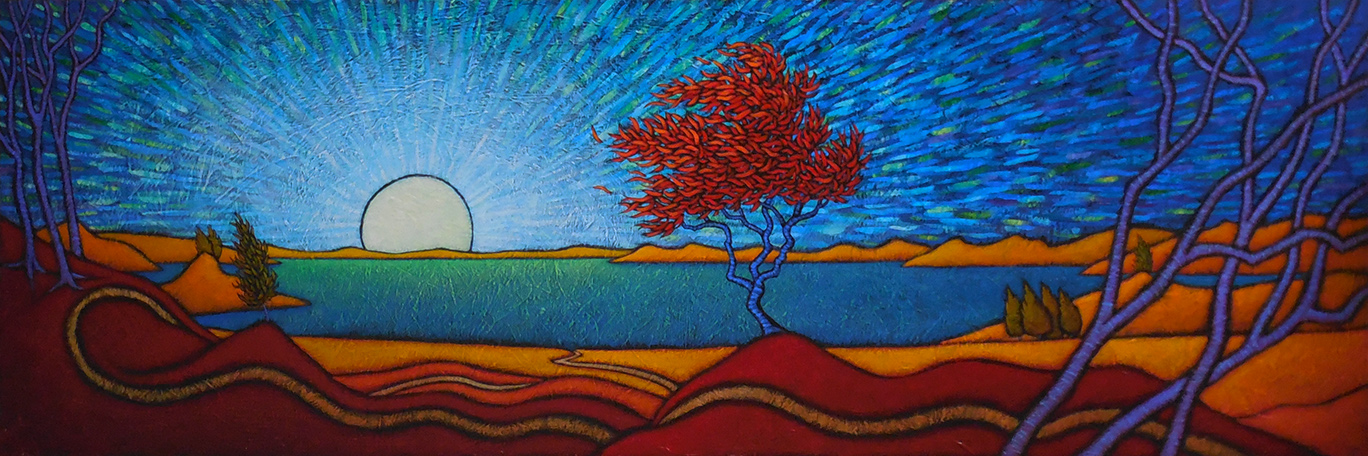
Infinity’s Call– At West End Gallery
“I don’t approve of novels mentioning actual issues and going on and on about politics,” she says. “I’ve never had any urge to put politics in a novel or to even mention that it exists.” But recent events have been too momentous to ignore. “It seemed so wrong to have any character going about normal life after that horrendous election,” she says. “I am worried and anxious and depressed and everything you can be. This is such an extreme, horrifying thing to happen. I always trusted our constitution.”
— Anne Tyler, The Guardian interview
There is an interview today in The Guardian with bestselling novelist Anne Tyler, author of The Accidental Tourist, Breathing Lessons and a bevy of other novels. 25 books, actually. She has had a long and acclaimed career producing intimate novels that by design seldom, if ever, deal with whatever is taking place in the wider world. While she has a new novel coming out that adheres to this design of hers, she is already at work on her next, set in this past summer of 2024.
In the interview, she admits to not being able to keep the current situation taking place here in this country from playing a part in the new book. As a quote in the headline for this interview states: ‘It seemed wrong to write about normal life after that horrendous election.’
I understand what she is feeling. I have tried to minimize mentions of a political nature out of this blog– seriously, I have– so that it serves as some sort of diversion from the beeline to Crazytown that we seem to be on at this time. I’ve tried to make that my aim in doing this.
It’s not easy. I find myself asking: Do we really need more diversion?
We are swimming in a vast sea of distractions and diversions. We are buffeted by media and endless opinion, disinformation, misinformation, and even a little information occasionally to the point we operate with the attention span of a tsetse fly. It sometimes feels as though this was the goal, a crucial part of some insidious, larger plot. In a prophetic 1985 book, Amusing Ourselves to Death: Public Discourse in the Age of Show Business, Neil Postman foreshadowed our current state of inattention, predicting the rise and influence of infotainment news, as well the flood-the-zone strategy of the current administration. In the foreword to the book, Postman compared the two most widely accepted dystopian futures, that of George Orwell’s 1984 against Aldous Huxley’s Brave New World and how they might pertain to the then-future we now occupy:
What Orwell feared were those who would ban books. What Huxley feared
was that there would be no reason to ban a book, for there would be no one who
wanted to read one. Orwell feared those who would deprive us of information.
Huxley feared those who would give us so much that we would be reduced to
passivity and egoism. Orwell feared that the truth would be concealed from us.
Huxley feared the truth would be drowned in a sea of irrelevance. Orwell feared
we would become a captive culture. Huxley feared we would become a trivial
culture, preoccupied with some equivalent of the feelies, the orgy porgy, and the
centrifugal bumblepuppy. As Huxley remarked in Brave New World Revisited,
the civil libertarians and rationalists who are ever on the alert to oppose tyranny
“failed to take into account man’s almost infinite appetite for distractions.” In
1984, Huxley added, people are controlled by inflicting pain. In Brave New
World, they are controlled by inflicting pleasure. In short, Orwell feared that
what we hate will ruin us. Huxley feared that what we love will ruin us.This book is about the possibility that Huxley, not Orwell, was right.
So, as I sit down early each morning, I ask myself a number of questions. Is it right to add even more to our distractions? Am I truly providing a service to anyone by creating a diversion at a time that demands our full attention?
It ultimately comes down to one question: Does what I do serve any function beyond diversion?
I don’t know the answer to that. Maybe if one or two people are inspired to change a view or a perception, that is enough.
Maybe it can be a diversion with a difference?
Again, I don’t know. Needless to say, there are no easy answers to anything during these anything-but-normal days.
All I can say is thanks for sticking with this and reading along to my well-meaning meanderings.
 Redtree Times