Feeds:
Posts
Comments

Archive for March, 2025

Frisson


Gravity– At West End Gallery

fris·son, frēˈsôn / noun– a sudden strong feeling of excitement or fear; a thrill. “a frisson of excitement”

Frisson (French for ‘shiver’) is a sensation somewhat like shivering, usually caused by stimuli. It is typically expressed as an overwhelming emotional response combined with pilo-erection (goosebumps), pupil dilation, and sometimes tears. Stimuli that produce a response are specific to the individual and most often involve a response to music, though it often occurs in response to film, oratory, literature, and art.


When the word frisson recently popped up as the subject of a short article I came across, it was new to me. It might be one of those words that just never registered in my mind when I had read it in the past or maybe I had simply come across it before.

Whatever the case, I immediately recognized it as it was something I have experienced all my life. In fact, so long and so often that I assumed it was just a natural for everyone.

The article I read pointed out that it was not as common as I had thought. It claimed that the number of people who experienced it was perhaps a little less than 50% and that those who experienced frisson on a regular basis to a wide array of stimuli was probably a little more than 10%.

It went on to say that that those who most often experience it have been found to have a higher volume of fibers connecting their auditory cortex to the areas that process emotion.

The numbers surprised me. But the difference in the wiring of the brain actually made sense to me. It probably explains, in a physiological way, why I do what I do and why I have struggled at other endeavors in my life. I know that I have experienced this frisson with my own work at times. I have told the story here before of the breakthrough moment I had when I first began painting and stumbled across the style and feel that I suddenly knew without knowing I was seeking. It was an electric reaction with goosebumps and the hair raising on the back of my neck.

Perhaps it has been that feeling of extreme frisson that I have been hoping to create in others with my work ever since?

Perhaps. I have been fortunate to have had a few people describe feelings that resemble the frisson response they had felt from my paintings. Their description of this feeling creates a similar response in me, and for that moment I feel like the luckiest guy in the world.

For me, I get strong feelings of frisson from many things. There are songs that will make me tear up or produce an immense feeling of elation, even if I were to hear them every day. The same for certain scenes in films. For example, the scene in Casablanca where the patrons of Rick’s loudly sing the Marseillaise to drown out the Nazi’s singing never fails to make me bleary-eyed. Even thinking about it now produces the effect. I can also recall often coming across works of art or reading passages in poetry and literature, as well as theatrical performances and great speeches, that do the same.

I am sometimes embarrassed by this response, especially when I am around those who seldom experience it. Fortunately, I am seldom around people. But knowing that it might just be a matter of how the brain might be wired a bit differently takes away some of that stigma.

In fact, I am grateful for these feelings of frisson. I certainly wouldn’t be doing this or looking forward to painting soon after. That being said, I wouldn’t have it any other way.

Here’s a song I have played here once before that creates this feeling of intense frisson for me, especially with the gorgeous harmonies contained in it. It is Undertow performed by the Irish singer Lisa Hannigan accompanied by fellow countrywoman Loah (Sally Garnett) from a pandemic era performance at the National Gallery of Ireland. Their joyful laughter at the end of their performance makes me believe they knew they had just created something special.

And they had.


Read Full Post »

Maestro— At West End Gallery


A rock pile ceases to be a rock pile the moment a single man contemplates it, bearing within him the image of a cathedral.

He who bears in his heart a cathedral to be built is already victorious.

–Antoine de Saint-Exupéry, Flight to Arras (1942)


Yesterday I shared a passage concerning a metaphor of a pile of stones and a cathedral from the book Flight to Arras from French author/pilot Antoine de Saint-Exupéry, who I failed to mention was also the author of the classic The Little Prince. The passage felt very relatable to the current situation here in this country.

I thought I would share a Credo from Saint-Exupéry that came soon after that passage. In general, I like these statements of belief from writers and thinkers. I have shared a few here in the past, the short one below from 19th century orator Robert Ingersoll, which was one of several creeds he wrote, being the one that immediately comes to mind:

Justice is the only worship.
Love is the only priest.
Ignorance is the only slavery.
Happiness is the only good.
The time to be happy is now,
The place to be happy is here,
The way to be happy is to make others so.
Wisdom is the science of happiness.

The credo below from Saint-Exupéry really struck a chord with me. It is a statement of belief and purpose that I wish to aspire to for myself, especially in this moment in time which is one that demands that a person consciously acknowledge that which they firmly believe. His description of the cult of the particular being a cult of death really jumped out at me since it seems, from my perspective, that we are currently dealing with the cult of the particular, which is used here to indicate cult that elevates and serves a particular race, a particular gender, a particular class, a particular religion, a particular definition of liberty and justice as well as a particular way of living.

It is a cult of the particular that will, as Saint-Exupéry writes, ultimately imprison the individual in an irredeemable mediocrity. It feels like that has already began, right from the top down.

Please take a moment and read the Credo below from Antoine de Saint-Exupéry. I think it’s worth the time.

My eyes have been unsealed, and I want now to remember what it is that they have seen.  I feel the need of a simple Credo so that I may remember.

I believe in the primacy of Man above the individual and of the universal above the particular. I believe that the cult of the universal exalts and heightens our particular riches, and founds the sole veritable order, which is the order of life. A tree is an object of order, despite the diversity of its roots and branches.

I believe that the cult of the particular is the cult of death, for it founds its order upon likeness. It mistakes identity of parts for unity of Being. It destroys the cathedral in order to line up the stones. Therefore, I shall fight against all those who strive to impose a particular way of life upon other ways of life, a particular people upon other peoples, a particular race upon other races, a particular system of thought upon other systems of thought.

I believe that the primacy of Man founds the only equality and the only liberty that possess significance. I believe in the equality of the rights of Man inherent in every man. I believe that liberty signifies the ascension of Man. Equality is not identity. Liberty is not the exaltation of the individual against Man. I shall fight against all those who seek to subject the liberty of Man either to an individual or to the mass of individuals.

I believe that what my civilization calls charity is the sacrifice granted Man for the purpose of bis own fulfillment. Charity is the gift made to Man present in the insignificance of the individual. It creates Man. I shall fight against all those who, maintaining that my charity pays homage to mediocrity, would destroy Man and thus imprison the individual in an irredeemable mediocrity.

I shall fight for Man. Against Man’s enemies – but against myself as well.

Read Full Post »

A Cathedral Undone


In my civilization, he who is different from me does not impoverish me— he enriches me. Our unity is constituted in something higher than ourselves—in Man. When we of Group 2-33 argue of an evening, our arguments do not strain our fraternity, they reinforce it. For no man seeks to hear his own echo, or to find his reflection in the glass.

–Antoine de Saint-Exupéry, Flight to Arras (1942)


I am just finishing the book Flight to Arras by Antoine de Saint-Exupéry that documents a single 1940 reconnaissance sortie that he piloted along with his 2-man crew, Group-2-33, during WW II. It took place as the vastly overmatched French military was in the final stages of its short-lived resistance to the Nazi invasion. The sortie, which took the crew over the invading German army’s positions, was an exercise in futility with the French flyers being outnumbered 10 to 1. The odds of returning from such a flight were about 1 in 5 and to be chosen for such a mission was almost always a death warrant for the chosen crew. Of the 23 crews in his unit, 17 had been lost in the first few weeks of the invasion.

Their futile sacrifice was as he described it as being “like glasses of water thrown onto a forest fire

This book was written in 1942, two years after the fall of France, when the author was in America and two years before he was lost over the Mediterranean Sea during a 1944 mission after having rejoined his old unit.

It is a beautifully written and philosophical book that touches on a variety of subjects– mortality, sacrifice, the individual’s responsibility to Man, the strength that comes with diversity, and so on.

One of the metaphors he employed was to compare a pile of stones and a cathedral. A mere pile of stones is comprised on individual stones and has no real meaning. But when they are assembled with intent and care, a unity takes place that gives meaning and purpose to each stone. Each stone is still as it was– an individual stone with its own characteristics– but put together with other stones contributes to the creation of something greater than itself, something with meaning and purpose.  Something stronger than a pile of stones in which each stone only serves itself.

There’s a lot more to his metaphor than I am sharing this morning. But one thing that jumped out at me was how he described how a country fails, how the cathedral that was once assembled begins to come apart, becoming a heap of stones once more, without any uniting bond to hold them together. It is this point when the power of the collective often falls into the hand of one individual– the reign of one stone over a heap of stones. He describes this new governance as being selfish and intolerant, less diverse and without compassion or charity.

That description along with the following passage really struck a nerve with me, sounding as though he were explicitly writing about the current administration here and their transactional coldness and cruelty.  

The good of the community is a thing which they perceive in arithmetic—and it is arithmetic that governs them. They learn by their arithmetic that they would incur loss if they sought to transcend themselves and become greater than they are. Consequently, they must hate those who differ from them—since they possess nothing higher than themselves with which to fuse. Every foreign way of life, every foreign race, every foreign system of thought is necessarily an affront to them. They have no power to absorb others, for if we are to convert men to our way we cannot do it by amputating them but must do it by teaching them to express themselves, offering a goal to their aspirations and a territory for the deployment of their energies. To convert is always to set free. A cathedral is able to absorb its stones, which have no meaning but in it. But the rock pile absorbs nothing; and for want of power to absorb, it can only crush. It is not astonishing that a rock pile, with its great weight, possess more power than stones strewn in a field.

And yet it is I who am the stronger.

I am the stronger provided that I am able to find myself. Provided our Humanism restores Man amongst us. Provided we are able to found our community, and, founding it, make use of the sole efficacious instrument —charity. For our community, as it was when our civilization built it, was no mere sum of interests: it was a sum of gifts. I am the stronger because the tree is stronger than the materials of which it is composed. It drained those materials into itself. It transformed them into itself. The cathedral is more radiant than any heap of stones. I am the stronger because only my civilization possesses the power to bind into its unity all diversity without depriving any element of its individuality.

It feels in recent years as though our cathedral has broken down and we have fallen apart into piles of stones that lack all unity. We are in the Reign of One Stone and its ability to crush with the weight of its rockpile. Until we recognize the power we possess when we utilize and unify every diverse stone, the grand cathedral we once knew remains little more than a cold and crude stone heap.

And that is a terrible loss for all…

Read Full Post »

Casey at the Bat– Sean Kane


Baseball is the most perfect of games, solid, true, pure and precious as diamonds. If only life were so simple. Within the baselines anything can happen. Tides can reverse; oceans can open. That’s why they say, “the game is never over until the last man is out.” Colors can change, lives can alter, anything is possible in this gentle, flawless, loving game.

W. P. Kinsella, Shoeless Joe (1982)


If you can take away anything from the passage above from Shoeless Joe, the book from W.P. Kinsella that was later adapted as the film Field of Dreams, I hope it is the sense of hope and possibility that exists in the game of baseball. Even when things look bleak, as he writes, anything is possible until the last man is out. To see your team flounder and stumble through the early innings of game only to somehow get it together and rebound to win in the final inning is one of the great thrills of the game. Americans love a great comeback. And in this country right now, that sense of the hope and possibility of a comeback is needed more than ever.  

I think that’s why today’s Opening Day for Major League Baseball takes on more weight than in many previous years.  It marks a return to some form of normalcy, a bond to our collective past, one of the few that seems immune to the historical erasure taking place.

I am replaying a post that was written for the beginning of spring training in 2019. It pretty much sums up with the feeling and need for the game in stressful times that I described above. Plus, I get to show off the terrific painted baseball gloves of Sean Kane again. I have also added an ethereal performance of Take Me Out to the Ballgame from Harpo Marx on the I Love Lucy show from May of 1955. It thrills me each time I hear him play this.


[From 2019]

The feeling is in the air again and brings back sensory memories. Green grass smell. Bright sun light and brown earth. The vocal patter of the players. The plunk of a ball entering a mitt. The sound of bat on ball, sometimes a dull thunk and sometimes a resounding crack that makes you turn your head to see the flight of the ball.

And the path of that hard hit ball in the air is sometimes a majestic arc that immediately ignites a sense of wonder and a brief glimpse of some innate understanding of physics that evades us at all other times.

Aaah, baseball has returned.

First spring training games start today and to be honest, I am a little more giddy than normal this year. It just feels like we need the game to be bigger and even more transcendent in these times. It needs to be a balm, a healing agent for what ails us. As a longtime symbolic shadow of this country, the game has served that purpose in the past and I have hopes it can do so again.

So, play ball. Please.

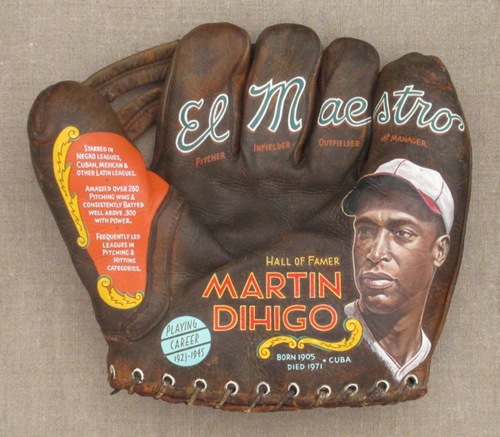
I am showing some of the work of Sean Kane, an artist who works painting baseball gloves, especially those beautiful vintage gloves that seem like little more than fat work gloves. If you’ve ever tried to play with one of those, you have greater appreciation for the players of earlier days and what they could do with those gloves.

Anyway, I saw his work and was immediately smitten. Just gorgeous stuff, especially for those of us with a soft spot for the history of the game. One of my favorites is the one from the Cuban player Martin Dihigo who played his career in the Negro Leagues and other leagues in Latin America.

And that Jackie Robinson glove, inside and out, and the Casey at the Bat triptych at the top are both masterpieces! Grand slams!

You can see much more of his work at his site,  Sean Kane Baseball Art, by clicking here.

Play ball!

Sean Kane- Martin Dihigo Glove


Sean Kane- Jackie Robinson Glove Outside View

Sean Kane- Jackie Robinson Glove Inside View

Sean Kane- “Say Hey” Willie Mays Glove

Sean Kane- Babe Ruth Glove

Sean Kane- Shoeless Joe Jackson Glove

Read Full Post »


The Natural— At West End Gallery

Solitude is not something you must hope for in the future. Rather, it is a deepening of the present, and unless you look for it in the present you will never find it.

–Thomas Merton, The Ascent to Truth


I had something in mind yesterday that I wanted to write this morning. It was a sort of vent. I won’t even mention the subject of this proposed diatribe but there is enough horrific crap floating around that won’t have to strain your imagination if you guess.

But when I finally plopped in front of my laptop, I had lost the desire to vent. It wasn’t a moment of exhaustion or dejection. I just wanted to sit in peace for a little bit this morning. Wanted to simply take in the quiet of the darkness around me.

Wanted to deepen the present, to steal a phrase from the Thomas Merton quote above. As he implied, you can’t hope or wait for solitude to arrive. It’s here in the present, always near and waiting to embrace you if only you can slow your mind enough to detect it.

That’s seems simplistic and much easier said than done. After all, it’s a hard task to slow the mind given the speed and anxiety of life today. There’s even a little guilt in doing so, especially for a compassionate and caring person. It might feel selfish for some to feel peaceful solitude while others suffer.

But solitude often brings clarity. And clarity of thought often brings decisive action. and that is what is needed in this world right now.

So, for this morning I am guiltlessly seeking the clarity that comes in solitude. I know it’s in here somewhere.

Here’s Across the Universe from the Beatles. It seems right for the moment, with its refrain of Jai Guru Deva Om which literally translates from the Sanskrit as glory to the shining remover of darkness. And looking out my window just now, I see the tall trees as dark bony silhouettes against the emerging light…


Read Full Post »

The Burning Secret– At the West End Gallery


As I thought of these things, I drew aside the curtains and looked out into the darkness, and it seemed to my troubled fancy that all those little points of light filling the sky were the furnaces of innumerable divine alchemists, who labour continually, turning lead into gold, weariness into ecstasy, bodies into souls, the darkness into God; and at their perfect labour my mortality grew heavy, and I cried out, as so many dreamers and men of letters in our age have cried, for the birth of that elaborate spiritual beauty which could alone uplift souls weighted with so many dreams.

—William Butler Yeats, Rosa Alchemica


In this passage from the beginning of Rosa Alchemica, Yeats describes the driving force behind his search for that driving force of alchemy that has not only the purported ability to transform lead into gold but can also in the same manner transform and elevate the human spirit above that of the ordinary and mortal. A search for the essence of the spirit. The alchemy within ourselves.

Though humans have searched diligently for such a thing since ancient times, I don’t know that such an ability truly exists. But as Yeats’ words indicate, one long look into the night sky makes it easy to see why one would want to believe that such a thing is possible.

With the sky filled with a universe of wonder and the promise from distant stars and worlds, why wouldn’t we think we had the ability to transform and elevate ourselves and our lives? Or our world?

Maybe that’s the driving force behind the creative arts, an attempt at some crude alchemical transformation of the ordinary into something more, something greatly enriched with the essence of the human spirit.

Maybe. I look out the window at the morning light beginning to filter through the trees and think to myself: Why not?

It’s time to get to work on my own small attempts to achieve an alchemy of some sort. Perhaps today is the day that unlocks the secret?

Who knows? Why not?

This morning, I am sharing a video of an acoustic instrumental cover of I’d Love to Change the World, originally from Alvin Lee and Ten Years After. This is from a musician, Johnny Thompson, busking with his guitar on the street in Costa Rica. His YouTube channel has covers as well as his own originals. Though there are a few spots of wind noise, I like this performance very much.


Read Full Post »

Dawn’s Return–At West End Gallery


Doubt is not a pleasant condition, but certainty is an absurd one.

-Voltaire, letter to Frederick II of Prussia in 1767


It’s one of those mornings. I am filled with uncertainty and the idea of focusing on writing something seems like an unbearable burden. I would rather get to a painting I am working on that will be included in my annual June solo exhibit at the Principle Gallery. That’s where the uncertainty sets in.

I am in the midst of a group of new work that is really hitting the mark for me on all levels. Oddly enough, that’s where the problem begins. My strong positive reactions are triggering equally strong feelings of doubt. It sounds crazy, I know, but the idea of certainty– my own or others– almost always raises my anxiety levels, especially when it comes to my work. 

Trying to balance these two polar opposites– doubt and certainty–results in times when one prevails. This morning, doubt wins the day. After I begin to work, certainty will make a mighty comeback. And after my painting day is done, the two will wrestle until I drift off to dreamland. 

All in all, it’s often an uncomfortable existence bouncing between the unpleasant and the absurd conditions, as Voltaire called them. 

I sometimes wish for absolute certainty. It seems like it would be satisfying to believe that your every word, action, opinion, and belief were absolutely correct. But we’ve seen where the extreme nature of that kind of certainty has taken us. I sometimes think the great divide between people is one of those who sometimes feel doubt and those who always feel absolute certainty.

Well, for someone who didn’t want to write this morning, I seem to have done quite a bit when all I wanted to do was write few words to share the post below that first ran here in 2014. FYI, I am not ready to share my new work yet but will start showing it in the coming weeks–on a day when I am more certain of things.


Much of my work seemingly has a journey or a quest as its central theme. But the odd thing is that I don’t have a solid idea of what the object is that I am seeking in this work. I have thought it was many things over the years, things like wisdom and knowledge and inner peace and so on. But it comes down to a more fundamental level or at least I think so this morning. It may change by this afternoon.

I think I am looking for an end to doubt or at least coming to an acceptance of my own lack of answers for the questions that have often hung over us all.

I would say the search is for certainty but as Voltaire points out above, certainty is an absurd condition. That has been my view for some time as well. Whenever I feel certainty coming on in me in anything I am filled with an overriding anxiety.

I do not trust certainty.

I look at it as fool’s gold and when I see someone speak of anything with absolute certainty–particularly politicians and televangelists– I react with a certain degree of mistrust, probably because I see this absolutism leading to an extremism that has been the basis for many of the worst misdeeds throughout history. Wars and holocausts, slavery and genocide–they all arose from some the beliefs held by one party in absolute certainty.

So maybe the real quest is for a time and place where uncertainty is the order of the day, where certainty is vanquished. A place where no person can say with any authority that they are above anyone else, that anyone else can be subjugated to their certainty.

To say that we might be better off in a time with such uncertainty sounds absurd but perhaps to live in a time filled with absolute certainty is even more so.

Read Full Post »

The Art of Kindness


Affirmation— At Principle Gallery

“Acts of kindness, I believe, are our way of letting the world know we’re delighted to be a part of it; we’re grateful; we’re sensitive. There was once a sign in a hospital reading ‘A baby’s birth is God’s way of letting us know the world should go on,’ or something like that. And I think that each of us—through our unique acts of kindness—can express that we think the world should go on—nicer and smoother. Kindness is an artform.”

—Alec Guinness/Interview with James Grissom/1991


Kindness is an artform.

And like any artform, it must be practiced on a regular basis so that it becomes one with that person, becoming a natural, fluid reaction. Like an actor rehearsing their lines, a musician learning a piece of music, an athlete training to compete, or an artist perfecting the style of their craft.

We could all use a little practice these days. Like they say: Use it or lose it, folks.

That’s all I have this morning. Do I need any more than that?

Here’s a song for this week’s Sunday Morning Music. Kind of on point. It’s Are You Alright? from acclaimed singer/ songwriter Lucinda Williams. She has written a treasure trove of great songs and her 1998 album Car Wheels on a Gravel Road is a peach. Always good stuff from her.


Read Full Post »

Emorries

Rest Stop – At the West End Gallery


Emorries

n. vivid memories of a certain experience that you carry in your head for years until they’re casually disputed by someone who remembers it very differently—correcting basic chronology, clarifying a misread gesture, or adding context you never knew—which makes you want to look again at all the images you’ve been using to piece together your worldview, wondering what details might’ve been hidden in shadow all this time, or washed out by your own naïveté.

After documentary filmmaker Errol Morris, whose work often addresses the fallibility of memory and how little of reality can be captured in a photograph. Pronounced “em-uh-reez,” like memories, but with a piece missing.

The Dictionary of Obscure Sorrows, John Koenig


I am well aware of the fallibility of memory, both my own and of other people in general. Being married so long, I am regularly confronted with recollections of things that have happened in the past– both distantly and recently– that differ wildly from my own memories of the same event. Sometimes one of us has memories that are absolutely absent from the memory of the other. As though only one of us was there.

Most of the time you just shrug it off as the events in question are usually not significant or earth-shattering in any way. They just take up valuable memory space that could better be utilized in holding on to more important things, like the name of some obscure band and the title of their obscure song from 70 years ago that you weren’t even fond of in the first place.

But sometimes, these gaps or misremembrances– these emorries— worry you a bit, especially if it concerns something that held importance to you, something that felt absolutely confident in your memories of it.

As an aging person, you immediately wonder if this is the beginning of some form of dementia. You’ve seen it in people you knew including some you loved so it seems natural to wonder. But you weigh out the facts and examine your other facilities and mannerisms and decide, or at least hope, that there’s nothing to worry about on this account. Unless, of course, you’re already well into dementia which means your observations on the subject are somewhat compromised.

But even if you can shrug that worry off and can be assured that you’re not yet in the throes of dementia, the fact remains that these emorries have somewhat shaken the foundation of the structure of yourself you have slowly built throughout your life. You begin to worry that that these once-trusted building blocks of memory were instead misremembrances, misinterpretations, falsehoods, or outright fabrications of your mind.

This makes you question if you are who and what you think you are and how you believe other people view you. Have you been living in a weird bubble of emorries all this time that is nothing like the reality of it all?

It makes one’s head spin. But then you realize that we’re all subject to the same condition, that everyone you encounter existence is built on their own set of  emorries. They most likely are all contending with the same set of worries. You then realize all we know, our reality as it were, is just a large bubble of emorries, that nobody has total clarity of what is and isn’t.

That moment of realization may well ease your worries or may make your head spin even a little faster. That’s just the way it is. Or just how I am seeing it this morning.

By tomorrow, it will all be just another one of many distant or forgotten emorries.

Here’s a song from an artist that I have never shared here before, for some unknown reason. Maybe he simply slipped from my emorries. Jim Croce died in an airplane crash in 1973 at age 30 when he was at the peak of his success. He left behind a strong legacy in his songwriting and music that doesn’t always get the recognition it deserves. This is his Photographs & Memories. Very soothing stuff…


Read Full Post »

Anchor— At West End Gallery


It is a strange freedom to be adrift in the world of men without a sense of anchor anywhere. Always there is the need of mooring, the need for the firm grip on something that is rooted and will not give. The urge to be accountable to someone, to know that beyond the individual himself there is an answer that must be given, cannot be denied.

–Howard Thurman, The Inward Journey (1961)


I wrote a couple of weeks back about how part of my response to the veritable dismantling of this country that is taking place was a feeling of grief for something lost. I think that lost something could be defined as many things– a loss of belief, loss of security, loss of trust, loss of respect, loss of pride, loss of honor, loss of community, and on and on.

So much has seemingly– and perhaps irrevocably– been lost by so many that there may not be a single definition that covers our loss.

For me, I define my grief as being for the loss of bearings, of losing a sense of having an anchor that I could rely on at any given time, one that let me know who and where and what I was in relation the world at that given moment.

A sense of place. Of home.

It makes me ache to write about this feeling of loss. It is one of feeling unmoored and adrift in a fast-moving current. Looking back, I can catch a brief glimpse of that place, but it fades further into the distance with each successive glance.

Can I escape this current? Can we? And if I do and somehow find my way back to some of that same sense of home, will these feelings of loss subside?

Can it ever be the same anchor that I once thought it was?

I don’t think anyone really knows that answer. I sure as hell don’t. And I don’t think speculating on it matters. Because if we cannot escape that rushing current, the path back is gone forever.

I know this sounds too stark, too grim. Grief is like that. Even so, it not without hope.

Hope has not been completely lost.

I can still look back and see home, as I define it, in the distance. It’s there and, therefore, a way to it must exist.

We just got to get back to it, one way or another, because where we’re at now ain’t home.

Here’s a favorite song, one of many, from Talking Heads. This is This Must Be the Place (Naive Melody) from their great 1984 concert film Stop Making Sense.


FYI– Howard Thurman (1899-1981), who is quoted at the top, was an American author, philosopher, theologian, Christian mystic, educator, and civil rights leader. He was considered a mentor to MLK and other civil rights leaders.


Read Full Post »

Older Posts »