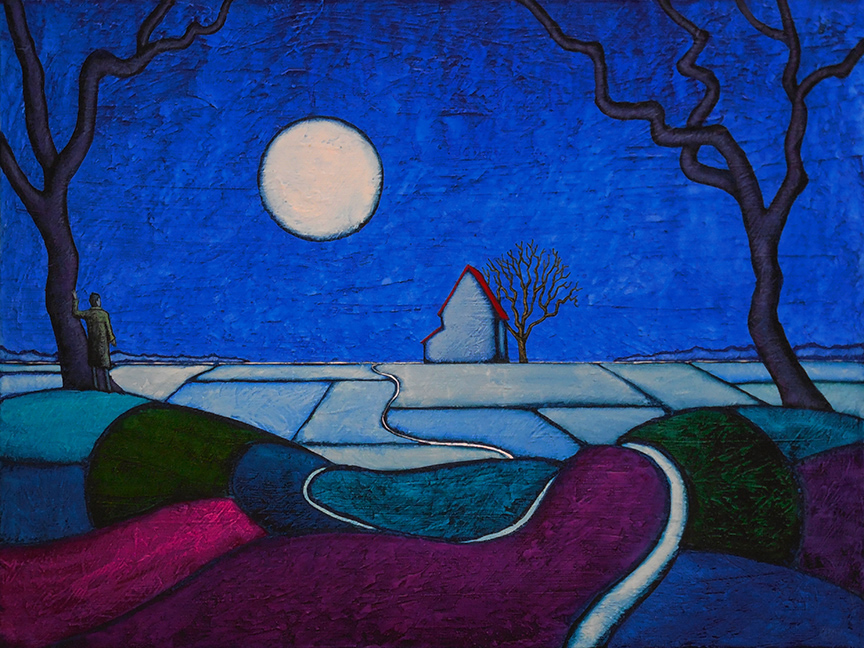
White in the Moon— At West End Gallery
I have always fought for ideas — until I learned that it isn’t ideas but grief, struggle, and flashes of vision which enlighten.
–Margaret Caroline Anderson, The Strange Necessity: The Autobiography (1969)
There’s a lot of anger, shocked disbelief, and trepidation here and abroad at the systematic disassembling of our government currently taking place.
As there should be.
Because no matter how they try to package and sell it to the rubes, the whole of it makes little sense to anyone willing to look past the sales pitch and really examine what they are doing with their attack on our nation’s institutions. Looking at the totality of the stupidity, cruelty, corruption, and treachery that drives it, one would be hard-pressed to not respond with some mixture of anger, shock, and fear.
But perhaps the most overlooked response is one of grief. I know that it is a big part of my personal reaction.
Why wouldn’t one grieve for the loss of something one loved and held so highly? I am talking about the idea of America as the symbol of the promise of freedom, opportunity, justice, and hope for both its citizens and others around the world that it has been for past century or so. Even when it wasn’t living up to that promise, as was sometimes the case, it usually rightfully adjusted its course, putting us back on a path that moved us once more toward that more perfect union as outlined in our Constitution.
But if we cannot soon stem this destructive tide, it feels that we will have little chance of ever returning to that path. The dream of America, the one with a conscience that showed us as a compassionate, welcoming, and generous nation, will be lost. Nearly two hundred and fifty years of slow but steady progress will be crushed and reduced to ash.
And once the dream is crushed, it will not be soon revived. It’s hard to rebuild with ashes.
The grief for a crushed and lost dream lingers and aches.
I sit here this morning as stewpot of anger and grief. The thought of what might have been, of what heights we could have achieved, haunt me. I feel like the figure in the painting at the top of the page who is looking back at what once was but forever remains distant, never to be revisited.
Here’s a song for this Sunday Morning Music that captures that feeling. At least for me, it does. It’s from Melanie, who died this past year, and her Look What They Done to My Song, Ma from 1971. The overall tone of it and this verse really sums it up best for me:
Look what they’ve done to my song, ma
It was the only thing I could do half right
Turning out all wrong, ma
Look what they’ve done to my song
Good intentions turning out all wrong…
FYI-– The quote at the top is from Margaret Anderson (1886-1973) who was the founder and publisher of the art and literary magazine The Little Review in the first half of the last century. She was responsible for introducing Ezra Pound, T.S. Eliot, James Joyce and many others to the American public. A very interesting life.
 Redtree Times
Without reading a word, I looked at this painting and saw a peaceful evening/night, the farmland guarded by the two trees so the people inside the home could rest peacefully, safely…and then I saw the figure…what is she seeing? Something far away, a dreamscape of a farm she had before? Very interesting and the best part was the figure that I did not see at first look. I, too, struggle with the grief. It mixes with anger but I think the foundation of all I’m feeling is grief. I know we, as a country, can always do better (and we’ve done some horrid things in the past) but it seems like all our values are being put into the shredder right now and then celebrated :(. I hope we can survive this without becoming pariahs of the world.
Thanks for sharing your interpretation of the painting, Rhonda. I appreciate that very much. As for grief, it’s hard to not grieve when someone or something you loved and thought you knew, turns out to be something altogether different. As you said, the values that we always accepted as being common are being thrown into the shredder. But remember, though there are sheep among us, this country is more like a herd of feral cats– not easily herded or be trained or to take orders. It might not make sense, but that might be our greatest strength and the one that may ultimately save us.