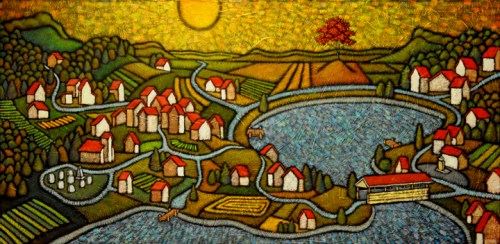
I am giving a painting demonstration this morning at the West End Gallery in Corning. It begins at 10 AM and ends somewhere between noon and 1 PM. I realize that most folks will not be able to make it to the gallery today so I thought it might not be a bad idea to share a blog post from a number of years back, from early 2013, that gives a glimpse into how I work, though it doesn’t show the entire process from start to finish. For today’s demo, the painting I will be working on will be smaller than this and will be a simpler composition that will hopefully allow me to get further along in the process in the allotted time.
There will be other differences, of course, but you will have to be at the West End Gallery this morning to see that. The doors open at 9:45 so that attendees can claim a seat, which are limited in number, if they wish. Or they can stand and go back and forth between the artists that will be giving demos today. I will be painting on the 2nd floor of the gallery and painter Gina Pfleegor will be in the Main Gallery beginning at 10 AM. We will be joined around 11 AM by Trish Coonrod who will be working on the 2nd floor with me. And at 2 PM watercolorist Judy Soprano comes in take over and finish out the day. It should be informative, interesting, and maybe even a little bit of fun. Hope you can make it!

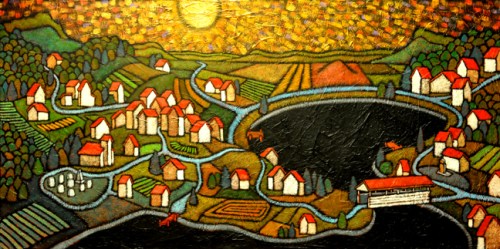
This is a new piece that I started over the weekend. It’s a fairly large canvas, 24″ by 48″, covered with layers of gesso then blackened before I began to lay out the composition in the red oxide that I favor for the underpainting. I went into this painting with only one idea, that it have a mass of houses on a small hilltop. That is where I began making marks, building a small group of blocky structures in a soft pyramid. A little hilltop village. From there, it went off on its own, moving down the hill until a river emerged from the black. An hour or two later and the river is the end of a chain of lakes with a bridge crossing it. We’ll see where and what it is when it finally settles.
I like this part of the process, this laying out of the composition. It’s all about potential and problem-solving, keeping everything, all the elements that are introduced, in rhythm and in balance. One mark on the canvas changes the possibility for the next. Sometimes that possibility is limited by that mark, that brush of paint. There is only one thing that can be done next. But sometimes it opens up windows of potential that seemed hidden before that brushstroke hit the surface. It’s like that infinitesimal moment before the bat hits the pinata and all that is inside it is only potential. That brushstroke is the bat sometimes and when it strikes the canvas, you never know what will burst from the rich interior of the pinata, which is the surface of the canvas here. You hope the treats fall your way.
One of the things I thought about as I painted was the idea of keeping everything in balance. Balancing color and rhythm and compositional weight, among many other things, so that in the end something coherent and cohesive emerges. It’s how I view the process of my painting. Over the years, keeping this balance becomes easier, like any action that is practiced with such great regularity. So much so that we totally avoid problems and when we begin to encounter one, we always tend to go with the tried and true, those ways of doing things that are safest and most predictable in their results.
It’s actually a perfectly fine and safe way to live. But as a painter who came to it as a form of seeking, it’s the beginning of the end. And as I painted, I realized that many of my biggest jumps as an artist came because I had allowed myself at times to be knocked off balance. It’s when you are off balance that the creativity of your problem-solving skills is pushed and innovation occurs.
It brings to mind a quote from Helen Frankenthaler that I used in a blogpost called Change and Breakthrough from a few years back: “There are no rules. That is how art is born, how breakthroughs happen. Go against the rules or ignore the rules. That is what invention is about.”
You must be willing to go outside your comfort zone, be willing to crash and burn. Without this willingness to fail, the work becomes stagnant and lifeless, all the excitement taken from the process. And it’s that excitement in the studio that I often speak of that keeps me going, that keeps the work alive and vitalized.
It’s a simple thing but sometimes, after years of doing this, it slips your mind and the simple act of reminding yourself of the importance of willingly going off balance is all you need to rekindle the fire.
This is a lot to ponder at 5:30 in the morning. We’ll see what this brings in the near future. Stay tuned…


 Redtree Times
Leave a comment