Feeds:
Posts
Comments

Archive for September, 2025

An Eternity

Gaining Understanding— At Principle Gallery


There is no dusk to be,
There is no dawn that was,
Only there’s now, and now,
And the wind in the grass.

Days I remember of
Now in my heart, are now;
Days that I dream will bloom
White peach bough.

Dying shall never be
Now in the windy grass;
Now under shooken leaves
Death never was.

An Eternity, Archibald MacLeish (1892 –1982)


I am pretty busy this morning with a bunch of small but important tasks for my upcoming October show at the West End Gallery and my September 27th Gallery Talk at the Principle Gallery. But I had this short poem from Archibald MacLeish in my holster and felt like pulling it out. Seemed like the right bit of verse for the moment since its theme is timelessness and I am feeling pressured by a lack of time.

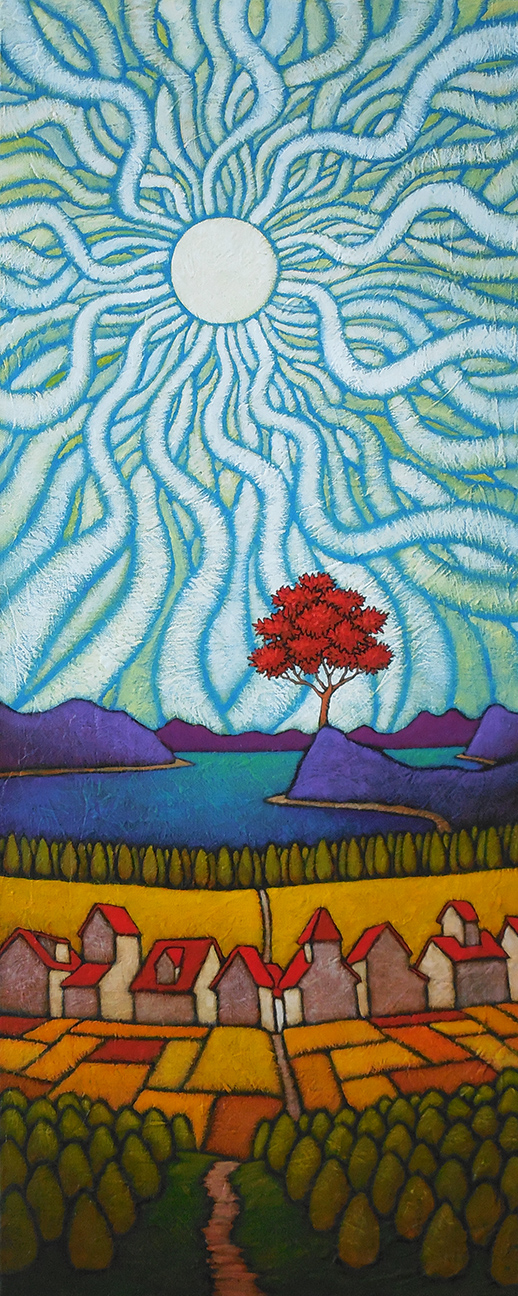
This idea that eternity exists in the present moment, one in which the past and the future have no place, is a concept in which I am trying to gain some understanding. See how I tied in the painting at the top? Bet you didn’t see that coming.

For the musical element of today’s triad, I am going a bit highbrow with a piece from George Frideric Handel, Eternal Source of Light Divine. It is an aria from his Ode for the Birthday of Queen Anne, composed in 1713 to celebrate the Queen’s birthday and the Treaty of Utrecht.

It’s an oldie but a goodie. It has a beautiful ethereal quality that lives up to its title. It is performed here by Marie-Sophie Pollak and the Ensemble Concerto München.

Got to run now. Time’s a-wasting. See? I still don’t get it…


Read Full Post »

Majesty of Creation

Pax Omnis– At Principle Gallery


We have lived by the assumption that what was good for us would be good for the world. And this has been based on the even flimsier assumption that we could know with any certainty what was good even for us. We have fulfilled the danger of this by making our personal pride and greed the standard of our behavior toward the world – to the incalculable disadvantage of the world and every living thing in it. And now, perhaps very close to too late, our great error has become clear. It is not only our own creativity – our own capacity for life – that is stifled by our arrogant assumption; the creation itself is stifled.

We have been wrong. We must change our lives, so that it will be possible to live by the contrary assumption that what is good for the world will be good for us. And that requires that we make the effort to know the world and to learn what is good for it. We must learn to cooperate in its processes, and to yield to its limits. But even more important, we must learn to acknowledge that the creation is full of mystery; we will never entirely understand it. We must abandon arrogance and stand in awe. We must recover the sense of the majesty of creation, and the ability to be worshipful in its presence. For I do not doubt that it is only on the condition of humility and reverence before the world that our species will be able to remain in it.

~Wendell Berry, The Art of the Commonplace (2002)


Poet/ environmental activist Wendell Berry wrote this is the early 2000’s. We haven’t changed much in the intervening years. There have been attempts and for a while it looked like we were making slow progress in learning to live on this planet as an integrated part of it rather than as a swarm of some alien parasites feeding on it.

Unfortunately, the current powers-that-be are paragons of arrogance and greed. They seem fixated on ruthlessly and spitefully defying any attempts at a peaceful coexistence with our planet. They wish to do away with many alternative/green energy initiatives, especially those having to do with wind. solar, or electric cars. Regulations put in place to protect our water and air are being gutted.

I believe that if they had their way, we would be moving around in coal burning cars and planes. Or that cities would be required to dump wastewater directly into the nearest body of water. Or that our National Parks will become vast drilling and mining reserves. Or that schools would have to put asbestos back in the classrooms. Maybe they would even heat the by burning asbestos logs in each classroom?

There is something in the crazy decisions they are making that goes beyond pure arrogance and greed, though both are still there as the industrialists clap their hands in glee. I used the word spitefully above. There seems to be an element of spite in their actions that defies common sense, or even their greed. Their choice in nearly every decision having to do with the environment is one that reeks of–and I hesitate in writing this–evil. It’s as though they are determined to damage the planet and its inhabitants.

Maybe they see it as some form of punitive action or maybe it is simply an arrogant show of the power which they believe they hold over the world and us. 

I don’t know. But I worry that since they are putting so much bullshit in the air right now (adding yet another form of pollution) on so many fronts that many of these environmental atrocities are going unnoticed, barely covered by the media.

But I do know that if it continues unabated, we will all pay a dear price. We will lose that sense of the majesty of creation of which Berry wrote. And from there it all downhill. We’re just beginning to get a taste of what in store for our future living on a planet made hostile.

Can we exhibit the humility and reverence required to keep this planet inhabitable?

It’s not looking good at the moment. But things can change, can’t they? If can if we, the people, decide things must change.

Can we make that decision?

Here’s some Marvin Gaye on this subject.


Read Full Post »

Our Town

The Elevating Eye— At West End Gallery


That’s why we feel so disoriented, irritated even, when these touchstones from our past are altered. We don’t like it when our hometown changes, even in small ways. It’s unsettling. The playground! It used to be right here, I swear. Mess with our hometown, and you’re messing with our past, with who we are. Nobody likes that.

–Eric Weiner, The Geography of Bliss (2008)


Everyone’s hometown changes over time. Some wither and slowly dwindle away. Some burn to the ground or are washed away by floods. Some prosper and grow. But even in the best-case scenario of these, they all change in ways that veer from the memory of that place that was formed while growing up there, at a time when we were younger and more carefree. We were more preoccupied with the desires contained in the moment and less concerned about the future.

And less likely to notice that change was already beginning to take place.

Change is the nature of things. And even those changes that we see as being good or beneficial often have that same unsettling feeling when it affects the picture of the past we have formed in our memory.

Maybe this is because this divergence causes us to question whether what we believed to be true then was really true. Or maybe it is just that the changes that occur in our hometowns remind us of the changes that are taking place in ourselves as we age, some good and some definitely not so good. The changes that took place in your 20-year-old self over time is very unsettling to your 60-year-old self.

Things change. In ourselves. In our hometowns. In our nation and the world.

We are going through a change right now in this nation that certainly is unsettling and disorienting, one that veers wildly from our memory of what it was before. I would like to say that it is just part of those changes that occur naturally, that we are just unrealistically holding on to an idealized past.

Unfortunately, it is not. It is an unnatural attempt to rewrite our memories of the past and take away our future. To take away our hope and make us desperately subservient, turning us into sharecroppers and serfs.

I hate writing this and am going to stop now. It always hurts to see your hometown– or country– deteriorate, leaving you with only a memory of what you once thought it was.

Here’s this week’s Sunday Morning Music. It’s from Iris Dement and the song is Our Town. Its lyrics have been rumbling around in my head for a while now. They are certainly on point for this post:

I buried my Mama and I buried my Pa
They sleep up the street beside that pretty brick wall
I bring them flowers about every day
But I just gotta cry when I think what they’d say

If they could see how the sun’s settin’ fast
And just like they say nothing good ever lasts
Well, go on now and kiss it goodbye but hold on to your lover
‘Cause your heart’s bound to die
Go on now and say goodbye to our town, to our town
Can’t you see the sun’s settin’ down on our town, on our town
Goodnight

Even so, I have hope for our town, but the window is closing fast. I’m not ready to give up on our town…


Read Full Post »

Wildflowers/ Schedule Update

All Embracing–Coming to West End Gallery


People from a planet without flowers would think we must be mad with joy the whole time to have such things about us.

–Iris Murdoch, A Fairly Honourable Defeat (1970)


I am using this time this morning to remind you of my upcoming schedule:

  • Three weeks from today, on Saturday, September 27, beginning at 1 PM, I will be giving a Gallery Talk at the Principle Gallery in Alexandria, VA. Keep an eye out here for more updates in the next couple of weeks. As you may know, there is the possibility of a painting being given away at these Talks.
  • My annual solo show, this year titled Guiding Light, opens on Friday, October 17, at the West End Gallery in Corning, NY. The Opening Reception for the show runs from 5-7 PM.
  • On Saturday, November 1, I will be giving a Gallery Talk at the West End Gallery in Corning, NY, beginning at 11 AM. Again, keep an eye out for details and for possible prizes!

Hope to see you at one of these events.

I woke up with a song in my head. It was a version of the Tom Petty song Wildflowers performed by The Wailin’ Jennys. They are a trio that began performing together in Winnipeg, Canada back in 2002.

This is a fine rendition of Petty’s song. It has stuck in my head for quite a while, if you need some proof. But then again, I hold onto all kinds of stuff in my head that doesn’t mean much to anyone else…


Read Full Post »

The Watcher in the Window

The Watcher in the Window


The night crept on apace, the moon went down, the stars grew pale and dim, and morning, cold as they, slowly approached. Then, from behind a distant hill, the noble sun rose up, driving the mists in phantom shapes before it, and clearing the earth of their ghostly forms till darkness came again.

~Charles Dickens, The Old Curiosity Shop (1840)


I am still vacillating over whether the painting above will be included in my October exhibit at the West End Gallery. Hell, I wasn’t even sure I would share it here.  It’s one of those pieces that have such personal meaning that it’s hard to tell if that same meaning or feeling that will come across to others.

Or if my personal feelings keep me from judging the painting on its own artistic merits.

 I woke up in the dark one morning a few weeks back with this painting firmly planted in my mind. There was a definite image I felt compelled to put down in paint it was painted it quickly that same day as though it were a task that needed to be completed at once. It couldn’t wait.

The image in my head changed as it went on the canvas. Little attention was paid to detail and much was pared away as I worked. It became more about capturing the feeling of that original image rather than replicating it, since most of the details were unimportant to anyone but me.

The result is a piece that feels a bit like folk art. Not that I care what label someone might attach to it. Call it whatever pleases you. Call it a cat box liner if you wish.

I call it The Watcher in the Window.

A short version of the backstory is that when I was growing up, we lived in a large old farmhouse that was built around the time of the Civil War. It was isolated from the other houses up and down the road on which it was located. It was a creaky and somewhat creepy place with little hidden nooks and crannies, a mysterious locked room on the second floor that our landlord claimed was just storage for some of his furniture though my kid mind felt it held something much more nefarious, a Widow’s Watch on its roof, and a walk-up attic that still haunts my dreams. 

Opening the door to the stair leading up to the attic was like that moment in the Wizard of Oz where Dorothy opens the door after the tornado and the film goes from sepia to vivid color. Only in this case, it was in reverse. Everything was coated in an ancient brown wood dust, illuminated by the light from the attic windows. There was ladder that went up to the Widow’s Watch which we never were able to access.

It was a place that felt strange and ominous to me as a kid, one that had its own presence, its own personality. I had many disturbing dreams about that attic space when we lived there and long after.

Even now, once in a while.

But even so, for all the time I spent alone in that big, isolated house and in that attic, I never felt threatened in any way. It was spooky at times, but it was more in that Halloween-y, want-to-be-scared kind of way that so appeals to some kids. Nothing more ominous than that.

It was more like the house and that attic was simply a watchful entity, one that existed in its own time and place that somehow overlapped ours. For all I know, I may have seemed like an apparition or ghost to it.

The watcher part comes from the numerous times I would find myself in the side yard under the attic window. Many times, I felt as though someone was watching me. I would glance quickly up at that attic window, fully expecting to see someone looking down at me.

Thankfully, nobody ever was there in the window. I don’t know how that would have went over in my kid brain. 

 I drive by that place periodically and it still has a presence and personality of its own for me. I wonder if the Watcher in its window still resides in that place.

Or does it only linger in my memory now? 

Read Full Post »

The Sailor’s Lament

Headed Home— At Principle Gallery


Ships at a distance have every man’s wish on board. For some they come in with the tide. For others they sail forever on the horizon, never out of sight, never landing until the Watcher turns his eyes away in resignation, his dreams mocked to death by Time. That is the life of men.

-Zora Neale Hurston, Their Eyes Were Watching God (1937)


I had intended to write something else this morning but it was one of those things that requires a lot more time than I have at the moment. Instead, I am sharing a triad with the words above from the opening of Their Eyes Were Watching God from Zora Neale Hurston along with the painting at the top, Headed Home. which seems to align well with the passage.

This painting appears to depict a ship coming into port, but will it land laden with the fulfillment of a wish or dream? Or will it arrive with its hold empty?

I can’t tell you the answer even though I painted it. I sense in it a return which might be the fulfillment of a wish for the Sailor and for those that wait for the Sailor. The dream of a homecoming. Yet, there is also a feeling of unfulfilled wishes in it. As though as the Sailors returns their eyes still scan the horizon longingly and a plan for the next voyage, the next attempt at fulfilling the dream is already growing. 

The Sailor’s Lament.

I am adding a piece of music from Moondog, an artist I mentioned awhile back, one whom I had promised to write more about. However, it is a long story with quite a few details and I just haven’t found time to write it yet. I will at some point. Promise. For now, here’s one of his more famous compositions, Bird’s Lament, as performed by the London Saxphonic.

This composition was written with jazz great Charlie “Bird” Parker in mind. Parker and a slew of jazz and classical giants were friends of Moondog when he was a street person in NYC in the 1950’s. We’ll get to that part of the story sometime. For now, here’s Bird’s Lament.


Read Full Post »

Of Fish and Dots


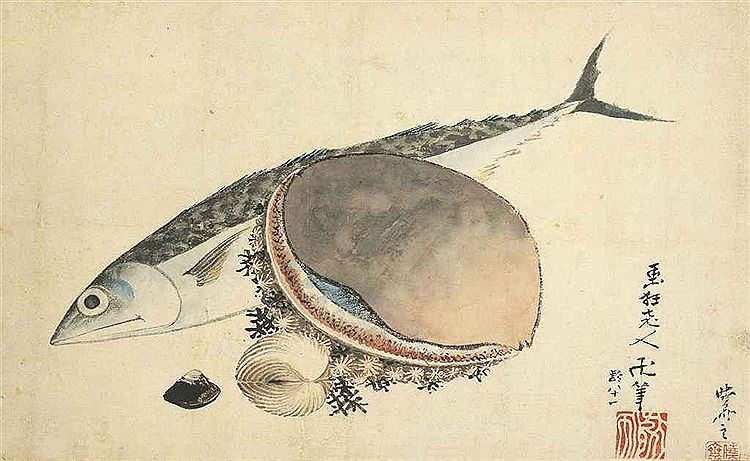
Hokusai Two Fish


At seventy-three I learned a little about the real structure of animals, plants, birds, fishes and insects. Consequently when I am eighty I’ll have made more progress. At ninety I’ll have penetrated the mystery of things. At a hundred I shall have reached something marvelous, but when I am a hundred and ten everything I do, the smallest dot, will be alive.

Katsushika Hokusai (1760-1849)


I really like the bit of wisdom above from the great Hokusai, both for his optimism on aging as well as the idea that as he continues to progress his work will reach a point where everything he paints– even something as simple as a dot– has a life force within it.

Attaining that life force in any one piece, where the painting transcends what you put into it, is a rare and difficult thing for any artist to achieve. This idea that you might one day reach a point where your work has moved from a product of thought and craft to a transcendent expression of the spirit often seems beyond our reach or even our aim.

But perhaps we should keep it as an aim in our mind, along with the idea that we will continue to progress as we age, even if it is stored in rarely visited corner. If we hold on to it perhaps we will subconsciously find our way to that goal. And when we are a hundred and ten, the dots we paint will have that same life force as those created by Hokusai.

It’s something to hope for…

I’ve included a few of Hokusai’s paintings beyond his famed wave and landscapes. I love his fish pieces and the raven is wonderful. Enjoy!


I came across this post from a few years back. It’s one that had slipped my mind but was appreciative for the reminder that art and creation have no endpoints within a person. More than that, this idea from Hokusai of the energy and life force of his work continually concentrating itself until it reaches the size of a dot jumped out at me.

It reminds me of the singularity theory first put forth by Stephen Hawking, which states that when a star dies it collapses into itself until it is finally a single tiny point of zero radius, infinite density, and infinite curvature of spacetime at the heart of the black hole formed from the star’s collapse. A single point of immense mass and energy.

A dot filled with everything.

It also struck me that much of my work in recent times has focused on the sun/moon as a central element and it has taken on more and more prominence as the years pass. I often see it as this same sort of Hokusai-like dot, the energy of the painting concentrating itself in and around this ball.

There are future blog entries coming on this subject. But for this morning I am going to just enjoy some of Hokusai’s wonderful fishes. And that raven!

FYI- I am aware that the second from the bottom image is not a Hokusai painting but rather one from Hiroshige that is styled after Hokusai. I am including it because it was in the original post and I like it. And that’s good enough for me.


koi-carp-and-turtles-katsushika-hokusai

Read Full Post »

gnossienne redux

On the Blue Side— At the West End Gallery


gnossienne- n.– A moment of awareness that someone you’ve known for years still has a private and mysterious inner life, and somewhere in the hallways of their personality is a door locked from the inside, a stairway leading to a wing of the house that you’ve never fully explored—an unfinished attic that will remain maddeningly unknowable to you, because ultimately neither of you has a map, or a master key, or any way of knowing exactly where you stand.

–The Dictionary of Obscure Sorrows


I don’t have much to say this morning.  I just wanted to share a little music from the French composer Erik Satie, someone whose work has always spoken to me in its elegant spareness.  It was a great influence on some of my earliest works.  In fact, I even titled an early piece or two after the composer, but I can’t locate the images at this point.

Thought I’d share his Gnossienne No. 1 as played in this fine video from the contemporary Italian pianist/composer Alessio Nanni.  The word gnossienne was created by Satie.  He sometimes created new terms or appropriated terms from other fields to describe his compositions.  Gnossienne is generally thought to simply denote a new form although I like the definition at the top from the website The Dictionary of Obscure Sorrows.  It seems to fit the composition very well.

Anyway, give a listen to Satie’s beautiful sounds this morning.


I am short on time this morning, so I thought I’d rerun the simple short post above that I have shared a couple of times over the years. The only difference in these posts is the accompanying painting. I chose On the Blue Side at the top because it had that same sense of an inner life that people that know you will never truly know. Its title was also taken from a song, one from the Steeldrivers, the bluegrass group that once featured Chris Stapleton, who sings on that track. A much different feel than this Satie piece but no less applicable to the painting.

After all, trees and people are complicated, filled with mystery and contradiction…


Read Full Post »

Welcome to September


Land Alive- GC Myers


But it’s a long, long while from May to December
And the days grow short when you reach September
And I have lost one tooth and I walk a little lame
And I haven’t got time for waiting game

— September Song, I Kurt Weill and Maxwell Anderson


It’s the first of September and I let out a sigh of relief that August is behind us. I have confessed my utter disdain for the month of August here in the past but have refrained from doing so this year. For me, going back to my childhood, August has usually been a month of heat and anxiety, an uncomfortable month in which things never quite go right and often go very wrong.

As a result, the first days of September have the feel of a prison door being opened so that I might be released. I feel the cool air of freedom on my face once more.

Refreshing.

That first day of September is finally here after an August that seemed to start in July this year, with the anaplasmosis that plagued me carrying me into August. Every year on this day I share a version of the classic September Song. It has long been one of my favorite songs and becomes even more so with each passing year as it becomes more and more personally relevant. The verse at the top sures feels relevant to me on this cool morning.

Written by Kurt Weill with lyrics by Maxwell Anderson, it was first sung, surprisingly, by Walter Huston in the stage production of Knickerbocker Holiday back in 1938.  Since then, it has been covered by literally hundreds of musicians and singers throughout the world. I have listened to and played many of them here from a wide variety of artists. As it is with most great songs, most of them are wonderful renditions. It’s just that good a song.

It’s a bittersweet and slightly melancholy reflection on the passing of time, that inevitable march to old age symbolized in the turning of leaves and the shortening of the days. These precious days, as the song says.

This year I am going to share a performance of September Song from the great Ella Fitzgerald. You can never go wrong with Ella. Having her serenade us out of August and into September feels right somehow.

Welcome to September.


Read Full Post »

« Newer Posts