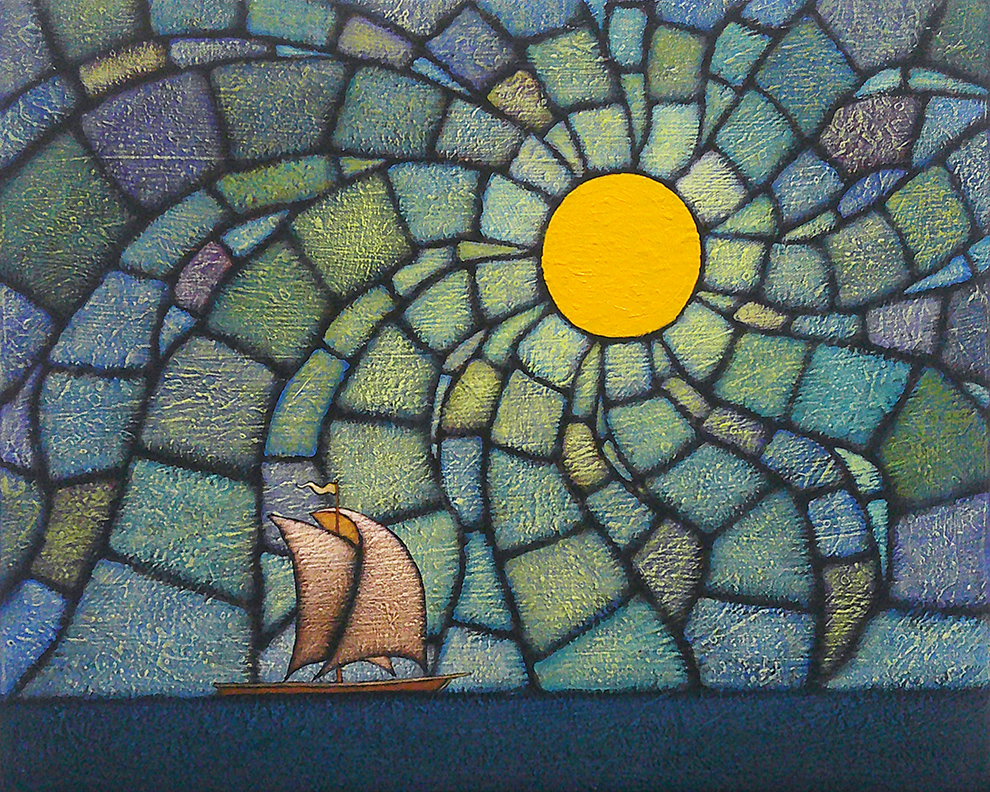
Color and Glide— At West End Gallery
I can give you my loneliness, my darkness, the
hunger of my heart; I am trying to bribe you
with uncertainty, with danger, with defeat.
—Jorge Luis Borges, Two English Poems, Verse II, 1934
This has been a long and arduous week. There have been a few high points and more than enough low points. Let just say for this morning that there are a lot of moving parts right now that I will explain in greater depth in the near future.
I am resharing a post this morning from two years back that has easily been my most popular post since it first appeared. I thought it was an appropriate piece to share as my show at the West End Gallery comes to an end this coming Thursday, November 13. I think the whole of the show now hanging very much reflects the thought behind this post, that art is indeed a love offering from the artist to the viewer.
A gift of the self.
And since it is Sunday, there’s a song at the bottom for the weekly Sunday Morning Music segment of our little show. It’s Bob Dylan and It Takes a Lot to Laugh, It Takes a Train to Cry from his landmark 1965 album Highway 61 Revisited.
[From 2023]
What can I hold you with?
I offer you lean streets, desperate sunsets, the
moon of the jagged suburbs.
I offer you the bitterness of a man who has looked
long and long at the lonely moon.
I offer you my ancestors, my dead men, the ghosts
that living men have honoured in bronze.
I offer you whatever insight my books may hold,
whatever manliness or humour my life.
I offer you the loyalty of a man who has never
been loyal.
I offer you that kernel of myself that I have saved,
somehow-the central heart that deals not
in words, traffics not with dreams, and is
untouched by time, by joy, by adversities.
I offer you the memory of a yellow rose seen at
sunset, years before you were born.
I offer you explanations of yourself, theories about
yourself, authentic and surprising news of
yourself.
I can give you my loneliness, my darkness, the
hunger of my heart; I am trying to bribe you
with uncertainty, with danger, with defeat.
—Jorge Luis Borges, Two English Poems, Verse II, 1934
Wasn’t going to write anything this morning, again. So, I didn’t write this morning. Haven’t felt much like writing lately. Just a little worn down, I guess.
But later in the morning, I came across a draft of a blog entry that I had never shared containing the second verse of a Jorge Luis Borges poem, Two English Poems. It sent me thinking and writing. It is basically about finding and losing love in the first verse, followed in the second verse with the narrator weighing out what he has to offer in order to regain or hold on to his beloved.
I focused on the second verse of the poem. Its first line– What can I hold you with? — is a thought that often goes through my mind when I stand before a blank canvas. In my conversation with some unidentifiable and indistinct viewer that I imagine being present in the studio, it is often phrased in a slightly different way– What part of myself can I give to you?
The meaning is much the same though. When I paint, I am making an offer of myself to the viewer.
But what has the greatest impact for me was the final part of the second verse, highlighted in red above. It reminds me of the thoughts I sometimes have when trying to describe what I hope others see in my work, those things I have to offer with the hope that it will entrance and hold the viewer.
The artist hopes that what they have to offer, while being their own memories and feelings, opens up new avenues of perception for the viewer of themselves. As Borges put it:
I offer you explanations of yourself, theories about
yourself, authentic and surprising news of
yourself.
I have struggled to say just that for a long time. It is just what I want from my work.
And that final line just crushed me:
I can give you my loneliness, my darkness, the
hunger of my heart; I am trying to bribe you
with uncertainty, with danger, with defeat.
I felt like it was describing much of what I have to offer in my work. You hope that your work represents the totality of you, all the many facets that make up your humanity, with the hope that others see their own similar feelings in it. That includes the deepest of feelings, those rising from loss and disappointment. These are sometimes a bit darker and more somber than feelings of joy and happiness, but they are as much a part of who we are as the brightest of our feelings.
As I said, Borges’ poem is very much a poem about what one has to offer in order to gain one’s love. In a way, sharing one’s art is often very much the same thing– a love offering of the deepest and most intimate parts of yourself. It may not be real or romantic love. But when you connect with art in a deep way, you often feel as though you are connected with the artist and know and understand them.
I don’t know that I can fully explain what I mean here. It may even sound a bit off the wall to you. That’s okay. I am used to that. Just felt like I wanted to share this poem today.
Here’s a reading from Tom O’Bedlam of the whole poem from Borges.
 Redtree Times
This is a favorite among your paintings. I especially like the similar texture of the sky and the sails, and what appears to be a slight, upward slant of the sea. I actually got out a ruler to measure the left and right edges of the sea, and I think the difference is there. Whether it’s real or an optical illusion, it’s an interesting juxtaposition with the title, since a glide usually is downhill rather than up. It’s a great, evocative painting.
Doesn’t water always run uphill? I must have been absent the day we covered that in science class. But thank you, Linda. I think it’s a special painting, whether it’s up or down or any other way you want to look at it.