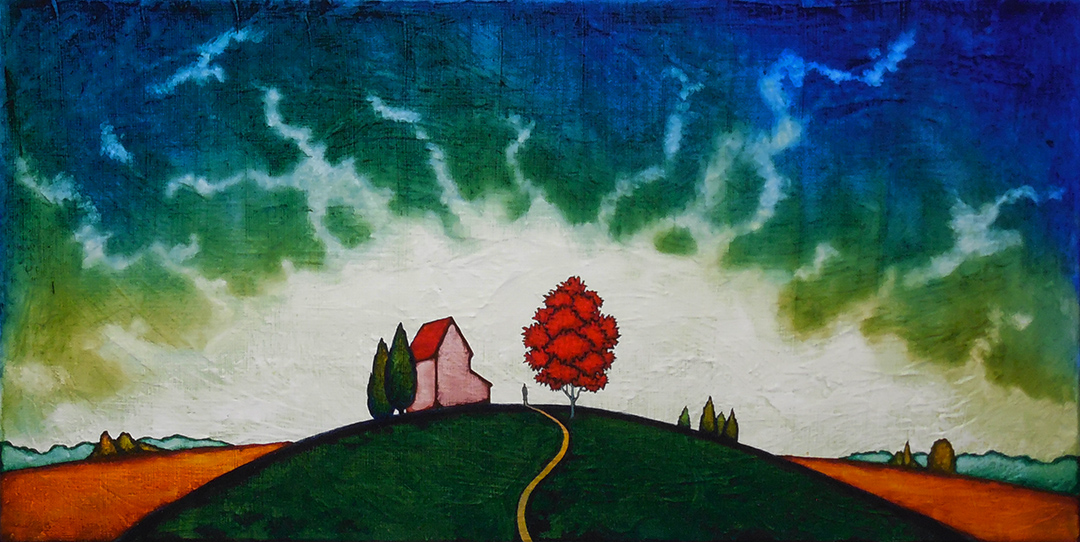
The Welcome Tree–At the West End Gallery
Life’s a voyage that’s homeward bound.
— Herman Melville, White-Jacket: Or, The World in a Man-of-War (1850)
This painting, The Welcome Tree, always captures my attention when I come across it in my files. There’s something in the look and feel of the painting that strikes a very personal chord, one that is both invitingly warm and uneasy.
I gave it its title because it symbolized for me the concept of home, that one place where you are always welcome without conditions or questions. It reminded me of the biblical parable of the Prodigal Son who leaves home and squanders his inheritance. He finds himself in poverty and returns remorsefully home, expecting to be berated or turned away by his father. Instead, his return is celebrated by his father. The story serves as a lesson in repentance and grace that comes in forgiveness and mercy.
While in the process of naming this painting, I also took a different view, one that viewed this scene as an idealized dream, a destination that could not be reached. At the time, I had been pondering a passage from the 1952 novel, Wise Blood, from Flannery O’Connor. If you have read the book or saw the 1979 film adaptation from John Huston, you know that it is grimly difficult to read or view. Its message is that there is little grace, mercy, or forgiveness in this world, except that which we find or create within ourselves.
This is that passage from Wise Blood:
“Where you come from is gone, where you thought you were going to never was there, and where you are is no good unless you can get away from it. Where is there a place for you to be? No place.
Nothing outside you can give you any place,” he said. “You needn’t look at the sky because it’s not going to open up and show no place behind it. You needn’t to search for any hole in the ground to look through into somewhere else. You can’t go neither forwards nor backwards into your daddy’s time nor your children’s if you have them. In yourself right now is all the place you’ve got. If there was any Fall, look there, if there was any Redemption, look there, and if you expect any Judgment, look there, because they all three will have to be in your time and your body and where in your time and your body can they be?”
It is obviously a much darker take to associate with this painting, one seemingly completely counter to the parable of the Prodigal Son. But I don’t think their meanings in relation to the painting are all that different.
The painting works for both in my eyes. It is an idealized dream of both, as a welcoming refuge for those who seek hopefully home and as a realization that all we have in the present moment is in ourselves, that we have to make our home in this moment that is the Now.
For me, it’s a more complicated painting than it lets on in a quick view. It is both joyful and sorrowful, containing both an embracing sense of love and an alienated loneliness. I think it is the contrast in this polarity that makes this piece always draw my attention. It certainly always makes my mind reel a bit as it experiences both ends of its spectrum.
Here’s a classic song from Simon and Garfunkel that I surprisingly haven’t played in many, many years here. To me, their Homeward Bound has the same kind of feel that I get from this piece.
And to my way of thinking, that’s a good thing…
 Redtree Times