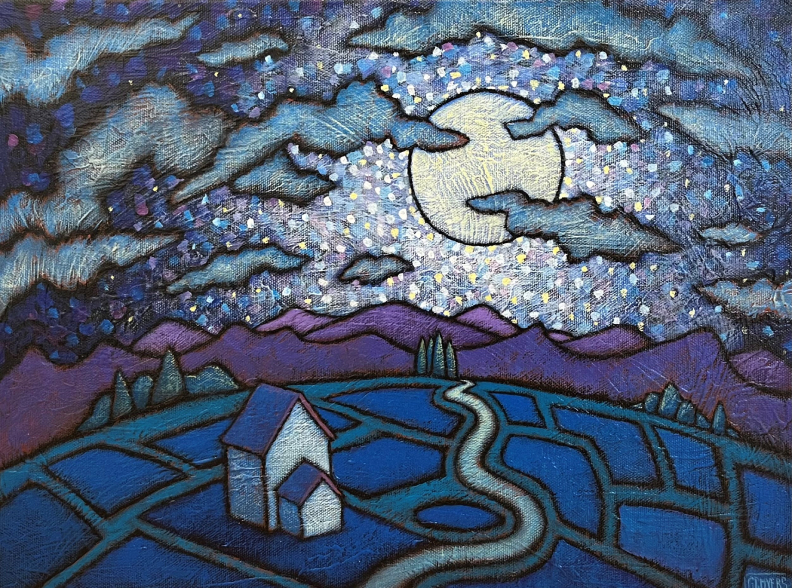
Night’s Dream— At Principle Gallery
God, it was good to let go, let the tight mask fall off, and the bewildered, chaotic fragments pour out. It was the purge, the catharsis.
—Sylvia Plath, The Unabridged Journals of Sylvia Plath
I came across an article this morning that had been forwarded to me by a friend several years ago in response to a blog post. Appearing in the online magazine Psyche, it was written by three researchers –Julia Christensen, Guido Giglioni, and Manos Tsakiris— and was largely about how creativity and wellness were often boosted by allowing the mind to wander. It’s an interesting article that discusses the neuroscience behind their research into the wandering mind.
While those that daydream have often been chided through history as being lazy and counterproductive, there has also been a school of thought that encourages random thought and rumination, believing that it can lead to creative breakthroughs and greater productivity. The Germans had a phrase for this concept of the wandering mind, ‘die Seele baumeln lassen,’– ‘let the soul dangle.‘
Interesting stuff. One part of the article that struck a chord with me discusses how art causes biological responses and often serves as a prop for emotional catharsis. As they put it:
“…art can help us adapt to the immediate source of pain by acting as a prop for emotional catharsis. We all know the strange, pleasurable, consoling feeling that comes after having a good cry. This experience appears to be precipitated by the release of the hormone prolactin, which has also been associated with a boosted immune system, as well as bonding with other people. The arts are a relatively safe space in which to have such an emotional episode, compared with the real-life emotional situations that make us cry. Even sad or otherwise distressing art can be used to trigger a kind of positive, psychobiological cleansing via mind-wandering.”
I immediately responded to this point as this is something that I experience on a regular basis. I often am moved to tears by artistic stimulus while in the studio, most often in the form of music, film, or the written word. It is such a common occurrence that I have come to use this response as a barometer for how emotionally invested I am in the work I am doing at that time. When I feel most immersed in my work, I find that I am receptive and reactive to emotional stimuli, quick to tears. I have found that the work I consider my strongest comes at times when I am on this edge of induced emotional catharsis.
It’s something that has taken place with me for decades now and it’s interesting to see that there might be a neurological component behind my response. I think I am going to go now and see if I can produce some more prolactin this morning.
Click here to go to this article. It’s a relatively short read plus there is an audible version available on the page if you would rather listen.
This post ran a couple of times over the past decade. It felt relevant to the present for me.
Haven’t been productive at all in the past couple of months. Everything feels like a distraction designed to keep me from painting. It is obviously the result of my cancer diagnosis and the stress that comes with it. But I still am letting my mind wander freely when it can.
Letting my soul dangle.
I believe, from my own experience, that this an important aspect of the artistic process. It creates the space in the work that carries its emotional weight. A lot of the time this period mind wandering brings me to moments of emotional catharsis that the researchers described as a positive, psychobiological cleansing. It certainly has in recent weeks.
Now it is just a matter of moving from the act of cleansing to that of painting. By the presence and sensitivity of those internal emotional triggers, I can tell that transition is nearing.
Here’s a song from Chris Stapleton that is on point. With his roots in bluegrass, Stapleton is labeled as a country artist but his music, driven by his soulful voice, transcends genre. This is Sometimes I Cry.
 Redtree Times