Feeds:
Posts
Comments

Archive for January, 2026

A Look Back: Railbirds

Railbirds, 1994


One thing I have learned in my painful career as a gambler is that bragging when you get lucky and win a few games will plunge you into gloom and unacceptable beatings very soon. It happens every time.

–Hunter S. Thompson, Hey Rube: Blood Sport, the Bush Doctrine, and the Downward Spiral of Dumbness (1904)


On Friday, I proposed running a post every week that looked back at my earliest efforts, the work that never made it out of the studio but were vital to my artistic development. This is the first official post of the A Look Back series and it features a favorite older piece that I have featured in two prior posts in 2009 and 2015. I have merged those posts below, added the very appropriate Hunter S. Thompson quote above (his Fear and Loathing in Las Vegas was a favorite book around the time in my life this painting depicts) and an equally appropriate song at the bottom from Sister O.M Terrell, The Gambling Man.

FYI: Sister O.M. Terrell was born in 1911 and died at the age of 95 in 2006. She had a short-lived recording contract in the early 1950’s but was primarily a Southern street corner guitar preacher, part of what is known as the Holiness Movement that eschewed the formality of traditional Baptist and Methodist churches, instead going out onto the streets and making joyful noise with their street gospel music.

Here’s the mashup of those earlier posts:


This is an older painting of mine from back in 1994. I was in the transition from trying to simply replicate the work of others to developing my own visual voice. I wasn’t sure where it would go from there and didn’t even have an idea of how to proceed. I just painted and painted, letting each piece be the guide for the next. Sometimes it brought forth breakthroughs and sometimes not. But this time and this work still brings back that excitement of the unknown that was so present in that time.

This little piece is a favorite of mine from that time and is painted in a more traditional watercolor style that I was dabbling in at the time. It is titled Railbirds and depicts a scuffle between the inhabitants at the rail of a horse track. Perhaps there was a dispute over a mislaid wager, a mumbled insult, or which jockey looked sharpest in their colors. Who knows?

The culture of gambling played a major part in my youth. I spent an inordinate amount of time at racetracks and taverns as a kid, reading the Daily Racing Form and drinking watery Cokes. There are a lot of stories and details I could add that might make this a personal mythology piece but I think in this instance, the less said the better.

One summer, my father and I were at the track on average 3-4 times a week. We would make the hour and a half drive, often stopping in at one of the taverns on the way to the track so he could knock back a beer and study the Racing Form while I played whatever game was at that tavern, usually an electric bowling machine. I can’t remember the name of those machines. It was a strange time, one where a 13-year-old kid could lay wagers, sometimes for hundreds of dollars, at the betting windows without any questions. I would often act as a runner of the wagers for my dad and uncles my dad. And my own.

I was, and still am, surprised that summer at how many of the same people were there every day, sitting in the same section of the grandstand as we were. To the point that we were on a first name basis with some.

That time was a great experience in watching people and how they click and interact with one another. It was a virtual laboratory and showcase for human behavior.

I was exposed to a world where adults were often at their worst.

Drunk. Angry. Greedy.

I learned a lot of lessons there besides the fact I was a lousy gambler. It stirred in me the beginnings of a realization that I didn’t want to spend my life in that way. I saw lives that were heavily addicted to gambling and alcohol and it seemed like such a waste of time in what even then seemed like a too brief lifespan.

There had to be a better life than this. Of course, I had no idea what that better life might be or how to get to it.

That took some time. A lot of time and many of what I have come to refer as beatdowns, breakdowns, and meltdowns.

Maybe these lessons and the behavior of many of these people formed the darkness that I use as a base for my work. I often think it is the contrast between the underlying darkness and the overriding light of my work that sometimes makes it effective, makes it feel hopeful without being naive or Pollyannaish.

I don’t know for sure. But I do look at this piece quite often in the studio, studying its rhythm and flow while thinking of those times and the lessons learned. As I’ve pointed out before, you can’t appreciate the good without knowing the bad -or the light without having been in the dark.


Read Full Post »

Snow Quiet

The Heart Warms— Now at Principle Gallery, Alexandria


This morning of the small snow I count the blessings, the leak in the faucet which makes of the sink time, the drop of the water on water.

–Charles Olson, The Maximus Poems (1960)


Came out the door of the house a little before 5 this morning and was greeted by a couple of inches of snow I hadn’t been expecting. Guess I should pay more attention to the weather reports.

The snow was lovely though. It was light and fluffy and filled with frozen, shiny ice crystals, the kind that glimmer on the surface like gems in the moonlight.

When I walked it made a crunching sound under my foot. There was no wind nor even a breeze and the trees were quiet as though they intently listening. This made me aware of the surrounding absolute quiet that allowed me to hear the crunch of my footsteps.

Listening deeper now, I could hear the sound of falling snowflakes coming to rest on the ground.

It’s such a delicate sound. Hearing these tiny soft taps has a calming, slowing effect on me, allowing me to take a more relaxed stance that makes the cold feel less biting.

I no longer feel the need to hurry through the snow to the studio. Instead, I linger for a few precious moments in the woods and absorb the blessing of the snow quiet.

For that brief instance, I feel gloriously and placidly distant from the woes and worries of the world.

And I know in a flash of realization that is just what I needed this morning– an elixir to reset and resync the inner self that had been knocked out of rhythm in recent days.

There’s some sort of magic in the snow quiet.

I may not be certain about much in this world, but I am positive about this.

Let’s have a song for the first Sunday Morning Music of the New Year. I was planning on playing a different song from one of my favorites, the Irish singer/songwriter Lisa Hannigan, but this particular song and performance is such a natural partner for the words above that that other song will have to wait for another morning. This is her song Snow. It has that snow quiet feel. Just lovely.


Read Full Post »

The Finger on the Zippo

Uncertain Times— At the West End Gallery


Government is either organized benevolence or organized madness; its peculiar magnitude permits no shading.

–John Updike, Buchanan Dying (1974)


I had planned on sharing and writing a bit about the combination of the verse   from Edgar Lee Masters’ Spoon River Anthology and a painting that seemed somewhat relevant to it. Both seem worthy of discussion.

However, coming into the studio before 5 AM I soon found out that the US was bombing Venezuela and that Venezuelan president Nicolás Maduro had reportedly been captured and, with his wife, whisked from that country.

I am not going to go into why this egregious act of war (without a declaration of war) is so wrong in my eyes and those of most of the world.

I am going to simply say that it created a great and turbulent ball of anxiety in my gut, a potent mixture of rage and dread.

It’s the feeling you might bet if you found yourself in your kitchen and an obviously imbalanced guy bursts through the door with an open 5-gallon can of gas and a Zippo. You want to bellow at him to get the fuck out of there, but you see that the Zippo is open and his finger is twitching on the flint’s wheel.

Your rage suddenly is tempered with the realization of what could happen if this madman in your presence flicks his thumb on that Zippo.

Questions race through your mind like wildfire.

What can I do now? Will he really blow up this place? Why would he do that? 

Is this how my house is destroyed and my world ended? 

It all brings back the question that haunted me in the early morning soon after the November election of 2024 standing outside the studio watching a strange and ominous sunrise: Is this who we are now?

For the moment it certainly seems that the answer is yes, even though I don’t think that answer is final in any way.

Can we change that answer?

I don’t know. We have responded in such a tepid manner collectively as a people to the atrocities set upon us and others this past year that I have begun to doubt our willingness to engage in the fight that is needed.

I say that with a great deal of sadness. And shame.

I truly thought we were better than this.

Okay, I have had my say for the time being. I am going to lock the kitchen door here in the studio in case that son of a bitch tries to get in here with his gas can and Zippo.

Ain’t gonna happen in my kitchen, if I have anything to say about it.

Here’s song that fits the mood I am feeling this morning. I last played it back in 2009 so you might have missed that post. It’s the classic murder ballad Dehlia from David Bromberg. I first encountered when I won 25 albums from a local radio station in 1972. They were all promotional albums sent to the station by record companies and almost all never saw a single track make it on air. Some were not good but there were a lot of gems in that group including David Bromberg’s self-titled first album. It has been a favorite of mine since 1972. His version of this song is special. Its refrain seems to fit this morning:

she’s all I got is gone


Read Full Post »

The Sky Is Always the Sky— September1995


Form is emptiness, emptiness is form.

–The Heart Sutra, Ancient Buddhist text


I finally started painting again this past week. I had been on a hiatus brought on by the distraction and uncertainty of dealing with my cancer. I just didn’t have the focus to work. At least effectively work. However, the treatment has gone well and has fallen into a predictable pattern that allows me to begin to focus on something other than the illness and what I can do to minimize its effects. That included getting back to focusing on new work.

So, as 2025 dwindled mercifully down, I finally picked up a brush again. It wasn’t easy. Any kind of break throws off my rhythm and flow. I think it has to do with how I paint. My process is constantly shifting and evolving. It never remains static. That’s one its attractions for me. But it is also daunting after a break since much of what was in my mind when I last worked– color combinations and even how I was applying the paint– has completely fled my mind.

The first weeks are a sort of refresher course. Kind of awkward and out of rhythm. I work small at first which is perfect since I am producing some new pieces for the annual Little Gems show at the West End Gallery in February. I also tend to begin with the transparent watercolor-like process with inks that marked my early work, often beginning with pieces that are rendered in shades of grays and black. Allows me to work with form. Color comes on in its own way later, the form dictating the colors for me.

It’s at this point that I often revisit my boxes of old work here in the studio, looking for something that will spark something– anything– that I can run with. There is a large assortment of small and tiny work from the first year or two years when I began painting after my accident. Most are from 1994 and 1995. 

So, at 5 AM this morning I am on my knees going through a box of old work. Some of it not good, maybe even awful, and should be destroyed. I never do that though, feeling that I learned something in doing it and it thus deserved to be spared the trash heap. And some of it jumps out at me, sometimes with an appreciation I didn’t have for it when it was painted. I almost always find something in these boxes that spurs me in a direction or form that I had veered from long ago. 

While I was going down memory lane this morning before the sun had even opened its eyes on this part of the world, a thought came to me. Why not feature an early piece of mine each week here on the blog? I’ll call it A Look Back and show and discuss those pieces that hold meaning for me as well as those that frustrated me then and now. 

I think I’ll do just that. The first in this series is actually a blog post from four years back about the early piece, The Sky is Always the Sky. It’s a small painting that was very representative of my early work, several years before the Red Tree made its first appearance. It has those qualities of quietness and empty open space that marked my early work. This early always makes me wish to make my work even simpler and sparer in form. The post below speaks of that.


[From 2021]

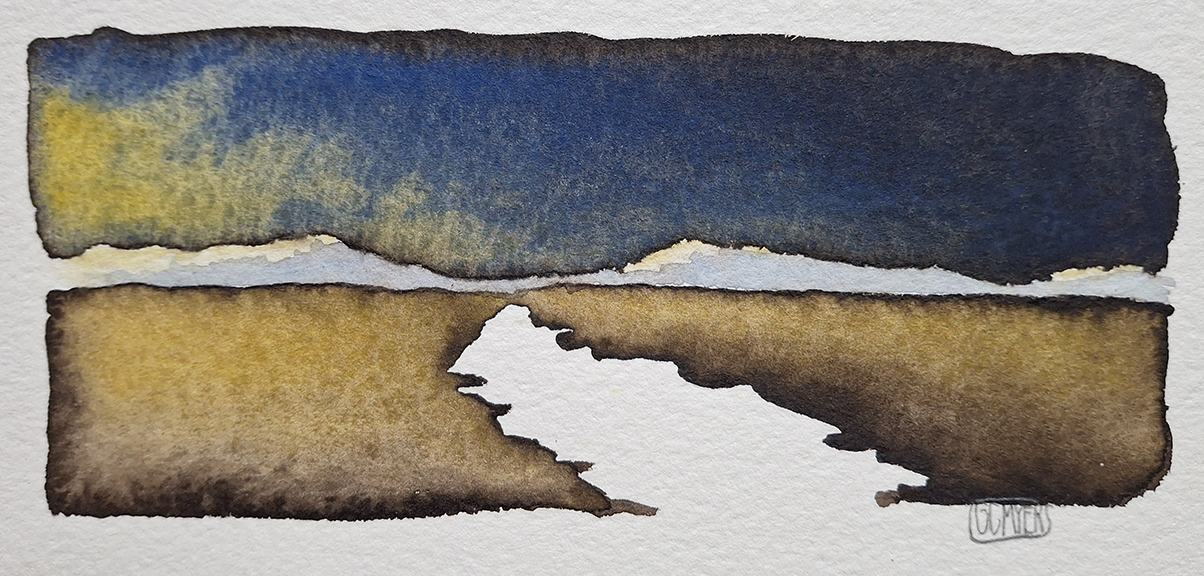
I’ve been looking at some early pieces lately, trying to differentiate in my mind how the work has changed over the years. I always come back to pieces like the one at the top, The Sky Is Always the Sky from back in September of 1995.

These early pieces focus on the emptiness of open spaces. I use the term emptiness because it seems to be devoid of all matter, save the space between the earth and sky. But I think a better term might be the Buddhist term sunyata which the Encyclopedia Brittanica defines as:

…the voidness that constitutes ultimate reality; sunyata is seen not as a negation of existence but rather as the undifferentiation out of which all apparent entities, distinctions, and dualities arise.

That infers that nothing — including human existence — has ultimate form or substance, which means that nothing is permanent and nothing is totally independent of everything else. Put in simple terms, everything in this world is interconnected and constantly changing, in a state of flux. To fully accept this concept of emptiness thereby saves us from the suffering caused by our egos, our earthly attachments, and our resistance and reaction to change and loss.

I think it was something close to this concept of sunyata that inspired early pieces like the one at the top even though I wasn’t aware to that term at the time. I do know that I felt there was more to the emptiness of vast space than met the eye, that there was meaning in the void.

As the Heart Sutra, the best known of the ancient Buddhist texts, states: Form is emptiness, emptiness is form.

Without knowing it at the time, I think this concept provided the strength in these early pieces. Their emptiness gave them form.

The reason I write about this today– and I have most likely wrote about this before as my memory is not what it once was– is that I was comparing work from back then and now and it has changed. Looking at this early work makes me realize that I was often more confident then than now. I wasn’t afraid to show emptiness with the thought that others would be able to see it as I did.

I don’t feel that I have that same confidence now.

And I wonder why this it is like this. It’s 26 years later [over 30 years here in 2026!] and I have made a career out of my work. Shouldn’t I be even more confident, more assured in my message and how it will be perceived?

I don’t know that there’s an answer. Not sure I want or deserve one.

Things change. That is the natural course for all things. To fight against this change is an attempt to fill the emptiness.

And that can’t be done.

I may be talking through my hat here. I am trying to think out loud about concepts that are far beyond my meager mental skillset. But maybe just wrestling with this idea for a while will spark something that will show itself in some new form that I can explore.

Maybe a new form of emptiness…

Read Full Post »

A New Year’s Wish

The Blue Moon Calls– At West End Gallery


I allow myself to hope that the world will emerge from its present troubles, that it will one day learn to give the direction of its affairs, not to cruel swindlers and scoundrels, but to men possessed of wisdom and courage. I see before me a shining vision: a world where none are hungry, where few are ill, where work is pleasant and not excessive, where kindly feeling is common, and where minds released from fear create delight for eye, ear and heart. Do not say this is impossible. It is not impossible. I do not say it can be done tomorrow, but l do say that it could be done within a thousand years, if only men would bend their minds to the achievement of the kind of happiness that should be distinctive of man.

— Bertrand Russell, Human Society in Ethics and Politics (1954)


a shining vision: a world where none are hungry, where few are ill, where work is pleasant and not excessive, where kindly feeling is common, and where minds released from fear create delight for eye, ear and heart…

That is my New Year’s wish. It may seem a naive request, especially given where we are as a country and species at this given moment. It might seem an impossible task but, as Russell states, it is not.

It may take much time to achieve, spanning many generations and even centuries. Maybe many centuries or even a thousand years as Russell wrote.

Unfortunately, we have become such creatures of instant gratification that anything that requires effort and time is viewed as impossible and not worth even the effort required to start since many of us will not live to see it through to completion nor reap its rewards.

That is, of course, a short-sighted view, one that discounts the incremental improvements in our world that might come as we progress along the long path towards the desired goals. There have been times in my lifetime when I have thought we were beginning to make real inroads toward this goal, that it well be possible in the near future.

But the cruel swindlers and scoundrels that Russell recognized over 70 years ago were never fully vanquished and, realizing that if the goal were to be achieved their ability to operate corruptly would be eliminated, plotted and worked feverishly to destroy any signs of progress. They knew that we are an impatient people, easily swayed by fears and the shine of empty promises.  They knew many would likely quickly throw up their hands in submission and our journey forward would stall and possibly fail.

That seems to be where we are today, at least as I see it. One man’s opinion.

But I hold fast to that goal as Russell described above as my New Year’s wish on this first day of 2026. We may not achieve it soon. Most likely will not in my lifetime. But let us be satisfied with being known as the people that had the resolve and willpower to put us back on that path of progress toward that goal.

Let us hope that history and future generations are able to view our efforts in this time not with scorn and revulsion but with kindness and gratitude.

Happy New Year.

As an example of what might be achieved with minds released from fear– Russell’s delight for eye, ear and heart– here is the late and legendary Flamenco guitarist Paco de Lucia with his Entre dos aguas from 1976. Interestingly, this song began as a recorded improvisation to fill out his first album. The album bombed badly and was pulled from circulation. But soon after this song took hold and the album was rediscovered, becoming the basis for a remarkable career.

His playing here seems impossible to most guitarists, but it has been done.

A lesson in there somewhere.


Read Full Post »

« Newer Posts