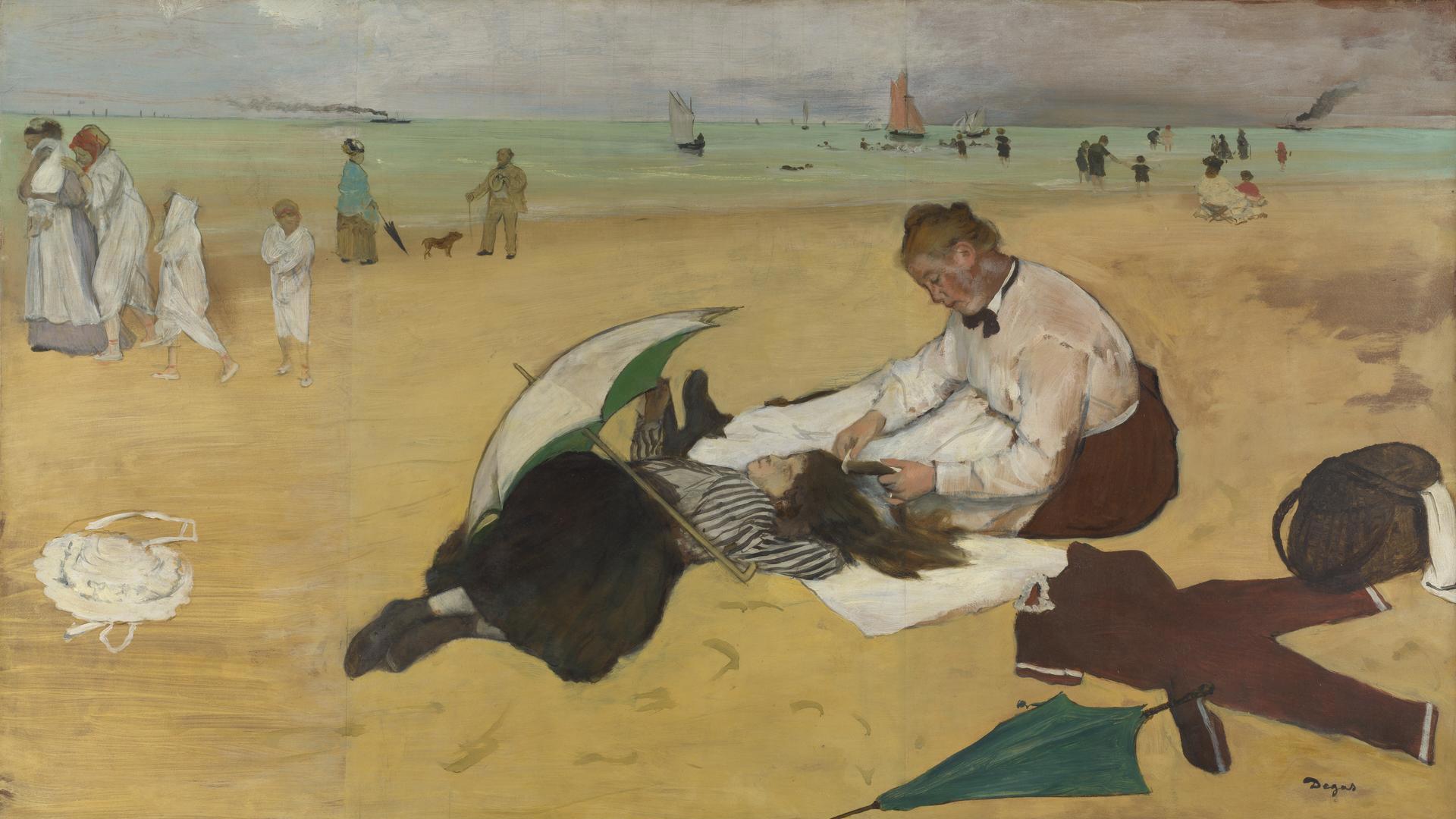
Edgar Degas Beach Scene (1870)
For how can you compete,
Being honor bred, with one
Who were it proved he lies
Were neither shamed in his own
Nor in his neighbors’ eyes;
— William Butler Yeats, From To a Friend Whose Work Has Come to Nothing (1912-13)
Starting radiation this morning so time is short. I am rerunning a post from several years back that has been garnering a lot more attention recently. It probably has something to do with that twat in our White House who posted “Good, I’m glad he’s dead” after learning of the death of Robert Mueller.
This is where we have found ourselves as a nation, stuck beneath the thumb of a government under the control of the least suitable, most despicable creature in our history. Maybe anyone’s history. Gone is any sense of decorum, integrity, or character. He has so bamboozled us that we find ourselves being dragged into angry debates about his impropriety rather than calling out the mass of corruption, deceit, criminality, and the multiple atrocities he foists on us and the world on a daily basis.
I wrote this yesterday afternoon in order save some time but had to delete a big chunk of it this morning. It was too angry. Writing about anticipating the death of someone else, even someone for whom I have absolutely no respect, seems like a stain on my own character. It goes against everything I believe in.
That is one of the many ways he has changed this country for the worse–forcing so many of us to compromise our beliefs, ethics, and morals.
Making us become something less than what we know ourselves to be.
Among the multitude of his crimes and transgressions, that may be the most unforgivable.
Hope you’ll read the post below. There have always been liars without shame. And there have always been those who stood against them with little effect, often losing everything in the process but their honor. You may think differently, but it is the latter who loom as giants in my mind.
Time ultimately reveals those honorable giants.
May we all live on as the giants we are meant to be.
 [From 2019]
I can’t say that I am a big Bill Kristol fan, the conservative political analyst, but yesterday he deftly used the excerpt above from a W.B. Yeats poem to describe the Mueller hearing of the day before. It so well described an honorable man dealing with the current occupant of the white house and his minions in congress that I wanted to know a bit more about the story behind that particular piece of verse.
It turns out that the poem from which those lines come is titled To a Friend Whose Work Has Come to Nothing that was included in a small volume of poems called Poems Written in Discouragement 1912-13.
The poem is at the bottom of the page and at first I thought it referred to someone in Yeats’ universe, a writer or artist or playwright, who had put their whole being into their work for years and years only to never be recognized for that work while others– who this person at least equals in talent and effort– gain greater recognition.
That seemed like a logical interpretation. The history of humankind is filled with such stories, especially in the arts.
Turns out there is a different story behind the poem.
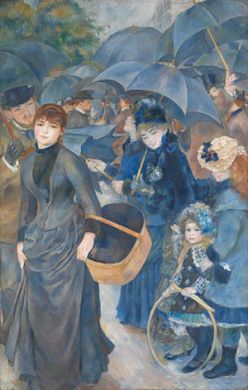
It has to do with an Irish art dealer named Hugh Lane who was trying to establish a public art gallery that would bring modern art of that time to Dublin near the beginning of the 20th century. He proposed to give the city his collection of 39 modern masterworks from Renoir, Manet, Degas, Monet, Daumier, Pissarro and Morisot so that they might establish a museum/gallery. The paintings shown here, the beach painting from Edgar Degas at the top and The Umbrellas from Renoir on the right were part of Lane’s collection.
At that time, Dublin had yet to display the new art of the age and its city fathers and religious leaders were not swayed by the offer. They viewed the new art as being decadent and with an air of libertinism to it. This turned into a heated public battle in which Yeats and others in the Irish artistic community fought to bring the new art culture to the country.
Lane and Yeats eventually lost and Lane’s collection eventually ended up in the possession of the National Gallery of Great Britain after Lane died in the sinking of the Lusitania by German U-boats in 1915. He was returning from New York where he had sold two great pieces (one was a favorite of mine, Holbein’s portrait of Thomas Cromwell) to what would become the Frick Collection. The Lusitania was only eleven miles from the Irish coast.
The battle for Hugh Lane’s collection has been fought continuously for the past century between the National Gallery and the Irish government. There are a lot more details so I am not going to get into the whole affair here. There is great article in the Guardian that goes into everything that transpired.
I just find it interesting how Yeats could turn a poem that dealt with the loss of a public debate about art and philanthropy into a poem that feels like it could be applied to many people who are in creative fields and may never realize the recognition their work may well deserve.
Or to a prosecutor dealing with a shameless liar along with his corrupt cadre of willing accomplices.
Here’s the whole poem:
-William Butler Yeats, To a Friend Whose Work Has Come to Nothing
 Redtree Times