Feeds:
Posts
Comments

Archive for the ‘At the Movies’ Category

Soundies

I heard from the filmmaker, Eric Krasner, who made the video, Yiddish Hillbillies,  that I used in Friday’s blogpost.  I will write more about Mr. Krasner’s work in another post but while looking through some of the oddities that he shows on his  CineGraphic Studios’s YouTube channel, I came across something that was off my radar screen– the Soundies.

Soundies were short, 2-3 minute, films that were produced primarily in the 1940’s to be shown in Panoram machines, coin operated devices that were often placed in bars, bus stations and coffee houses.  They projected a 16mm film from the rear onto a screen at the front, much like a TV in viewing , or into a peepshow setup where only one person could view the film.  They were pretty big at the time and many, many films were produced for these video jukeboxes.  There were music videos featuring the top bands and performers, both white and black, of the era as well as comedy bits and cheesecake videos with strippers that seem pretty mild by today’s standards.  I had seen some of these videos before but didn’t realize this was the machine for which they were produced.

With the huge growth of popularity of the television in the 1950’s, the Panoram machines fell out of favor but the films that they spawned are still around and are a treasure trove of rare performances.  Here’s a short promo video from a PBS documentary on the Soundies that gives a taste of the films.

Read Full Post »

In yesterday’s I talked a bit about some of the films that I watch in the studio as I work, mainly talking about the real classics.  I didn’t mention some of my favorites simply for the fact that I can’t watch them in the studio.  Some are pretty self explanatory, like silent films or foreign films where attention to the screen is required to simply follow the basic storyline.  I have many, many of these great silent and foreign language films just waiting to be watched when I’m not busy in the studio. I’m not sure when that will be.

But there are other films that I can’t watch because of the  way in which they’re directed and put together.  They are simply too beautifully constructed to not watch, so  much being lost by not seeing every bit of the film.  Take for instance the films of David Lean.  I love so many of his films but seldom watch any of them for just this reason.  Lawrence of Arabia is a prime example.  The scene shown above is a wonder.  There is only a few words of dialogue.  The whole scene is simply two man at a desert well as a rider approaches from far across the desert floor, fading in and out in the haze of the heat as though he were a mirage.  It is almost silent but is filled with tension.  This is only one scene in a film filled with grand wide shots that speak volumes, scenes that should not be missed in order to feel the power of the whole film.

Or take a peek at Lean’s Ryan’s Daughter, set in Ireland in the early part of the 20th century.  The scenes set on a desolate beach as the local townsfolk who support the IRA struggle in a mighty storm with waves crashing all around them to retrieve a shipment of rifles coming in to shore.  It is one of the most amzing scenes in film, mainly because it was all real.  There was no computer generated effects, no wind machines.  This was a dangerous effort, almost as perilous as the scene it depicted.  How could I not look at something like that?

I’m not even getting into his other great films– The Bridge on the River Kwai, Dr. Zhivago or the sublime Summertime, with its spectacular scenes of Venice taken from a train on which Katherine Hepburn’s character arrives.  Nobody used the train as powerfully in cinema as did Lean.  His shots of the train wreck in The Bridge on the River Kwai or his shots of the train crossing the frozen desolation of Siberia in Dr. Zhivago are masterful.

Then there’s his earlier, less epic in scale work.  The moody Brief Encounter or his now classic takes on Charles Dickens’ Oliver Twist or Great Expectations are just perfectly put together films, beautifully shot and full of great nuance. These are the work of a master, a maker of films for adults.  Watching them is really a pleasure in itself. So why would I have something on that I couldn’t fully appreciate.  Makes me want to blow off the day and watch a David Lean film.


Read Full Post »

Favorite Films?

I was out of the studio yesterday doing some outdoor projects while the sun was shining.  When I cam ein this morning there was a phone message from an artist friend who, knowing of my habit of watching old movies in the studio while I worked, asked if I had any recommended films he could borrow.  I began thinking of what films I might pull from my collection for this person who is probably twenty years or so younger in age.  It was a much more difficult task than I had thought it might be.

I mean, the films each of us enjoy, like paintings, are subject to our own personal tastes and values.  Whenever there is a list of great films made, there are very few films that are not disputed in their placement on the list.  I’m sure there are a few people who think that Casablanca, normally near the top on most lists, is overrated and not to their taste.  I don’t know this artist friend well enough to know his personal tastes so the task becomes greater.

You might say that I should just suggest my favorite movie but I don’t have any one specific film that I would call my favorite although there are films that whenever I stumble across them on television, I have to watch even if only for a short while.  Most of them are classics.  NinotchkaSingin’ In the RainBen Hur,  which features the magnificent chariot race in the photo at the top of this post.  The Philadelphia Story and just about any movie with Cary Grant and/or Katherine Hepburn– Holiday and Bringing Up Baby are both great films.  Speaking of Hepburn, there’s The African Queen with her and Humphrey Bogart, another guy who I could watch nearly everything he did including the aforementioned Casablanca. 

Or I could go with any Hitchcock  film.  That brings me back to Cary Grant in North by Northwest or Jimmy Stewart in Rear Window or Vertigo. Or Jimmy Stewart in just about anything.  Harvey Mr. Smith Goes to Washington.  Or any of his great westerns such The Man Who Shot Liberty Valance, the classic he made with John Wayne.

This quickly becomes a name association thing with one name reminding  me of another, making me realize that this could be an almost impossible task.  I haven’t even gotten around to some of my other personal favorites.  The Godfather.  Most of the Coen Brother, Capra and Preston Sturges films.  John Ford westerns– how could I leave off The Searchers?!   And about a thousand more that I don’t have time to mention and that’s without even venturing too far into the present generation of film.  I just can’t imagine making a list of ten films that I could call my favorites.

I’m going to have to call this friend today and narrow this down.


Read Full Post »

Marwencol


Last week after a post I wrote about one man’s artistic transfromation after experiencing a stroke, Al, a longtime reader, sent me a link to an interesting site about the imagined world of another man whose life had been similarly transformed and whose story is told in a documentary, Marwencol, which airs tonight on the PBS  series, Independent Lens. It’s also available streaming on Netflix. 

This fellow, Mark Hogancamp, didn’t suffer brain damage due to a stroke.  He was beaten and stomped by five young men outside a Kingston, NY bar back in 2000 to the point that he lost large chunks of his memory including that of his actual identity.  He slowly began to gather bits and pieces of his past in rehabilitation but the trauma of the attack lingered, deeply carved into his pysche.  When the Medicare funding for his rehab ran out Hogancamp started his own therapy.

That’s when Marwencol was born.  Marwencol is the name of  a small fictional Belgian village in the  World War II era world that Hogancamp’s mind began to form.  Hogancamp began a new life in the character of an American GI who found his wayto this place where all of the men were either off to war or had been killed by the German SS.  The only inhabitants of Marwencol were the women who had survived by hiding from the SS and who, in a show of their appreciation for Hogancamp, gave him the village tavern.  The towns inhabitants and the other GI’s who come to Marwencol are all fashioned and named after friends of Hogancamp.

Hogancamp, using small dolls (Barbies are used as the women) and roughly made buildings made from found lumber, recreated the village and scenes  from his Marwencol stories then photographed them.  It’s a grim world where the SS, often in groups of five, are a constant threat.  His photos are highly realistic and vividly compelling, giving a sense of experience that goes beyond the narrative of the photos and into the mind of Hogancamp.

I was able to see the documentary last week and liked it a lot, finding parts that were uplifting and humorous, including his discovery upon coming home from rehab for the first time  that he owned a couple of hundred pairs of women’s shoes and didn’t know why.  Hogancamp’s world of Marwencol is a triumph of the creative mind in coping with the reality of a very harsh existence.  But as the film ends,  there is a tinge of sadness as Hogancamp remains a very fragile, damaged soul.  I found myself hoping that he finds some way to keep this creative part alive and still find peace so that he doesn’t have to live the rest of his life in Marwencol, always under attack from the dark forces that haunt his past.

Read Full Post »

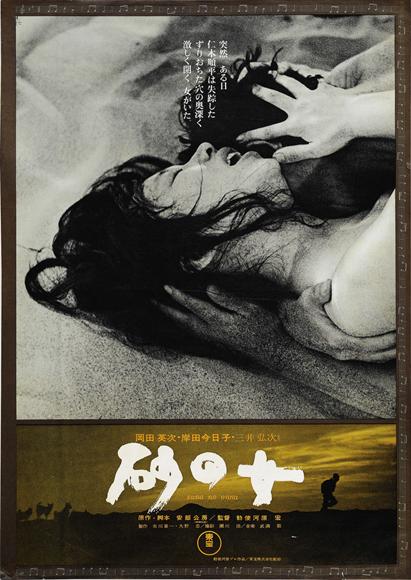
Woman In the Dunes

There’s a film starting in a few moments on TCM that really intrigued me, one I’d never heard of before.  It’s a Japanese film from 1964 whose title translates to Woman in the Dunes.  When I read the description I had to go back and read it several times to make sure I was understanding it fully.  It said “A Japanese entomologist is trapped with widow in a sand pit.” 

That was it. 

My mid began to twirl into imaginations of what this story could be.  It didn’t sound like any story I had heard before and that is pretty rare in a world where most narratives are simply variations on well worn tales.  It turns out that the story is of a man who is collecting bugs for research stumbles upon village situated among the seaside dunes.  Asking if there is a place to stay in the poor village, the locals tell him he can stay in a house that is located at the bottom of one of the large sand pits which apparently are used to produce sand for the concrete industry.  The house is inhabited by a widow.

He descends into the pit and the next day discovers that the rope ladder leading down into the pit has been removed and that he is trapped.  The  widow it seems is a prisoner whose purpose is to constantly shovel the sand into baskets.  She shovels to produce sand for the villagers and to keep her ramshackle home, and herself,  from being buried.  There’s an element of Sisyphus here.

The story becomes an existential tale of the entomologist struggling to escape then becoming accepting of his situation and living with the widow for many years, even after he realizes he could easily escape.

It sounds like such an absurd premise, especially to face at 6:30 in the morning, that I must take a look…

Here’s the trailer for it from 1964:

Read Full Post »

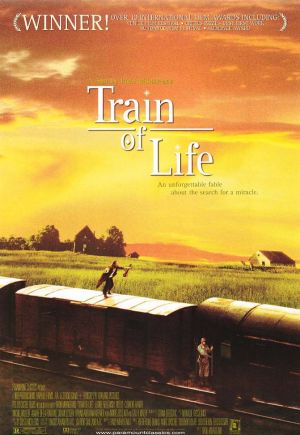
I was looking online for some music to feature today and my ear turned toward klezmer music, the traditional music of the Jews of eastern Europe.  Think of  Fiddler on the Roof, with lively music that features the fiddle and clarinet.  As I was looking I came across a clip from a film I had not seen or heard of,  for that matter.  The clip featured a group of eastern European Jews playing their klezmer versus a group of Gypsies playing their similar, but slightly coarser, music in a sort of musical face-off.

The film was a French film from 1998 from Romanian director Radu Mihaileanu called Train de Vie which translates to Train of Life.  The story takes place in a small Jewish village in eatern Europe that has a local resident return from a neighboring village where the Nazis have entered and taken over, sending the residents away on trains to the camps.  He describes the horrors but nobody takes him seriously for he is , unfortunately, the village idiot.  But the rabbi sees that he is telling the truth and a plot is formed where they would procure a train and have local residents pose as Nazis to herd the townspeople on to the trains.  The trains would not go to the concentration camps, however.  They would head for Palestine.

It has the feel, from what I read, of a Life is Beautiful, the Roberto Benigni film about the Holocaust that had comic elements concerning a tragic event in history.  A delicate line to tread.

Whatever the case, it looks interesting.  I’ll have to try to find this film soon.

Here’s the clip with the klezmer and  gypsy players–

Read Full Post »

I wrote yesterday, while descibing the initial stages of my painting process for a new piece, about stepping back from the canvas at a distance to take in the piece as a whole.  During these early stages, when I’m blocking in the painting with red oxide, I give it what I call my snake-eyed look. This entails squinting the eyes and sort of unfocusing, taking in the shapes as sort of abstract forms that play off one another.  Without taking in great detail with this snake-eyed look I am also imagining ahead in the process, seeing the shapes taking on color and how they’ll react within the composition.  It’s hard to explain except to say that it is a sort of intuitive visualization.

I got the term, snake-eyed look, from a scene from the movie Little Big Man starring Dustin Hoffman as Jack Crabb, the son of westward bound settlers who are killed in an attack by the Pawnee tribe and is subsequently raised as a Cheyenne after being foundby them  in the wreckage of their family’s wagon.  The story tells of his misadventures in going back and forth between the worlds of the Native Americans and the white man , culminating in him being present at the Little Big Horn where Genral Custer (played brilliantly by Richard Mulligan) meets his death.  Great movie and a great tale based on Thomas Berger’s wonderful novel of the same name.

In one scene Jack is reunited with his sister who also survived the massacre but escaped from their rescuers, certain they would rape her.  The Cheyenne, however, thought she was a man.  She takes Jack out to teach him how to use a handgun.  She tells him to go snake-eyed and to visualize shooting a bottle before drawing his gun.  Kind of like the description I gave above.   It’s a scene that I always think of when I find myself standing back from a painting with my eyes in a snake-eyed squint and I often wonder if I adapted this because of the scene or if my squinting  just came naturally.  Whatever the case, it worked for Jack Crabb and it works for me.

I will show the progress of the piece I wrote of yesterday in tomorrow’s post.  For today, here’s that scene from Little Big Man with that snake-eyed look.  If you haven’t seen the whole film or read the book, I definitely recommend either.

Read Full Post »

Turner Classic Movies (TCM) starts a 24 hour marathon tonight  featuring the Our Gang shorts from producer/director Hal Roach

 If you’re not familiar with the Our Gang films (or The Little Rascals, as they were also known), they were a series of shortcomedy  films produced from 1922 up until the late 30’s that featured children as the stars of the storylines.  The children acted in a very naturalistic manner and the stories often had the kids, who were poor, at odds with authority figures and the wealthy.  For the time, there was surprising evidence of racial and gender equality in these films, with girls and young black child actors performing in  starring roles.  There was a level of stereotyping that may not be politically correct today but , at the time, this equality was new and ground-breaking in films.

For those of you who do know them, simply reciting the names of some of the gang are enough to raise some memories.  There was Spanky, Alfalfa, Darla, Chubby, Stymie, Buckwheat ( parodied in a huge way later by Eddie Murphy on SNL), Farina, and Dickie among the many children who appeared in the cast over the years. Not to mention Petey, the white dog with the black ring around his eye. 

I mention this not because of any special love for these films, although I saw and enjoyed most of them over and over again as kid.  I mention it because Hal Roach was a fellow native of this area, born and raised in Elmira, going to the same high school as me.   While known for the Our Gang films, Roach is perhaps better known for his Harold Lloyd and Laurel and Hardy films.  It is legendarily said that Roach’s path in life was greatly influenced by hearing Mark Twain speak at his school when he was a young boy.  Twain spent the better part of twenty summers here in Elmira, writing some of his best loved works from his study overlooking the city, and is buried in the same cemetery here as Roach, who died in 1992 at the age of 100.  I often wonder if those same Eastside Elmira streets above which Twain lived are represented in these Our Gang films.

So, if you get a chance, take a peek tonight or tomorrow at some true Americana.  The Our Gang films represent a unique time in our history and are entertaining,  to boot.

Read Full Post »

I wrote yesterday, in a sanguine manner, of not making resolutions for myself.  But this morning, still under the weather, I have decided to contradict myself.  I will maker a resolution, dammit.  Why not?  So for this year I resolve to read all of the Roald Dahl books that I missed as a kid.  I don’t know how I didn’t come across them in my rabid reading days as a child.  I would have loved them, I’m sure, with their dark humor and their sense of ethereal justice.  I mean who didn’t feel a little better when Veruca Salt got hers at Willy Wonka’s factory?

I decided on this resolution after recently viewing the film version of The Fantastic Mr. Fox, a stop-motion animation from director Wes Anderson who made one of my favorite films, Rushmore, as well as a handful of  other quirky, funny, bittersweet films.  His debut film, Bottle Rocket, is a little known charmer.

I don’t ususally like to suggest films for anyone because, like any artform, it is  highly subjective.  I like what I like and you like what you like based on a whole series of personal preferences and opinions and often that which triggers my emotions may seem silly or shallow to you.  But I highly recommend The Fantastic Mr. Fox.  It is smart and funny and just a lovely film.

So, there.  Anyway, I am off to search for more of Mr. Dahl’s work.

Read Full Post »

Yesterday, after finally getting back in the studio after running errands, I flipped on the tube and caught the end of the classic John Ford film The Searchers.  On the day that the Coen Brothers’ remake of True Grit opened, it was fitting that they were showing what is probably John Wayne’s finest performance, as the damaged and hate-filled hero Ethan Edwards.  Beautifully shot film with layers and layers of content. 

 The reason I mention this this morning is the image shown here, the final shot of the film.  Ethan has finished his quest to find and retrieve his kidnapped niece and has deposited her with what remains of her family.  He stands apart, the darkness of the interior walls forming a frame that highlights his alienation and isolation.  He is a living ghost.

It is an image that never fails to move me, bringing forward a strong emotional reaction to it, even if only seeing it in a passing clip for a mere second or two. It captures perfectly the tenor and content of the whole story in a single iconic image.  Ethan holds his damaged arm representing his emotional scars as well and he slowly turns and walks away towards the desert as the door shuts behind, bringing the story to an end in darkness.  Just perfect.

I remember seeing a documentary on John Ford that equated his filmmaking to painting in that he looked at the compositions with a painter’s eye, letting the background become part of the storytelling process.  You can see it in most of his films.  There are shots that are so beautifully composed that they evoke an immediate emotional response.  What you hope for as a painter. 

Even now as I sit here writing this, my eye wanders up that image and I am struck by it.  I will probably have that image with me for the rest of the day, at least.  That is powerful.

Read Full Post »

« Newer Posts - Older Posts »