Feeds:
Posts
Comments

Archive for the ‘Folk Art’ Category

William Matthew Prior Self Portrait

I spent several hours yesterday at the Fenimore Art Museum in Cooperstown giving a talk to the staff  and docents about my work and the paintings hanging in my current exhibit at the museum.  Many thanks to Maria Vann and the  staff  there for making me feel so welcome and for their many questions and comments.  They are a really impressive group of professionals who make the Fenimore a world-class facility and I was honored to be able to talk with them.

There was also news yesterday at the Fenimore about one of the other exhibits that is currently on display,  Artist & Visionary: William Matthew Prior Revealed.   This is the first  retrospective exhibit that focuses solely on William Matthew Prior, the great 19th century folk portraitist and features more than 40 examples of his work.  Yesterday, it was featured in a review in the Wall Street Journal written by Lee Rosenbaum.

It’s a great show that I encourage anybody within range to take in before it closes at the end of the year.  For a real in-depth peek Rosenbaum has also posted an interview with Fenimore president and CEO, Paul D’Ambrosio.  His insights into the works really bring them and Prior to life.

Read Full Post »

I came across an item that caught my eye on the blog of Candler Arts, a great folk art site that I check out on a regular basis.  It was a page from a book with an old photo of a man standing next to a dead tree that had been carved with all sorts of figures.  Alligators, monkeys, lions, Indian heads and bunnies adorned the tree.  What caught my eye was that it said he was from an area not too far from here, just below Auburn  in the Finger Lakes region of NY.

His name was George Carr.  According to his obituary  (Totem Tree Man Dies at Age of 86) in the Auburn newspaper that appeared in 1926 after his death , he was a veteran of the Civil War, serving as a musician in both the army and navy during the war.   It also said that his carved tree was a big tourist attraction in the Finger Lakes, drawing thousands of visitors from all over the country over the years and giving Mr. Carr nationwide celebrity as the story of his tree went out in the press.  Unfortunately, it also points out that the tree was destroyed in a cyclone that struck in the previous year, bringing to an end the  attraction for tourists.

I had never heard of George Carr or his totem tree nor have I been able to find much beyond a few photos, postcards and a thin but very collectible book on Ebay, George Carr’s Totem Tree and Other Curious Things.  This lack of available info and the obvious fact that the tree and any other carvings from his home no longer exist brings me pause.  As an artist, I always consider the possibility that my work may or may not live on beyond my own short lifespan, hoping that it does find a way to continue on its own, of course.  But the thought that it might someday fade completely away but for a few images caught in photos or a few words in an old newspaper is sobering.

Art is life and life is ephemeral.  Some fortunate art will always live on, carried by a life force that is continually replenished by those who see and love it.  Some art is less fortunate and is forever lost to new eyes and new energy that could carry it forward through time.  The same things could be said for any of us.

Maybe by writing about George Carr and his Totem Tree, I am actually hoping that someday someone in the distant future will do the same for one of my paintings and help revive it in some way, even if only a memory.

Read Full Post »

Ulysses Davis- Lost Tribe in the Swamp with Alligators

I recently came across the work of another folk/outsider artist whose work really resonates with me.  It is by Ulysses Davis, a barber who lived in Savannah, Georgia, passing away in 1990 at the age of 76.  His medium was woodcarving and over the course of his life he created a very diverse body of work that had both the simple and free feel of the Outsider artist’s vision and the compositional sophistication of a fine artist.  His subjects covered a wide spectrum,  ranged from the fantastic to straight portraiture including a series of busts of all of  the US Presidents up to the year of his death. Very striking stuff.

Ulysses Davis- No No Bird

He  seldom sold his work, saying “They’re my treasure. If I sold these, I’d be really poor.”   As a result, his work never garnered the exposure or the recognition it deserved although he did receive a few honors before his death, his work showing in an important 1982 exhibit of modern Black Folk Art at the Corcoran Gallery of Art in Washington, DC.  In the years since, the American Folk Art Museum did mount a retrospective of his lifework in a 2009 exhibit called The Treasure of Ulysses Davis,  the title playing off of Davis’ own words on his work.

And what a treasure it is, one that we are fortunate enough to at least share in images and in a few museums.  Beautiful work with a unique vision…

Ulysses Davis- Get Off My Back


Read Full Post »

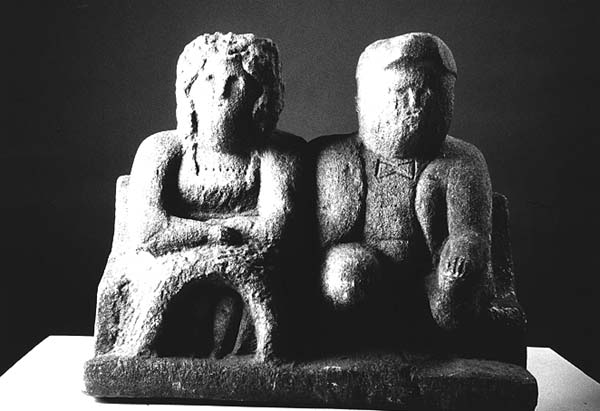
I was out in the driveway with some old pieces of stone when I heard a voice telling me to pick up my tools and start to work on a tombstone. I looked up in the sky and right there in the noon daylight He hung a tombstone out for me to make.

—–William Edmondson, on his inspiration to begin sculpting

****************

My last post was about the grand paintings of the Renaissance era, beautifully crafted pieces from painters who were extensively trained under master artisans so that they could capture the religious spirit that was the subject and inspiration for most of the work of that time.  But that post made me think about how others, less schooled and less well equipped, translate this same inspiration into forms.

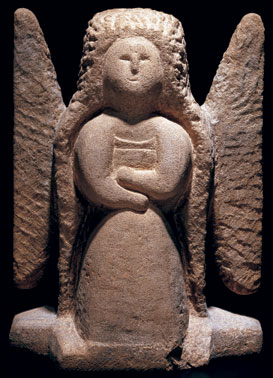
That  thought brought me quickly to William Edmondson,  a man born in 1874 in Tennessee to former slaves.  Edmondson worked in a number of jobs throughout his life, losing his job as a hospital orderly in the late 1920’s when he was in his mid-50’s.  It was at this point that he had the vision he describes above which led to him to begin sculpting for two African-American cemeteries in the Nashville area.

 Using handmade tools such as a chisel made from a railroad spike and working on discarded chunks of stone from building sites, it soon became clear that Edmondson had a true affinity for capturing the essence of figures in stone with forms that were spare but elegant with subtle shaping.  I see a simplified elegance in much of his work that cannot be taught, that is simply an expression of the artist’s self and spirit.

Edmondson sculpted for the next couple of decades until his death in 1951, gaining acclaim as perhaps the finest American folk sculptor of the century.  He was the first African-American artist to be featured  in New York’s Museum of Modern Art in 1937 and his work is still celebrated today for its extraordinary qualities.

Edmondson’s called each of his sculptures “miracles,”  something that strikes very close to home for me.  I think it’s that feeling of having something emerge from your hand that seems to transcend what you are as a human, something that is more than the sum of your own parts.  I have sometimes been fortunate enough to have experienced this and have felt that same sense of wonder at this miracle of creation.  It’s a wonderful moment that serves as  inspiration to continue to push forward with the work, to continue the inward journey.  It’s a true  pleasure to see Edmondson’s inspirations come to life.

Read Full Post »

I’ve written here before about some of my favorite Outsider artists, those untrained artists who follow their obsessive need for expression even as they suffer hardships such as illness, extreme poverty and mental disabilities.  People like Martin Ramirez, the Mexican-born artist who was committed to an asylum in his thirties and spent the rest of his life, 30+ years, locked away as he created an amazing intricately designed world in his art. 

There was another artist years before Ramirez whose road was very similar and who work was as deeply designed and engaging.  It was the Swiss artist Adolf Wolfli who was born in 1864 and died in 1930, about the time Ramirez was committed.  Wolfli was considered one of the first acknowledged Art Brut artists, as Outsiders are called in Europe and, like Ramirez, he had a difficult life that ended with him living the greater part of his life locked away.

Wolfli, an orphan at the age of 10, was physically and sexually, abused throughout his childhood.  He suffered from severe mental illness which manifested itself in vilent outbursts and hallucinations.  It was this and a series of child molestation charges that led to his committal in 1895.  He was about 31 years old.  He never left. 

He began to draw at some point during his life in custody, it soon becoming a true obsession as his inticate drawings covered every scrap of paper he could lay his hands on.  Walter Morgenthaler, a doctor at the psychiatric hospital who documented Wolfli case in a book, wrote this about the extent of Wolfli’s obsession:  Every Monday morning Wölfli is given a new pencil and two large sheets of unprinted newsprint. The pencil is used up in two days; then he has to make do with the stubs he has saved or with whatever he can beg off someone else. He often writes with pieces only five to seven millimetres long and even with the broken-off points of lead, which he handles deftly, holding them between his fingernails. He carefully collects packing paper and any other paper he can get from the guards and patients in his area; otherwise he would run out of paper before the next Sunday night. At Christmas the house gives him a box of coloured pencils, which lasts him two or three weeks at the most.

Wolfli’s work incorporated musical notations that were woven into the designs, an odd looking notation that seemed purely ornamental but was later proven to be an actual  idiosyncratic notation sysytem that could indeed be played.  Wolfli would sometimes play the music on a paper trumpet he had crafted. 

Wolfli produced a prodigious body of work in his years in the asylum, including a semi-autobiographical epic that was a massive 45 volumes in size.  It consisted of over 25000 pages and 1600 illustrations.  His work has been largely kept together as a collection which is in the Museum of Fine Arts in Bern, Switzerland.  There is also the Adolf Wolfli Foundation which was formed in 1975 to bring his work to the attention of the public through education on and exhibitions of his works.

Like many of these artists about which I write, Wolfli’s work is new to me.  But it is so immediately grabbing in its design and its harmony of color and form that I am enthralled by it.  When I clicked on the Google images page for his work, there was such a gorgeous continuity that ran through every image on the page that I found it hard to choose which image to explore first.  Such beauty revealed in the dark recesses of a life spent locked away.

Read Full Post »

I have a real soft spot in my heart for self-taught and outsider artists, the untrained artists who are driven to create by forces that no one truly understands.  There is something about their passionate need for expression that really fills in the voids of the work they do,  making their sometimes unsophisticated creations sing as a reflection of the artist.  Many of these artists have interesting stories or lives that have been overtaken by their need to create their work.  One of these is the late Lee Godie.

Godie (1908-1994) showed up on the steps of the of the Art Institute of Chicago in the late 60’s and for the better part of the next three decades was a fixture there, hawking her rolled canvas paintings to museum-goers and art students.  Her work was often made in ballpoint pen and watercolor and depicted mainly figurative work, often fashionably attired people in a style resembling fashion plates.  Over the years,  her work and her persona became almost legendary in the Chicago area and there was a career retrospective of her work at the Chicago Cultural Center in 1992,  just two years before her death.

I mentioned her persona, which may have been the biggest part of her work. While little is known of her life before her years as an itinerant artist on the steps of the museum, she was a big personality.  Although not French and with work that was not of the Impressionist school of art, she called herself a French Impressionist and often attached the title to her name on the back of the canvases she painted.  It was actually a nod to the inspiration she got from the Imprssionist paintings she saw in the museum.  As she said of her favorite artist , “Renoir was the greatest artist of all time. He always said he painted beauty. Now I always try to paint beauty, but some people say my paintings aren’t beautiful. Well, I have a beauty in my mind, but it isn’t always easy to make paintings beautiful.”  

Like many Outsiders, Godie lived a hard and homeless life, often sleeping in the bus terminal or, when sales were good, in flophouses.  But it didn’t deter her search for beauty.  One of the interesting things she did was to take advantage of the bus terminal photobooth, taking a series of photos over the years of her in different personas, often in heavy stage makeup.  She would often touch-up these photos with the colors with which she painted, creating photos that in themselves are as much works of art as her paintings.

I didn’t know much about Lee Godie before stumbling across her work but there is something quite special in her work, a childishly naive yet full view of her world that reaches out beyond the surface.  Knowing a bit more of her story makes that sensation even more profound.

Read Full Post »

« Newer Posts