Feeds:
Posts
Comments

Archive for the ‘Influences’ Category

I’m back to painting after a hiatus of about five weeks, one of the longest periods I’ve went without lifting a brush in the past fifteen years.  I really felt it was necessary at this point to just step back and take a pause.  Take a deep breath and let things build back up inside.

The last few days I’ve been working on a new piece that is a continuation of the Red Roof series.  It felt pretty odd, at first, to step before the easel again after such a long period.  In fact, I kept delaying it for the days before I finally started.  There was a slight fear that it would be a struggle to find anything there and it was easy to let myself be distracted by any and everything.

But I was finally there.  I had a knot in my gut and was really unsure but, as I do with the Red Roof pieces, I started with a block of color in the bottom left corner and suddenly the anxiety began to lift.  This first block started a chain of actions that began to spread, even before I painted them, across the canvas.  All the distractions receded to a point far in the distance and I was completely in the moment there in front of the easel.

Man, it felt good.  Felt right.

There are still distractions that pull time away from this feeling.  It still is going to take several days to be in full rhythm which is, as I’ve described before, a very important aspect in my process.  The rhythm I’m talking of involves total immersion in the surface, free of all distraction.  Every action is effortless and immediate.  There’s a freeing of something in the mind that allows color and form to flow easily out.

That’s still some time away but that first hour or so with the brush in hand let me know it was there to be attained.

It felt good.

Read Full Post »

They showed the 2009 Kennedy Center Honors on television last night.  It’s always an interesting show, highlighting the careers of some of the most enduring and venerable performers and entertainers.  A virtual who’s who of our culture over the last half century.

For me, this years group of honorees was as good as it gets across the board.  You had high culture with operatic hero Grace Bumbry, jazz culture with the ever hip piano of Dave Brubeck, rock and roll with Bruce Springsteen, the world of comedy from Mel Brooks and the ultimate in dramatic acting from Robert De Niro.  What an incredible group.

One of the highlights for me was the absolute look of joy on Dave Brubeck’s face as his four sons joined in to play a medley of his compositions.  The night fell on his 89th birthday and he seems to be a testament to the longevity of those who are able to follow their passion.  I don’t know squat about jazz but what I feel is that Brubeck’s work has appeal across the spectrum of listeners out there.  There’s enough stellar playing and complicated rhythms to satisfy real jazz fans yet it’s incredibly accessible to the less savvy, like me.  Great stuff.

Of course, the other was the tribute to Bruce Springsteen.  I’ve been a big fan for well over 30 years and it’s been interesting to see how he has transformed into an elder statesman of  popular music.  I think that Jon Stewart hit it right on the head for me when he spoke of Bruce’s willingness to empty the tank for his audience every night as being the thing that most struck him and influenced him as a young fan.  I know seeing Bruce when I was younger made me hungry to find something, anything, that would make me feel that same passion and commitment in my own life.  Something where, like Bruce, I could give everything I had.  The medium wasn’t important.  It was all about the spirit of the effort, the total dedication to your own vision.  That is always in the back of mind when I see him, even today.

I remember writing a letter in the 70’s (long before e-mail) to Dave Marsh, the Rolling Stone editor who had just written an early bio of Bruce, describing how the music affected me.  I was working in a factory and couldn’t see anything on the horizon but when I listened to Bruce I was no longer a loser, a factory drone.  I had hope.  It was very much how Jon Stewart described his own experience.  Marsh responded with a lovely handwritten letter, that I still prize today, telling me how he was moved by my letter.  That, too, served as inspiration to search further, to give more.

Thanks, Bruce, for the inspiration.  You deserve this honor…

Here’s nice version of My City of Ruins from night’s show, performed by Eddie Vedder.  Enjoy.


Read Full Post »

I’ve been doing some genealogy lately.  Don’t worry- I won’t bore you with all the details of my family.  Nobody wants to read that.

But doing so raises the question of why I’m doing this.  What is the purpose in looking back?

Growing up, there was never a sense of history in our families.  It felt as though our family lines had started one or two generations before, little known before the lives of our grandparents.  Hardly anything in the way of familial knowledge was passed down, either in words or objects.  It gave a feeling of being disconnected from the rest of the world.   It left me wondering if the place we occupied in life at the moment was always this same niche.  How did we arrive at this point?

For example, there’s a side in my family that seems like a hopeless lot.  Barely educated with many being illiterate.  Poor.  Prone to violence and crime.  The only stories I heard about this side of my family were lurid accounts of fights breaking out at funerals where the casket ends up overturned and guys kicking out the screens of their televisions while watching professional wrestling.  There were other stories that were worse than that but I’ll keep them to myself, thank you.

The point is, how did they get to this low level?  Were they always like this?  Were they always stupid?  Were they always fighting themselves at the bottom?

When you’re trying to figure out who you are and you see that half of your past is less than inspiring, you begin to wonder.

So I begin to dig, putting together a fragile puzzle with bits and pieces spread all over the place.  I use all the online resources I know of to gain  bits and pieces of info.  There’s hardly any movement then, with a single piece of found information, there’s a landslide of information and the pattern of this family seems to be uncovered.  Their place in the web of the world is there to be seen, not hidden anymore under layers of ignorance and shame.

I felt like an orphan discovering the name of his parents, feeling connected with a knowable history.

And for this side of my family, it was truly enlightening to view their line.  They seemed to be the products of nothing but ignorance at this point but it was not always the case.  Their decline was many, many generations in the making.  They had been religious scholars and among the wealthy merchant class of northern Europe going back to the mid-1500’s.  Recruited by William Penn and coming to America they had been among the first settlers of Philadelphia. They fought with Washington at Valley Forge.  They moved westward, forming some of the earliest frontier settlements in Virginia and beyond.

But as they went, there was a serious erosion of the value they placed on knowledge and learning as evidenced by the numbers of them who were marked down in censuses of the 1800’s as being unable to read or write.  While their family line had once been at the forefront of the great movement west as leaders and landowners, they gradually settled into a life as tenants and farm laborers.  Each generation bringing them closer and closer to the version of this family that I now know.

So what’s the purpose of this whole exercise?  I don’t really know for sure.  For me, it’s finding that my family was an active part of the American past, that there is a foundation down there under the rubble.  It’s a newly found pride in a name that I didn’t want to claim as part of me.  It’s knowing that a positive contribution to the formation of this country has been made and that this line of the family is a real part of the American experience.

It also points out the value of knowledge and education in the survival of a family.

And a country…

Read Full Post »

This painting, And Into The World  There Came a Soul Called Ida, is the work of the late Ivan Albright.  Not a household name by any means, but if you’ve seen his work you’ll definitely remember it.

I saw a large  retrospective of his work a number of years ago at the Met and was fascinated ( and a little creeped out) by his subjects and the darkness and tone of the work .  But it was the incredible textures of the paintings that I found amazing.  They were very sculptural on the surface, with deep moonscapes of color, layer after layer of paint that seemed to be shoved and mashed on to the surface.  It was unlike anything I had ever seen.  It was obviously the product of a huge amount of labor but it wasn’t labored.  There was something very beautiful there that transcended the unflattering depictions of the paintings.

Albright was best known for the painting he produced that was used in The Picture of Dorian Gray, the 1945  film version of Oscar Wilde’s famous novel of a corrupt young man who defies the ravages of time while his portrait reflects the true result of his debauched life.  It was the horrifying image at the end of the film.

I’m still fascinated by his work even though I have to admit I get a queasy feeling when I really take in the whole of his characters, like seeing a car wreck and not being to turn away. They are horrible and beautiful at once.  I now also really appreciate the epic efforts that must’ve went into creating these pieces, the hundreds of hours that must have been spent.  The patience of maintaining vision.

So check out the work of Ivan Albright.  He had great titles, as well.  You don’t have to like his work  but you should be aware of it…

Read Full Post »

I’ve been writing lately about browsing the newspapers of the early part of the last century. That era has always held a particular attraction for me because of the energy of the wide sweeping change that was taking place across all aspects of our world.  The transition from a horse-drawn world to the automobile.  The beginning of man in flight.  The beginning of true mass communication in the form of the recording and radio and film, a move away from live entertainment.  Everything was speeded up, changing faster and faster.  It was the birth of the Modern.

In art it was no different.  It was a transitional period away from the traditional, from the studied, academy-trained artist to the more expressive, individualized artist.  Modernism.

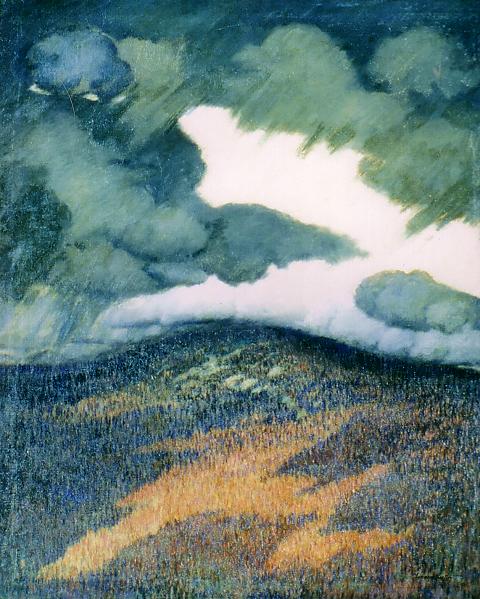
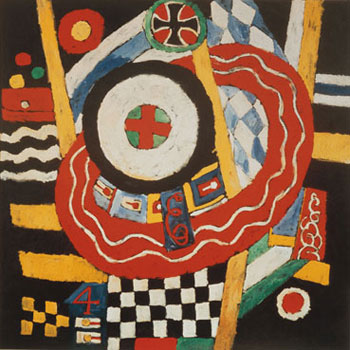
One of my favorites from that time is Marsden Hartley, a Maine-born painter.  I’ve always been attracted to a series of collage-like paintings he executed that are painted on a black ground, such as the one above, Portrait of a German Officer.  I love the way he puts his forms and colors together in these pieces, giving them a real visual impact.  His landscapes, such as Storm Clouds shown here, have that organic feel that I really like and look for in my own work.  By that, I mean that his shapes have a natural, human-like roll and feel.  I can’t really describe this well.

But it’s there.

There are stories behind many of his collage-like pieces. for instance, Portrait of a German Officer, was an homage to a German officer of WW I, the cousin of a close friend with which Hartley had been enamored ( he was gay) before being killed in the war. Knowing this gives the piece new meaning, added depth.

I know this is not a great lesson on Hartley or his work but there is more info out there, if you’re interested enough to look. He’s not the best known artist of his time but his influence continues…

Read Full Post »

I was looking for a painting in my files and came across this piece, Time and Tide, from a few years back.  It was a piece, an 18″ by 25″ image on paper, that  I well remember but had lost a few of the details in the creases of my memory.  I had forgotten how well this piece came together and the impact it carried.  Even though it possesses many of my standard elements, such as the red roofs, it feels as though it is a bit of an anomaly.  Maybe that’s why I had to stop over this image and look for a while.

The title, of course, is a reference to the old proverb, time and tide wait for no man, which is basically saying that all men are equal in the eyes of time and nature, that no man has any greater reign than another in those realms.  We are all equally powerless before the passing of time and the movement of nature.  It’s a message that I often see in my work, or at least hope to see.

When I stop to look at pieces from the past, I’m always looking at the differences in the textures and the way I’m handling the colors from what I’m doing currently.  Sometimes I’m able to find something that I really liked in the piece, something I was using that really contributed greatly to the piece, that I was not consciously aware at the time.  It was just part of the process.  For instance, the texture in the open part of the sky in this piece was just done in the way I normally would do that at that point in time.  But as time goes on there are subtle, unthought of  changes in the process that after a time alter the whole feel.  So when I look back what I’m trying to ascertain is how a painting of mine is different and if those differences are things that I might want to revisit. Perhaps I was at a certain juncture then and moved in one direction yet there was another direction available– do I want to step back and try that other direction?

That’s the beauty of art, one can go back in time in a way and for a while defy time and tide….

Read Full Post »

This week, after having made deliveries of new work to the galleries that represent me over the last week,  I’ve been catching up on some maintenance around the studio, getting things ready for the upcoming winter.   It’s a break from thinking about painting and a chance to recharge the batteries.  Sometimes much needed recharging.

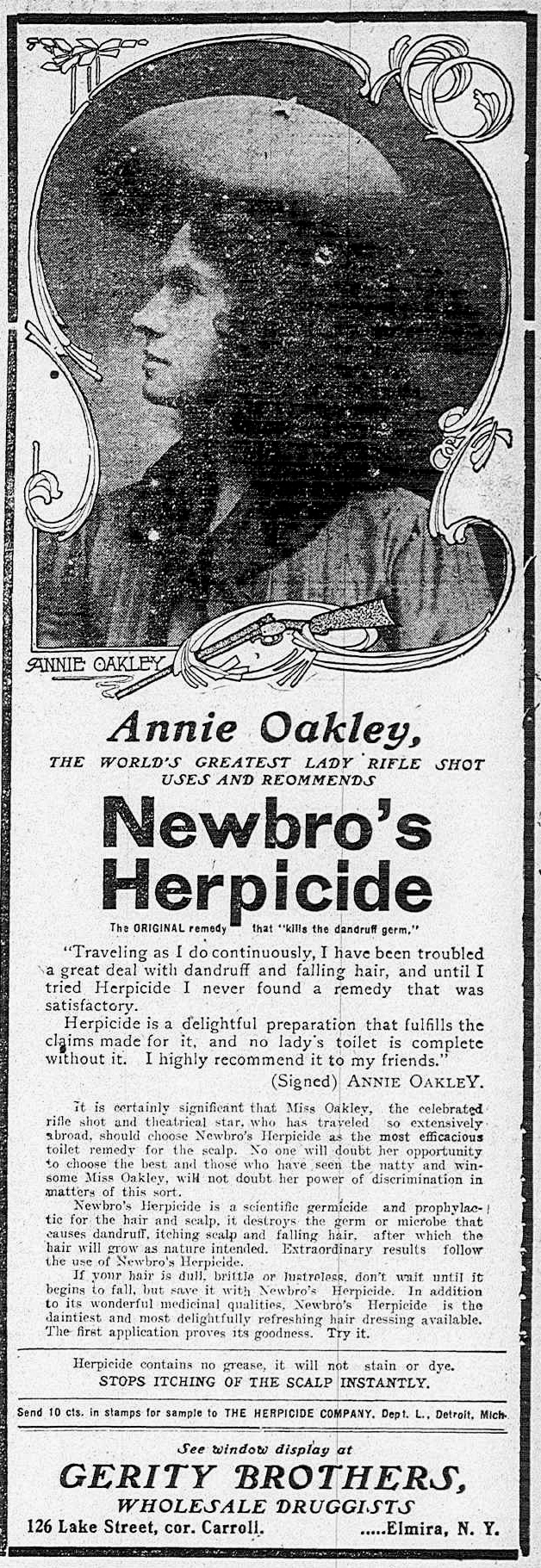
As I mentioned in a post a few days ago, I’ve also been spending a little time looking at old newspapers as I do a little research into a few ancestors.  It’s also really interesting to see an article concerning a relative next to an ad of that time, such as the one shown here, with Annie Oakley endorsing a dandruff shampoo.  It makes you realize what a transitionary period those early years of the 1900’s were, with so many aspects of rapid progress taking place in a world that had changed much slower for centuries before.

For instance, in the article that was near this ad, there was an account of a wrestling match here in Elmira.  Wrestling was a big deal around here back then with matches held several times a week in various locations such as men’s clubs, hotels and the gyms of local athletic clubs.  The story here told of the night opening with a vaudeville-type tumbling exhibition from a touring wrestling family complete with selections sung in rich baritones.  There was a short boxing match followed by someone performing ragtime, which was new to that time.  The headline event, usually a match between heated local rivals or a local favorite facing a touring pro, finished up the night.

I had heard stories that my grandfather, Frank “Shank” Myers, had lived and participated in this rough and tumble world but had never seen any evidence until I started reading these old papers.  But there he was, a 17 year old kid described as an Eastside mat ruffler, rolling around in smoky halls with strangleholds and body throws.  In one little notice, he was advertised as the preliminary match for a match headlined by Americus, shown here, who was touring pro who would come into town and take on the  best of the locals.  It was to be held at a hall in a local hotel that had been remodeled for the event.

I was able to find several articles with his exploits but only in a short period of time due to the lack of continuity in the newspaper availability from that time.  I did find a few pieces from a few years later, in a match from Binghamton, a slightly larger city about 60 miles away, between a Binghamton man and a well-known champ from NYC, where he was mentioned.  He was introduced to the crowd as the lightweight champ from Elmira and he issued a challenge to the Binghamton grappler, for a match to be held there, in Binghamton , or Elmira.

I may never know if this match ever took place but it ‘s great to finally fill in little details of a world that only existed in a cloud of familial myth. An interesting time…


Read Full Post »

This is a painting from back in 2002 titled Muse.  It was part of a series I was painting at that time, in the months after 9/11, that some of my galleries still call my Dark Work. It was painted in a style that I call my obsessionist style these days, meaning that it is painted by building layers of color over a dark ground as opposed to the reductive style I have used so much in the past where I apply a lot of wet paint, puddles, then pull it off the surface until I reach the desired effect.

When I was doing these paintings they seemed like a stark contrast to the reductive work, especially given the tone of that time.  They were well received although not with same gusto as the lighter, more transparent,  work.  I felt very strongly about this work but allowed my desire to please the galleries need for my most sellable work override my desire to pursue this work to further levels.  I moved back to primarily painting the wetter reductive work and was able to continue to push that work further through color and texture.  I never regretted the move back to this work but there was always a little nagging voice in the back of my mind that I hadn’t pushed the other work to its full destination and had let outside influences hinder an inner process.

I have begun to see my body of work as my own personal narrative, the story of who I am and how I am seeing my world at any given time.  In order for it to be so it must be an honest and complete reflection, guided by my own inner muse and not outside forces telling me what I should or should not do.  It took a while but I realized that I have the ability and right to control my own personal narrative, to tell my story in my own way.

I’ve done this in many ways for years already.  I am constantly given ideas for paintings or am requested to do commissions but seldom do I follow up on them unless they fit in with where I see my work heading.  In that aspect, I normally reject outside influence.  I stick to my narrative.

The piece above, Muse, actually fits this post well in that it now belongs to a man who asked me to do a painting of his son, a truly gifted guitarist.  He sent me photos and they were wonderful.  He was long and lanky with a really interesting ethereal  look, a portrait painter’s dream.  In fact when I looked at the pictures I could only see him as painted by other painters I know.  I struggled for a while trying to do something with this but in the end I realized it wasn’t part of who I was at that point, not part of my narrative.  I let it slide and after a long while, apologetically explained this to the father who was extremely gracious.

So I am back focusing more, at this time, on this obsessionist work, allowing it to be a bigger part of my story.  I will continue to paint in the other style but I just feel that there is something waiting to be told, something to be discovered in this other work at this time.  That is my decision made without outside influence, my choice for my personal narrative.

Read Full Post »

I wrote the other day about doing some genealogy about my great-grandfather, Gilbert Perry, and how interesting it has been in reconnecting with an ancestor about who I knew so little about.  One of the great pleasures has been reading the old newspapers from the late 1800’s that are available online via  the Northern New York Library System.  I am constantly fascinated in browsing the ads and notices of the times, seeing how day to day life changed and evolved.

This ad for a balloon ascension with Professor Squire, a la The Wizard of Oz, at the Franklin County Fair in Malone, NY appeared in the September 2, 1872 edition of the Malone Palladium.  It was on the front page alongside accounts from the Republican convention of that year where Ulysses S. Grant was nominated for the presidency as well as death notices, ads for pianos (they were selling Steinways up there!) and dry goods.  Ads looking for tin peddlers, a furniture dealer selling metal burial caskets, a lumber dealer, carriage painters and a mail order ad for a tea dealer on Wall Street in NYC.  There was a list of  rules of behavior that would be enforced at the Fair.  No drinking or betting on the trotters.

It was all pretty interesting, a glimpse into that time, but the part that caught my eye was near the top of the page, just under the death notices.  It was a Notice of Liberation where my great-great grandfather, Francis Perry, was giving Gilbert Perry, my great-grandfather, the remainder of his minority, giving him freedom from furhter financial obligations to his father.  Gilbert was free to transact business as he saw fit.

It was at this point that Gilbert formed his first crew and headed into the North woods with his first contract to deliver logs.  He was just 18 years old.  He continued to be a logger for the next 60 years, only stopping a few years before his death at age 81.  My Aunt Norma has recollections of visiting his farm in St. Regis Falls when she was small girl in the early 1930’s.  She said there were big log sleds scattered all around, the type pulled by teams of horses.  He was throwback even then to an earlier time before big tractors and chainsaws.

So in this little piece in this little newspaper from the north I see the beginning of my great-grandfather’s world, one that led to my grandmother’s much different world and to my father’s even more different world to my world which would probably seem incomprehensible to a man so at home in the woods.  Or maybe not…

Read Full Post »

GC Myers 2002Sometimes, at this point in my year, I spend a considerable amount of my time revisiting past work, going through old image files or leafing through older work that I still have in my possession.  It’s kind of a reminder of how my mind has been sparked in the past and I’m always looking for a revival of that spark, especially at the end of a period of time when I have been working a lot and have fallen into what I feel is a too predictable pattern with my painting.

I tend to focus on the odd little pieces when I’m doing this.  Pieces with figures in them, odd compositions, odd shapes- things of that nature.  I came across this little triptych from 2002 and had to linger over for a bit.  I remember it well, the way the surface had a smoothness, almost enamel-like finish and the way the three pieces played off one another.   I never fully understood the meaning behind this piece but I was always reminded by it of the music of Richard Thompson, a writer of many wonderful distinctive songs, many of them with dark undertones.

So, I’ll keep looking back, hoping for a rekindling of inspiration,  and in the meantime, here’s some Richard Thompson with Mingus Eyes

Read Full Post »

« Newer Posts - Older Posts »