Feeds:
Posts
Comments

Archive for the ‘Influences’ Category

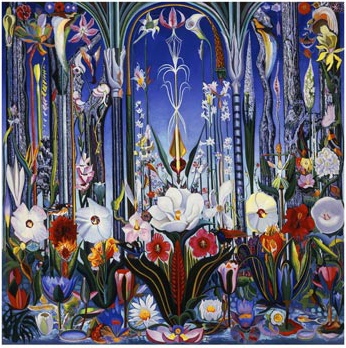
Joseph Stella Flowers, ItalyWhen I see the paintings of Joseph Stella, particularly his modernist work, I am immediately engaged.  They seem dense and complex, almost manic in their compositional content, yet the color and symmetry have an effect that I find calming.  I often wonder how Stella viewed this work, what he felt from it.  Not in an artspeak sense.  Not academic jargon.  Just how it made him feel.

Stella (1877-1946) was an Italian immigrant to this country who has often been linked with several movements- modenism, futurism, and the precisionism among them.  There is a contradiction in this in that everything I find about him points to someone with an outsider’s mentality, someone who never felt himself a part of any group  and with an “antipathy for authority” with which I identify.  Joseph Stella Brooklyn Bridge

Maybe that’s what I see in the work.  I don’t know.  I do know that I am drawn to the boldness and beauty of it.  The strength of the lines.  The depth of the colors.  The sheer visceral bite of the  image that when taken in as a whole seems to engulf you.  Gorgeous stuff.  Work that makes me feel smaller, even tiny,  for a moment yet inspires me to want to move my own work further ahead.  To grow and expand.

Maybe that’s how I classify other’s work in my head- by how much they make me want to do better, by the way their work’s impact becomes an endpoint for me, a goal that I hope to achieve.

The work of Joseph Stella is definitely such an endpoint.  Now I must work…

joseph stella fountainjoseph stella old brooklyn bridgejoseoh stella

Read Full Post »

Poole Early MeltI am currently in the process of getting ready for my annual show at the West End Gallery in Corning, NY.  This exhibit, titled Dispatches, is my ninth solo show at the gallery which was the first gallery to exhibit my work, starting back in 1995.  

For the past several years at the West End, the show that is hanging in the month or so before my show is from one of my favorite artists,  Martin Poole, who also lives in this area.  Marty’s work is always beautiful, with wonderful handling of the paint and luminosity in his colors.  There is little he can’t do with a brush and it shows in all the genres he paints.

Poole CassandraHis landscapes are filled with light and space, often immense, complex  skies that fill the picture plane.  His portraiture goes beyond traditional portrait painting.  For Marty, it’s not enough to paint a superb representation of the subject- it’s more important to have them be mere components in a beautiful composition, which makes for a more interesting viewing experience for all.  Marty’s unique eye comes through in everything he paints and other painters usually just sigh resignedly when they look at his stuff.Poole Long Talk

I know I have on more than one occasion.

It’s always a daunting task to follow Marty’s show at the West End.  His shows are always filled with beautiful, strong work that draws raves and oohs and aahs.  You never want to be the one who comes in with a lackluster show after Marty sets the bar a little higher each year.  So, I work a little harder after I see his show each year and hope I can match his consistency and his obvious commitment to his work.  It’s the sort of pressure that some artists don’t enjoy, having to follow the show of a highly skilled and well known artist.  I can’t say I enjoy it but I know it provides an impetus to continue striving, to continue to grow my work.  For that alone, it’s a pleasure to follow the Martin Poole show.

You can see the work of Martin Poole in a number galleries throughout the country including the West End in Corning and the the Principle Gallery in Alexandria, VA.  His current show at the West End hangs until July 18.

Read Full Post »

Alfred E. NeumanOne of the great things about the internet  is being able to, with a few clicks, come across things and images that have been stored away in your memory for a very long time.  The characters that lived so vividly with you as kid come back to life the second you see them, taking you back to specific memories associated with them.  For me, many are cartoon characters and other highly visual creations, all influencing my eye.  I probably shouldn’t be admitting that. 

Maybe it’s simple nostalgia but there’s something kind of comforting in seeing these icons from your past for just a moment just to know they’re still there.  Many have never left, such as the eternally grinning Alfred E. Neuman from  Mad Magazine or the icon of all kid icons, Snoopy,whokid snoopy_cool holds a special place in my memory.  Snoopy was the first thing I really learned to draw well.  A kid on my school bus, Tom  Hillman, who was a couple of years older and a drawing whiz, showed me the basics of how Snoopy was put together with a few simple circles and ovals and a curved line here and there.  It seemed like magic and I was hooked.  I drew Snoopy everywhere.  I particularly liked drawing him when he was in the character of one of his alter egos such as the World War I pilot battling the Red Baron, or Joe Cool who was definitely the Big Man on Campus.

Spy Vs. SpyMad Magazine also provided a wide variety of other imagery from the their wonderful parodies of current TV shows and movies to their great back covers that you had to carefully fold to reveal it’s true content to the regular strips such as Spy Vs. Spy, with its Cold War characters trying to off one another in every issue.

Ed “Big Daddy” Roth was in his heyday in my youth and his Rat Fink kid ratfink_logo_smcharacter was the hero of young boys everywhere.  There was a sense of anarchy  and chaos in his drawings that really appealed to kids in the 60’s.  I think every kid wanted to sit in one of his crazy hot rods for just a minute and feel the tires screeching and the heat from the flames blowing out the side pipes.

There are so many more images I could show.  Great cartoon characters.  Great characters from kid books.  Advertising icons.  All littering my memory and still living somewhere on the web.  If you want to just look…

Read Full Post »

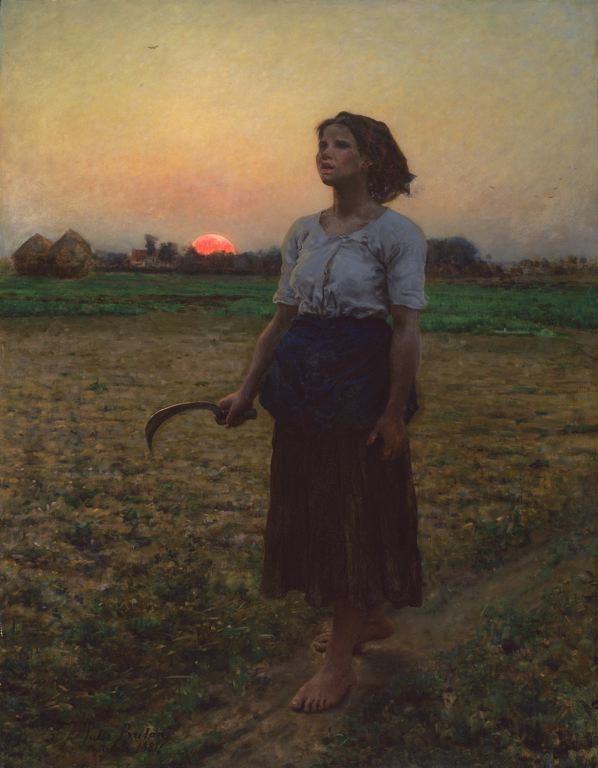
Jules Breton "Le Soir"My first real exposure to genuine art came when I was a kid in the early 70’s, going to school at Ernie Davis Junior High on Elmira’s east side.  My father worked at the Sheriff’s Department which was just several blocks away so after school I would walk down there to ride home with him.  It beat the school bus ride which could be a real drag because I was the first kid picked up in the morning and one of the last dropped off at night, an hour or so each way.

So after school I would head downtown where I often ended up at the Newberry’s store that had an old pinball machine tucked away in the corner of it’s basement, hidden among the knick knacks and housewares.  Great machine.  Only a dime a play.  Spent too much time there.  More often though I ended up at the old Steele Memorial Library, a beautiful old Carnegie endowed structure that was like a treasure chest.  I spent hundreds of hours there, reading and exploring the stacks behind the reception desk that you entered by climbing a tight cast iron stairway.  What a great atmosphere.

But the other place downtown that caught my attention was the Arnot Art Museum.  It was located in an old mansion and was free to the public at the time.  They had ( and have) a wonderful permanent collection of paintings, a real surprise for a small city like Elmira, and I was mesmerized by the group in the main parlor.  The piece that caught me was the Jules Breton painting above, Le Soir.  It glowed on the wall there and the beauty of the surface and the sense of place and time were palpable.  For a 14 year old, it was heady stuff and often I would head into the Arnot to just spend a few minutes with the Breton and some of my other favorites there.  The Brueghel.  The Millet.  There was a great sense of calmness there and to this very day whenever I enter that place I am taken back to those days as a shaggy haired kid dragging my denim gym bag through the doors to see that Breton painting.

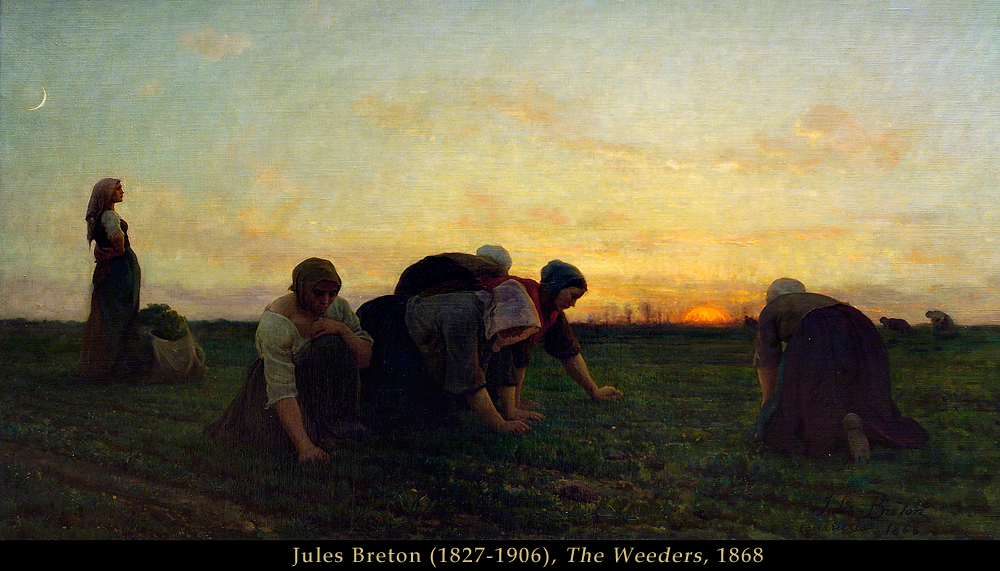
Below are a couple of other Bretons, not at my Arnot Museum…Breton song of the larkJules Breton the weeders

Read Full Post »

Pieter Bruegel- Tower of BabelI am totally in awe of the work of Pieter Brueghel the Elder, the patriarch of the great Flemish family of painters.  There are so many paintings of his that I could show that would be equal to those I chose for this post but I find these particular pieces striking.  There is great richness and depth as well as a tremendous warmth in his colors.  I always feel enveloped in his paintings as though they wrap around me like a blanket, particularly his peasant pieces.brueghel_hunters in the snow

This piece above  depicting the Tower of Babel has always excited my imagination beyond the actual biblical story.  I’m always reminded of the Gormenghast Trilogy from Mervyn Peake when I see this image and wonder if it had any influence when he was formulating the story for his novels.  The scale of the building and the way it dominates the composition is breathtaking.
The Fall of the Rebel Angels

His earlier allegorical works seem to have been heavily influenced by Hieronymous Bosch and have incredible energy.  He had an ability to take multitudes of forms and scenarios and bring them together in a way that had great rhythm, lending almost an abstract quality to the overall scene.  I find these paintings quite beautiful despite their sometimes jolting imagery.Pieter_Brueghel_The_Triumpf_of_Death

I could look at his work for hours and even writing this short post is taking a long time because I just want to stop and look at his work.  I find it truly inspiring and wonder how it will find its way into my own work someday.  Somehow.  Maybe…brueghel fall of icarus

Read Full Post »

LolomaThis is a new painting called Loloma that was done after I was invited to participate in an upcoming exhibit at Lovett’s Gallery in Tulsa, OK that is called Masters of Influence in which the invited artists create works in their own mediums inspired by the work of the chosen master-artist.  The master selected this year is Charles Loloma, a Native American silversmith/potter.  His multicolored stone jewelry straddles the worlds of Native American art and Modern art, possessing qualities that make it stand out in both worlds.  His work is bold and has an aesthetic vocabulary of its own that I find remarkable.

Charles LolomaIn doing a little research I came across the fact that he had studied ceramics after returning from World War II  not too far away from here at Alfred University, famed for their ceramics program.  That gave me a bit of a connection and made me wonder how his eyes  viewed the landscapes of western New York, if they influenced him in any way.  The works that I viewed online were stunning and modern, gorgeous collages of stone in a multitude of colors that could grace any modern art gallery.  I was taken by how he created a sense of place in such a beautiful and abstract form.  It reminded me, in appearance, of some of the glass art that I have loved over the years.  

I really didn’t know what to do when I began creating my piece that was to be influenced.  I wanted to simulate a typical landscape composition but with colors and shapes that might have been used by Loloma.  Perhaps the yellow/amber color that I selected for the foreground was more my color of choice, rather than Loloma’s, but I wanted my signature in the work as well.  It evolved as I painted it into something that seemed more like a painting of a glass window that was influenced by Loloma.  

It ended up as a piece that has a beautiful range of color and one that may have become far more my piece than Loloma’s.  It’s hard to fully capture the spirit of another’s work because when someone is creating work that is a form of their essence and being it contains a wholeness and intricacy that defies replication.  The best you can do is try to see the rhythm of their work and let it guide your own.  I can only hope that this is the case here.   However it got here, this is a piece full of color and rhythm.

The Masters of Influence show opens June 19th at Lovetts’s Gallery in Tulsa, OK.

Read Full Post »

Fallen TreeLast night Cheri and I were out in the yard of my studio when we heard what sounded like firecrackers going off from what we first thought might be our neighbors.  The rapid fire popping was suddenly followed by a roar and the crashing sound of what must have been a large tree falling, smashing through the limbs and trunks of its neighbors.

I trotted over towards where the sound seemed to originate, first making sure it hadn’t fallen on our home or outbuildings since the sound came from that direction.  I headed into the woods but saw no new downed trees so kept moving until at last there it was at the edge of our property, a large oak tree.

It was on its side with the trunk left in huge chunks and splinters, showing the evidence of a large hollow that had weakened its support.  Its huge limbs lifted it several feet off the ground and the trees around it were pushed over from the massive weight being exerted. The smell of broken wood and damp earth where the broken trunk had gouged the ground when it flipped over filled the air and I wondered at its age.

Over the years I have had the honor of hearing and sometimes seeing many trees fall in our woods.  I say honor because it seems a rare thing to be able to see something that has lived for many decades or even centuries, as in the case of the oak, come to an end.  There’s a certain feeling of being attached to the earth that comes with being there at the very moment when something that seems somehow eternal ceases to be.   There’s a bit of sadness that accompanies the witnessing of such a thing and I can only think of how the outer world has changed in the life of these trees.  As I am a witness to the end of their lives, they have witnessed the vast changes that have taken place in our lives, many of us falling as well.  They have seen the land around them evolve from thick forests to cleared farmland and back to thick forests.  They have witnessed the explosion of sound that has accompanied our technological advances.  They have seen us come and go.

So today the sound of that tree crashing back to the earth rings in my ears.  And the world keeps turning…

Read Full Post »

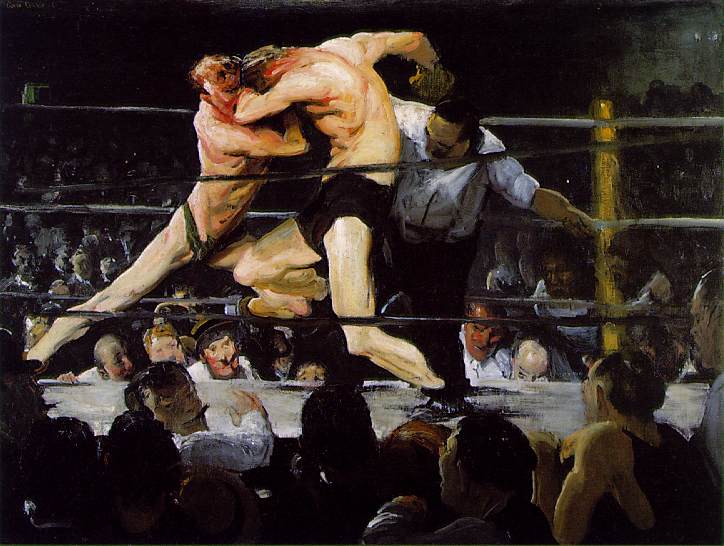
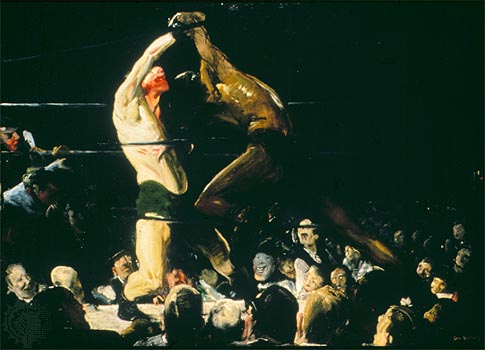
Bellows Stag at SharkeysThis is Stag at Sharkeys, painted by George Bellows in the early part of the 1900’s.  Bellows was part of the Ashcan group of artists who depicted the reality of the time in their paintings, creating gritty scenes of city life and all that this entailed- street scenes, nightclubs, tenements, etc.Bellows Both Members of this Club

I’ve always been drawn to Bellows’ work particularly his several scenes of club fights.  There is such great movement and rawness in these pieces that you get the real sense of the fury of the violence taking place.  This is enhanced even more by the high contrast between the brightness of the fighters’ skin and the great blackness of the open space above the ring.  It all creates a great feeling of drama.

These paintings always bring to mind my grandfather, Shank.  This was his time and this was his world.  He had been a club wrestler which was the predecessor to professional wrestling except that it was real wrestling where one competitor might put a leg lock on the other and hold it for a long time until his opponent gave in.  The matches could last an hour or more.  Shank later went on to be a stage manager at on of the many vaudeville theaters that once  populated our city.  I remember as a kid, going to play bingo at the American Legion and this old cop, Sailor Devlin, who was at the time the oldest active police officer in the country as recognized by Ripley’s Believe It or Not, would amble over to our table to talk with my dad.  He would always comment on Shank, who was at this point dead, calling him the toughest guy he ever met. That really resonated with me and I always valued toughness after that, putting high regard for those who  could, as they say, take it.

Maybe that’s why I’m drawn to these images.  The guys in these paintings can take it.

Read Full Post »

Archaeology: A New WindI was going through some old books that I hadn’t looked over in some time and came across a thin paperback I had bought when I was in the third grade.  It was a Scholastic Book and the mere sight of it brought back memories of those days when the boxes of books we had ordered weeks before were delivered to the classroom.  There was a mix of excitement and anticipation until the teacher, white-haired Mrs. Rogers in this case, would finally open the box and hand out books to those who had ordered.  The smell and feel of the new books as they were came into my hands is as vivid now as it was so many years ago.

This was a book of poetry selections and across the cover was a photo of a group of British soldiers of an earlier times, astride horses in a desert setting.  It was depicting the doomed soldiers of Tennyson’s The Charge of the Light Brigade, one of the included verses.  Inside, going past my crude scrawled signature on the title page, there were poems from Frost, Edna St. Vincent Millay, Langston Hughes, Poe and others.  Looking at it now made me realize what a great influence this slim volume printed on rough paper had on my youth.

Turning the pages I came across a poem that still remains a favorite and whose theme has always resonated in my work, particularly in my Archaeology series.  It deals with time and the ephemeral nature of our existence,  how we cannot control our place in the future despite all the wealth and fame we may acquire now.  This sonnet from Percy Shelley still has legs today…


 Ozymandias of Egypt 

I met a traveller from an antique land
Who said:—Two vast and trunkless legs of stone
Stand in the desert. Near them on the sand,
Half sunk, a shatter’d visage lies, whose frown
And wrinkled lip and sneer of cold command
Tell that its sculptor well those passions read
Which yet survive, stamp’d on these lifeless things,
The hand that mock’d them and the heart that fed.
And on the pedestal these words appear:
“My name is Ozymandias, king of kings:
Look on my works, ye mighty, and despair!”
Nothing beside remains: round the decay
Of that colossal wreck, boundless and bare,
The lone and level sands stretch far away.

Read Full Post »

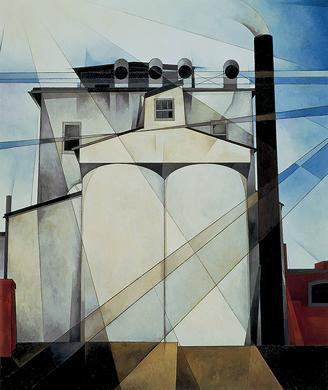
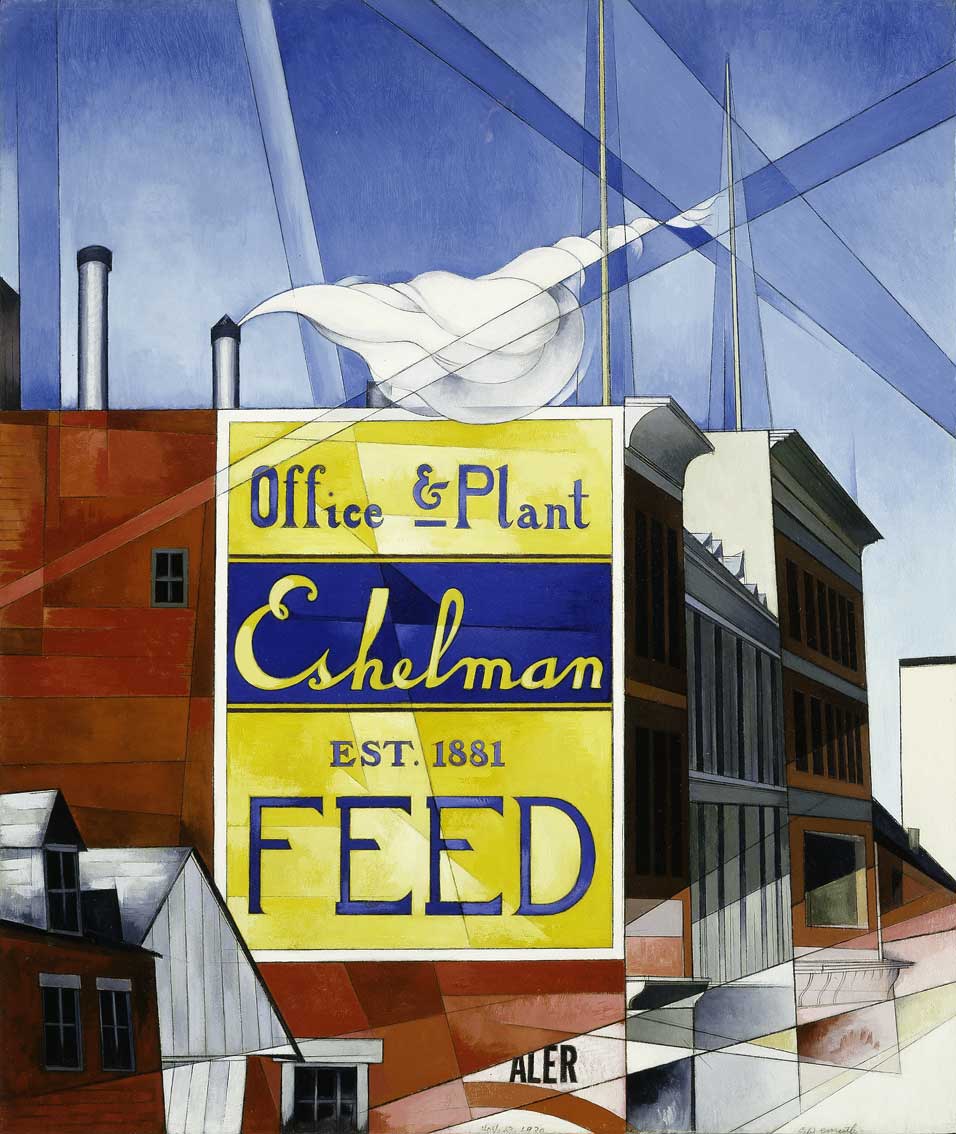
I Saw the Figure 5 in GoldI’ve been a fan of Charles Demuth since the first time I saw his work.  He was considered a part of the Precisionist movement of the 20’s, along with painters such as Charles Sheeler and Joseph Stella among many others, with his paintings of  buildings and poster-like graphics such as this painting, I Saw the Figure 5 in Gold.  He was also one of the prominent watercolorists of his time and while they are beautiful and deserve praise in their own right, it’s his buildings that draw me in.

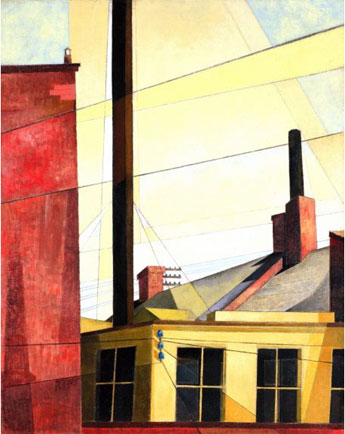
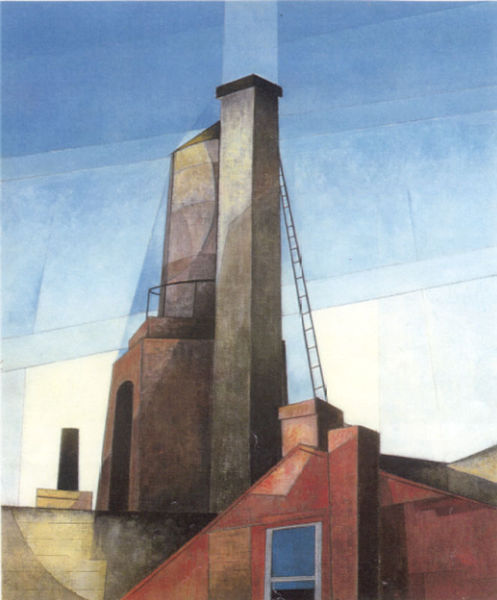
Demuth’s work has a tight graphic quality but still feels painterly to me.  There’s still the feel of the artist’s hand in his work which to me is a great quality.  There are photorealist painters out there whose craftsmanship I can really admire but who are so precise that they lose thatdemuth-my-egypt feel of having the artist’s hand in the work.  I like seeing the imperfection of the artist.  The first time I saw one of the Ocean Park paintings from artist Richard Diebenkorn, it wasn’t the composition or color that excited me.  It was the sight of several bristles from his brush embedded in the surface.  To me, that was a thrill, seeing  a part of the process.  The imperfect hand of the artist.  I get that feeling from Demuth.

He also had a great sense of color and the harmony and interplay of colors.  His colors are often soft yet strong, a result of his work with watercolors.  His whites are never fully white and there are subtle shades everywhere, all contributing to the overall feel of the piece.  His work always seems to achieve that sense of rightness I often mention.Buildings, Lancaster 1930

His works, especially his paintings of buildings, have a very signature look, marked by a repeated viewpoint  where he views the buildings above him.  His paintings are usually fragments of the building’s upper reaches.  There’s a sense of formality in this view, almost reverence.  I don’t really know if he was merely entranced by the forms of industrial buildings or if he was making social commentary.

Whatever the case, do yourself a favor and take a look at the work of Charles Demuth.  It’s plain and simple good stuff…

demuth-from-the-garden-of-the-chateaudemuth-after-all

demuth_charles_aucassiu_and_nicolette_1921

Read Full Post »

« Newer Posts - Older Posts »