Feeds:
Posts
Comments

Archive for the ‘Influences’ Category


1998In January of 1998, I was still working as a waiter in a Perkins Restaurant, at the same time painting and showing  my work in three galleries.  I was still unsure as to whether I should make the jump to going full-time as a painter.  Oh, the work was well received and nearly everything I was painting sold but I was never convinced that it was anything more than a temporary whim of the public.  Something that would soon fade.  

So I delayed going full-time.

One day while waiting, a single man sat in my station.  I recognized him as someone who I had waited on a number of times with his family.  It was lunch rush and my station was full so I was dashing around.  I stopped and quickly asked if I could get him something to drink.

“I didn’t come here to eat.  I came to buy paintings.”

I looked at him and my mind was blank.  I wasn’t excited.  Actually, I was a little irked.  I was busy as hell and this guy wanted to talk.  I always sort of prided myself in giving 100% to whatever job I had at the moment, even something that might be considered menial.  Hastily, I told him that this was not the time or place for such a conversation and we agreed to meet later that day at the West End Gallery in Corning.

We met and it turned out that he was a designer/ project manager for Corning, Inc.  He knew me from my waiting on his  family and was always impressed by my service as a waiter.  He said I reminded him of waiters he knew in  Venice who treated waiting as an honored profession and would wait their entire lives.  Because of this favorable impression, when he learned a couple of years before that I was showing my work at the West End, he started to follow the work.  He said he loved the way I worked with color and the personal style of my work.

With this in mind, he was now in the middle of a project, building a new photonics research facility in New Jersey for Corning.  The project was nearing completion and he stunned me when he said he had used my work as the basis for the color scheme of the building.  Now he needed some paintings for some key spots and he thought that my work would only be fitting.  Five or six larger pieces.  And he needed them in about six weeks.  Could I help him?

Instantly my head was reeling with questions on how I could do this.  You see, my work up to that point was very small, generally little things in the 4″ X 6″ or 9″ X 12″ range with a few going up to the 18″ x 24″ range.  I had taught myself a technique that worked really well in small blocks but wasn’t sure if I could translate it to a much larger piece.  And where would I paint?  I had started building my studio but it was nowhere near ready.  I was painting on a folding table in our kitchen/dining area.  How could I do this in the time frame he was giving me?  Was I ready for this?

“Sure,” I said.  “No problem.”  Inside, I wasn’t so positive.1998

I took time off from my job at Perkins and set up on my little folding table.  Since I was only adept at painting small blocks of color, I devised my paintings to be larger paintings comprised of smaller building blocks.  It allowed me to maintain my technique.  I struggled for a few weeks but somehow the pieces came around.  I used acrylic inks, acrylic paint, oil paints, chalk and pastels- whatever fit the need of the moment.  As the deadline approached I finally began to believe that I could do this.

At the end, I delivered five paintings.  Two large single pieces and a large triptych for the boardroom.  They were happy and I was very pleased and exhilarated by the whole experience.  It had given me an opportunity to paint on a much larger scale, to expand my work.  My confidence grew in my ability to create work that was beyond the temporary whim I mentioned earlier.  I could do this.

Within a few months I was painting full-time.  All the fears I had allowed to keep me from doing this were swept aside.  That was eleven years ago and seems like a hundred.

Read Full Post »

Sunday Morning Edward HopperEarly Sunday morning.

A week or so ago I showed a painting, Nighthawks by Edward Hopper and talked a bit about how this painting, and many of his other works, always reflected to me a sense of aloneness and alienation.  On this Sunday morning I am reminded once again of this by another of his paintings, fittingly titled Early Sunday Morning.

While it is bright and colorful, there is a quality in the emptiness of the street that speaks of  loneliness, an aloof sense of existence in the midst of a city.  The warmth of the red in the building and in the sunlight is a strong counterpoint to the coolness of feeling depicted. I’ve always found this a powerful painting.

In the spirit of Hopper’s painting, I’m also showing a video of Johnny Cash and Kris Kristoffferson singing Kristofferson’s Sunday Morning Coming Down, a longtime favorite of mine whose main character has certainly walked down this Sunday morning sidewalk…

Read Full Post »

Memento Mori

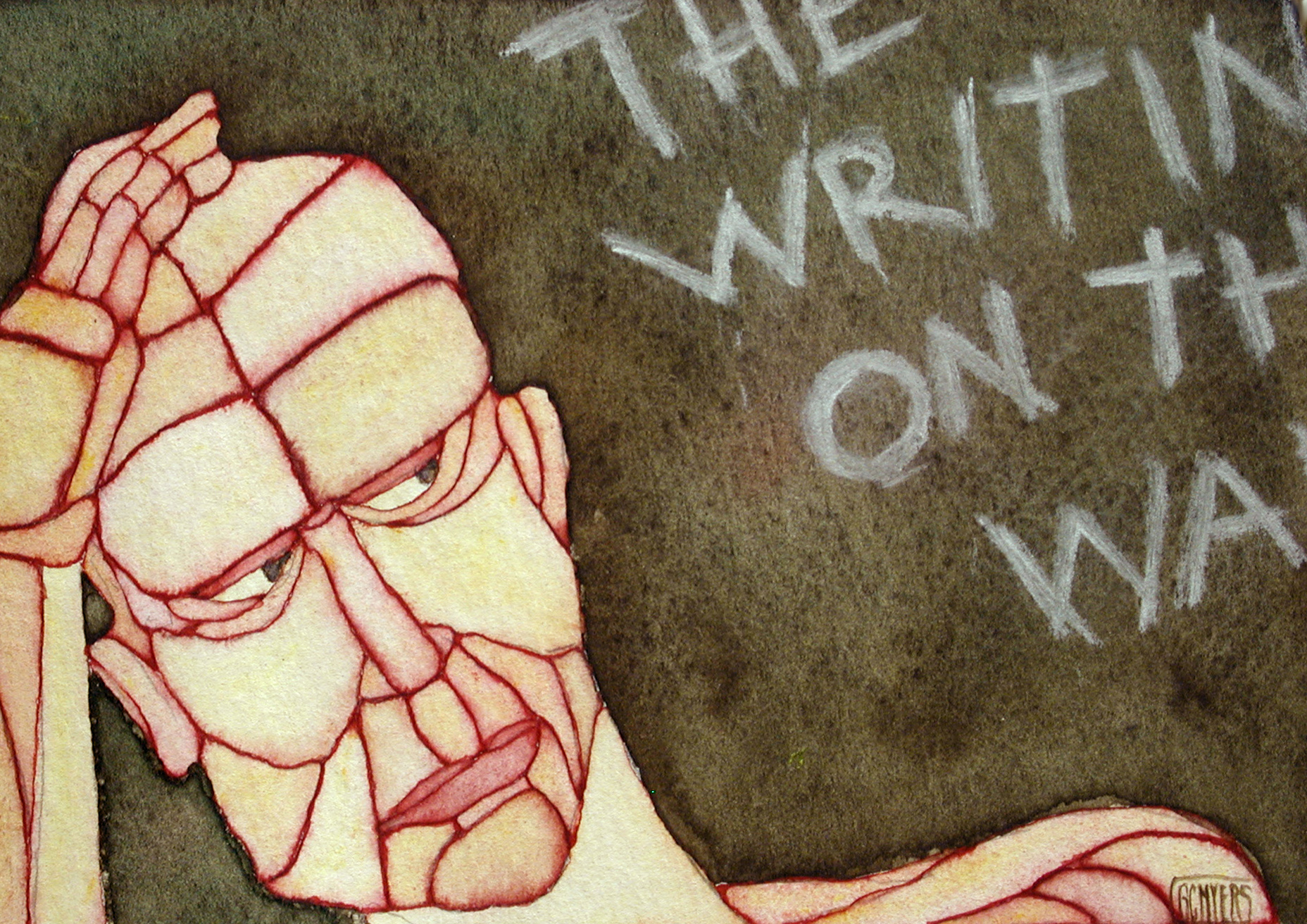
The Writing's On The WallThere are days when I get up in the morning and the normal aches and pains of my middle age seem a bit different.  A little more pronounced and in spots that didn’t seem to hurt this way before.

At these moments, a phrase always comes to mind.

Memento mori

Remember that you are mortal…

The thought doesn’t frighten me but only serves as a reminder that I have a finite amount of time here to learn what I need to learn, to see what I need to see and to say what I need to say.  A limited amount of time to leave a reminder that I have existed in this world.

A short time to create what I feel needs to be created…

So I get up in the dark most mornings and trudge, sometimes achingly, to my studio and feel reinvigorated because today I live. Today I work.  Today I leave a mark on this world.

And that is a good thing…

Memento mori.

Read Full Post »

Songs Sent on the WindIt’s Thursday and I’ve got a thousand things running through my mind already at 6 AM, little bits of thought and images that are vivid and strong but not really forming into one coherent message.

So I am left to try to grasp one straw and hold on tight, hoping it will come to fruition.  Here’s how it goes:

As I said, nothing is forming so I go to YouTube to see if there’s anything that will catch my full attention.  I come across a video of the Killers and an acoustic version of their song All These Things That I’ve Done.  Normally, it’s a big anthem-like song so I’m interested in hearing a different take on the song.  As I’m listening I realize most people will recognize it mainly from a famous Nike commercial called Courage that aired during the Olympics featuring the songs refrain ( “I’ve got soul but I’m not a soldier“) over rapidly changing shots of athletes in dramatic moments, in victory and defeat, ending with a memorable shot of a sprinter running at full bore- on two prosthetic springs.  

It’s a striking image that always thrills me.  It makes me realize that while I might on somedays yearn for a Luddite existence without modern technology, wanting to smash my computer with a simple whack from my sledgehammer, we are living in a world  of transformative technology, one that allows a person who at one point, not that long ago, would have been wheelchair bound live an empowered life, maybe even a better and fuller life than they had experienced previously.  It has torn down barriers.  It has allowed many to have the tools to overcome obstacles.  For the time being, I am awed.

This all goes through my head in seconds as I hear the refrain of the song and the image of that runner will be with me all day.  Such is the power of imagery.

So, after that bit of thought process here is the song…

Or if you just want to see the ad…

Read Full Post »

Chagall


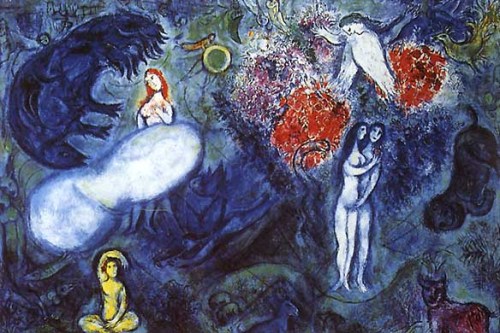
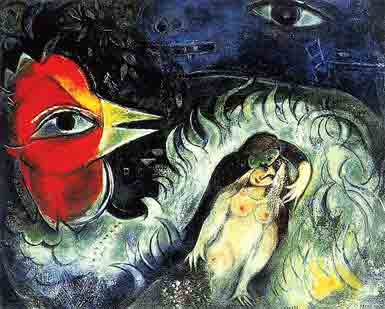
Marc ChagallI thought I ‘d briefly talk about the work of Marc Chagall and some of the things I’ve gleaned from him over the years.

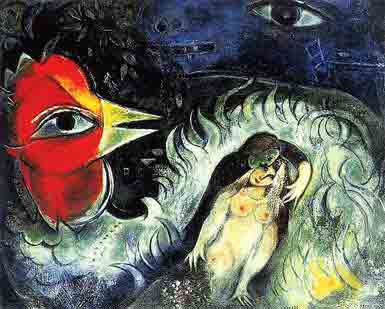
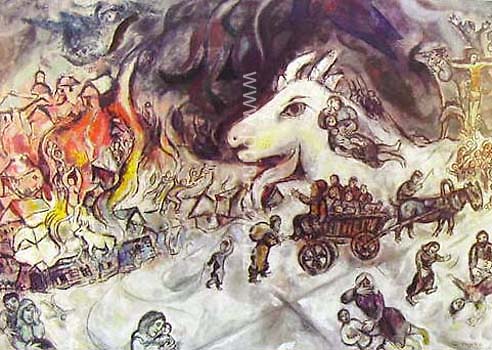
Marc ChagallHis development of his own vocabulary of imagery and symbols always fascinated me.  His flying brides, goats, roosters and such were all like Jungian archetypes in his paintings, each seemingly representing a psychological facet of our universal consciousness.   His use of such iconic imagery really inspired my decision to create my red trees and chairs and roofs.

I was also influenced by his distinctive and bold use of color.  His deep blues and reds glowed and made one believe such colors were naturally occurring in the natural world.  The mind easily translated his colors and images.  His vocabulary was unique and universal at once.

marc-chagallthe-rooster-in-love2

marc_chagall-wedding-imagemarc-chagall-1487marc-chagall_the_war_

Read Full Post »

A Return to Heroism

Oath of QuietIn the last couple of days I’ve written about heroism and how I see its qualities in everyday lives.  Being a blog, there’s a superficiality to such an examination, as there is to anything written off the cuff.  I’m never sure if I’m fully getting across my point .

I think the main thing I want to say is that we are living in a time where some of the basic qualities of the hero, compassion and empathy, have come to be seen as weakness.  We live in a culture that has over the last thirty or so years come to think of greed and self-interest as signs of strength.

Until we can restore compassion and empathy to their rightful position as the hallmarks of the strong and courageous, we will continue to linger knee-deep in the cesspool created by our allegiance to greed and our refusal in taking personal responsibility for for our actions.

That is the gist of what I’ve wanted to say.  I’m sorry it’s rhetorical and painted with a broad brush but I think this is a basic philosophical problem  and needs to be addressed at the broad brush level, starting from the bottom up, with people taking responsibility for the world immediately around them, living each day with their eyes open.  Living with charity and empathy for others.

I know it sounds simplistic, even naive.  That is just another product of  being immersed in a “get mine” world.  Without empathy, everything that challenges your worldview must be belittled or destroyed.

And that’s where we appear to be…

So. let’s try to see the strength and courage in living an empathetic life. Okay?

If you can agree to do that I promise to not preach tomorrow…

Read Full Post »

Hero’s Journey

OmegaIn my last post, Legendary Heart, I mentioned the hero’s journey, a term often used in the work of Joseph Campbell, the famed mythologist who gained widespread popularity in the 1980’s.

Campbell described the hero’s journey as a metaphor and paradigm for the passage we all take through life.  The journey of Ulysses, for instance, in many ways parallels the lives of many, perhaps not in such epic terms.  His search is the search of many.

For Campbell. it was all about discovering the transcendent truths that we all hold within us, inherent knowledge that predates the written word or systems of religious belief.  What might be called the spiritual.

The unknowable.

That is what I referred to when I used that term.  in these terms we are all engaged in a form of hero’s journey.  I only mention  this because I think we have come to believe that heroic is a term that only describes the extraordinary when in fact we are surrounded by heroic efforts every day.  We all have the capacity for heroism in our own lives.

If we only choose to live that life…

Here’s a song from many years ago, around 1992, from Jeffrey Gaines, that speaks to this idea.

Read Full Post »

Legendary HeartThis is a painting from a few years back that always sticks in my memory.  There are many things I like about this piece, many things which I think make it notable but the part that sticks most with me is its title. It’s  Legendary Heart.

I suppose the title visually came from the shape of the tree’s crown or maybe it was something in the atmosphere of the piece that suggested the name.  I’m not sure exactly except to say that I have always seen something quite heroic in this piece.

What do I mean by that?  What is heroic?

Oh, it’s easy to define heroism in terms of combat or competition, the obvious examples for displays of courage and bravery.   Soldiers racing forward through a hail of bullets to capture an enemy, a fireman climbing into a burning building to rescue a child or even a competitor fighting through injury to bring their team victory– all are truly heroic.

To me however, this piece speaks to the root form of heroism,  the element that defines all heroism, from the most glorious to the most mundane  everyday variety that often  goes unnoticed.  

I’m talking about self-sacrifice.

Heroism is the giving of  yourself to and for others.  Whether it’s a soldier or rescuer risking their safety so that others may be saved, a parent putting aside their own self interests for the benefit of their children or person who sacrifices their time  and  fortune for the betterment of those who truly need their help– all are heroic in terms of self-sacrifice.  Heroism is not about amassing accolades or wealth.  It’s about amassing a wealth of spirit and that that can only be achieved, paradoxically, through giving, not taking.  It’s about shedding the greed and meanness of spirit that dwells deep within us, side by side with our sense of charity and courage, in some cases pushing aside these better traits and overtaking our characters.  We are living in a time where this has happened all too often.

The heroic is in compassion and empathy, not in domination of any sort.  It is in having the courage to let the better parts of our character shine.  

We could all use a little of this courage.  I think many of us are always on a sort of hero’s journey, trying to find this bit of good while fighting back our baser demons.  Occasionally, even momentarily, it appears to us and we feel nourished, strengthened  enough to continue forward.

That’s what I see when I look at this painting.  Oh, it’s a striking image but it’s the message that I glean from it that makes it stand out and whenever I see this painting, on a computer screen or in my mind, I am reminded to keep moving forward.

Read Full Post »

Edward Hopper NighthawksWhenever I see an Edward Hopper painting I feel a bond with him, as though he were a kindred spirit in a world full of alienation.  There is always a great sense of distance in his paintings.

Aloofness.  A disengagement of sorts from the wider world.  Even in his cityscapes, one feels as though they are miles away from anyone else.

I suppose this disengagement may be the reason I and many others choose to communicate in paint.  With few exceptions, I have seldom felt inclusion in many groups of people,  always feeling a bit like an outsider.  And while I have actually become comfortable in this position, always bearing a sort of suspicion toward groups or cliques, the need to be heard drives my painting.  

Even in a world of alienation, one wants to have their say.

In my paintings, I sometimes see this aloofness in my red tree and the way it is often portrayed as a single figure in a large space.  Sometimes the pieces reflect a celebration of the self and self-reliance but sometimes there is this sense of a Hopper-like alienation.  The solitary character just wanting to be heard.

I don’t see this as being a sad portrayal.  There’s much more I could say on this but I think that’s enough for the moment.  Here’s a song from the great Hank Williams that kind of speaks to this subject.  It’s Lost Highway, a song that is, for me, one of the most transcendent songs Hank ever recorded, a song with a spirit that feels new and alive even today, even with its early ’50’s production values.

Read Full Post »

Miserere

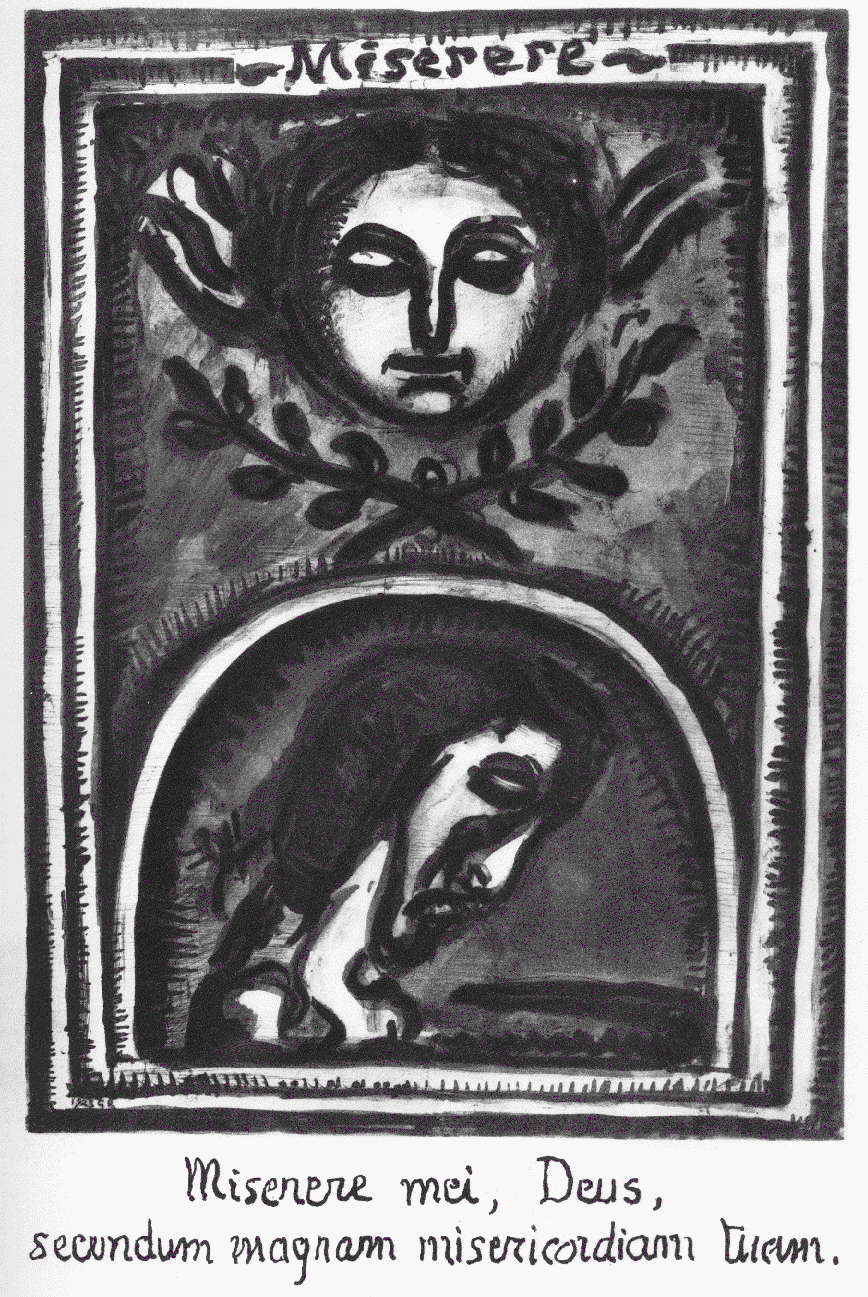
Who Does Not Wear a Mask?I wanted to briefly talk about the painter/printmaker Georges Rouault, whose work I first came across a number of years ago in a book containing his print series, Miserere, which translates to Mercy.  

It was around the time I was doing my Exiles series and in his work I found an immediate connection in both spirit and content.  I easily stepped into his raw, expressionist prints and when looking further into his work, particularly his paintings, was equally impressed with his rough brushwork and his use of dark outlines in his work, an influence of his early career as a glass painter.

I was also drawn to his subject matter and his use of the spiritual in his work.  His harlequins and kings impacted me immediately.  Also, the idea of using his images as pieces to a larger cycle was also influential.

Are We Not Convicts?We Believe Ourselves Kings

Have Mercy On Me, Lord

Ecce Homo

Read Full Post »

« Newer Posts - Older Posts »