Feeds:
Posts
Comments

Archive for the ‘Influences’ Category

Maxfield Parrish

Parrish  Christmas Morning 1949Today I want to just show the influence of Maxfield Parrish on my work.  He is certainly well known for his fairy tale-like scenes of scantily-clad young women or children  in fantastical settings but I have always loved his other, lesser known work, particularly his landscapes and homescapes.

There’s an intensity and warmth of color that I find completely compelling, drawing you in immediately and immersing you in a luxurious blanket of warm tones.  For instance, in the piece above, Christmas Morning 1949, even though it is a wintry, snowy scene there are warm tones in the snow fields.  It changes how you look at and feel about the scene, differentiating it from the normal, obvious winter landscape.Parrish Hunt Farm

I am also visually excited by the way Parrish used gradience in the colors of his skies, taking a deep rich color at top and drawing it down in lighter fragments of the colors that make up the original color.  It creates a brilliant effect.

The trees often took a central part in his compositions as well, something to which I was obviously attracted.  Many were boldly colored and powerful.

The houses were mainly long range and very idyllic, warm interpretations.  More home than house.  There was never a specific story conveyed in these homes, just an overall feeling that was formed by their part in the overall picture.Parrish Hill Top Farm Winter

I have also been influenced by the way Parrish put his compositions together, how all the elements were placed to create mood.  The way the trees fill the picture plane.  The way the houses are shown, never in full view.  More about feeling and inference rather than representation.

I could go on and on about his work and all the little things comprising his magic that I’ve tried to incorporate into my own work but the images tell the story much better.  Enjoy…

parrishevening-shadows1parrish-the-reservoir-at-villa-falconieri-frascati1

Read Full Post »

Let Us Now Praise Famous MenThis painting is another of the Exiles series, its title, Let Us Now Praise Famous Men,  taken from a group of Depression-era photos of sharecroppers in the American dust bowl from the camera of Walker Evans.  I have always been taken with these portraits as well of those of Dorothea Lange.  There is a sense dignity and will that has an eternal quality as though anyone in anytime in any culture would know and could empathize with their sorrow, their struggle.

That universal feeling is what I had hoped for this piece.  I am never sure it hit that particular mark but there is something quite haunting for me in this slightly alien face and the sadness written in his face.  He is a true exile…

Read Full Post »

harlequin3Saturday morning and I’m in the studio early, anxious to get to work.  There are things I’d like to post on my blog but I feel like there’s a painting waiting to be released.

I think that for this Saturday morning I’ll instead show a little early Rolling Stones.  At Christmas, I was talking with my nephew, who is around 30 years old, who commented on how many people he knew who were totally ignorant of the music of the Beatles and the Stones, particularly before the mid-70’s,  and the great influence that both had on current pop music and culture.

For anyone from that time that is a remarkable thought because of the incredible changes that were taking place at the time and, for many,  how their music was very much the soundtrack for the era.  Perhaps this is hyperbole and the world would pretty much be the same without either band and their songs but I doubt it.  Great change is only affected by great influence.  The greater the influence, the more we are inspired to go beyond, to take what they have shown us and to synthesize and integrate it with our own voices and visions.  

Growing up, listening to this song, Get Off My Cloud, was empowering.  There was a sense of defiance and a sense of standing up for yourself that pulsed out of the grooves.  I don’t know if it completely comes through but at the time, it played loud and strong.

Read Full Post »

Arnold Bocklin

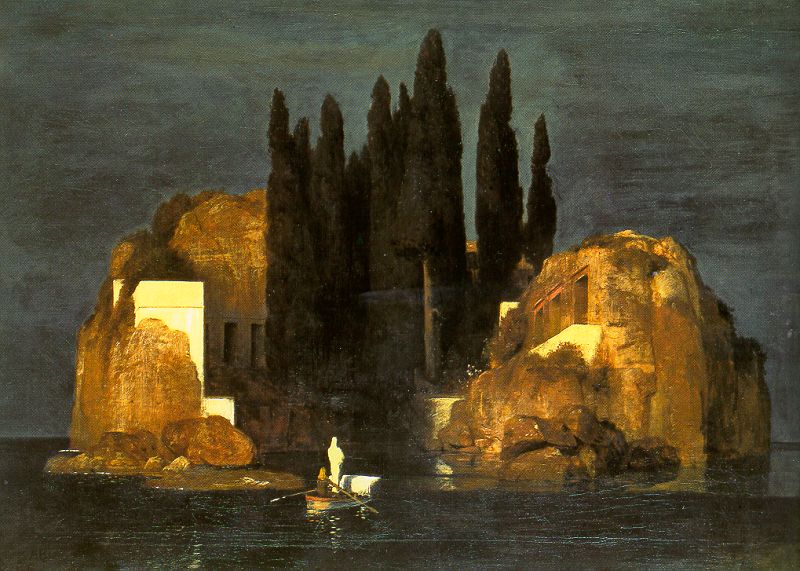
arnold-bocklin-the-isle-of-the-dead-1880This is Isle of the Dead from artist Arnold Bocklin, a Symbolist painter of the late 19th century.  This was a painting that Bocklin painted in several versions and is the painting for which he is best known.

I’m showing it because it’s a piece I’ve always been drawn to and to illustrate how an artist gets inspiration from work that is wild divergent from his own.  

Obviously, I don’t paint in a style that resembles Bocklin in any manner but the way he uses great contrasts of light and dark struck me immediately.  When you look at great pieces throughout history, one of the common elements is invariably great contrast.  It creates tension and mood within the piece and draws the eye in.  It heightens the visual impact of any piece.

So when you see a piece of mine with high contrast you can bet I was thinking of Bocklin and many others when I was at work even if there isn’t smidgen of their work visible in mine.

Read Full Post »

Sunday Morning Rumination

reserves-cover-blank-jpegSunday morning is usually an even quieter time for me.  It seems that memories from the past usually flood in on Sunday mornings, all triggered by a mere word or sound.  It seems most of these sense-related bits are from childhood when everything is soaked in and forged into memory.

For instance, there are Beatles’ songs that come on and I’m six years old again, living at the old house on Wilawanna Road.  The music is coming from our hi-fi console with sliding panels on top that expose the record player on one side and the other, the radio and controls.  The light wafting through the curtains over the large, old windows is from the spring and brightens the living room and its weathered floral wallpaper.  It’s a very secure feeling, the kind you hold onto from childhood.

On this Sunday morning, it’s about 8 degrees outside  (much warmer than yesterday’s -18 )  but it’s a little warmer when I hear this…


The painting from the top is a piece that was used as the cover for a CD by a northern Virginia based band, The Reserves, titled Where Have All The Dreamers Gone.

Read Full Post »

Andrew Wyeth

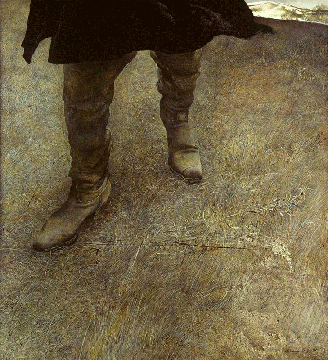
Wyeth Trodden WeedAndrew Wyeth died yesterday.  Age 91.

Damn great artist.

I’m showing the piece to the right, Trodden Weed, because I always feel a sense of awe when I see it.  

The gorgeous color.  

The daring composition.  

It raises more questions in the viewer, both about the painting and the viewer himself, than it answers yet there is a sense of satisfaction.

Of completion.

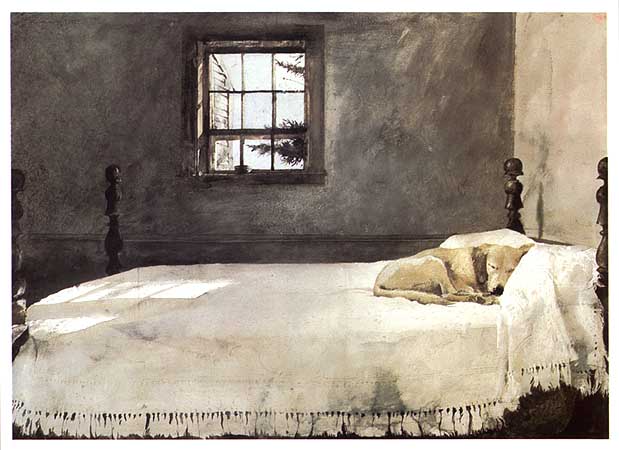
Wyeth Christina's WorldAndrew Wyeth was not the darling of art critics and I think there’s a simple reason for this:

His work didn’t need them.

His work transcended the need for their explanation and validation, translating at once to the viewer.  

There was no warming up to his work, no need to try to feel his message.  It was immediate and powerful.andrew-wyeth

And to someone who is considered the arbiter of taste, this could only be the work of sentimentalism.  This bias would not allow themselves the effort to truly see the work’s beauty and power.  It’s graceful simplicity.

Well, that’s their loss.  Screw them and thank you for all you gave us, Mr Wyeth.

Wyeth Master Bedroom

Read Full Post »

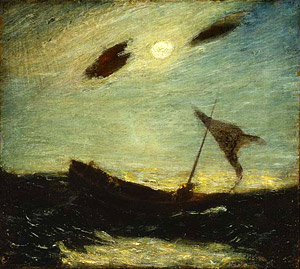
The Race Track (Death on a Pale Horse)I have always been affected by the dark, moody compositions of the  the American painter Albert Pinkham Ryder, a somewhat under-appreciated  painter who worked in the late 1800’s/ early 1900’s, dying in 1917.

He is probably not as well known as he should be because of the manner in which he painted.  He had little regard for working in a fashion that would insure the longevity of his work and as a result, most of his pieces are heavily cracked and fragile.  Many have not survived.

AP Ryder Flying Dutchman
When I have seen his work in person I am always filled with a sense of excitement, as though I’ve stumbled upon a hidden treasure.  There’s also a feeling of knowing this person and feeling their essence.  It’s as though I feel something in my own being that parallels his in some way.  I hesitate to say this because I do not know in any fashion the man or his personality but that which I see in his work I truly identify with in some manner beyond appreciation.

AP Ryder Toilers of the Sea
I see real poetry and soul in his work, something I think which is lacking in much work.  I can’t describe how I see that– it’s more just a matter of sensing it.  To me, Ryder seems to be trying to communicate something vaporous and indefinable, something beyond the senses, something beyond words.  I identify with that endeavor and find inspiration in his work.


ryder_moonlight1

Read Full Post »

Rousseau The DreamSunday morning and I’m thinking, of all things, about Henri Rousseau.

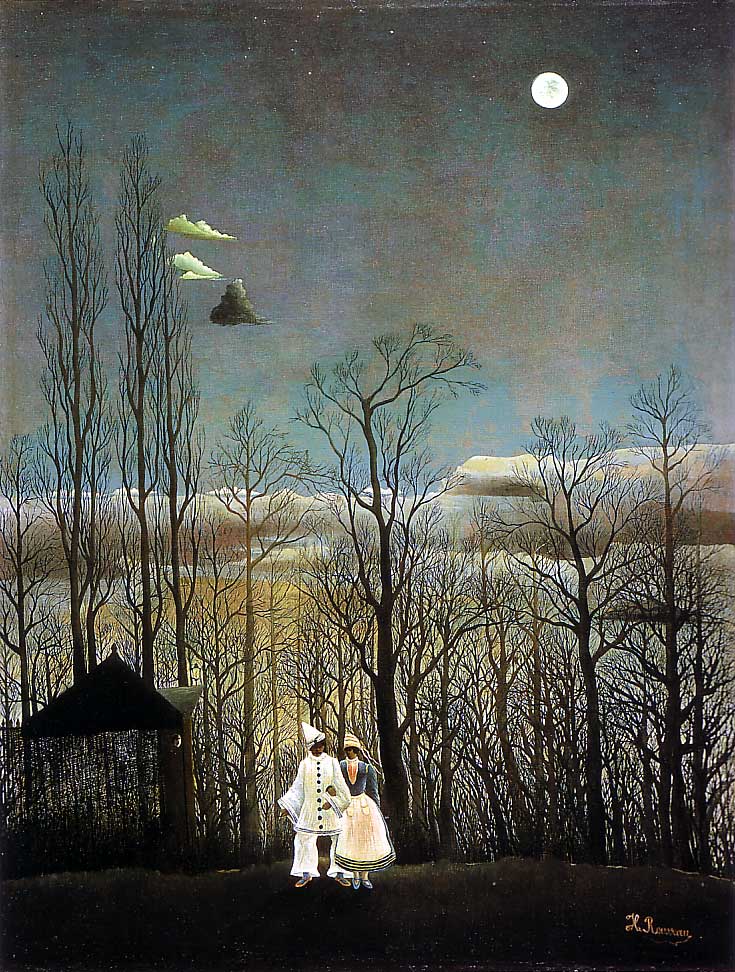
I’ve always been attracted to his work, mainly by the quality and density of his color.  It is rich and deep and translates easily to the eye and mind.  The lushness of his many greens and the way they all come together so cohesively is another factor.Rousseau A Carnival Evening

Then there his life as a self-taught painter, a man who was never taken quite seriously in his lifetime.  Quite compelling and an object lesson for artists everywhere to stick with their own vision and not be swayed by the style of the day to merely fit in with that which prevails.

Obsessionism

That’s the first time I’ve used this term and one that my wife, Cheri, uses to describe my work.  I’m still trying to define this definition.  In my head, it’s the intoxication of color, when I’m in front of a piece and the color I’m working in is deep and strong and I seem to be within the paint itself, engulfed and embraced.  Time is irrelevant at that moment and floats away.Rousseau Jungle Sunset

Thought becomes mute.  It is not from the front of the brain anymore, it is deeper, instinctual and reactive.  Ancient and ingrained.

It becomes a different form of expression where language is reduced to sensation, the feel of the wind above, the excitement raised by a mere arc or curve.  The depth of color.  Raw emotion.

Obsessionism.  It leaves me at a loss for words to properly describe what the term means to me but I see it in the work of Rousseau and perhaps that is why I am so drawn to it.

Read Full Post »

To Every Question...Sometimes I wake up and the mind is still tired.  Not as sharp as usual, everything filtering in as through a haze.  There’s a fatigue of thought and will.

At these times, I wish I were a smooth stone…

A smooth, cool stone at the bottom of a clear stream, the waters rushing from one place to another above me.  The world beyond the banks of the stream clattering noisily on and I’m just there.  As always. 

Stoic and silent.  Cool and calm.

I wish I were a smooth stone…

Read Full Post »

apI’ve talked before about personal mythology, which is taking ordinary events and finding details in them that give them depth and interest. 

For example, after I left high school I worked in a factory for about five years.

Left alone the statement says nothing of interest to anyone but me and even that is borderline.  But when you find the details that fill out this time spent,  it becomes more interesting.

I worked at the A&P factory in Horseheads in the late ’70’s and early ’80’s.  It was only open for about 17 years or so and was torn down a few years ago to make way for yet another shopping center.  But in its time it was a huge factory (its roof was alone was over 37 acres in size) that could reputedly produce enough food to supply the population east of the Mississippi each day.  It produced all types of food- pastas, juices, teas, canned foods of all sorts, condiments and on and on.  I worked primarily in the candy department, as a candy cook, making jelly beans, candy corn, thin mints, chocolate covered cherries, etc.  

It was actually interesting work at times but the real interest came in learning the details of the lives of my co-workers.

There was Lester Clark, a black man who was like a big teddy bear with his gentle nature and easy humor.  He had ran jazz clubs in his native New York in the 50’s and ’60’s before fleeing the chaos and crime of Harlem in the 1960’s to settle upstate.  He had seen and known many jazz greats but now was the thin mint maker.

Then there was Rich Dempsey.  Rich was a little Irishman from County Cork who had came to the States in the late ’40’s and never went back.  He had a quick grin, huge laugh and  legendary toughness.  There were stories of fist-fights at the factory he had with guys twice his size that were told periodically at the lunch table.  He taught me some Gaelic curses.

There was John Taylor.  He was a very thin man with a neat appearance and quiet manner.  He looked like a cat with his neatly trimmed mustache  and wire rim glasses.  He would quietly approach new guys and  calmly ask, ” Lick your nuts for a nickel?” just to see how they would react.  Most freaked out and John would smile a very small, wry grin.  He had been a Marine, had a history degree from Penn State  and had been in the Foreign Service in the Middle East in the ’50’s.  He had lived in Beirut, Jerusalem and Damascus, a city that he spoke of with great affection and nostalgia.  He would talk literature with me and taught me Arabic curses.

There was Rasputin.  I won’t use his real name.  He was a convicted rapist who had spent 6 years in Attica and had been there for the riots.  His ribs were a mass of scar tissue from having them broken by the authorities after they regained control of the situation.  He was called Rasputin for the wild unruly beard that adorned his toothless face.  No uppers at all.  He looked like an old hillbilly until he took off his shirt.  The guy was ripped from many years of working out in prison.  He was a scary little guy, crude and angry.   I got along well with him but working with him was like having a strange pit bull around –  you never felt too comfortable.

There was Nelson Waffle, a country boy from northern Pennsylvania with a twitchy , exceedingly nervous demeanor.  He, too, had few teeth but had a passion for music.  He could play all types of instruments but played guitar best of all.  He spoke of his Gretsch guitar as though it were his lover and had played with Chet Atkins and had backed Elvis several times while they were both in Germany in the Army

There was Jim B. who had spent two tours in Viet Nam as a medic and was still living it in his mind through those A&P years, which manifested itself in alcohol and drug abuse.  Jim was a smart guy with a great sense of humor but the war stories he told were horrific.  He was never shy about telling his tales but his eyes would always go a bit dull and distant when telling them, like he was only a few steps from that time.

When war stories were told Tommy K. from Corning  would regale us with his stories of going through Europe in WW II  as a radio operator for Patton’s forces.  He had been in Berlin at the end and told of the terror in the Germans who begged to not be turned over to the Russians.  He also told of the constant shooting from across the river where the Russians were receiving the German prisoners.  He told, with damp eyes, of shooting a young  boy armed with a hand grenade from a second story window.  Tommy lived as much in his distant WW II memories as Jim B. did in his more recent war experience.

For a young guy, the texture of these lives made the droning, mind-numbing hours and hard labor somewhat easier to tolerate.  There are so many others I could have mentioned that would add even more layers to this little sliver of my own personal mythology.  I think though that this enough for now.

So, if your days seem drab, look around– there’s a story everywhere…

Read Full Post »

« Newer Posts - Older Posts »