Feeds:
Posts
Comments

Archive for the ‘Neat Stuff’ Category

Steampunk

There is so much stuff out there that one can’t possibly keep up with it all.  I saw a short segment yesterday morning on television about a sort-0f aesthetic movement that I had completely missed in my regular sweeps through popular culture.  It’s steampunk,  based loosely on the early science fiction of the Victorian Era of the 19th and early 20th century.  Think Jules Verne and HG Wells.  It basically reimagines history, melding the technology of that era with that of our own time.  For example, one of the steampunkers had a computer keyboard that was constructed of brass with beautiful round typewriter keys.  It was a spectacular piece of work that he described as being right on place in the Nautilus sunmarine of Captain Nemo.
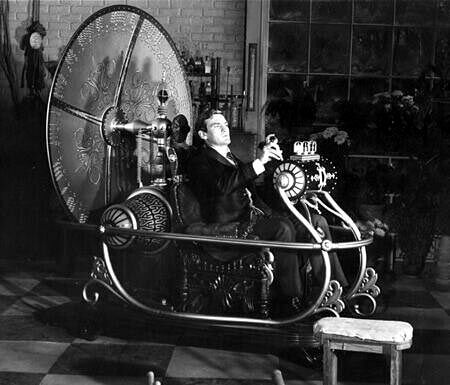
When I first saw this, I immediately thought of the movie The Time Machine with Rod Taylor as the Time Traveller.  I had saw this again recently and had marvelled at the techno-beauty of the actual Time Machine in the movie, with its decorative curves and beautiful brass surfaces.  It is just the sort of thing that these steampunk followers grabbed onto and made the basis for their movement.  They have translated this look into many items such as the guitar ,shown above, and the motorcycle and laptop, both shown below.

This movement has been the basis for the recent Sherlock Holmes films with Robert Downey, Jr and it certainly looks like something that could easily fall out of any Terry Gilliam film.  Another cited influence on the steampunk movement was the 1960’s TV series The Wild, Wild West , a favorite of mine when I was a kid, which had this same look and use of technology.

I think it’s interesting, especially from a visual perspective.  I love the surfaces, the sweeping design lines and the busy overuse of levers and gauges.  I ‘m just not sure about the folks who follow it in the same way as the Trekkies or Star Wars people.  I’m more surprised that steampunk has been around for about twenty or thirty years and hadn’t come to my attention in some way.  As I said, it’s a big world out there and you can’t keep up with it all.  I’m looking over at a cheap electric guitar in the corner of my studio and am thinking it might look pretty cool with a few brass gears and a vintage steam pressure gauge or two.  Hmmm…….
 

Read Full Post »

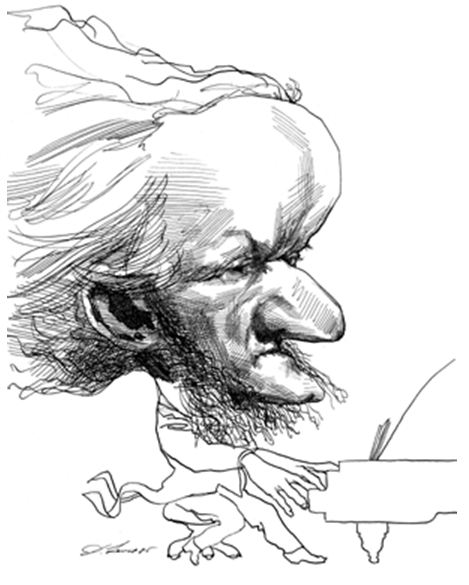
This is a caricature of famed German composer Richard Wagner drawn by the great David Levine.  It was one of the  many,many caricatures that he created in an illustrious career for the New York Review of Books and other major magazines.  Levine was considered the king of caricature and, according to John Updike, was “one of America’s assets.”

I recently obtained this from the West End Gallery from the personal collection of  Thomas Buechner, the late painter/museum director/writer  who had painted with Levine for decades as part of the renowned Painting Group in NYC  (the subject of an HBO documentary in 2007 about the group’s 25 member’s simultaneous portrait of Justice Sandra Day O’Connor, who sat for them) and had written a book on Levine’s work. 

I really like this piece a lot and like the connection it has to Levine and Buechner’s relationship.  I also know that Buechner was a huge fan of Wagner’s work and had undertaken the illustration of Wagner’s Das Rheingold in 1988.  His work was translated into glass and was subsequently displayed at the Metropolitan Opera when they presented the Wagner epic.  I am excited about the prospect of having such a piece with me in the studio and hope it brings even a small bit of inspiration.

You’re probably all most familiar with Wagner through the use of his music in populkar culture such as it’s use in the film Apocalypse Now where it was the soundtrack for the calvary’s helicopter attack.  My favorite use of his music is, of course, as the inspiration for the Bugs Bunny classic, What’s Opera, Doc?   But to show the music in its natural environment, here’s Arturo Toscanini and the NBC Symphonic Orchestra with a little taste.

Read Full Post »

Soundies

I heard from the filmmaker, Eric Krasner, who made the video, Yiddish Hillbillies,  that I used in Friday’s blogpost.  I will write more about Mr. Krasner’s work in another post but while looking through some of the oddities that he shows on his  CineGraphic Studios’s YouTube channel, I came across something that was off my radar screen– the Soundies.

Soundies were short, 2-3 minute, films that were produced primarily in the 1940’s to be shown in Panoram machines, coin operated devices that were often placed in bars, bus stations and coffee houses.  They projected a 16mm film from the rear onto a screen at the front, much like a TV in viewing , or into a peepshow setup where only one person could view the film.  They were pretty big at the time and many, many films were produced for these video jukeboxes.  There were music videos featuring the top bands and performers, both white and black, of the era as well as comedy bits and cheesecake videos with strippers that seem pretty mild by today’s standards.  I had seen some of these videos before but didn’t realize this was the machine for which they were produced.

With the huge growth of popularity of the television in the 1950’s, the Panoram machines fell out of favor but the films that they spawned are still around and are a treasure trove of rare performances.  Here’s a short promo video from a PBS documentary on the Soundies that gives a taste of the films.

Read Full Post »

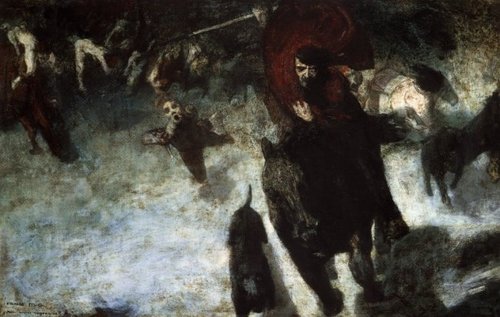
We all are influenced by the stimulus around us and art is a big part of that, from the music we hear to the visual imagery that we take in every day.   Most of us simply take it in and don’t process it directly to our behavior.  Well, maybe we do but not in ways that seem obvious to the outside world.  But Adolph Hitler did. 

Biographers state that he was very drawn as a very young man to the work of the German symbolist painter Franz von Stuck (1863-1928) whose paintings were dark in nature and filled with the symbology of Germanic myth.  In fact, the painting above, The Wild Chase, is referred to by many biographers as the main influence for Hitler’s signature moustache and forelock.  The central character in The Wild Chase depicts the Germanic god Wotan ( the equivalent of the Norse god Odin) as he sweeps across the sky in a thunderhead, accompanied by a pack of wolves.  He bears a creepily ominous resemblance to Hitler.  The painting was from 1899 when Hitler was  a mere 10 years old. 

It’s probably no coincidence that he chose this particular piece as he used a lot of Germanic mythology in his manipulation of the German population and the idea of a German god sweeping across Europe, terrorizing everyone in his path seems in line with how Hitler viewed his mission.

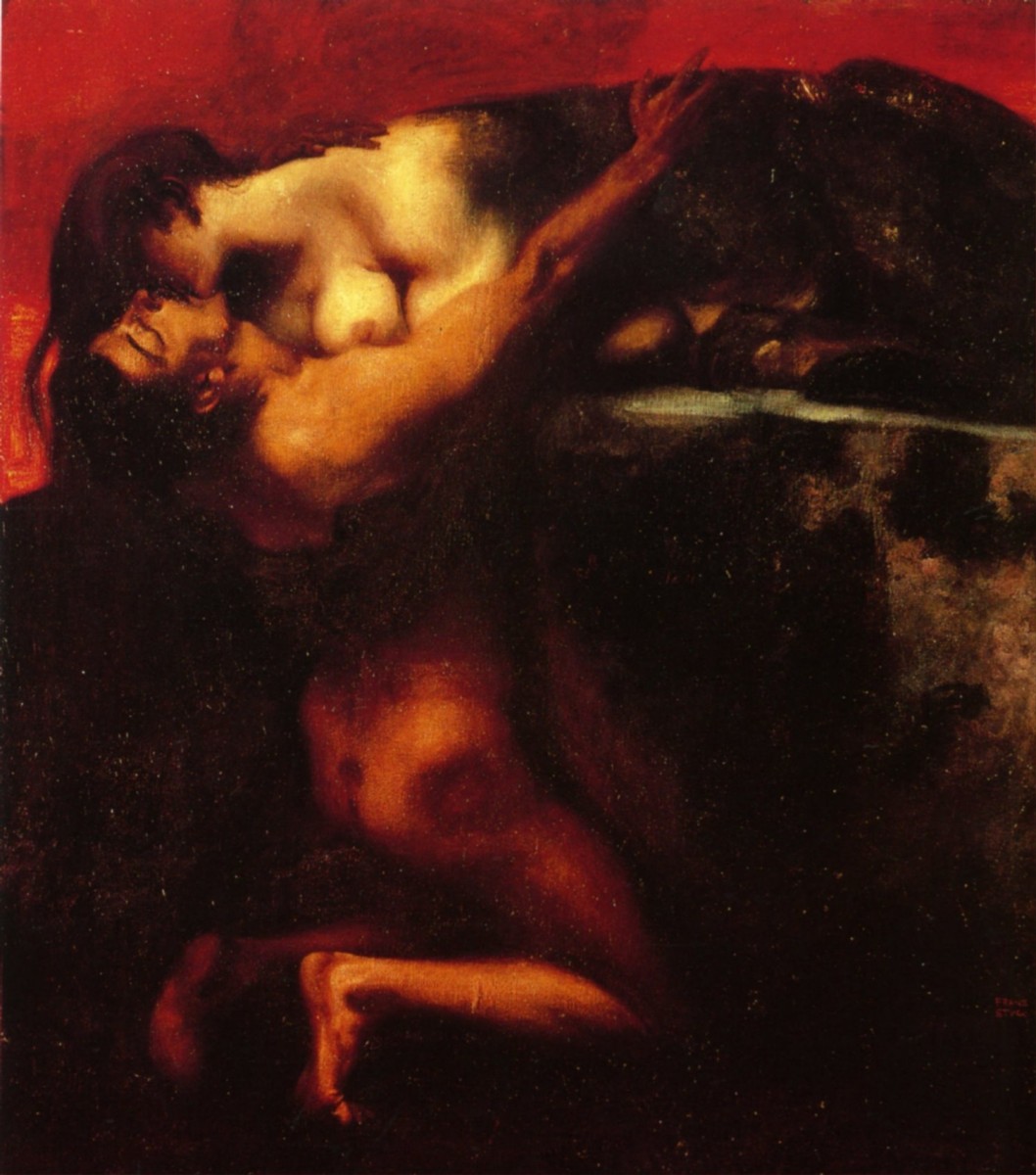
It’s a shame that von Stuck’s main claim to fame is probably this awful connection.  He was a well known teacher and some of his students are among the best known painters of the 20th century– Paul Klee, Kandinsky and Albers among them.  His  own work, which lost favor in the later part of his life,  is filled with deep, dark colors and extraordinary imagery that, while sometimes bordering on decadent or creepy, is beautifully striking and deserving of recognition. 


Read Full Post »

Recently stumbled across a site that has become a new favorite.  It’s called Luminous Lint and is devoted to the art of fine photography from the earliest days of the medium up to the present time.  It is filled with an incredible archive of imagery from the work of the giants of photography such as Richard Avedon and Walker Evans to the most obscure photos from unknown photographers.  I have only scratched the surface with my own visits to this sight, at first drawn to it because I discovered they had a group of photos from Henry Beach, a photographer of the turn of the 20th century who chronicled life in the Adirondacks.  I was familar with some of his photos of the village of Forestport, a place I’ve mentioned several times here.  My great-grandfather was a prominent lumberman there in its heyday and it remains an area of fascination for me.

One of the oddities you can find on this site is a good sized collection of Post Mortem photography from the late 1800’s, such as the piece shown above.  It was not uncommon for families of that era to have photos taken of the recently deceased as a final memory of their family member.  It is a very different viewpoint of death than we have as a society today and perhaps stems from the relative nearness of death in their world as compared to ours.  I know from my genealogical research that many families losing several children to death was not uncommon and many households held extended families so that aged relatives passing was a normal course of everyday life.  Death was simply a part of life.  It still is even though we often try to deny and delay it. 

So, if you are attracted to imagery that is beautiful or odd or filled with history, this is a great site to spend a bit of time.  Unlike many sites, you won’t feel as thought your time was wasted.

Read Full Post »

Low Rider

Another one of those looking-for-one-thing-and-finding-another moments.  I can’t even remember what brought me to this picture but I stopped as soon as I saw this.  At first, I thought it was some spaced out lowrider with a see-thru hot tub on the back.  I mean, it’s tricked out with flashy rims and it looks like the front end is starting to buck a little. 

Then I realized this was no ordinary lowrider but was, in fact, the PopeMobile.  It kind of took me aback for a second, the idea that the Pope had somehow converted to some sort of lowrider high priest, calling himself Joey Ratz and cruising the streets around the Vatican in his souped up Benz.  Just an odd image that seems a bit out of place.

Anyway, it got me thinking about the song Low Rider from War, the classic 70’s hit that had an infectious rhythm that still clicks today.  Here it is with a video of some real lowriders doing things I don’t think Gottleib Daimler or Henry Ford ever envisioned.

Read Full Post »

The idea of an artist devoting his whole life to creating a large body of work that remains hidden from most of the world is an interesting concept.  In some minds there is a romantic notion where this body of work is discovered after the artist dies and the great talent  is suddenly unveiled to the world.  The hidden genius. 

 Unfortunately, this seldom happens.  Probably because there are so few people driven to continue making a body of unique and expressive work over a long period of time without somehow finding its way out into the greater world, even in a small way.  Some are prolific for short periods of time but few let their passion carry through the entire course of their life.

One who did fill his whole life with the fruit of his creative impulse and kept it hidden until after his death was Eugene Von Bruenchenhein, who was born in Wisconsin in 1910 and died there in 1983.  For most of his life, he worked as a bakery employee, keeping his creative side well hidden from the outer world.  He occupied his time with painting, creating sculpture from chicken bones and ceramic and erotic photography of his wife, Marie, wearing crowns and jewelry he had crafted, probably the aspect of his creativity that has gained the most notoriety.

After his death in 1983, a friend wishing to somehow find a way for Marie to survive financially and hoping that some of this artwork might be selllable , took some of the work to the Milwaukee Art Museum.  The bulk of it eventually was acquired by the Wisconsin based Kohler Arts Center.   The inner world of Eugene Von Bruenchenhein was finally out into the light of the outer world.

His painting was mainly abstract and verging on the psychedelic, with swirls of bright paint that he manipulated with his fingers, brushes made with Marie’s hair and tools he fashioned from bakery items.  Painted in the Cold War era of Assured Mutual Destruction, many of his paintings have a definite apocalyptic feel to them.  Definitely visionary stuff. 

There’s a great site featuring his paintings that has been set up by a fan of his work and there are other sites that can give you more info on this creative life than I can in this short post.  Just an interesting story of the triumph of the creative impulse. 

Read Full Post »

Lake Eyre

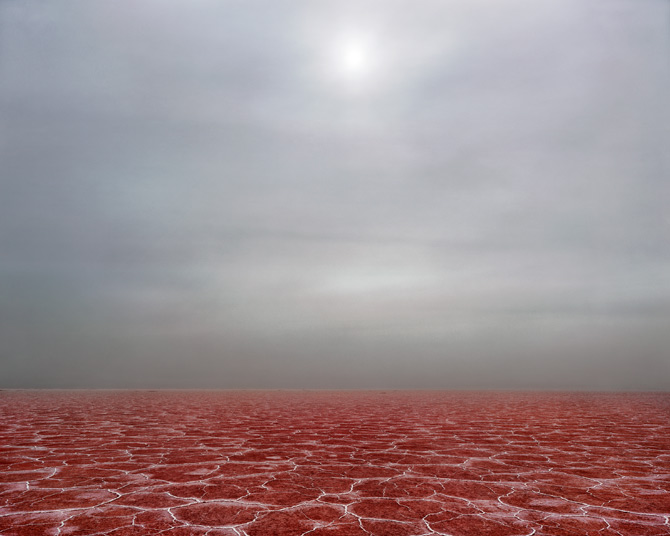
In the latest National Geographic magazine there is a great photo essay by Australian photographer Murray Fredericks.  It is a series of photos that Fredericks made on and around the salt flats that make up Lake Eyre, a vast ( the largest in Australia)  and most often dry lake in central Australia.  He would camp for several weeks at a  time, alone in the harsh and barren environment as he waited for the conditions to change and create absolutely stunning images of pure space.  Nothing but a horizon and color.  There are vivid colors and combinations caused by the atmospheric cinditions and a bit of sporadic  rainfall that are simply beautiful.

There is a great spiritual feel in this work although Fredericks claims that was not his initial aim in pursuing the project.  He simply wanted to photograph a landscape in pure space.  One interesting thing he mentioned is how during the many weeks he would work alone in the desolation of the space he never felt alone yet sometimes when he back in the cities, having a drink at a bar, he feels very alone.  It’s a sensation I have felt in the studio and in the forest.

This body of work very much speaks to what I was seeking in my own work when I began, an extension of things I had written where I tried to describe such vast and empty spaces.  Spaces that allowed for pure thought and sensation.  I still use this feeling of absolute wonder at the grandeur of space in my work although I’m not sure I have ever caught it in the way Fredericks has with this group of photos which is just stunning work.

There is a documentary of this project by Murray Fredericks called Salt which aired on PBS’ POV last year.  I missed that but am looking for it now.  You can see a trailer for this documentary by clicking on this link: POV – Watch Video | Salt: Trailer | PBS.

Read Full Post »

I’ve been pretty busy as of late so there are some websites that I like to check out regularly that I haven’t visited recently.  One of my favorites is Candler Arts, a site out of the Atlanta area that features American folk art, oddities and eccentricities.  Along with their accompanying blog, they always have something that really is quite interesting and often quite beautiful as well.  I finally stopped in yesterday and found a couple of folk paintings that really clicked with me.

The one above is signed by a Laura Doyle, a name that I couldn’t find anything about with a quick check.  This piece really has a certain sense of rightness and rhythm, one that really captures my fancy.  I like the depth into the picture frame that the moon and horizon create here.  The bony trees and gray skies make it feel like a darker, colder version of the Peanuts comic strip’s world.  It really works.  Someone recognized this as it has sold.

The other painting is this piece from the 1890’s of a young man with a huge slice of watermelon.  It’s not a great painting but it has a certain flair in the way the boy’s grinning face is painted .  He reminds me a bit of Alfred E. Neuman, the mascot of Mad Magazine.  With the preoccupation of that big slab of melon I can imagine him uttering Neuman’s  “What? Me worry?” catchphrase with ease.  Just kind of a neat piece.  Still available for sale, too.

Check out Candler Art or their blog sometime.  There’s always something to pique your interest.

Now, back to work.

Read Full Post »

I came across this photo on the Facebook page of  a band called Goliath in Transit, a name which would be a fitting title for the photo as well.  Since seeing this photo yesterday morning, I keep coming back to it in my mind.  It’s such an amzing photo, full of  odd wonder that makes me imagine different scenarios for this setting.  It is, of course, from a fair or circus from the first half of the 20th century and is from an attraction called the Wall of Death.  This particular race on the aforementioned wall consisted of a motorcyle, a go-kart (you can just see the exhaust fumes at the bottom of the photo) and a hot rod with a lion in an attached sidecar.  I can’t tell what emotions the lion was experiencing on this particular ride but in my mind I see him devouring the driver of the hot rod as soon as it comes to a stop. Justifiable homicide, I would think, but a great photo nonetheless.

 One of the aspects of being shown in a gallery for a long time is keeping up with the many people I meet through my work, following the changes that take place in their lives. 

 Sometimes there is sadness, as when those folks who collected my work as couples separate and divorce.  It’s an odd thing because I often don’t know these people very well but I always feel terribly for them, probably more than I do for closer friends and family who have went through the same situations.  Perhaps it is because when I meet and get to know them a bit I see and remember them as couples, united when they choose a painting for their life.  It often seems like such a strong bond to me that I am shocked and saddened when I find that they have split.

Other times, there is pure tragedy as I found out this past weekend in Alexandria when I discovered that a person who I looked for at every show had died in a small plane crash.  She and her husband ( they later split which is part of the sadness talked about above) were some of my earliest collectors in Alexandria and had purchased some of my personal favorites, always seeming to have a knack for picking them from the group.  She was a lovely lady that really seemed to bring a spark with her.  I last saw her last year and she seemed  genuinely excited and proud  for how far my work had come, as though she were observing my progress with the eyes of a proud mother.  It was hard to not feel great warmth for her.  So her death brought a deep groan in my gut and I was saddened that I, nor any others,  would never see that joyous face again.

But there is often also good news that lifts my spirits and one of the members of this band is part of that.  Mikey Mattice is a prodigious guitar talent who I came to know a bit through the gallery when he would come to events as a young teenager with his dad, also named Mike.  Mikey had a striking appearance that begged to be painted, containing an ethereal quality that seemed to keep him apart from everything that surrounded him.  A very special aura, I suppose it could be called. His dad asked me to to do a portrait, something normally not in my repertoire, but as I said, he had a look that should be painted.  He sent me a group of photos that really captured Mikey’s special presence.  I tried and just could not capture what I saw in those photos.  I still periodically look at the photos and hope to someday do something that does Mikey justice.

You could always see that Mike’s mind was captive to his music.  He’s in his final year at the Berklee College of Music in Boston and this band, Goliath in Transit, is one of his many projects.  He has a number of videos online showing off his virtuosity ( a favorite of mine that really shows off his chops is his cover of the Maps & Atlases’ song  Stories About Ourselves which can be seen here) and seems destined for some pretty big things, given the evident dedication he has.  I will be watching with great interest.

Here’s a song called Velvet Skies from the band Goliath in Transit.


Read Full Post »

« Newer Posts - Older Posts »