Feeds:
Posts
Comments

Archive for the ‘Neat Stuff’ Category

Yesterday on the Folk Art at Cooperstown site, Paul D’Ambrosio wrote about this painting that is in their collection.  It is by a late 19th century painter by the name of John Rasmussen and is of the Almshouse in Berks County, Pennsylvania.   This piece has really stuck with me since I saw it, not only because it is such a beautiful piece of work with wonderful color and composition.  It’s more because of how it almost lovingly portrays an aspect of society at that time that is largely overlooked– the poorhouse.

The poorhouses of that time were a depository for what was then considered the refuse of society– the mentally ill, the homeless, the disabled, just released prisoners and abandoned children.  In fact, the artist of this painting, John Rasmussen, was a resident at this particular poorhouse, having had severe problems with excessive drinking throughout  his life. 

You can imagine how terrible the conditions might have been at many of these facilities.  But many, like this Berks County Almshouse had a mission of self-sufficiency and rehabilitation.  It required all physically able residents to work on the farm which supplied all of the food for the resident population.  They believed that the ills of many of these people were the result of not understanding the value of hard work. 

It actually was a fairly successful system at the time until the demands of a growing general population overwhelmed its capabilities.  There came a point where it was no longer economically possible to have this type of institution in very county or town and the poorhouses faded from sight and have remained there, even in our memories of the past.  I can’t say whether the system was better or worse than anything we have today or whether the residents of places such as this Almshouse would remember it fondly or with horror.  But the loving way this painting is presented doesn’t give one the sense of a dark place but rather a place filled with renewed life.  And I think for some, like John Rasmussen, it did represent a refuge and a palce of restoration when he periodically reached his bottom.
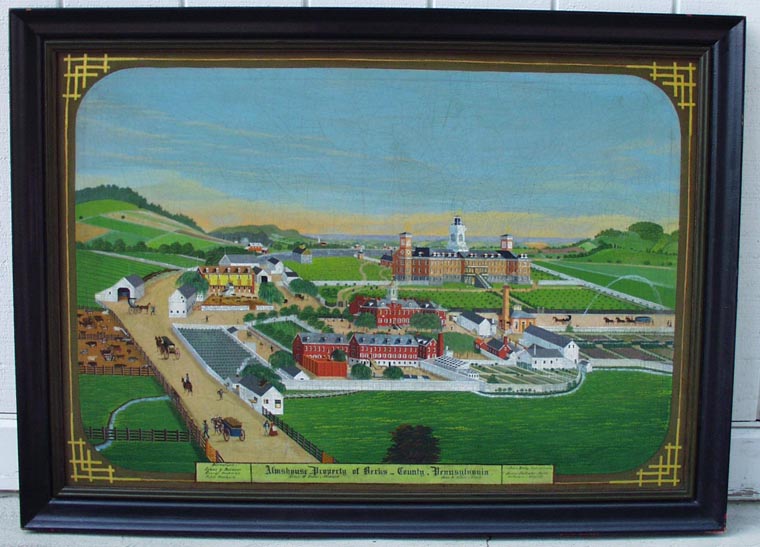
The Berks County Almshouse is now completely gone save for a small stone wall.  But it is preserved in the paintings of Rasmussen and others, such as this earlier painting of it by painter Charles Hoffman, also a resident at the Almshouse.  And writer John Updike fashioned the subject of his first novel, The Poorhouse Fair, after this very place. 

I’m sure most were not like this beautiful scene but they remain part of our past and deserve to be remembered.  There is another site, The Poorhouse Story, that documents the history of American poorhouses.  It has a state list with pages devoted to the poorhouses of most counties.  It’s an interesting glimpse into a shaded part of our past.


Read Full Post »

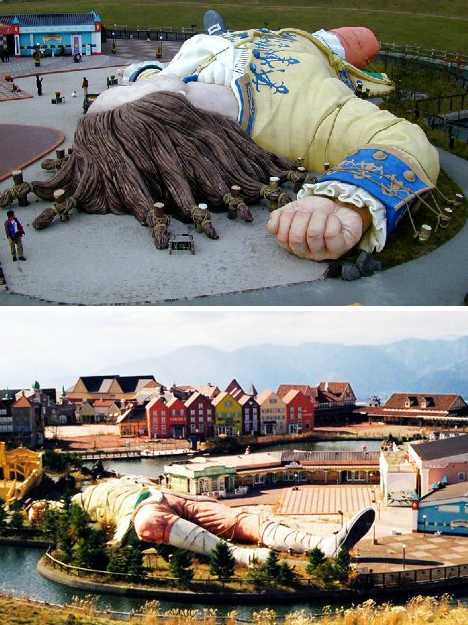
I stumbled across this image while looking for something else and had to come back to it.  It’s from an abandoned amusement park resting in the shadow of Japan’s Mt. Fuji that celebrates Jonathan Swift’s Gulliver’s Travels.  I don’t know what connection to Gulliver made someone want to spend a lot of money building a theme park in this part of Japan but it makes for an interesting juxtaposition between the iconic mountain and this sad, abandoned park.

According to WebUrbanist.com, who has a wonderful post on this park with lots of info and many more photos, Gulliver’s Kingdom, as it was called,  was opened in 1997 and closed in 2001.  For several years after its closing it was a mecca for the curious who climbed over the nearly 150′ long Gulliver, many leaving bits of graffitti on the poor tethered giant.  Nothing remains of this ill-conceived theme park today after it was demolished in 2007.

There were apparently several reasons for the park’s closing.  It was never able to shake its proximity to the location of the Aum Shinrikyo headquarters.  Aum Shinrikyo was a doomsday cult who produced Sarin nerve gas (at a location near the park which was under construction) then launched  attacks, including one  on the Tokyo subways, killing 19 people.  A massive force stormed the nearby headquarters to end the cult’s run.   

If the  the smell of chemicals used to make Sarin that still lingered for years after the Aum Shinrikyo attacks  wasn’t enough to kill enthusiasm for this tourist trap,its proximity to Aokigahara probably didn’t help make things better.   Aokigahara  is considered Japan’s “suicide forest“, a dense woodland that is considered the 2nd most popular place on earth (behind the Golden Gate Bridge) to commit suicide.  Putting Sarin gas and suicide together does not spell success for any venture designed to attract tourists to the area.

There’s something in seeing these photos of this lost place.  Maybe it’s the ridiculous absurdity of it.  Maybe it’s the reminder of human failings, a tribute to our follies.  Or maybe it’s the idea of a place that no longer exists, as though one were looking at a ghost from the past. Maybe there’s even symbolic in the huge figure of Gulliver trapped in this ill-fated shadow of the beautiful Fuji.  I don’t know.  It just seems to be compelling for some reason to me.

However, don’t be sad.  You can still get into that Jonathan Swift state of mind–there are a couple of Gulliver-inspired theme parks in England.


Read Full Post »

I came across an obituary in the Washington Post the other day for Maynard Hill, who passed away at the age of 85. It’s not a name that will mean anything to many of us but in his field he was a true legend.  You see, he was a model airplane enthusiast who made his hobby his vocation and the focus of his life.  In the process he pushed the boundaries of  possibility, creating miniature planes that flew further, faster and higher than anyone had before imagined.  His work led to the  high tech drones that our military use today to surveil enemy forces.

His greatest achievement came in 2003, when a plane that he designed and built (over five years with a team of like-minded experts that he had assembled) made its way from Newfoundland to Ireland, a distance of 1882 miles.  The plane, weighing less than 11 pounds and carrying a single gallon of fuel, covered the distance in just under 39 hours.  A truly remarkable feat when you think about those model airplanes buzzing around the park.  To those in the know, such as other model airplane enthusiasts, the feat rivalled our 1969 moon landing in importance.  Nobody had ever flown a radio controlled plane even a third of the distance that Mr. Hill’s plane covered in it’s crossing of the Atlantic.

I mention this today not because  I knew of Mr. Hill or know even the slightest thing about model airplanes, drones or aeronautics. I am just interested in those people who find a passion in their life and unfalteringly follow it.  It’s a rare occurrence to find that one thing that jibes with one’s thought process and innate talents, to take that spark and willingly pursue it. 

Maynard Hill was obviously one of those people and, like him, we should all strive to fly further in our pursuits, to create new horizons to seek.  It doesn’t matter what we do.  It’s that we strive to do what we do as well as we can.


Read Full Post »

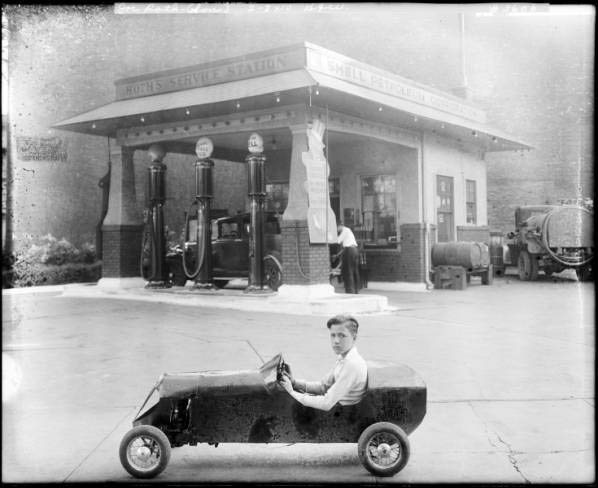
I came across this photo,  titled  Roth Service Station, Muscatine, Iowa, May 14, 1934, on a terrific site that features a great archive of photos of historical and sociological significance, These Americans. Well worth a visit.

I was immediately taken by this image.  I loved the way it came together as a composition as well as the beautifully simple yet elegant design of the service station.  It also made me think about that boy in his road racer, made me wonder if he was aware this image of his eternal youth was out there somewhere, floating in cyberspace.  He would have to be near 90 years old if he were still alive and would have a lifetime of experiences to place on that youthful face.  But here he is always 11 or 12 or whatever age he was.   There is no evidence of what might come of him except for that road racer in Iowa. 

Maybe he ended up in Detroit,  becoming one of those designers who brought us those wonderful cars in the post-war years of the 40’s and 50’s.  That is, if he survived the war.  He would have been about the right age when war broke out for us in late 1941, seven years after this photo. 

Or maybe he didn’t even live to see the war.   A tragic road racer accident?  Who knows?

A photo like this is such an enigma, filled as it is with multitudes of possibilities with only a few people, if any,  knowing the true story of that boy.  I’m hoping he lived a long and calm, uneventful life, surviving the highs and lows we are all subject to in our passage through this world.  Whatever the case, he lives on as young man in a road racer on a spring day in Iowa in 1934.  Great photo…

Read Full Post »

Yesterday I was working in the basement of my studio which is set up to accomadate the matting and framing operations for my work.  It’s a finished space  that is decorated in a typical 1960’s fashion with woodtone paneling, a drop ceiling  and carpeting with a geometric pattern that has  brown mustard  as its main color.  It has a kind of shmaltzy feel and I always mean to overhaul the space but never find the time. 

I have a number of  long tables throughout the space as well as a couple of large drafting tables, covered  almost  always with something.  Sometimes they contain sheets of heavy watercolor paper as I apply layers of gesso.  Sometimes they are filled with frames in various stages as they are being finished or with canvasses that are being coated with their final protective varnish.  At one end there are heavy industrial shelf units that hold unfinished frames and canvasses and stretcher bars.  Along the walls there are several other shelfing units that hold bottle of gesso and varnish and  tape and all the little things that are needed  for framing.  Large rolls of brown and black kraft paper are hung on one wall.  There are several paintings of mine on the wall, a few older pieces that have somehow stayed with me over the years.

 There is also a painting that we bought many years ago from a PBS auction.  Shown above, it’s a folky piece of a black Lab sleeping on a checkerboard pattern surface.  There is no name but we have always called it Winston Churchill.  I can’t remember the reasoning but we both immediately latched onto that name.  It has bounced around with us for a long time and its plaster frame has began to show its age a bit, losing a few of the half  rounds that go around its outer edge.  It’s not a great painting but I have a lot of affection for it.

I mention all of this because yesterday as I was working down there, I had a moment.  I suddenly stopped at one end of the space and turned, looking down the length of it.  I had this odd feeling that I needed to take in the whole scene, register the details in my mind.  It was as thought I knew that somewhere down the line I would be remembering this moment, this view.  It might be in a dream or in a moment of deja vu, those moments where one seems to recognize the occurring instance as being from their past and are reliving it.   This felt pre-deja vu, as though I knew I would someday relive this moment and this feeling.

It was an odd moment and I took in as much as I could, looking from item to item as I stood there.  There seemd to be nothing profound in that instant when I turned from that mundane view back to the frames I was staining.  I wondered how this could possibly matter in the future, why my mind would want to someday recall this moment, this scene. 

I don’t know.  But, as I’ve learned from my painting, sometimes we don’t really know what we know.  We can’t question that moment, that feeling.  Just have to take it in and see where it takes us.

Read Full Post »

Calvin Black, Folk Artist 1903-1972

There’s another terrific website out there called folkstreams.net which is an archive of films that describes itself in its site’s header as “ A National Preserve of Documentary Films about American Roots Culture.”  It is a treasure chest of great fims about roots music (Cajun, Delta Blues, etc.), lost American crafts and folk or outsider art.   Most relate to things that are fading fast in our culture, a sort of  expressive ephemera.  I could spend a day just browsing this site, which makes all of its films available for viewing online.

 
One of the first films I came across was Possum Trot, made by documentarians Allie Light and Irving Saraf back in 1977, which shows the work of Calvin Black.  Black and his wife, Ruby,  ran a rock shop in the Mojave Desert and in 1954 he began to create life-size female dolls as an added attraction for his shop as well as an outlet for eslf expression.  He created more than 80 dolls each with distinct features, costumes and personalities.  Some were crudely animated and performed in his Birdcage Theatre there, singing in voices recorded by Black himself.
 
Black died in 1972 and Ruby maintained the attraction for several years but eventually Possum Trot was abandoned and no longer exists today.  The dolls have been dispersed into the folk art collections of the world, one recently fetching about $80,000 at auction. 
 
There something kind of haunting in seeing this created world that no longer exists but for photos and a little film, as haunting as the dolls themself.  The full 28 minute film is available to see here on the folkstreams.net site.  Here’s a short trailer that gives a great overhead shot of the place when the film was shot in 1977 and has the voice of Calvin Black singing in falsetto as one of his dolls.  Interesting stuff…


Read Full Post »

I sometimes stumble upon things and don’t quite remember how or why I got to them in the first place.  Such is the case with this kind of neat photo that’s currently up for bid on eBay.  It’s a card promoting the 19th century circus strongman John Jennings, the Iron Jawed Man.  My jaw is sore just looking at this  and I finding myself wondering if it’s a real feat that he regularly performed in his act. 

I decided to try to find out a little more about this iron jawed man but there;s not a lot to be found with a quick search on the web.  The circus life of the the late 1800’s was not the most documented or stable aspects of the American landscape and I’m sure many of the performers and crews of these circuses were a little on the sketchy side.  I did however come across an interesting site, the Circus Historical Society, that has listings of circus people of that era, including one from a book titled Olympians of the Sawdust Circle.  This book had a short listing of Jennings alongside the likes of the The Albino Brothers, who were a gymnastic group,  and Admiral Dot,  aka the “California Dwarf”, and a slew of other intriguing figures.

Jennings lived from 1845 until his death in 1906.  It mentions that he was injured in a wreck of a circus train in Tyrone , PA and died in Harrisburg.  His last engagement was with Ringling Brothers.

I find this a curious world, this one filled with strongmen, trick horse riders and freaks that trekked all over our country back in the day.  I can only imagine some of the stories that could be told and I’m sure there are some that well beyond my imagination.  Most, I fear, are lost to memory.  But at least the Iron Jawed Man still is around, forever gripping that barrel with its two riders in the iron vice of his jaw.

Read Full Post »

Si Lewen

Yesterday in the studio, I had a documentary playing on ther television.  It was The Ritchie Boys which tells the story of a group German speaking draftees, primarily  immigrants from Europe, during World War II who were trained in psychological warfare and interrogation at Camp Ritchie, Maryland.  Using their language skills and their knowledge of the German culture, they proved invaluable to the Allied war effort.  Their story is told in often humorous and compelling anecdotes by a  members of the group in the film, many of whom went on to great prominence in a variety of fields.

Image From "The Parade"

One member who caught my eye was Si Lewen, shown here, who went back to the world of art after the war and is shown in the film in his studio.  In the background as he spoke, there were racks filled with a multitude of canvasses, all neatly placed and stored.  It seemed a prodigious amount of work and it made me want to know more about his work. I looked him up and was pleasntly surprised by his internet presence.  Still actively painting at age 92, his site is large and filled with his striking works as well as many of his writings, including an entire memoir.   Also shown there, is his book, The Parade, which tells in 55 impactful images  how war is constantly recurring , moving from celebratory martial parades to the horrific death marches of war. It’s a powerful piece of work that drew praise from Albert Einstein in 1950, when he said of Lewen,” Our time needs you and your work.”

There is so much to be said about Mr. Lewen and his work, so many things that I personally identify with,  that I am leaving most of it to his own website which I heartily encourage you to visit.  I could write on and on but his words and images speak so much more eloquently of his life and spirit.  It is truly a treasure trove, a  fascinating document of a most interesting life, one scarred by the horrors of war and rejuvenated by the power of art.  I feel really fortunate to have stumbled across his work.

Read Full Post »

“Sisyphus” Bruce Shapiro

I stumbled across the video below quite by accident and at first simply wrote it off as some computer generated animation.  But I did a quick search on the man behind it, Bruce Shapiro, and found that it was genuine– real sand with a real steel ball rolling through it to create intricate patterns.  You see, Bruce Shapiro plies his craft in the art of motion control.  That is to say that he blends the scientific and industrial aspects of technology to create something beautiful, something artistic.

 
His sand installations are large tables filled with sand that move ever so slightly, guided by a computer program, so that the steel ball moves a wee bit at a time, leaving a ridge in the sand that creates the visible pattern.  His permanent installations do so endlessly, one pattern beginning atop the last finished pattern.  Hence, the name he has given them,  Sisyphus, after the mythic king who was punished by the gods for his deceitful ways by being forced to push a boulder up a hill each day for eternity, nearly making it to the top each time only to have it roll back to the bottom.  An endless labor.
 
There are two videos below, one showing a pattern in the making and the other showing Shapiro explaining the background of his work.  You can get more info at his site.


Read Full Post »

I was talking to a younger friend last night at an opening of an exhibition.  I have known this person since she was quite young and have always admired her native talent in many disciplines that she has chosen to follow over the years.  She has shown great ability in painting and drawing but also craves to create in video, music and dance.  She said she wants to paint but feels that she wants to equally do all these other things as well.

We talked about whether it was possible to do everything and still reach the highest peak of your potential in any single endeavor.  I cited other artists I had known who had this immense talent and felt the need to go in several different directions with their creative energy.  As a result they never achieved maximum focus in any single creative area and, while the work was good, never felt like it reached as far as it might have with a more singularly focused effort. 

She said she had been thinking about just that thought, that just because you can do everything doesn’t mean you should do everything.  She spoke about Twyla Tharp, the famous choreographer whose 2003 book on creativity  is shown above, and how she had written that sometimes the artist must choose a single route even though they have wide talents in order to achieve the greatest focus.

I joked with her that I felt lucky to be so limited  in talent that I only wanted to paint.  But I wasn’t completely kidding.  I understood early on in this process that I had to choose and focus fully.   I somehow felt that if I went in too many directions my message, my expression of self, would go from being a focused and resonant single note to a cacophony of disparate notes.  That single, shining note would be lost in the chaos, never to be clearly heard. 

I got up this morning and thought about that conversation and about her words about Tharp.  I felt lucky that my choice was made and hope that thoise lucky talented folks, like my young friend, can someday find their own clear resonance.  I found this clip of an interview with Tharp and much of what she says here can be transferred to any endeavor of effort.  It’s worth a listen.

Read Full Post »

« Newer Posts - Older Posts »