Feeds:
Posts
Comments

Archive for the ‘Neat Stuff’ Category

There is a documentary film out now that is being premiered locally here tonight called 300 Miles to Freedom.  It tells the story of John W. Jones, an African American born into slavery on a Leesburg, Virginia plantation in 1817.  Fearing his sale to another plantation owner known to be violent with his slaves, Jones and four other slaves escaped in June 0f 1844 and fled north.  After a harrowing journey they arrived in the Elmira area in July, 1844.  Jones made Elmira his home and remained there until his death in 1900.

Elmira was a major stop in the Underground Railroad of the per-Civil War era, the last major stop for many slaves before heading north towards St. Catherines in Ontario.  In 1851, Jones became an agent for the Undergound Railroad and was responsible for the successful passage of at least 860 slaves into freedom.  With the coming of the railroad lines in 1854, Jones made arrangements with rail employees that allowed him to stow the escaping slaves in early morning baggage cars which came to be known as the Freedom Baggage Cars.

In 1859, Jones became the sexton, or caretaker, of  Woodlawn Cemetery in Elmira.  In the next few  years, during the Civil War period, Jones was charged with the burial of the Confederate soldiers who died at the nearby prisoner of war camp, notoriously called Hellmira.  Nearly 3000 southern troops died at that time, all buried by Jones, who was recognized by the federal government for the care he took with these burials and with the precise records he kept for each soldier, eventually making the site a National Cemetery.  My mother and many other relatives are buried in that same cemetery that grew from Jones’ labor.

Jones was paid $2.50 for each burial which made him a tidy fortune which made him the wealthiest black man in the region.  While doing some genealogical research I came across some relatives of mine who lived a few houses away from the home that Jones bought and owned on College Avenue.  This home has been moved to a site across from the National Cemetery and is in the process of being made into a museum celebrating the life and work of John W. Jones.

I’ve always loved the story of John Jones life here in Elmira and am glad that it is being retold in a film.  Here’s the trailer for the film.

Read Full Post »

Ghost Deer

I was taking advantage of the clear and warm day yesterday, finally daring to take the plow off of my tractor in my garage.  As I finished I stepped out into the sunlight and looked to my right, up towards the edge of the woods about 50 feet away.  I was startled by sight of a strikingly white creature standing in my sightline.  It was a small white deer along with a normally brown colored white tailed deer.  It practically glowed in the sunshine, contrasting sharply with the dark background of the forest.  The two of them bounded a short ways into the woods and turned to watch me.  I put out a scoop of corn and went inside the studio.  They immediately came back and I was able to capture a few photos before they strolled away. 

I had seen a white deer once before, many years ago as my mother and I were blackberry picking on the hill behind our house.  That had been an albino with pinkish eyes.  This guy (although it’s more likely a gal) is not an albino.  It has the normally brown eyes of  the normal deer.  It only lack pigmentation in its hair.

White deer are not completely unusual to this area.  There is a famous herd of them at the Seneca Army Depot  which is probably 30 miles to the north of us.  When the Depot was built in 1941, an area of about 18000 acres was fenced off and a small herd of deer was trapped within the confines.  One or two of the deer in that herd had a mutation that displayed the lack of pigmentation and in the protected environment it was allowed to continue and grow within the herd.  There are estimates that the herd of white deer there is around 250-300 in number.   A small group of white deer has appeared near my home in the town of Horseheads as well, probably the result of a few deer that have their way out of the fenced area of that now retired Army Depot.  I’m sure my gal here  is somehow related as well.

The Native American tribes called the white deer the Ghost Deer and maintained a belief in a prophesy that  a White buck and doe  seen together would signal a time when all people should come together.  I’m hoping my white gal will bring back a white buck. 

For more info on the Seneca Depot herd, go to the Seneca White Deer site.

Read Full Post »

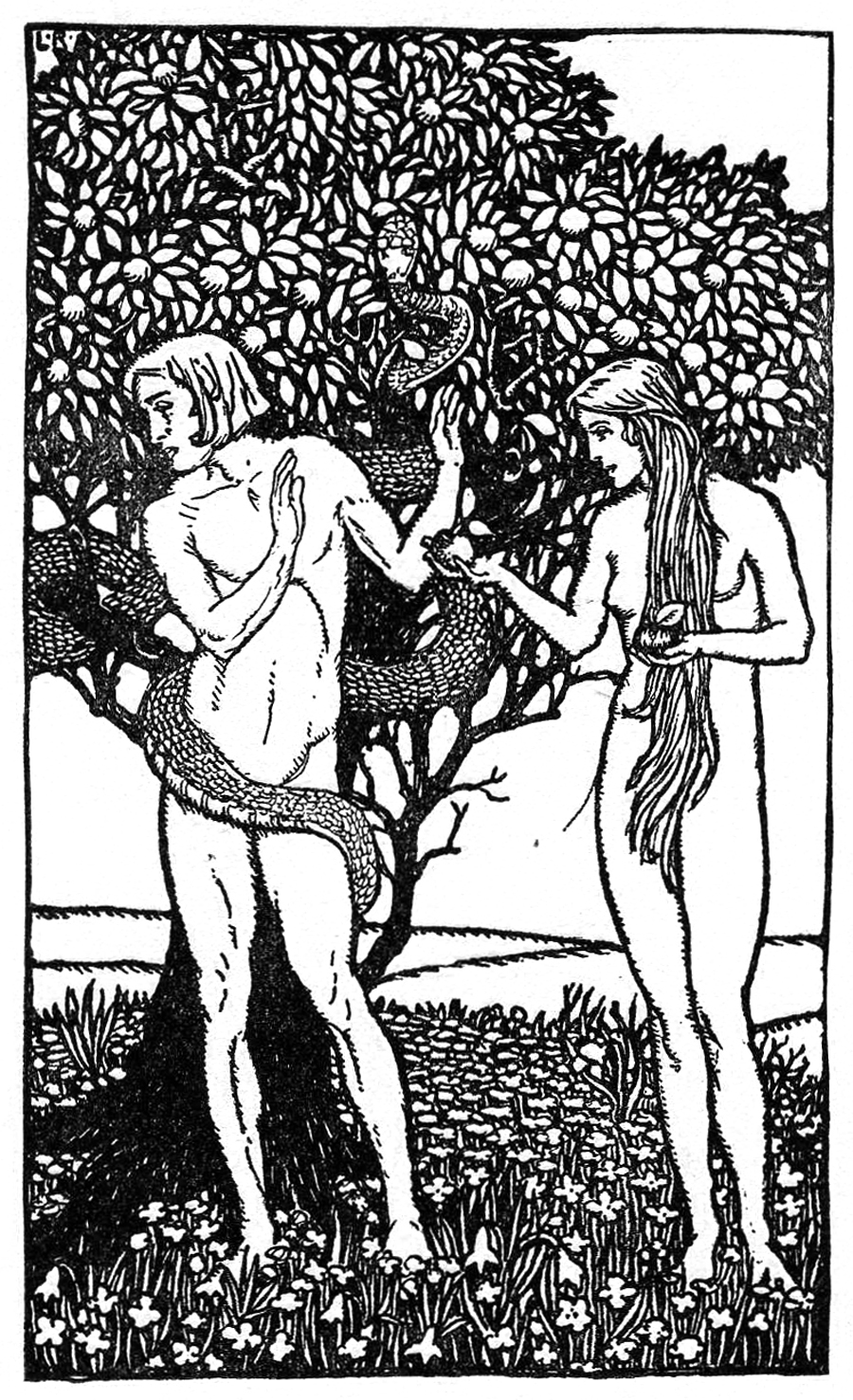
Mark Twain's "Eve's Diary" Title Page - by Lester Ralph

There is a slate of activities scheduled tonight at the historic Park Church in my hometown of Elmira to commemorate this city’s part in an episode that Mark Twain chronicled in a very short vignette called A Monument to Adam.  It seems that Twain had made an offhand comment at one point in the late 1870’s to the then minister of Park Church, Thomas K. Beecher, who was the  brother of Harriet Beecher Stowe and Henry Ward Beecher and a favorite drinking buddy of the famed writer.  It was in the era when the evolutionary theories of Charles Darwin were taking hold of the wider population and Twain, in speaking of Darwin with Beecher, joked that the biblical Adam had altogether been overlooked by the naturalist and that  he would surely soon be forgotten.  He then suggested, with tongue even more firmly planted in cheek, that Elmira should erect a monument to Adam that would keep his name alive as well as serve as a great boon to local tourism.

Much to his surprise, the idea took off locally and soon he was in meetings with bankers who pledged thousands of dollars to erect the monument and began to solicit designs from all over, some from Paris, as Twain notes.  Elmira was on its way to becoming a tourist mecca.  Or so the locals thought.

The Park Church, Elmira NY

Twain felt it was always a ridiculous idea and, in an effort to curtail its momentum, wrote a request to be read before the congress asking the federal government to erect the monument, knowing full well that once the idea was presented it would be ridiculed and would soon be forgotten.  But the representative wouldn’t read it because he felt that it was so seriously written and sentimental that they might just consider it in earnest. 

Of course, the idea ran out of steam and was soon set aside only to revived later as a short article by Twain.  Elmira never became a tourist destination, outside of the folks who come to see Twain’s gravesite.   But tonight the idea lives on again in that same church where Twain would periodically listen to the preaching of Beecher.

Read Full Post »

Marwencol


Last week after a post I wrote about one man’s artistic transfromation after experiencing a stroke, Al, a longtime reader, sent me a link to an interesting site about the imagined world of another man whose life had been similarly transformed and whose story is told in a documentary, Marwencol, which airs tonight on the PBS  series, Independent Lens. It’s also available streaming on Netflix. 

This fellow, Mark Hogancamp, didn’t suffer brain damage due to a stroke.  He was beaten and stomped by five young men outside a Kingston, NY bar back in 2000 to the point that he lost large chunks of his memory including that of his actual identity.  He slowly began to gather bits and pieces of his past in rehabilitation but the trauma of the attack lingered, deeply carved into his pysche.  When the Medicare funding for his rehab ran out Hogancamp started his own therapy.

That’s when Marwencol was born.  Marwencol is the name of  a small fictional Belgian village in the  World War II era world that Hogancamp’s mind began to form.  Hogancamp began a new life in the character of an American GI who found his wayto this place where all of the men were either off to war or had been killed by the German SS.  The only inhabitants of Marwencol were the women who had survived by hiding from the SS and who, in a show of their appreciation for Hogancamp, gave him the village tavern.  The towns inhabitants and the other GI’s who come to Marwencol are all fashioned and named after friends of Hogancamp.

Hogancamp, using small dolls (Barbies are used as the women) and roughly made buildings made from found lumber, recreated the village and scenes  from his Marwencol stories then photographed them.  It’s a grim world where the SS, often in groups of five, are a constant threat.  His photos are highly realistic and vividly compelling, giving a sense of experience that goes beyond the narrative of the photos and into the mind of Hogancamp.

I was able to see the documentary last week and liked it a lot, finding parts that were uplifting and humorous, including his discovery upon coming home from rehab for the first time  that he owned a couple of hundred pairs of women’s shoes and didn’t know why.  Hogancamp’s world of Marwencol is a triumph of the creative mind in coping with the reality of a very harsh existence.  But as the film ends,  there is a tinge of sadness as Hogancamp remains a very fragile, damaged soul.  I found myself hoping that he finds some way to keep this creative part alive and still find peace so that he doesn’t have to live the rest of his life in Marwencol, always under attack from the dark forces that haunt his past.

Read Full Post »

I wasn’t going to post anything today but when I flipped on the television first thing this morning to check out the news an episode of “I Love Lucy” was on with Ricky singing a beautiful song called Similau.  I’ve seen every episode of the show many, many times over the years and am always amazed at how talented Lucille Ball and Desi Arnaz were.

Everyone knows about Lucy’s comedic sklils but it’s her dancing that I really admire.  She plays up the clumsiness in her  comedy dance routines creating bits that make me laugh every time I see them.  But periodically she flashes the grace and movement of a real dancer.  I don’t think a less talented dancer could create the comedic effect of her often failed dance attempts on the show.

Desi also flashed his wonderful talents on the show, both as a comedian and a real entertainer.  There are a number of his performances of songs on the show that I find really really fascinating with their Cuban beats that were popular in that time.  Of course, there was his signature Babalu but it’s songs like this one, Similau, that captivate me.  Not what you’d expect from one of the most popular sitcoms of all time.

I couldn’t find the version of the song from the show which featured a really interesting and more pronounced rhythmic counterpoint but this is an equally fine version taken from the Peggy Lee radio  show of that time. 

Read Full Post »

Easter Egg?

Not your typical Easter egg, I suppose.  Certainly different than the brightly colored eggs of my youth.

Back then I never knew much about the origin of the egg in the Easter tradition.  Never gave it much thought at all.  But there is a story behind that iconic egg.  Like the rabbit which has come to symbolize Easter as well, the egg stems from the pagan Easter festival  which celebrated both as symbols of fertility and the emerging new life of spring.  The coloring of the eggs, done in earliest times by boiling the eggs with flowers petals, also symbolized the budding colors of spring.

For the Christians part, the egg also had a part in their tradition.  There is a legend that states that  Caesar summoned Mary Magdalene before him after the crucifixion of Jesus, and upon hearing her claims that Jesus had been resurrected is claimed to have said, pointing at a nearby basket of eggs,” Christ has not risen, no more than that egg is red.”  At that point  the eggs supposedly turned red.  Many orthodox Christians traditionally color their eggs red to symbolize this story as well as the sacrificial blood of Christ.

There’s also a pragmatic part to the story of the Easter egg.  The festival of Lent, the 40 days prior to Easter that symbolize Jesus’ 40 days spent fasting in the desert, had long had a prohibition on all meats and animal by-products including milk and eggs.  This created quite a surplus of eggs which would have went to waste in those days long before modern refrigeration without their preservation by boiling.

Now, where the topless lady in this Victorian era image falls into the story, I have not a clue.

Read Full Post »

Self Portrait-- Jon Sarkin

I was sent a link by a friend in response to yesterday’s post that really sparked some thought early this morning as I read it.  It was a story about author Amy Nutt’s book, Shadows Bright as Glass, which concerns itself with the story of Jon Sarkin.

  Sarkin had been a chiropractor until a day in 1988 when he experienced a stroke which transformed his life in a way.  He began to paint voraciously,  trying to express somehow the new self he suddenly identified in the aftermath of the damage done to his brain by the stroke.  He knew that he was somehow changed, could sense that there were parts of his mind that had transformed him into what he felt was a completely different person.  Painting allowed him a vocabulary to express the new sensations he was experiencing.

It made me think about my own accident years ago and the transformation that has taken place in the time since.  I often think of my life before that time as almost another life in another person’s mind, even though I still feel the continuum of my existence.  I am the same but different.   I can’t put my finger on it exactly but  know that  it has been the seed for much of my work over the years, a seeking and expressing of true identity. 
 
In the Ken Burns’ documentary Baseball, which I’ve been viewing this week in the studio, someone described Babe Ruth after his death as the most natural, unaffected person he had ever met.   He was what he was.  This made me think of this same concept of identity.  How many of us are perceived as what  we really are?  Does anyone ever really know anyone’s true and central self?  I wondered how many of us live in lives that are counter to our inner identities, constantly struggling in our minds, perhaps on a very subconscious level, with maintaining an outer face that we sense is not our true self?  It seems to me that this conflict in ourselves would be the source of much unhappiness in this world.  I know it was for me.
 
I don’t know if there are answers to be found.  Yet.  We still seem to be in the earliest stages of knowing how the brain and  the mind connect and  interact but given the acceleration of  discovery and technology over the past few decades, we may know more soon.  For now, we are who we are.  Or at least, who we appear to be.

Read Full Post »

We have quite a few pileated woodpeckers that call our woods home.  They’re a very large bird, about the size of a crow, and the clatter of their pecking echoes loudly through the forest as does their distinctive cackle.  They do a hell of a lot of damage to the white pines but I love seeing and hearing them, which  always reminds me of the Woody Woodpecker cartoons from my childhood.  I was a big fan for a short time but moved on eventually to what I felt were more sophisticated cartoons, such as the Warner Brothers work of Chuck Jones and Tex Avery.  But I still have warm memories when I hear that crazy woodpecker laugh clatter through the trees.

I was also reminded of Woody when my friend Brian recently sent me an interesting link to a New York Times article that talked about one of his animators, Shamus Culhane.  During a scene depicting an explosive moment, Culhane inserted cels into the film that contained art that more resembled that of the abstract expressionists that that of a traditional studio cartoonist.  There is a multimedia link on the page that shows the sequence in a frame by frame breakdown and amid the very smooth edged cartoon rendering there suddenly appears a  short series of frames with raw, rough brushstrokes.  When you see it in slow-motion, you realize how different htis was for normal cartoon fare. 

The article points out that this was not Culhane’s only foray into the edgier side of cartooning, describing other cartoons where other abstract imagery is inserted and a prankish few that contained bawdy hidden humor such as doorways  in an Eastern castle being phallic shaped.  Maybe theose caartoons really were a bad influence after all?

Anyway, it was an interesting article and one that will come to mind whenever my pileated woodpeckers send their shrill laughs through my woods.

Read Full Post »

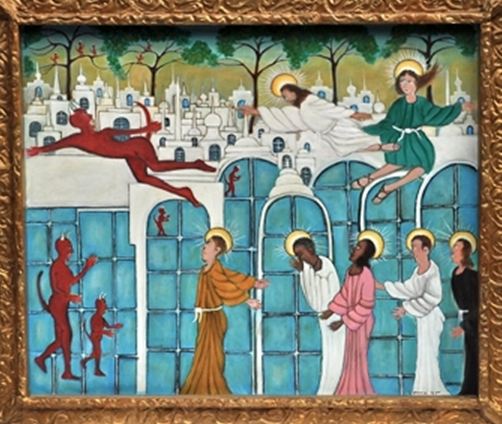
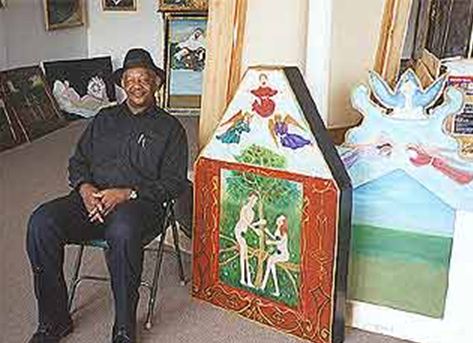
I often like to periodically check out sites that deal in folk art and one of my favorites is Candler Arts, an Atlanta based site that has an online gallery and blog.  I generally find something new and interesting, most often the result of self-taught artists.  This piece for sale there recently caught my eye.  It’s a painting of God expelling Lucifer from Paradise by Lorenzo Scott, a self taught visionary painter from the Atlanta area.  I was intrigued by the composition and decided to look up more on Mr. Scott.

Born in 1934 in Georgia, he moved in the 1960’s to New York City, where he noticed the numbers of people who who paint and sell their work outside the museums there.  He had maintained an interest in drawing since he was boy in school to the point of distraction from his studies but that was about the extent of his knowledge about art. Inspired by these other artists, he started going to the Metropolitan Museum and began studying the works of the Renaissance masters, examining closely how they painted the features of their subjects and the manner in which they composed their pictures.  In a way, he went through a Renaissance guild-like training as an artist without the benefit of a Master to fine tune and influence his talent. After several years in NY, Mr. Scott returned to Atlanta and continued his studies before the paintings of the High Museum there. 

 What emerged was a truly interesting mix of Renaissance-influenced imagery and the folk art hand, a unique interpretation that had classic themes and the raw immediacy of the self-taught visionary.  Vibrant.  His work caught the attention of collectors and curators and over the years he has been the subject of several museum shows and has placed his work in a number of museums, including two at the Smithsonian in Washington, DC.  In the 1990’s he began to include with his classical based compostions a bit of work with more contemporary and traditional folk art themes, many based on visions that, Mr. Scott has said, come to him while asleep. 

His framing is also unique.  They are generally self-made from from lumber topped with bondo, the autobody filler, then painted with gold paint.  They carry that same mix of classical and folk as the paintings and are a perfect companion for the work.

It’s great to see folks who find a way to tap into this inner pool of creativity, inspired by brushing against things far removed from themselves.  For Mr. Scott it was seeing the work of the masters and carrying their work forward in his own personal style.

Read Full Post »

War Horse

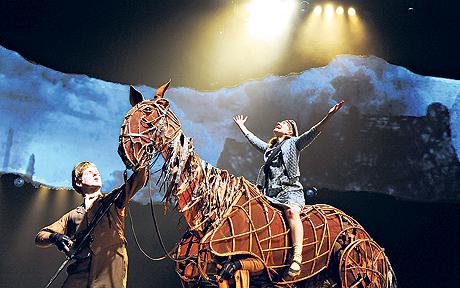
I’ve seen several ads lately for a stage show opening for previews this coming week at Lincoln Center in New York.  Called War Horse, it tells the story of a young man and his beloved horse in England during  World War I.  His horse is sold to serve England in the calvary ( remember that this was WW I and horses were unfortunatelystill a large part of then modern warfare) in the fighting in France.  The horse ends up serving on both sides of the battle and ends up lost in no-man’s land.  The young man sets out to find his horse and bring him home.

Sounds compelling.  The interesting thing is the amazing puppetry that takes place onstage.  They have created life size puppets of the horses from leather, steel and aircraft cable that, operated by two puppeteers underneath the horse and one at the front, fully simulate the motion of horses, even to the smallest details such as a quick flick of the tail or an ear twitch.  They’re also strong enough for a man to ride which creates remarkable opportunities for a stage production, allowing them to have a show where the central figure is a horse without actually subjecting a real creature to the stress of performing on a small stage.  The puppets, created by the Handspring Puppet Company of South Africa, are remarkable.  I have to admit that I spent a bit of time just watching videos on Youtube of these creatures moving and am stunned at the sense of reality thay create. 

The show first opened a couple of years back on London’s West End and has drawn huge crowds and rave reviews since that time.  So if you’re in London or NYC this year, it might be worth a peek if the opportunity arises.   Below is a British newsclip telling a little more about the show. 

Read Full Post »

« Newer Posts - Older Posts »