Feeds:
Posts
Comments

Archive for the ‘Neat Stuff’ Category

Plumbing on the March

I came across this video from the BBC that features the work of Dutch artist Theo Jansen, kinetic sculptures called strandbeests.  Made from simple PVC pipe, an inexpensive product found in any hardware store, Jansen has over the years created creatures that prowl the Dutch beaches, starting first with smaller ones that required Jansen to pull them along until evolving to larger, more intricate beasts that are wind powered.  He evens mentions that these creatures have the ability to detcet and avoid obstacles.  It’s an ingenius blending of art and engineering.

Plus it’s just neat to watch.

The BBC video is a nice intro to his work and more can be found at his Strandbeest website, which features more short videos of his many creations in motion.  Maybe you’ll see one on a beach near you soon.

Read Full Post »

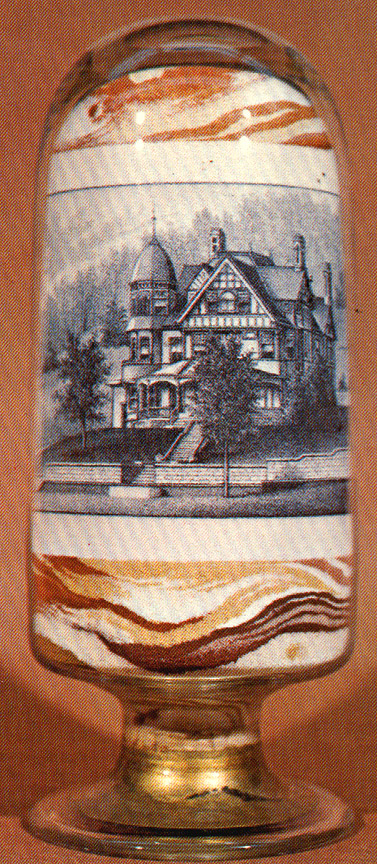
I was really amazed when I first came across these items and their back story only makes them more intriguing to me.  They are bottles of sand where different colored grains of sand are manipulated, without use of glues or any bonding agents, to create highly detailed images and patterns.  These were created by Andrew Clemens who lived in Iowa and died in 1894 at the age of 37.

Clemens was stricken at an early age with encephalitis which left him deaf and practically mute.  He encountered the art of sandpainting at about age 13 and began to search the local terrain for different colors of sand which he incorporated into his craft.  With practice he moved from simple layers and geometric patterns into more and more intricate patterns, even replicating photographs with ornate shading.

As I noted above, Clemens used no glues in his painting, using only the pressure of the surrounding grains of sand to keep his images in place.  To manipulate the sand he created his own tools from pieces of hickory and fish hooks.  It’s a classic case of an artist finding a medium that fits the way his mind operates. 

When finished, Clemens would pack the jar tightly and seal it.  As his abilities grew so did his notoriety.  His jars soon became fairly popular with orders coming in from around Iowa and the rest of the country.  Small jars sold for a dollar or two and larger ones sold for 6 or 8.  Today, the larger, intricate ones like those at the top of the page would sell for $50-100,000 according to experts.  That is, if they came up for sale.  There are not too many left.  Not only because of the short life of Clemens.  His work had an ephemeral quality.  A slip of the hand and a beautiful work of art becomes a pile of sand and glass, never to be put back together. 

The more I see of these pieces from Clemens, the more amzed I am at his ability to break down an image and render it grain by grain, almost as though each grain were an individual pixel in a modern digital image.  He truly found a medium that meshed with his vision and abilities and thankfully much of his work still survives in collections for us to see.

Read Full Post »

If any artist has stuck more closely to variations on a single theme than Chuck Close, I am not aware of him.  Close has had a long and illustrious career painting portraits based on the grid system often associated with photographic  pixels, taking the contents of each grid placed over a photo and transferring and expanding it in size to a corresponding grid on his canvas, to put it in simplistic terms.  Beginning early on, Close created  huge canvasses where he would capture every single detail and blemish in his subjects’ faces in an extreme photorealist manner.  These have tremendous impact when seen in person, from the massive scale as well as the ultra-clarity provided in the detail.

  But over the years he went beyond the photorealist aspect and created variations.  Instead of replicating each pixel with absolute precision, Close would use the grid to create almost abstract mosaic tiles that captured some of the color and form of the referenced grid but had their own form as well.  The self portrait shown above is such an example. He also used his thumbprints to create portraits in this manner, taking fingerpainting to new heights.  Fanny/Fingerpainting 1985, shown here, is an example.  Hard to believe that this very realistic image is built from thumbprints.

As an artist, I am most intrigued by Close’s dedication to his process and his ability to discover variation within it.  Ultimately, subject matter is not the important part of his body of work.  It is his unique process that makes his work special.  That’s something that you hope young artists realize, that it is more vital to adapt a way of painting, a process,  that meshes with the workings of your own mind than finding interesting subject matter.

There’s a lot more to say about Chuck Close than I’m saying at the moment.  For instance, how he has adapted his process to his physical limitations that resulted from a spinal blood clot in the late 80’s.  That’s a story in itself.  There’s a wealth of info on the web about the artist for those who seek more detail.

Here’s a neat promo for a show from 2009 of Close’s printwork held at the San Jose Museum of Art.

Read Full Post »

I have a book that I often find myself flipping through in the studio.  It’s  Gardens of Revelation: Environments by Visioionary Artists from author John Beardsley.  It is an overview of various atist gardens around the world, documenting the creative and idiosyncratic outdoor worlds made by average folks who have a drive to leave some sort of mark on the world.  It’s a wonderful book that shows how strong this need to create these environments can manifest itself, often becoming the driving force in the lives of those who undertake them.

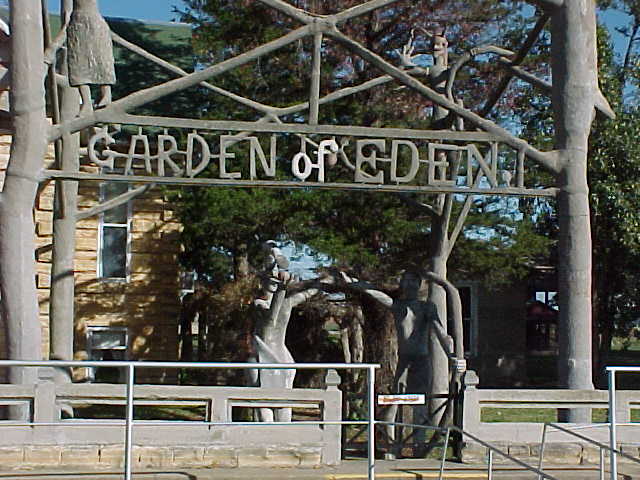
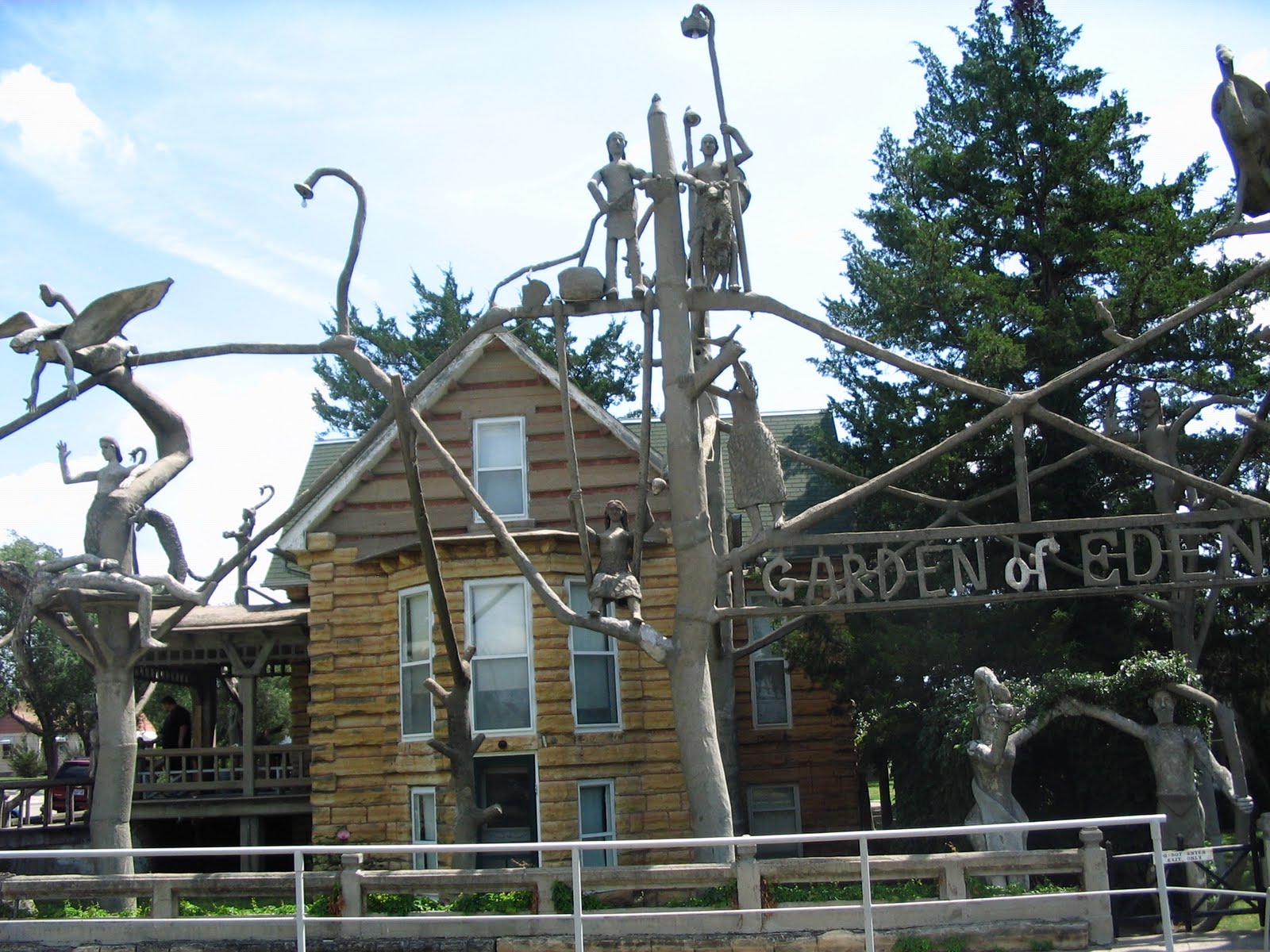
One of my favorites is the Garden of Eden, located in the booming metropolis of Lucas, Kansas, population 460.  Built there by Civil War veteran Samuel Perry Dinsmoor, it started as a home built for Dinsmoor’s family.  In the timber-bare plains of Kansas, Dinsmoor painstakingly built a cabin  from limestone slabs carved to look like logs.  After completing the house, he soon set to building his vision formed from Biblical tales,  mixed in with his unique view of the world at the time, as he saw them.  Built over steel and chicken wire, each element is made with handformed concrete, sealed well to keep it from deteriorating in the unrelenting weather of the plains.  It soon spread to cover most of the 1/2 acre lot and became a well known Kansas roadside attraction. 

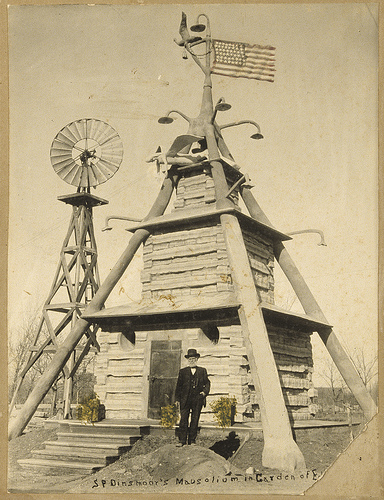
Dinsmoor was quite a character and saw his creation as a way to support his family long after he was gone.  He married his second wife when he was eighty years old.  She was 20 and they had two children before his death in 1932 at the age of 89.  Wanting to still be a presence, he proceeded to build a final structure on the lot– a mausoleum constructed from the same limetone logs as he had incorporated in his home.  In a final attempt to provide for his family after his death , he built a tomb that allowed paying visitors to view his embalmed body through a viewing panel.  You can still take a look at the leathery and somewhat mildewed creator of this Earthly Garden of Eden today.

I’m glad that Dinsmoor’s garden still prospers today.  The sculpture seems to be in great shape, seeming as vibrant as they must have nearly 100 years ago. Someday I must wander across the plains to Lucas and give it a gander and pay my respects to its builder.

Read Full Post »

Forms

Periodically I look up from my easel or my computer at a set of shelves that are built into the stonework of the fireplace in my studio.  I have some books and a couple of  small older pieces of mine along with a few mementos.  The one that always catches my eye is an old shoe last (the forms a cobbler would use in making a shoe) that I found here when I moved in.  I was drawn to it from the moment I first saw it. 

It’s carved from what looks to be a fairly soft wood, a fir or poplar.  The weight is deceiving when you pick it up as there are heavy brass inserts on the heel.  On these inserts you can see where the shoemaker has nailled many heels over the years, leaving little pits in the brass.  It has several markings on it.  ITALIO is printed in block letters on one side and the size 8 1/2 D is stamped into the wood.  There is a date as well, Apr 6 1960 on one side.

There’s something very beautiful in the form of this object, a certain rhythm  in the smooth lines of the wood as it rolls up and over the instep.  The graceful nature of the object makes it seem more a work of sculpture than a utilitarian object and when I hold it, the weight of it and the coolness of the wood give it a  tactile quality that belies its true nature.

The forms used in making objects such as shoes or hats are often quite beautiful to my eye.  Seeing the form of the intended object in a material other than the leather of the shoe or the felt of the hat gives a much different impression.  It allows you to look past the object, which may not have even drawn the eye in its intended final state, and see the forms underneath.  The essence of the piece.

I found these hat molds at a site , Just Folk, that is offering them for sale.  Their site has a great opening page with funky music and a slideshow of some their unique objects.  These hat molds have a great look that I’m sure transcends the beauty of the original hats although these designs are very solid.  I wonder how many of these hats are still floating around, stored away in attic chests or propped up in the windows of a vintage clothing store?

Read Full Post »

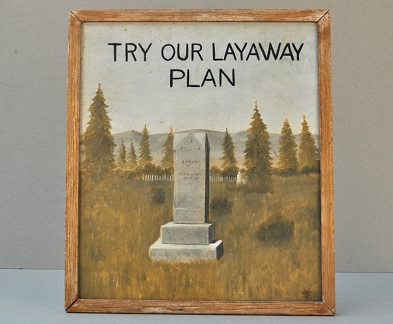
I came across this on  Candler Arts , website that features an eclectic collection of American folk art available for purchase.  I wrote a couple weeks ago about one of their paintings, a nativity scene from Jimmy Lee Sudduth painted with mud and housepaint.  When I saw this piece I gave a chuckle and thought about the reactions it would bring hanging in a shop or gallery. 

It is probably an advertising piece for a monument maker, probably in the first half of the 20th century, probably in a rural region.  Advertising pieces through the last century or so have provided us with some great folk art.  Think of the large cigar store figures.  Paul D’Ambrosio, who writes the vastly informative blog, American Folk Art @ Cooperstown, has written a number of times about the handmade signs and figures that once graced the counters of small shops and stores in earlier America.  Many are a bit rough, like this sign, but all are simply trying to communicate with their customers and did so with a sort of grace that we can still see in them today. 

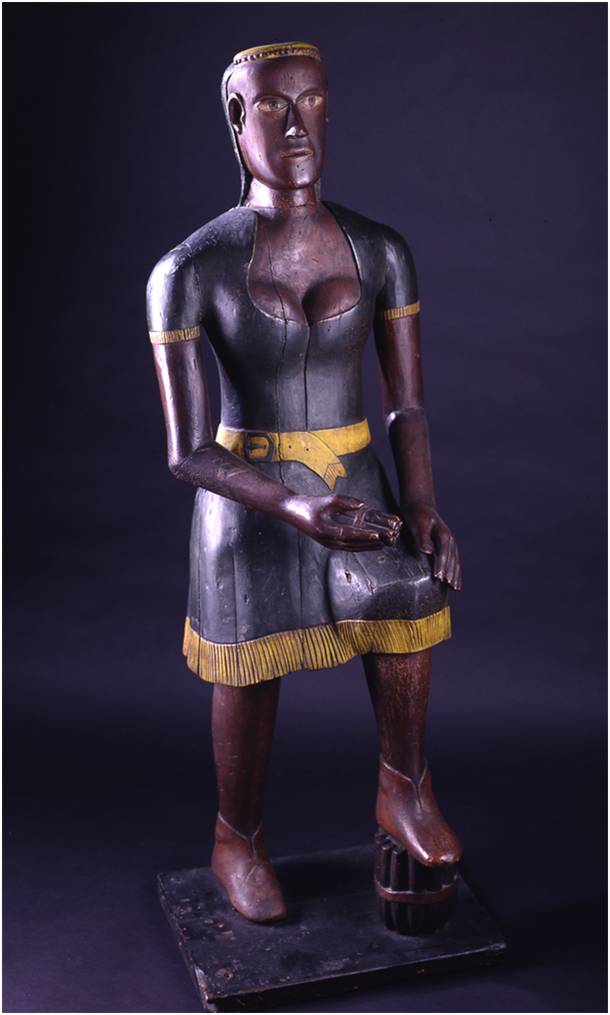
One of my favorites from Paul’s blog is a piece from the Fenimore Art Museum collection believed to be from a freed slave named Job from around 1825.  It is an African-American cigar store figure and is a sensitive depiction of such a figure for the time. A female figure holding out a bundle of cigars, it is not a harsh caricature one often would see at that time.  But is still an eye-catching figure which was the purpose of these pieces, to attract customers into the shops. 

 I would definitely stop and take a serious look today if I saw a carving like this outside a shop.  And maybe I would even ask about their layaway plan.

Read Full Post »

On the Chang Tang

I wrote this past week about Jeremy and Eliza, my nephew and his wife, and their adventure to climb Aconcagua in Soth America.  After arriving in Mendoza in the foothills of the Andes, they set up for  preparations at hostel there that is a gathering spot for international climbers on their way to and from the mountains.  There they met a Swede named Janne Corax.

Of course, the name meant nothing to me but it turns out he is a legendary figure in the world of adventure travel, a man who is best known for his bicycle treks that have taken him all over the globe.  He rides his bike to the mountains, climbs them, then mounts his bike and pedals home.  I’m not talking about riding a few hundred miles down the road here.  He has several times started his journey from his home in southern Sweden , pedaling to Tibet to climb the peaks there then back home via the bike.  At this point he has logged over 82500 km on his cycle.  That’s over 51000 miles.

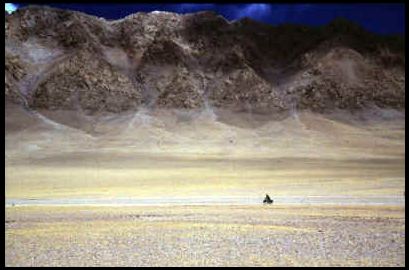
The picture shown here was on his website and is from one of his journeys across the Chang Tang plateau in Tibet.  The Chang Tang is a vast barren plateau that is about the size of Texas in size, all at an altitude of between 4500 and 5500 meters.  That’s between 16000 and 18000 feet which makes this a very high altitude.  Corax was the first cyclist to ride across this severe terrain.  Actually, he’s done it twice.

When I saw this photo it reminded me of an image I had in my mind many years back, before I had started painting.  It was almost identical to this image of a lone figure crossing a vast desolate plain with mountains rising  directly behind it.  It was something I struggled to capture in writing  but could never capture the essence of how it made me feel.  For lack of a better term, I called it the Big Quiet, a term I still use today.  It refers to a personal paradise for me, even in this harsh and desolate context.  An environment free of the constant throb and noise of man.  The world laid bare, at it’s most essential.

So, here it was.  He had found the Big Quiet that I could only imagine.  Actually, I could never do what he has done.  But knowing that it is still out there is a comfort and I am glad there are people like Janne Corax to inspire the imaginations of others with their determination and their daring in seeking their own Big Quiet.

Read Full Post »

I’ve always been a fan of graveyards, a fact that I’ve proclaimed here in the past.  The monuments and tombstones are an unceasing source of fascination, both in the data provided and the design of the stones. 

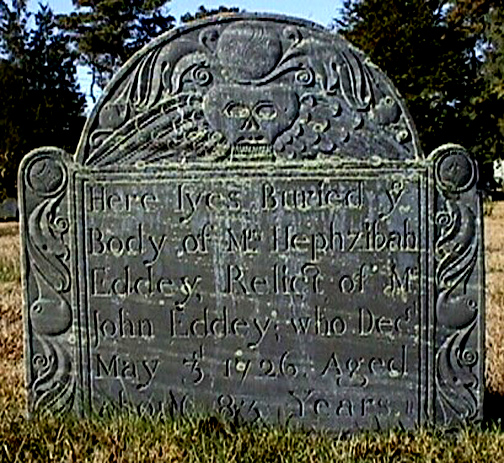
 So you can imagine how happy I was to stumble across a relative who also has a great tombstone.  Such is the case with this particular stone, one that marks the grave of my tenth great grandmother on Martha’s Vineyard.  Died in 1726 at the age of 83.  Her name was Hephzibah Doggett who was married to John Eddey.

Hephzibah Doggett.  Got to love that name.

   Before I started venturing into genealogy a few years back I had no idea of any family before the last two or three generations, and even then the history was sketchy at best.  On my mother’s side, it was almost non-existent.  So, to turn previously unturned pages in the family history is exciting and gives a new perspective on how we arrived at this place.  It also provides an opportunity to imagine how the thoughts and mind of a person like Hephzipah relate to your own, to wonder if their eyes saw things in a way that I could understand.

Of course, I will never know the answers to such questions but at least I know that she existed and has left a wonderful monument as her marker on time.

Read Full Post »

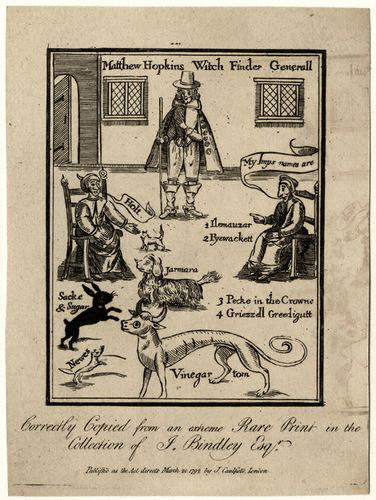
Sometimes you run across things in history that sound so odd  to our own modern sensibilities that they seem like they could be fictional in nature.  Such is the case with Matthew Hopkins, the self-proclaimed Witch-Finder General  who flourished in 1640’s England.

Because of the power and influence of the church, anyone who held contrary views was considered a heretic and was therefore assumed to be in an alliance with the Devil.  Hopkins saw a great opportunity in this belief and in the years 1645 to 1647 travelled from town to town through the English districts cleansing the towns of witches, for which he was paid a handsome fee.  In those few short years, Hopkins was responsible for the death of 300-400 people he deemed to be witches.

He would use a variety of tests to determine whether the accused was indeed a witch.  His assistants would shave the body of the accused and Hopkins would search for a devils-mark.  It could be a mole, a birth mark or a third nipple.  He would then prick it and if it failed to bleed the accused was a witch. 

Then there was the time honored tradition of tying the accused to a chair and heaving them into a pond.  Float and you’re a witch.  Sink, you’re not a witch and you’re safely at the bottom of a pond.  This method was eliminated by Parliament during this time.  Even then it seemed a little out there.  He also used sleep deprivation and other traditional methods used for extracting confessions from those accused, who often happened to be older women, many widows. 

 It is believed that Hopkins also used a spring-loaded blade for his testing which meant that when he pricked the skin, the blade would appear to enter the skin but would in fact push back into the handle, leaving no mark or blood.  A little insurance that there were enough witches in town to make it worthwhile.

Thankfully, Hopkins’ actions raised a lot of eyebrows and opposition was raised against his campaign by a vicar who went so far as to publish a treatise condemniong Hopkins and his ways.  Hopkins reacted with his own pamphlet, The Discovery of Witchcraft, from which the illustration shown above is derived.  As a result of this opposition an investigation was launched which ended when Hopkins retired from his odd vocation in 1647.

There is little known of Hopkins after this .  It is held in legend that he met his death when he was confronted by townsfolk who were up in arms over his activities and was subjected to the water test.  Most others believe he died from tuberculosis.  Whether he believed his own words or was simply a charlatan out to make a pile of dough will never be known.  But it made for an odd, and terrifying , tale that one wishes were fictional.

I  wonder who will be our time’s Matthew Hopkins five hundred years in the future?  What  beliefs of ours will be made to look ridiculous with time?  I’m sure there will some…

Read Full Post »

Aconcagua

Today, my nephew Jeremy and his new wife, Eliza, head out to Philadelphia from where they will depart tomorrow for Argentina.  They lived and worked for several years in the San Francisco area and this past year made some big life decisions.  The first was to get married and the second was to quit their jobs and take to the trail for a year or so,  starting with an expedition climbing Aconcagua in the Andes.  It is the tallest peak in South America as well as the tallest peak in the Western and Southern  hemispheres.

It’s a real mountain at over 22000 feet and will present their group, comprised of the two of them and three close climbing friends, with  challenges they haven’t faced yet in their previous outdoor excursions.  Several years back, Jer and Eliza completed the Pacific Crest Trail (PCT), a grueling hike that began in April at the Mexican border and ended in October at the Canadian border.  They chronicled their 2650 mile journey on their blog,  A Wolf Walk.  While their trail then took them through the highest points of the Sierras and the Cascades, it offered none of the high altitude challenge that Aconcagua will offer.  To determine their tolerance of the altitude as well their overall readiness, their group  will spend a week or two climbing lesser peaks surrounding Aconcagua before making their attempt in mid-February.

For those of you have an interest in following their journey in the Andes, they are maintaining a blog from the trail (ah, technology!) that is called Foschizzel Around the World!  The Foschizzel here is a combination, of sorts, of their last names, Foster and Schissel.  Snoop Dogg is not sponsoring their trip, if you thought that was the case with the name.

I envy the intentionality with which they are living their life and wish them well on this expedition.  I will follow their progress closely and live vicariously through their experiences.  Hopefully, good fortune will be with them.

Good luck and good climbing, Eliza and Jer!

Read Full Post »

« Newer Posts - Older Posts »