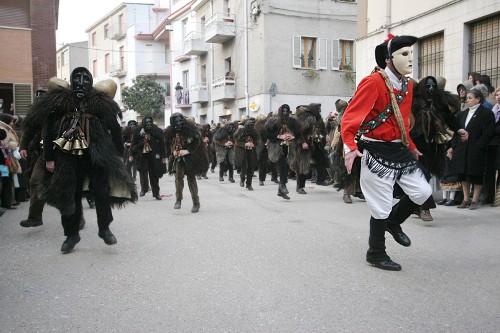
Off the coast of Italy, on the island of Sardinia, there is a village called Mamoiada where festivals are held throughout the year, many having origins in ancient pagan ceremonies. Appearing in several of these fests, some of which are described as being Festivals of Good and Evil, are two symbolic characters called Mamuthones and Issahadores, representing the two forces.
It’s not completely clear as to the exact meaning of the symbols but in the most widely believed version it is said that the Issahadores, dressed in their red shirts and white wooden masks, represent the early shepherds of Sardinia and their victory over the invading Saracens who are represented by the Mamuthones, dressed in their furry suits laden with cowbells and wearing black masks. They parade through the town with the Issahadores leading a procession of the imprisoned Mamuthones in rows of two. As the Mamuthones walk they heave upward with their bodies in unison and come down hard creating a huge sound with the many cowbells on their costumes. It creates a rhythmic throb of sound that fills the streets. The Issahadores at the front and rear of the parade periodically use their lassos to snare women from from the crowd.
There are other interpretations as to what these characters represent but whatever the case, it’s quite a spectacle. I don’t know why I show this today. I saw a brief clip of their parade and was really taken by it. The sound, the rhythm, the the striking sight of the costumed characters as they do their simple choreography. It just reeked of a symbolism that you don’t need to know to appreciate, like looking at a painting and being moved without understanding why.
So this Sunday I start my day with echo of the Mamuthones’ bells throbbing in my ears, inspired…
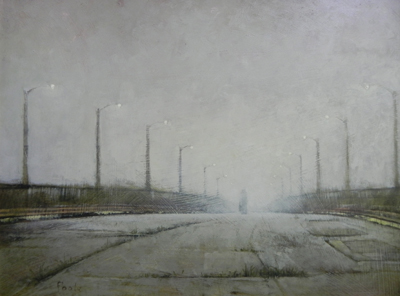
This is a new painting that is also part of the New Days exhibit at the West End Gallery. Titled Roots Show Through, it’s one of those paintings that, for me, brings to mind an immediate thought. When I look at this piece I am instantly reminded that we are the products of our past and that our ancestry deeply dictates many of our behaviors. We may believe that our actions are ours alone and that our forebearers are remote from us in all ways but they show themselves in ways we may never recognize.
I was watching the end of the PBS series Faces of America with Henry Louis Gates (of the infamous arrest and subsequent Beer Summit at the White House) which traces the genealogical background of a number of well known folks, showing how they came to be and how they are interrelated to many others. I was captivated by how they were able to break down the genetic composition of their subjects, showing how richly we are endowed those things that make us unique by prior generations. Each one of our direct anscestors made it possible for us to be here in the form, for better or worse, that we are at present. Take away any of them and we become much different people, if we exist at all.
The roots show through.
Now there are roots that we would like to keep deeply buried. I know from doing genealogy that there is a tendency to want to see our ancestors in the best possible light, to give them the most positive attributes. You imagine them to be wise and good and often you can find some evidence that some of your ancestors were . But sometimes you find things that are less flattering, things you hope haven’t found their way to you through the genetic network. In doing my own genealogy ( and my guess is that it is similar to a great many people out there) I have found a number of good and learned people who had places of respect in their communities. But for every one of these folks I found even more who were less accomplished.
Going through census records, I find many ancestors in the recent past who could not read nor write. Some are listed on these same records in prisons and county poor houses and sanitariums. Some are found in other records listing their misdeeds. I have thieves and swindlers in my line. My favorite was a beaver thief from the late 1600’s up the Hudson Valley. I have some ancestors who were killed in various battles and massacres and as many who took part in other massacres, including one who was darkly remembered for the lifelong revenge he took against the Indian tribes who had killed his father. I have murderers including a great-great grandfather from several generations back who was hung in the town square in Easton, PA for the murder of his wife.
You hope some of those roots found a dead-end generations ago. But they probably found their way through in some form and you ultimately deal with the background that brought you here in ways you hope allow you to live and prosper, with some semblance of wisdom and good. You hope that the positive traits handed down to you by your ancestors far outweigh the negative ones.
Oddly enough, all of this and more comes to mind when I glimpse this piece. It has almost become an icon for this particular thought. How others see it, I cannot guess…
I was looking for something else online this morning when my eye was caught by something completely off the track from what I was seeking. Like an infant, I am drawn to shiny things waving in front of my face and leave my original goal behind and shift to the shiny new. Maybe this is one of the symptoms that the author of the new book, The Shallows, describes concerning our ever shrinking attention spans due to the fast scan nature of the internet and the ever shallowing basin of our knowledge.
Ah, I’m bored with this- let me tell you about the shiny thing.
Flipbooks.
You know, basic animation using the edge of a page where each page is a small incremental movement of whatever you’re drawing on that page so that when you flip all the pages together gives the impression of a film. Wow, that was a tortured sentence.
I never really did any animation, even though I often portray the movement of wind and branches and leaves in my work. I tend to think of my work as a single moment captured. But I do love animation and admire those who do it well. At the top is a page from animation great Max Fleischer’s 1930’s book, Betty Boop’s Movie Cartoon Lessons, that allows you to cut out and assemble your own flipbook featuring his Koko the Clown character running. I found this on a website, Uncle John’s Crazy Town, that features a lot of vintage animation. On his site he has assembled the flipbook and you can see how it runs as a cartoon byclicking here.
Here’s another modern one. It’s not as polished as Max Fleischer but it’s clever anda great concept. And fun.
You’ve heard the sound before. The electronic soaring, sustained notes, like a singing saw ( I know that’s a reference that has almost no meaning to most of you), that gave many sci-fi films of the 50’s and 60’s their eerie, otherworldly feel. Think of The Day the Earth Stood Still ( the old one) or the opening credits of the early Star Trek series. That is the theremin, the only musical instrument played without touching it. Using a vertical and a horizontal antenna that creates an energy field, the hand moving up and down along the vertical axis creates an interruption that creates the sound, a musical note, and the hand moving along the horizontal axis controls the volume of the note. It is considered the easiest instrument to play but perhaps the hardest to play well. I’m still not convinced anyone really plays it well.
It’s one of those things we often just shrug off as another geegaw that comes down the pike and has a short run in the eye of popular culture. But the theremin and its inventor, Leon Theremin, are an interesting case.
Theremin (1896-1993) was born in Russia and, and as a state scientist for the early Communist Soviet Union worked on many groundbreaking projects there including an early wireless television , developing the instrument that now bears his name around 1920. He began giving concerts with the instrument throughout the Soviet Union and soon throughout Europe, creating a sensation wherever he played. Finally, in 1927, he came to New York with Lenin’s blessing, as a sort of cultural ambassador for the Soviets.
In New York, the sensation of the theremin continued. He played a landmark concert at Carnegie Hall that made the instrument the must-have item across the country. RCA purchased the rights and began producing scores of the instruments for home use. Theremin continued during this time to live comfortably in New York, including a marriage, controversial at the time, to an African-American ballet dancer. Then, in 1938, he abruptly left the States to return to the Soviet Union. Some say he was whisked away by the KGB. Some say he was merely homesick. Theremin himself claims he left to avoid creditors and tax problems here. Whatever the case, he ended up serving in in Stalin’s workcamps for eight years and afterwards working under the watchful eye of the state as scientist into the 1960’s.
Perhaps his best known invention other than the theremin instrument is one that is at the center of one of history’s great espionage moments, the Great Seal episode. In 1945, Soviet Boy Scouts presented our ambassador there, Averill Harriman, with a carved Great Seal of the United States to honor our partnership as allies during the just ended World war II. It hung for seven years in the Moscow embassy offices until one day a British radio operator discovered he was able to hear conversations on an open radio channel. A search discovered a cavity in the Great Seal. In this cavity there was a small membrane attached to a short antenna. No power source. No wires. Nothing that emitted radio signals. It took several months before they figured out that this was a passive listening device, one that only became active when it was exposed to radio waves beamed at it from a remote location. This made it practically undetectable and brilliant in its simple sophistication.
Theremin finallywas allowed to leave the Soviet Union again in the late 1980’s. He came to the USA in 1991 under the auspices of a filmmaker, Steven Martin, who later made a documentary, Theremin: An Electronic Odyssey. He died in 1993, at the age of 97.
So when you hear that wooo-OOOO-aaaa-OOOO of the Theremin, rememerthat there is some history behind it…
Here’s a Trekkie showing off his theremin licks, just to give you a taste of the sound:
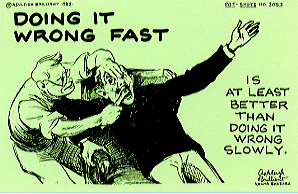
I was looking for a quote in one of the many online quotesites when I came across several attributed to someone called Ashleigh Brilliant, a name I had never heard. Many of his quotes made me chuckle and some had an Oscar Wilde-ish bite. For instance:
My play was a complete success. The audience was a failure.
Looking him up, I discovered he is a British-born epigrammist (yes, I said epigrammist) living in Santa Barbara who has a syndicated feature called Pot-Shots, described as “Brilliant thoughts in 17 words or less“, which features his clever epigrams and line drawings in a small postcard shaped box. His website features many of his best works ( and some not so) for sale in many forms. Mugs. T-shirts. Postcards. Placemats.
Placemats?
In other words, the guy is a character who is not afraid to market his unique personality. Good for him. Take a moment and check out his site. It’s entertaining and has a real human feel.
Here’s another of his bon mots:
I waited and waited, and when no message came, I knew it must have been from you.
At yesterday’s memorial service for Tom Buechner, former congressman and head of Corning, Inc Amory Houghton was one of the speakers who stood before the large crowd under the spectacular Tiffany stained-glass windows of the Christ Episcopal Church in Corning and told stories about the man. At one point, Houghton said that while Tom was a brilliant man (he had , after all, been chosen by the Houghtons to start the Corning Museum of Glass in 1950 at the tender age of 23) he sometimes came up with “nutty ideas“. He then cited the stained glass bridge that I mentioned in yesterday’s post as an example, almost harumphing as he finished as if to say, “How crazy is that?”
Cheri and I exchanged sideways glances and to the crowd’s credit, very few seemed to share the humor Amo seemed to find in it.
But at the same time, it is an idea that is forward-thinking on a grand scale, filled with the possibility of returns for the community and company that dwarf the initial risk. Visionary, yes. Nutty? Hardly.
And therein sits the division between those who see possibility and those who see impossibility. It’s a very narrow chasm often leaving two people seemingly standing next to one another, close enough to touch. But between them is a gaping ravine deep enough to deter crossing. The believer in possibility stands on one side and tries to convince the denier of possibility that all he must do is to dare to lift his foot and simply step across to the other side. Though not so far away, the view is so much different from this side!
Maybe this difference of views is the same that separates us all. Deep chasms we dare not cross, formed by our fears and the thoughts of what can’t be done rather than what can. I read an interesting editorial the other day where the writer talked about this moment in time in our country versus the time after World War II. At that time, our national debt was 120% of our GDP as opposed to the nearly 90% now. The highest income tax rates hovered at 90%, shockingly higher than today. Unemployment was soaring as the masses of troops returned to the civilian ranks. We were staggering and teetering after a decade of the Great Depression and a costly war. Yet, as the writer of the editorial pointed out, there was a positivism then that is virtually absent now. We had persevered the worst in the Depression and came out victorious in the War and we had come out the other side with an atitude that we could get anything done if we set our will to it. We embarked on two huge and costly efforts despite staggering costs- the Marshall Plan to rebuild war-ravaged Europe and the GI Bill that rewarded our troops for their selfless sacrifice with a chance at a higher education and low-cost housing, one of the largest entitlement programs in our history and one that set the table for the growth of the middle class in the 1950’s.
Today, that positivism is nowhere to be found in the general populace. Gone is the roll-up-your-sleeves attitude. We have become afraid to move forward, preferring to stand in the present and not step across the chasm of possibility to a future that moves forward. We have fallen prey to fear and negativity and nothing good, absolutely nothing, can come of this attitude.
So, maybe hearing “nutty idea” spoke to more than a little museum on a little bridge in a little city in a rural county in upstate New York for me. Maybe it spoke to the symptoms and causes of what ails us as a nation– the differing viewpoints of those who look on the same thing and see two vastly different versions. A chasm between possibility and impossibility.
We are heading off this morning for a memorial service for the late Tom Buechner, a man of many talents ( including those as an artist, writer, curator, art historian and teacher) who passed away on June 13th. The memorial is being held at the beautiful Christ Episcopal Church in Corning which, with its great stained glass windows, brings to mind one of Tom’s dreams that never reached fruition, unfortunately.
The Chemung River cuts the city of Corning into two halves and there are two active bridges that span the often lazy river. There is also a third bridge, the old Centerway Bridge that sits right next to the newer Centerway Bridge, that was built in the 1970’s, leaving the old bridge to sit idly by acting only as a wide pedestrian bridge between the downtown Market Street district on one side and the Corning Museum of Glass on the other.
Buechner saw this idle bridge and its scenic perch above the river as a waste of an asset. In his creative mind he saw it as something more, as a foundation for a structure rising from it, one that would celebrate Corning’s glass heritage and fame. Stained glass, in particular. He saw the bridge holding a world class museum and facility for the study of stained glass, a natural extension of the present Glass Museum which draws glass scholars from all over the world.
It would sit above the river and have glass panels on each side that would permit the freeflow of light through the panels on display, giving the outside of the building a colorful gleam. At night, it would glow above the river in the glorious colors of so many stained glass windows. It would have been quite a sight to see and would have become, no doubt, a great addition to Corning’s lure as a tourist destination.
But it was a big dream for this small city and never came about. Money, structural concerns, etc. They all conspired to leave the stained glass bridge as a seed in Tom Buechner’s mind. This past year, at his October exhibit at the West End Gallery in Corning, he displayed the painting above which showed his concept for the museum. I remember being excited at seeing this piece because the idle bridge always seemed to be sitting there, waiting to be transformed into something. A phoenix hovering in the ashes.
There’s still hope that someone will recognize the beauty of this dream and let the phoenix rise. But it’s doubtful now that Tom has passed, taking with him his vision and his passion. But at least the idea and the dream still remain.
Imagine a lazy summer evening and, as dusk breaks, the deep colors of many stained glass windows cast their rich light over the river …
Present Day Old Centerway Bridge in Painting from Tom Buechner
When I was doing research on my grandfather’s career as a professional wrestler in the earliest days of the sport, back in the first decade of the 1900’s, I came across a newspaper account of one of his earliest matches. It was held at the Kanaweola Club in Elmira which was one of the men’s sporting clubs of that era, a place where men gathered to to participate and watch sports. Since there wasn’t ESPN, or television, or even radio, they often held live sporting events such as pro and amateur boxing and wrestling. Oh, and they also would drink a bit at the clubs.
In one of his headline matches at such a place, Shank, my grandfather’s wrestling moniker, started a match one evening at 9 PM and wrestled until midnight without either wrestler gaining a fall, which means neither was able to pin his opponent or get him to submit. They stopped at midnight and resumed the following night, wrestling for another two and a half hours before Shank was finally pinned. I wanted to lie there and say that Shank had gloriously persevered but I just couldn’t do it. I was proud enough that he just competed in such a marathon and I think he might have been proud of the feat despite the loss.
I don’t know if the two competitors in the current marathon competition still in action on the tennis courts at Wimbledon, John Isner and Nicolas Mahut, are ready to say they’re proud just to be involved in such a match. To say so would be a psychological concession of sorts and they both aren’t ready to give in just yet. They started this match Tuesday and played until dark. The match resumed yesterday afternoon and stretched until they could barely see the balls. Or stand. Ten hours in all. The fifth set, still unfinished, stands in at a time of 7 hours and 6 minutes, making it alone longer than the longest match ever. The third day of this grinder takes palce this morning and I might have to watch.
At this point, the competition between these two men has transcended physical triumph of one over the other and moved into the realm of conquering their own psyches, convincing themselves that they can persevere. Steeling themselves against the desire to just give in and let it be done.
It’s a remarkable thing to witness, this stalemate of wills between two equally matched competitors. It’s liking stealing a raw glimpse of our desire to survive, our desire to overcome struggles of life and death. To be wounded, hurt, but still rise to our feet and return to the fray. Only in a safer way. This is tennis, after all.
Good on both of you today, Mr. Isner and Mr. Mahut. Don’t give up now.
It’s about 6:30 in the morning and I’m sitting here, stumped and looking at a blank screen. Nothing to say so I flip on the television. Don’t really want to watch the news. Not ready for that just yet.
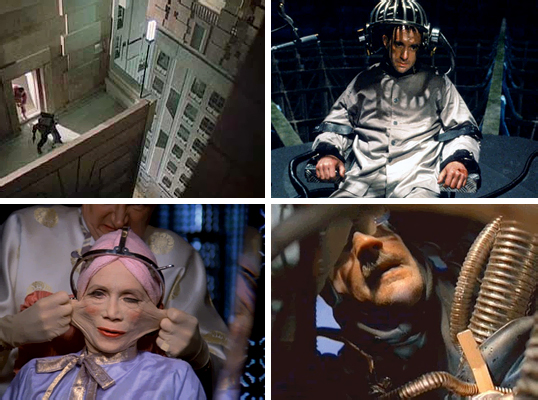
So I flip around the dial and up comes the opening from the movie Brazil with the music from the old song of the same name blaring, but in a gentle way. It’s a sort of 1984 storyline that is set in a futuristic nightmare world that vaguely resembles 1950’s England, only with some slight twists and bends. I know I can’t watch it and get anything done but keep it on because I know that at any moment I can look up at it and see incredibly interesting imagery.
It’s a Terry Gilliam film after all.
Terry Gilliam was the American member of Monty Python’s Flying Circus, the least visible member but the one responsible for much of their visual look including their trademark opening credits and most of their animations. In his post-Python life he has become one of the most original film-makers in the world, creating films that are wildly original and always richly visual. Films likeTime Bandits, The Adventures of Baron Munchausen, Jabberwocky, Twelve Monkeys, The Fisher King and most recently, The Imaginarium of Doctor Parnassus. All films that march to their own drum and have had degrees of success but hardly movies that have had widespread appeal for the general movie-going public.
I can imagine when film critics in the future, if there are such things then, will look back on Gilliam’s body of work and will recognize him for the creative genius he is for creating richly detailed alternate visions of this world in his films, with stories that are consistently strong and beautifully conceived, that often deal with the individual trying to make his way through a world in which he is usually out of place in some way. A theme I think we can all identify with in our own way. I think that is how his work will be remembered, as highly individualistic visual feasts.
Each film is definitely recognizable as his work.
So, as I struggle tofinish this post and get back to my own work, Brazil still rolls across the TV screen in my studio and I know I won’t get much done until it’s over. Thanks, Terry…
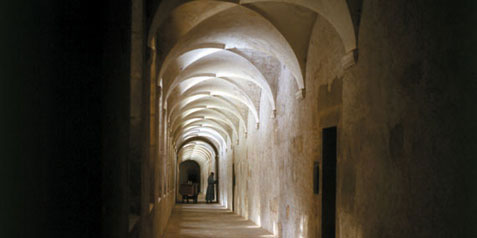
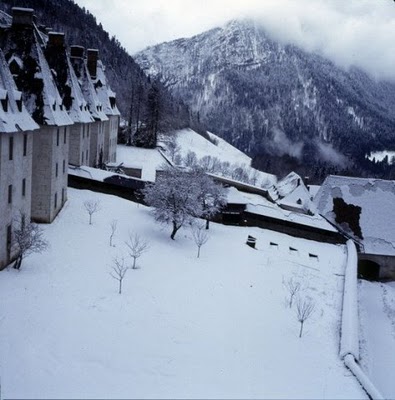
There is a film that was made a few years back by Phillip Groning called Into Great Silence. It is a documentary that was filmed over a year at the Grand Chartreuse Monastery in an awe-inspiring setting in the French Alps, home to the Carthusian Order which dates back to the year 1084 and remains fairly unchanged from that time to the present. It is an order that maintains silence at all times in the monastery.
I came across this a few nights back as I scanned the channels and only caught a short bit of it near its end. It is a film that is silent but for the sounds of the monks movements that echo in the ancient spaces of the monastery. The sound of footfalls down a long stoned hallway. The sound of the monastery bell. The sound of their Gregorian chants from the sanctuary. The filming is in natural light so there is a quality to all the scenes, combined with the surroundings, that gives the film the feel of a medieval painting– dark and quiet. It moves beautifully with a spellbinding quality and a rhythmic quietness that seems the antithesis of most modern films. No car crashes here.
No cars.
There is one segment where the camera follows a group of monks as they head out into the snow outside the monastery in their flowing robes. It is shot from a distance so you can’t hear anything specific but you suddenly realize they are chatting away, almost excitedly, once they leave the boundaries of the monastery. They come to a smaller hill set among the higher, sharp peaks of the Alps. You sit watching and wondering what they might be doing as the scene unfolds, the camera set several hundred feet back so the monks are small in the frame. And with a faint laugh that carries across the distance, they are sliding down the hill as though their feet were snowboards. They would whoosh for a bit then often tumble through the snow to the accompaniment of guffaws that seem startling in the context of the rest of the film. It is a moment of pure but simple joy and gives the monks a more human quality, lets the viewer identify with them and see them not only as dedicated men of their faith.
This film and its imagery have haunted me since I saw the small part of it that I did that night. I have always claimed to be seeking Big Silence and these men seem to have found it. And it appears just as I hoped it might.
Do I want to be a monk?
No. I don’t have the faith or belief that must be required. Not even sure I could live with so many others, even without words.
But that silence. There is something there in the void of words, something that speaks volumes, that gives us a peek into the chasm of time that we all seek and fear. And not too many of us are willing to take that leap into great silence…




 Redtree Times