Feeds:
Posts
Comments

Archive for the ‘Painting’ Category

Growing a Painting

Above is the tentatively finished version of the painting I started earlier this week, a 24″ by 48″ canvas that I am considering calling Escape Route. I showed the first few steps of the painting process on this blog two days ago, ending with the sky being near finished and the composition blocked in.  I’m not going to go into all the steps and decisions that went into completing this piece.  Instead, I put together a short film that shows the painting evolving to the finished product.

I will say that the final version is much different in many ways than I first envisioned with the first strokes of red oxide that went on the canvas.  Each subsequent bit of color, each line that appeared, altered the vision in my head just a bit, evolving the piece constantly until the very end of the process.  Even the last part, where I inserted the treeline that appears on the farthest ridge, was not seen in my mind until just before the decision to proceed with them was made.  I decided to go with this treeline to create a final barrier for the road to break past on its way upward toward the sky.  A final moment of escape.

This painting has given me a great sense of satisfaction after finishing it.  I spent much of the late afternoon yesterday just looking at it and taking it in.  I don’t know if it will translate as well on the computer screen but this piece has substantial size at 24″ by 48″ which gives great weight to the blocks of color from the buildings and the light from the sky.  There is a sense of completeness here that I could  only struggle to explain, but as I said, brings me great satisfaction.  I feel as though the evolved painting has exceeded what I imagined when I first started this piece.   While I can’t fully explain that, it is all I can hope for from my work.

I will spend some more time over the next several weeks looking at this painting, determining if anything should be tweaked or altered.  A highlight added here, a line crispened there.  But as it stands, I think it has taken on its own life and I will probably leave it alone as it is.

Here is the short film, Growing a Painting:

Read Full Post »

I wrote yesterday, while descibing the initial stages of my painting process for a new piece, about stepping back from the canvas at a distance to take in the piece as a whole.  During these early stages, when I’m blocking in the painting with red oxide, I give it what I call my snake-eyed look. This entails squinting the eyes and sort of unfocusing, taking in the shapes as sort of abstract forms that play off one another.  Without taking in great detail with this snake-eyed look I am also imagining ahead in the process, seeing the shapes taking on color and how they’ll react within the composition.  It’s hard to explain except to say that it is a sort of intuitive visualization.

I got the term, snake-eyed look, from a scene from the movie Little Big Man starring Dustin Hoffman as Jack Crabb, the son of westward bound settlers who are killed in an attack by the Pawnee tribe and is subsequently raised as a Cheyenne after being foundby them  in the wreckage of their family’s wagon.  The story tells of his misadventures in going back and forth between the worlds of the Native Americans and the white man , culminating in him being present at the Little Big Horn where Genral Custer (played brilliantly by Richard Mulligan) meets his death.  Great movie and a great tale based on Thomas Berger’s wonderful novel of the same name.

In one scene Jack is reunited with his sister who also survived the massacre but escaped from their rescuers, certain they would rape her.  The Cheyenne, however, thought she was a man.  She takes Jack out to teach him how to use a handgun.  She tells him to go snake-eyed and to visualize shooting a bottle before drawing his gun.  Kind of like the description I gave above.   It’s a scene that I always think of when I find myself standing back from a painting with my eyes in a snake-eyed squint and I often wonder if I adapted this because of the scene or if my squinting  just came naturally.  Whatever the case, it worked for Jack Crabb and it works for me.

I will show the progress of the piece I wrote of yesterday in tomorrow’s post.  For today, here’s that scene from Little Big Man with that snake-eyed look.  If you haven’t seen the whole film or read the book, I definitely recommend either.

Read Full Post »

I worked on a new piece the last couple of days, a large canvas that is  2′ by 4′ .  I had already gessoed the canvas with a distinct texture and applied a layer of black paint.  I had vague ideas of where I thought the painting might go from a composition standpoint but knew that this was only a starting point in my mind.  Like most of my paintings, the finished product is often drastically different than what I imagined at the beginning.  As I paint, each bit of paint dictates the next move and if I don’t try to force in something that goes against these subtle directions given to me by the paint the piece usually has an organic feel, a natural rhythm in the way the different elements go together.  A cohesion of sorts.

Knowing I wanted to use a cityscape in this piece, I started in the bottom left, slowly building the city with geometric forms and rooflines in a red oxide paint that I use to block in my composition.  I like the red oxide because ti gives a warmth under the layers paint to come that comes through in small bits that are almost undetectable at a quick glance. 

At this point I still am unsure where the painting is going.  I have thoughts of filling the canvas completely with the cityscape with the smallest view of the sky through the buildings but am not married to this idea.  The paint isn’t telling me enough yet to know.  But it has told me that I want a path of some sort- a street or canal- through the composition.   I make room for one near the center before starting on the right side with the buildings there.  I go back and forth between the right and left sides as I build the city, constantly stepping back to give it a good look from a distance to assess its progress and direction. 

 At a point where the city is nearing the halfway point on filling the canvas, I decide I want this piece to be less about the cityscape and more about how it opens to the open sky beyond it.  I extend the road that started at the bottom and twist it upward, terminating it at a bend in what will be now a field beyond the city edge.  The sky, though still empty, is pushing me ahead, out of the city.  The piece has become about a sense of escape, taking the street from the cityscape and heading upward on it towards the open fields and sky.  Painting faster now, another field with a bit of the road appearing is finished beyond the first lower field.  I have created a cradle in the landscape for the sky to which I now turn my brush.

There’s a certain symetry at work here and I decide I want the central focus of a sun in this composition.  I roughly block in a round form, letting it break beyond the upper edge of the canvas.  I pay little attention to the size of this sun except in its relationship to the composition below it.  My suns and moons are often out of proportion to reality but it doesn’t matter to me so long as it translates properly in the context of the painting.  If  it works well,  it isn’t even noticed.

I finish blocking in the sky with the red oxide, radiating the strokes away from the sun,  and step back.  The piece has become to come alive for me and I can start to see where it is going.  The color is starting to fill in in my mind and I can see a final version there.  This is usually a very exciting time in the process for me, especially if a piece has a certain vitality.  I sense it here and am propelled forward now, quickly attacking the sky with many, many brushstrokes of mutiple colors. working from dark to light. 

There are layers of a violet color in different shades that are almost completely obscured by subsequent layers.  I could probably leave out these violet  layers but the tiny shards that do barely show add a great depth to the flavor of the painting for me and to leave them out would weaken the piece in a way. 

I ahve painted several hours on the sky now and still have a ways to go before it reaches where I see it in my mind.  There are no shortcuts now.  Just the process of getting to that final visualized point.  But it’s dinnertime and my day is now done.  I pick up and step back to give it one final look before I head out into the darkness.  This is where the painting is at this point, where I will start soon after I post this:

Read Full Post »

The Struggle

Yesterday was the best day I’ve had painting in the past few weeks.  The holidays and the distractions they provide had really knocked me out of  rhythm and I’ve been struggling to get back on the path.  I think this has probably been evident in the writing on this blog.  Writing for this is a real chore when I fall out of my painting routine.  I find myself struggling for things to say and words to express anything.  The writing rhythm is definitely entwined with my painting rhythm.

But yesterday was good in the studio so I’m hoping to see some improvement here, even though I view this writing and my painting as very separate and different entities.  I’ve always viewed writing as being an expression of what the writer knows and sees.  On the other hand,  painting to me is about expressing what I feel but don’t know and am incapable of expressing otherwise.  Painting is more about intuition and the intangible for me. 

Not to say that intuition and intangibles don’t play an important role in writing.  But I can’t find them as effortlessly in writing as I can with a slash of color here or in the way a form plays off another in my painting.  I don’t have to fill in detail, don’t have to create a whole scenario for my work to communicate. 

I think that’s the distinction between the two forms.  With writing, I must know what I am trying to communicate.  With painting, I can communicate without knowing.  In fact, it is preferable that I don’t know.  The work that comes without trying to direct it is usually the best, graceful and filled with emotion.  I don’t see that happening with my writing.

So, I must get back to the paints and gain a bit more rhythm, let the momentum carry me ahead.  I’ll let you know how it goes.

Read Full Post »

A question asked of me this weekend inspired me to go back into my archives and pull out the images of a few pieces done several years back.  I was asked if I used this time of the year as a starting point for new work and I said that I often did,  using it as a time to begin new ideas that I want to try.  I explained that it was important for me to continue trying new things as it excited me in the studio and that this excitement was important to all of my work.  This new work provides a vibrancy that permeates all my work and helps me find the new in compositions that I have painted in the past.

I explained that I liked to try new concepts in series in most years and that some are more embraced than others and become part of my regular painting vocabulary for years.  The Red Roof series is such a series.  I have painted examples in this series for several years and it has become engrained.  The Archaeology series is another. 

Other series last but a season.  While they may be popular from a sales standpoint,  they soon exit my routine.  The In the Window series is an example of such a series.  Done in 2005, they were a series of paintings that featured simple interior scenes with large windows that were highlighted by examples of my typical landscapes.  The idea was that the interior scene acted as a setting to show the landscapes in a different manner, much like the setting for a piece of  jewelry dictates how a gem is seen.  The gem here was  my landscape.

This painting shown on the left, In the Window: Dream Away, was the first piece.  It seemed to jump off the paper on which it was painted.  Very vibrant.  The setting of the window pushed the scene of the tree atop the mound overlooking the water out of the frame and seemed to intensify it.  I was immediately taken with the concept and a number of others soon followed, including the one at the top.  These pieces sold pretty well but they eventually lost steam for me from a creative standpoint.  While I still felt that they were vibrant , I sensed that I had done as much as I could with the concept and didn’t want it to become labored and tired.  My excitement was passing and I wanted to stop near a peak rather than at a low when the work was completely played out when I was viewing it as a toil rather than a joyous activity.

I still feel excitement personally when I see these pieces from this time and I know they are of a certain time for me.  I want them to stand as they are in my body of work.   As I described this this past weekend, I explained that the interesting thing about stopping a series is that it creates a finite number of pieces within it.  They become more distinctive over time, more representative of a certain time in my own artistic continuum.  So while these series, such as the In the Window series, are short-lived they have a longer viewpoint.

Read Full Post »

I am always fascinated with the need for self expression displayed by many folk or outsider artists.  There is a great purity in it,  a direct line to the artist’s inner drive and self that can’t be replicated with all the craftmanship available to the most trained of artists.  It’s just real.

I was reminded of this when I came across the painting shown here for sale on the Candler Arts website.  It’s a wonderful  nativity scene painted by the late Jimmy Lee Sudduth, a self-taught artist from rural Alabama who died in 2007 at the age of 97.  His drive to express himself started at an early age and, despite having few if any resources, was able to create paintings with pigments with the red and grey muds of his home soil.  In later years he used house paints and finally acrylic paints as his fame (he was fortunate enough to have his work discovered by the larger outside world) peaked.  But his lack of supplies or training provided no obstacles for his need to create. 

Probably a lesson there for us all.

I was immediately struck by this painting.  There’s a real sense of rightness about it that really resonates with me.  I don’t know if this is a mud painting or whether he was using house paints here but it doesn’t matter.  It’s simply a raw and real expession, something I wish that more us could capture with our own works.  To put aside craft and technique, or at least make them secondary to the expression of something deeper pulled from within.

Then we might be on to something truly special.  Like Jimmy Lee Sudduth.

Read Full Post »

Well, it’s the day after Christmas and I’m trying to clear my palette from the holiday and get ready for the new year.  Not the holiday but the actual year 2011.  I’m starting to really begin to think about moving in new directions, even in a subtle fashion.  I’ve talked before about how this change is important to me and how it keeps me excited in the work.

Sometimes this new direction comes in the form of new compositions or a differing use of the materials at my disposal.  Sometimes in entails visiting past work or influences and seeing how they interpret at this point in time.  The same composition painted at different times often brings surprisingly different results.  Maybe my color palette is different at one time versus the other or maybe my emotional state is different, which has a huge effect on my work.

As for past influences, sometimes the time that has passed allows me to see different aspects of the painting I’m looking at and take this aspect into my own work.  The painting I’m showing today is an example of a past influence that I have used.  It’s Death on the Ridge Road from the great Grant Wood in 1935.  I love this painting.  It has so many aspects to ponder and take from.

When I first used this as an influence, in this painting from 2001 on the right, I focused mainly on the movement in Wood’s painting.  The curve of the road and the shapes and positions of the vehicles hurtling at one another, along with the lean of the telephone pole at the top of the hill set against the moving sky, all give this piece a sense of motion and action.

At the time, I wanted my painting to carry that same sense of movement as I felt in Wood’s piece but in an even simpler composition, without the drama of the vehicles potentially crashing together.  In my painting the road and motion in the leaves of the tree carry the action aspect.  It very much a different piece, compositionally and emotionally than the Wood painting.  At that time, when I painted this, that was what I took mainly from the Wood painting.  Now, I might focus on other aspects and create work that is quite different than what I first pulled from this influence.  For instance, today I might want to pull something from his shadowing at the bottom of the painting, something I actually have used in a number of paintings over the years.  Or the symbolic aspect of that lower telephone pole and the way it creates an almost shadow-like effect of a cross on the hillside.  That is filled with possibility.

So I will spend the next several weeks taking some time to look at past work of my and work from those I consider influences, such as Grant Wood, and hopefully something new will merge.  At least, a newer version of my work with a new facet.  We shall see.

Read Full Post »

This time of the year I often do a series of  small paintings to show in the galleries that represent my work.  It allows me to start moving towards new ideas that I may be working on in the upcoming year, as well as  revisiting themes from the past years in a smaller form. This gives me a chance to work on a small scale which allows for quicker alterations to the work while working out concepts as well as providing a lower priced entry point to those who might want to obtain a piece.  These are as close as I come to sketches or studies.  The difference is that unlike many studies, these are complete pieces  done in the same manner as all my paintings no matter the size. This is one such piece from this year, a small 3″ by 5″ canvas that I call Eyes on Time.

The idea of the tree piercing the large sun/moon behind it is one that I ‘ve played with in the past although having the strata beneath is new.  This has a great profile and would translate really well as a larger painting although sometimes it is hard to move a piece to a larger size without losing some of that feeling that makes it seem vital and alive.  The color relationships sometime change  over larger spaces, requiring alterations to the intensities that fundamentally change the way it is perceived. 

 Plus, committing in large scale to some of the elements that work well in a very small painting is sometimes difficult.  For instance, moving this painting to a larger scale might make the sun/moon seem too big as I hover over the canvas or paper.  I have to be fully committed to this idea, have to see it in my mind, or I might be tempted to scale it back in size which changes the whole composition.

It sounds like all of this is well thought out but actually this is a longer explanation of something that occurs in seconds, on the fly as the brush is in motion.  There are many, many decisions in the painting of a piece that are made like this, each one fundamentally changing the painting and sending it in a new direction that calls for more decsions. 

It’s a bit like driving a car.  Blind. There is constant adjustment to the steering wheel as you move forward, feeling the road and reading what it’s telling you as to how to next move.  Or not.  Whatever the case, this feeling along process produces a piece like Eyes on Time, which may be small but is very strong.

Read Full Post »

I had an interesting conversation at the opening a week or so back at the Kada Gallery in Erie.  It was near the end of the night and John D’Angelo, the brother of Joe D’Angelo who owns the gallery along with wife Kathy, approached me.  John is in his 80’s but it is not an old 80’s.  He is vibrant and filled with energy.  He is also a very talented man.   After his retirement, John started carving full size carousel animals, copying the masters who crafted the beautiful creatures that adorned the merry-go-rounds of the late 1800’s and the early parts of the 1900’s.  His beautiful beasts were the subject of a show at the gallery that drew huge crowds and raves.

We talked for a short while about the paintings then I asked him more about his carvings.  He talked about  how he just couldn’t sell them.  Not because there was no demand.  On the contrary, he described how many people were upset that he wouldn’t put a price on them, wouldn’t part with them at the show.  He said he only gave them away to family members and held on to the rest.  He talked about the joy of carving the animals and how, after he was done, he would run his hands over the large smooth carvings and be filled with wonder as to how he had done this.  It seemed beyond him, more than he was capable of doing.  He asked if I ever finsihed a painting then ran my hands over it with that same feeling.

I immediately knew the feeling he described.  In fact, it brought back a memory of the piece shown above, Big Fish.  It is a large wide painting that is over 60″ wide in its frame and now spends its days in a very prestigious office in DC.  When it was still in my studio, I was part of a project for a book by photographer Barbara Hall Blumer where she would visit artists’ studios and chronicle them in their work environment.  On the day she visited my old studio, which was infinitely more rustic than my current one, she had me show her around and talk about my process as she snapped away.  At one point, I stood at one of my painting tables where this piece was resting, nearly complete.  As we talked, I absentmindedly ran my hands over the surface of the heavily textured painting, feeling the coolness of the paint on my skin.  Barbara noticed and commented as she took a shot of my hands on the painting, asking if that was something I did regularly.

I thought about it and said I guess I did. 

Thinking about it now, I was indeed doing that very thing that John D’Angelo had described.  I often look at my work after it is done and wonder where it came from, how something so graceful came from someone so often awkward.  About how it seemed more than me,  just as John had described.  I needed to feel it if only to verify that it was real, that it indeed existed outside of my mind.  It’s a strange feeling and one that I was pleased to share with John that night, comforted in knowing he knew that same feeling of surprise and wonder.

Read Full Post »

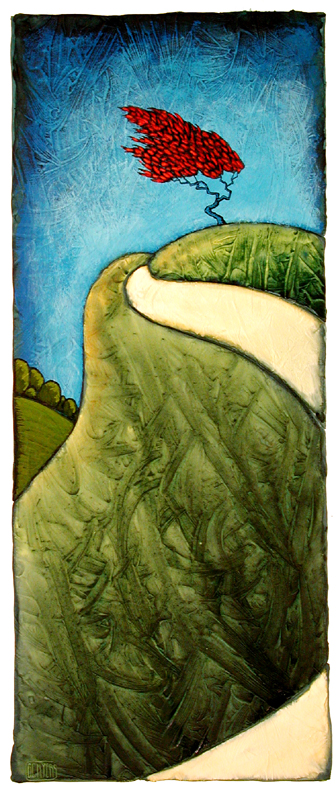
There are particular types of paintings that I do that I sometimes paint expressly for certain galleries where they show more interest for that particular type than other galleries.  One such case is the long, thin sliver paintings such as the one shown here.  This piece, The Thin Shard, is an image measuring 4″ wide by 44″ tall on paper and was done specifically for my upcoming show at the Kada Gallery

I have done a number of these paintings over the years for all of my galleries but Kathy, the owner of the Kada Gallery along with her husbamd Joe,  has always had a personal preference for this tall, lean shape which comes across when she talks with her clients.  As a result, these paintings have always left the gallery fairly quickly.  Whenever Kathy asks what is new in the studio she almost always asks if I have been working on any of these this slices for her.

I started painting this shape early in my career, basically as a way to make use of all the scraps of paper left over from other more traditionally shaped paintings.  As I painted them, I realized that there was a certain pleasure that came from putting together this type of paintiing, from conquering the puzzle of how to create a scene that incorporates multiple elements into such a thin view while still maintaining a certain cohesiveness and natural feel, without the appearance of being contrived.  Creating depth into the piece was also an obstacle that had to be overcome without the benefit of a wide horizon and little room to convey much perspective. 

Then there was the problem of creating the balance in the painting that I’ve talked about in past posts.  It’s still there in each thin painting but it’s a tighter, more organized sort of thing that requires more precision in the placement of each element that makes up the painting.  A misplaced line or a sloppy juxtapostion of colors can be disastrous in such a such a small area with little room for compensating in other ways.  The shape of the painting seems to make the normal puzzles of painting seem larger.

But for me, these barriers create a wonderful environment for the paintings to grow.  The narrowness of the pieces creates its own visual excitement and is a wonderful carrier of color.   When successful, these pieces have an easy feel that allows them to be taken in at once.

I like this particular piece very much.  The color is rich and  and the weighting of the color and contrast, along with focus created by the placement of the moon,  make the eye take in the depth of the piece easily.  The tree breaks mildly out of the picture plane, giving it even a bit more feel of depth and an interesting silhouette.  On the wall, the size of the painting when framed (10″ wide and 50″ tall) gives the piece great visual impact.  It demands the eye, which is ultimately what I hope for all my work– that they have a force that is so vibrant and alive that they reach out from the wall.

I think The Thin Shard does that.

Read Full Post »

« Newer Posts - Older Posts »