Feeds:
Posts
Comments

Archive for the ‘Technique/History’ Category

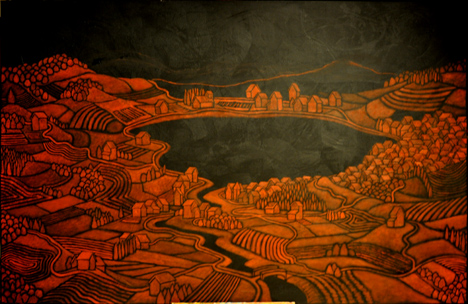
Left Side detail

In my last post, I wrote about how I was going over the large canvas on which I am currently at work, weighing the different elements against one another as I try to create balance in the composition.  It’s a large canvas, 54″ by 84″,  and there is so much more space to oversee, making sure that one area doesn’t so dominate the whole.  In a large horizontal landscape composition, if the one side is overly dominant, making the other seem weak or dull, the entire piece suffers  no matter how wonderful the strong area may be. 

  The right side with the heaviest grouping of houses  was very strong in the overall composition and I found my eyes always settling on the right side of the canvas.  There just wasn’t enough boldness in the sections to the left of center to counter the weight of the houses.  I wasn’t about to add more houses or elements so I decided to turn my attention to heightening the colors and contrasts on the left side, strengthening it so that it came closer to the right in weight.  I spent a day just going back in with colors that brightened the area and brought more attention to it.
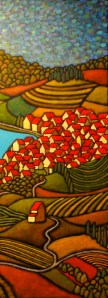
Right Side detail

I decided to better see the strength of the different areas I would break up the canvas into sections on my computer. This would let me see their strengths without the influence of the surrounding areas and evaluate them as individual compositions.  The right side  (shown to the right here) was bright and strong with the houses just dominating the area.  But after making the changes on the left side ( the image above) I found that it had tremendous strength of its own and was equal in strength to the right, at least in my eyes.  The strength of the left side, for me, was in the weight created by the harmony of the colors and the elements.  In fact, looking at the left side detail above, I think that it could stand easily as a  really strong piece on its own.

 
Satisfied with this progress, I can now start to evaluate other parts of the painting and make the final touches that will hopefully pull it all together.

Read Full Post »

I’m in the final stages of finishing the  large canvas that I’ve been documenting here, spending a lot of time weighing the weight of the colors and forms and adding a bit here and there to bring it into balance.  It’s slow work and sometimes I have to just get away from it to clear my head.  I have spent this time working on finishing a few other paintings that have been in hanging in limbo for some time, in various stages of semi-completion.

One such piece is shown above, In the Early Morning, a 12″ by 36″ canvas that I started some time ago and just couldn’t get it past the initial stages of laying in the composition and several layers of color on the sky.  The color just wasn’t working for me on this piece and I wasn’t excited by where it seemed to be heading.  So I put it aside, thinking that eventually I might try again.  I usually do try again although there is one similarly sized canvas in my studio now that is about a year old and about which I seem to have enthusiasm.  That piece may just end up getting painted over if only to get it out of my sight and mind.

On the other hand, this painting survived its time in limbo and I find myself glad of it.  It felt, the more I looked at it, as though it needed a single color to bring it together thematically.  I initially thought of making it a nocturnal scene but could see that, while I wanted the color to be blue, I wanted it to be lighter.  It ended up being more of a dawn scene, a time to which I am attracted to naturally, both personally and in my work.

I don’t know what this piece is saying yet but it doesn’t matter to me now.  It has a placid feel and I find the blues soothing throughout this scene.  It’s beauty is enough for now– in the early morning.

Read Full Post »

I’ve been documenting the progress  that has been made over the past two weeks on a large canvas on which I’ve been been working.  It’s been a roller coaster of emotion for me as I’ve been working on the 54″ high by 84″ wide painting.  Sometimes I am completely satisfied, thrilled with what is unfurling before me, and at other times I am worried that it may not pop in the way I envisioned in earlier stages.  At the moment, I am closer to happy as the piece has started to come into full sight.

After beginning to bring more light to the sky, I have started adding color to the lake that dominates the center of this piece.  As I do so, I can better see tweaks that need to be made in some of the colors of the landscape around it.  Nothing big but small adjustments that bring it closer to completion. 

After coming to the still dark blue color as shown above, I decided that I wanted the color to be more dominant and added a light teal that really emboldened the whole composition.  I have to better photograph this so there is a bit of glare on the image below.  I also noticed that the sun is showing a bit harsher here, less warm than it actually is.  But this gives you an idea of what is there at the moment.

This painting pretty much dominates everything in the studio at the moment.  It’s big in size and visual impact and my eyes immediately fix on it.  There is still a ways to go but it’s coming closer to being the internal landscape that I envision.


Read Full Post »

I thought I  would show a bit more of the large canvas I’m working on at the moment.  As I’ve described in previous posts, it’s a 54″ tall by 84″ wide canvas that has been biding its time for nearly 10 months in my studio, waiting for me to finally give it some life.  Well, it’s beginning to take shape and I can see better its final stages, if things work out as I hope.

I’m always a little hesitant to show these pieces in progress because sometimes they lack the life that the final stages of the process bring.  But even though there is still a lot of depth to be added, this piece is gaining animation quickly.  It’s been interesting seeing how the colors of the fields have changed as other colors are added in the process, some of the reds and oranges that seemed to jump off the canvas modulated in intensity by adding varied shades of green and yellows.

I’ve brought the sky to a certain point where it creates enough ambiance that I can be influenced by it  but is not yet at its final intensity.  I see a certain blue in my mind that will be a challenge to pull off here but at least it is there now, pulling at my mind. 

The same goes for the great black void that is a lake in the center of the canvas.  I see a certain color and depth ahead for this critical part of the composition,  which is the focal point for the whole thing, everything else revolving around and reacting to it.  The overall strength of this painting  is dependent on my ability to recreate the color that I see in my mind for this section.  If I don’t reach that visualized color, what could be a very good painting could become a ho-hum piece.  As a result, my mind is always running through methods of achieving that color even while I am at work on other parts of the painting.

Today should be a pivotal day for the bigger part of the composition, as I finish up this layer of color on the landscape and begin adding what may be the final layer for some parts of it.  The composition should really come together at this point,  just waiting for that color in the lake.

We shall see.

Read Full Post »

I debated over showing the  progress of the large painting on which I am currently working.  I know that I have done it it the past , especially with this style of work, but I almost felt like I wanted to keep this one more guarded.  It feels kind of like pulling the curtain back on the little man working the controls which make him appear as a much more magnificent Wizard of Oz.  Or maybe it’s like showing how the sausage is made– tasty but nobody wants to see it.

But whatever I thinking, in the end, I decided that I would show how this piece is moving.  If the final product is not worthy, knowing how it came to be so won’t taint it and if it ends up being a good piece, nobody will care or remember.

Again, this is a 54″ high by 84″  (4 1/2′ by 7′) canvas that I have finally decided to start after 10 or so months of pondering it in the studio.  Well, pondering is overstating it.  Avoiding is probably closer to the mark. 

 This is the progress after about three days of roughing in the composition with red oxide paint and I am  finally nearing the end of this this part of the progress.  As I near the terminus where the landscape ends and the sky will begin, I have started roughing in with a piece of rouge chalk, trying to find that final silhouette that will stand out in the final product.  I am hoping to finish this phase today.

So far, I am pleased.  The elements all seem to work well together and the whole composition has a unity that I am looking for.  This is vital especially in a piece of this scale where any element that lacks that sense of rightness will be magnified by the sheer size of the comsposition.  I am really beginning to see how I think the painting will finally emerge and I am getting antsy, wanting to get beyond this initial phase.  But as I said earlier, the key is to not jump ahead, not speed up at any point.  If I make a shortcut now, it will change that final version dramatically.

So, I will be patient.  But I must go.  Gotta paint.

Read Full Post »

I’ve shown pieces with  multiple panels and images here in the past and they often are very regimented, with each panel measured and uniform in size.  There is sense of order in these paintings.  But I’ve been doing a few multiple pieces lately that are less precise, with individual panels that bulge and expand in a fashion that creates a sense of the organic.  I find these pieces very naturally engaging, meaning that the organice nature of the lines create a sense of rightness that lets you take it in easily, without questioning its validity or accuracy.

I think this piece is a good example of what I’m trying to describe here.  It’s a small 12″ square canvas that I’m calling On a Cellular Level.  The raw but right nature of the lines and the interaction between the  individual panels here gives me the sense of each panel being a living cell.  Living and moving, affected by each surrounding even though it is complete within itself.  The RedTree here is part of a group of cells that bulges up and downward, almost like mutated cells.

I don’t know if there’s any meaning in that observation but it makes the piece more alive for me. Less static.

There is just something that I really like about these multiple paintings.  Perhaps it is the power of a simple image presented in an amplified sense.  Kind  of  like tap-dancing.  One person doing a very simple tap step is not that compelling.  But put a hundred people doing the same simple  step together and it becomes a powerful entity.  Or maybe it’s like singing.  One average voice singing a simple tune, while it may be lovely, may not come across as powerful.  But add a hundred voices, none extraordinary, and you have a magnificent chorus. 

Maybe that’s how I will start viewing these multiples, as choruses.  But for now, I see this painting on a cellular level.

Read Full Post »

Sometimes you find yourself out little bits of advice to other people, never realizing the irony behind the act.  Take yesterday’s post, where I passed on some advice from Chuck Close about getting to work and not waiting for inspiration.  Well, after reading what I had read yesterday morning, I looked across the studio at a large canvas that I had prepared last year, knowing that the time to take Close’s words to heart was at hand.

The canvas is 4 1/2′ by 7′  and has been haunting me for almost a year.  I had written about this canvas in a post last March called Daunting and I guess it must have been just that because I have found excuse after excuse to not start working on it over the past 10 or so months.  Too busy doing other things and the sort.  But in reality I was just plain scared of facing such a large challenge.

But thinking about Close and his words as well as his work and the challenges he has faced in his life made me feel a bit embarassed.  You shouldn’t run away from big challenges.  You should embrace them as an opportunity to simply overcome in a bigger way. I know that and have passed on that advice to others over the years.  Yet, here I was, not heeding my own words.  This was a challenge and to put it off only created other problems of avoidance.

So, I finally put it on the easel and started at it. 

It was difficult to start but it slowly is beginning to take form.  It will be a long process, much longer than I am accustomed to in my work, and I know that this will a challenge.  I will have to fight my urge to shorten the process, to take shortcuts that might not be too noticeable to the outside observer but would nag at me in the aftermath of completion. 

But the battle has been engaged and I am on the way to whatever this canvas holds for me.  We shall see…

Read Full Post »

This painting took a long time to emerge.  I started with just a large block of color,  originally feeling that there was a distant, stark landscape in it.  But it never felt completely right and I let it sit for many months, occasionally picking it up and trying to decipher what it might hold.  But recently I decided that it was long enough and that I would either pull something from it or destroy it. 

Either way would be a bit of mercy for me.  There’s something in having a piece sitting unfulfilled for long periods that gnaws at me, as though they are poking at me in the studio, begging to be released from the state of limbo in which they are trapped.  I have a group of such paintings floating around and I have to hide them at times because of this constant, silent pleading from them.  So it is a degree of mercy in the relief that comes from finishing one– in one way or another.

What emerged in this painting, an image that measures about 6″ by 22″ on paper, is quite different from what I first envisioned.  It ended up as more of a silhouette piece, the dark boniness of the trees standing in stark contrast to the pale, almost sullen feel of the sky.  Even the sun struggles to bring light to this surface,  appearing darker than the sky itself.  The whole effect is quite somber with an air of drama.

Originally, the chair was the only other element in this piece but the more I looked at it, the more I wanted something to counter the chair.  Something to create a context for  the drama of the revealed moment.  The small figure in the background provided just that.  I saw him as a ghost of sorts– perhaps dead.  Perhaps not.  But caught somewhere between existences.  The Red Chair here fills in as his memory and he looks upon it, seeing all his misdeeds and regrets.  He has lived his life as a rake and the empty chair sums up his time.

That’s one way of looking at it. 

I chose the title from the old English folk song of the same name that evolved from it’s 18th century origins into the early blues song, St. James Infirmary Blues, a song covered over the years by many, many musicians.  It has a deep and wonderfully  mournful feel and  it meshes well with this image in my mind.  Here’s a great version from the Belfast Cowboy, Van Morrison, who gives the song the weight it requires. See if you feel the same.

Read Full Post »

I was rummaging around in one of my favorite sites, Luminous Lint, looking for something that would somehow sum up the world of Kodak and Kodachrome film on this day when they file for bankruptcy, the end of an era.  As I flipped through the photos this image caught my eye.  There was a blaze of green that lit up the edge of it and flecked through the faded and vague image of a farmhouse giving it an otherworldly glow. It reminded me of the effect I wanted in much of my early work, of the image seeming to be somehow pulled from time and space, leaving it in a rough-edged cell.

Reading below it I discovered that the photographer was Levi L. Hill and that was taken in 1851 in Greene County in the Catskills of New York.  It also said that this may be one of the first color photos taken and that Hall came across the image accidentally and spent the last 15 years of his life trying to recapture the effect.

Levi Hill Portrait

Intriguing.  I decided I wanted to know more and came immediately across an article from the Catskill Mountain Foundation titled Levi L. Hill: Fool or Fake? by writer Carolyn Bennett.  The whole story is a bit more involved and even more interesting.  It seems that Hill began a Quixotic journey to discover color photography after a discussion with famed Hudson River painter Asher Durand who told him that if he could find a way to capture color with photography he would be far ahead of all of the painters of the time.  The public was crazy for photoimages and especially clamored for color.  The man who discovered a color process would gain renown and fortune. 

So Hill started an intensive search even though he had little training in chemistry or science, performing thousands of experiments.  The image above was one of the few, if limited, successes and that was merely by chance.  His grand quest ended with his death in 1865 at the age of 49.  To get a better sense of this little known bit of photo history I suggest reading the article from the Catskill Mountain Foundation mentioned above or an article from Smithsonian curator Michelle Anne Delaney that talks about Hill’s work and the museum efforts to determine if he was indeed a fraud or a genuine trailblazer.

Whatever the case, I still am intrigued by his image.

Read Full Post »

I’ve been pretty busy in the studio lately.  That’s not unusual at this point of the year because it is when I’m gearing up for upcoming exhibitions but  in past years  this is when I have often  felt a bit blocked and far removed from the point where I wanted my work to be .   But thus far this year, things have been flowing easily and I feel as though I am near that sometimes elusive groove where the act of painting becomes more  instinctual than cerebral.  When I feel myself in this groove, I start to trust these instincts, this pushing back of conscious decision making.  As a result, there’s no dwelling over decisions at the table or the easel.  I just make the mark and move on from there.

And each piece brings an inspiration and desire for the next painting with ideas gushing forward.  I often find myself making quick little sketches on scraps of paper, little rough stick drawings really.  Just enough of the thought to be able to rekindle the idea later.  Often, I don’t make the sketch and the idea floats away and is sometimes fortuitously recalled at a much later date or is gone forever.  I sometimes think my best thoughts have taken this fleeting route.

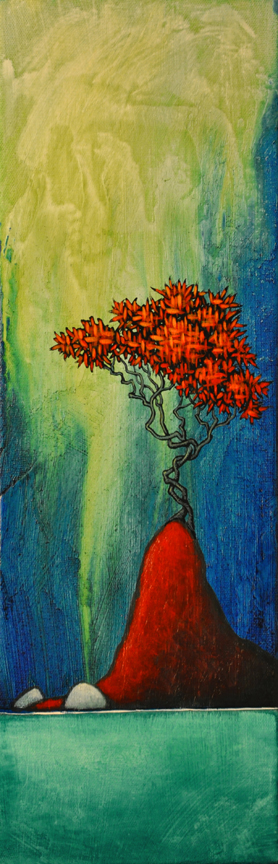
The piece shown here is from this recent burst, a smallish canvas, only 6″ by 18″ that I call Tangled Up In Blue.  The title is, of course, taken from the old Bob Dylan song.  This is a simple composition, very typical of much of my work, but it’s carried strongly forward by it’s colors and contrasts.  It has a dramatic edge to it.  I think the red of the mound really highlights this feeling of high emotion.  I try to envision it in other, more natural colors and the result is less potent, more understated.  This feels to me like the tangled trees are two lovers springing from the same red bleeding heart.  The intensity of the red mound and the trees is a sharp contrast to the cooler blues of the water and sky, even though they still have their own intensity.

But the piece is probably brought to completion by the break of pale yellow in the sky, the light that comes through creating chasms in the blue night wall.  This break sets off all the other color and creates a sense of moment in this small, simple piece.  The result is that the result is greater than the sum of its parts.

Or at least I think so.

Here’s a little music.  I bet you thought it would be Tangled Up In Blue.  It was going to be but I came across this version of  a different Dylan song, Love Sick.  I really like this film and performance of a song that has been a favorite since it first came out in 1997 and decided to share it instead.  Enjoy.

Read Full Post »

« Newer Posts - Older Posts »