Feeds:
Posts
Comments

Archive for the ‘Technique/History’ Category

I see this new piece, a 12″ by 24″ canvas, more as a meditation than a scene.  There is rhythm in the motion of the path’s ascent as well as a rhythm in the chaotic nature of the underlying texture that gives this painting its name, Rhythm of the Mountain.  As I first started painting I had every intention of inserting a tree to act as the focal point of the piece but as I progressed it became evident that it would actually pull away from the meditative simplicity of the barren landscape.  The sun/moon becomes the central figure here and the mountain pass leads the eye upward to it.

I am drawn to the simplicity of this piece.  It has a dramatic calmness to it, like the actor delivering a soliloquy who takes a dramatic pause and in that moment there hangs all that has come before alongside the potential of what is to come, held up for the audience to ponder in the silence of that pause.  Empty yet full.

I mentioned the texture of this piece and it plays a central role here.  It has ribbons of gesso that spin  across the canvas which in the sky actually dictated how I was to paint it.  It gives this piece a greater depth and this would be a much different painting without it.

I can’t say if this will appeal to everyone but that’s something I can’t worry about.  The important thing is in satisfying something inside myself and hoping that others recognize that same thing within themselves and identify with it.  Hopefully, this piece will strike an inner chord with others.

Read Full Post »

This painting called Dissolve is another in the series I’ve been working in for the past few months.  This 24″ by 36″ piece is based very much on the same format as Like Sugar In Water, which I displayed here several days back.  Both paintings grow from the bottom where they begin in structured blocks of color.  The path cuts through, rising from the geometry of the fields up to a plain that flattens out.  The path continues by the red-roofed house and is not seen again as it enters the broad yellow field that runs to the horizon.  The path’s upward movement is continued in  the spreading bare limbs of the distant tree which merges into the broken mosaic of the sky.

It’s a simple concept and a simple composition, dependent on the complexity of the color and the placement of the elements in order to transmit feeling and emotion.  These simpler compositions, when done so that they work well, are often very potent purveyors of feeling and are among my persoanl favorites.  The stripped down nature of the scene takes away all distractions and centers the essence of the work in the willing viewer’s eyes, making it very accessible to those who connect with it.  And that is much of what I hope for my work- to create work that stirs strong emotion within a seeming;ly simple context.

Maybe there’s more to it than this.  I can’t be sure if my thoughts and interpretations are any more valid than those of a first-time viewer.  That’s the great thing about art– there are no absolutes.  It’s also the thing about art that scares a lot of people.  Many people fear the gray areas of this world, of which there are many,  and desire absolute belief and knowledge in all aspects of their lives.   But art most often  lives in the ambiguity, the uncertainty,  of those gray areas and that can be unsettling to some. 

 Dissolve seems absolute and certain at first glance but is all about the gray areas of our world and our belief.  At least as I see it…

Read Full Post »

I first painted one these faces back in 1995 when they became what I call my Exile series.  They were painted in very much the way I paint some of my landscapes, starting with one block of color and letting that block dictate what the next will be.  I had no reference points to work from, just letting the image grow on its own and for much of the time when I was painting these I had no idea how the face would emerge.  Often, they completely surprised me.

This 12″ square canvas was my first new Exile piece since that time and it took a while to reengage.  The originals were painted from a very emotional personal standpoint and  I am in a different emotional place now, sixteen years later.  But after I haltingly began there came a point where it began to take hold and pull out its own emotion, with which I began to empathetically identify.

Call it an existential melancholy.

I see some of these figures in that way, alienated from their past and haunted by memories.  They are, in a way, prisoners of their own experience, trapped in a moment long gone and never to be seen again.  Not all of them, but many, fall into this category.

I’ve been wanting to restart the Exiles series for some time.  To what end, I can’t say.  I don’t know if I will show these anywhere but here.  I don’t know if they would want to venture from the safe haven I offer them here. 

We’ll see.

Read Full Post »

The new work I’ve been showing over the past few monthes has maintained a similarity in the color and in the way they are painted.  I often switch back and forth between the two distinct styles I maintain in my work-  the reductive style which is very fluid and transparent  and is about adding paint then taking it away, as though carving the image from the paint, and the additive which is about building layers of paint upon layers of paint to form the image- but when I get in a certain groove where I feel one style is clicking in sync with my mind I will stay in that style for a while, creating a series of paintings that have unmistakable similarities.

I’ve talked about this here before, explaining that one of the benefits of staying in a series is that it reduces the number of conscious decisions, allowing me to focus not on decisions of color selection or composition but rather on qualityand depth of color and brushstrokes.  It also allows me to almost paint without conscious thought, allowing other parts of the mind to enter the equation, which creates a subtlety and nuance that makes each piece distinctive.

Taking away these decisions simply makes the flow of the painting smoother, like a piece of music in the hands of a musician after monthes of rehearsal.  I’ve often thought of my paintings as rehearsals in a way, each often a fine tuning from the last.  Actually, I think performance is the better term.  Each is complete within itself, each stroke being done with the intent of that piece alone, like a note being played for the beauty of its tone at that moment, not as a rehearsal for a later performance.

I am usually pretty excited by the work I do when I am am painting in series.  If not, I wouldn’t be able to stay in the groove long and wwould move on.  Maintaining my own excitement is pretty important for my work, and I think for most artists.  I don’t know where I heard it  but the saying goes that a bored artist makes boring work.  I have certainly found that to be true.  Though there are always exceptions to the rule, if a piece moves or excites me in some way it generally will do the same for others.  If I am not moved by a piece then I know it should not leave the studio.  Simple as that.

So far that has been a good rule to follow…

Read Full Post »

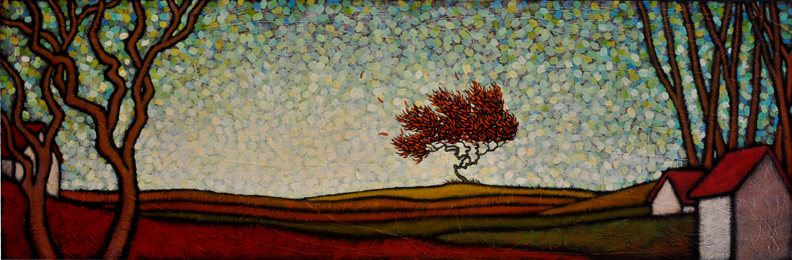
This is a painting that I started in December and on which I finally put the finishing touches just a week or so ago.  It’s a large piece, a 20″ tall by 60″ wide canvas, that really accentuates the panoramic aspect, one that I enjoy working in.  I really was at a standstill on this piece at one point, really savoring the composition and the sky but not knowing how to bring it to completion that fit with where it was at that point.

But it came.

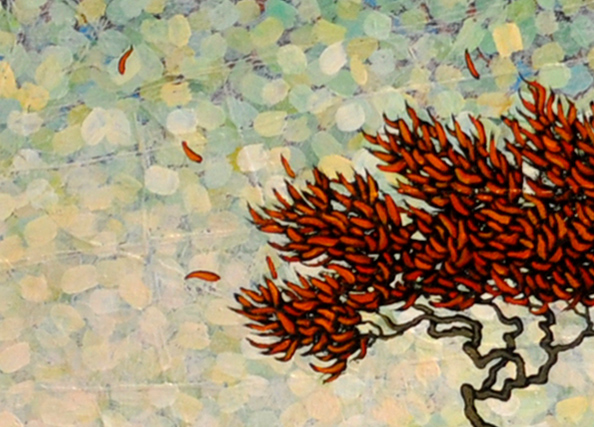
I’ve really been enjoying this sort of groove I’ve fallen in over tha last month or so, feeling the tedium of painting the skies growing, with the thousands of small strokes slowly building to a sort of crescendo.  There’s been a common thread of color running through this work, including a very large 36″ by 60″ painting that I am working on now.  The sky is comprised of dozens of different shades of blue and green and yellow all over deeper violets and reds that peek through  in tiny almost unseen glimpses.  To me, these pieces are really about the light of the sky pulling out the dark colors of the ground below, creating a tension between the light and dark that gives the piece the emotion it emits. 

For me, this emotion goes back and forth between joyous, almost triumphantly defiant, and a bit sad, as though the leaves are moments slipping away, opportunites lost.  Perhaps it is both.  Whatever the case, I find myself liking this piece a lot, looking at it quite often as it sits over the fireplace in the studio.  Now to find a title…

Read Full Post »

This is a new piece that I’ve been working on for the last week.  It’s fairly large at 30″ by 40″ and carries the size well, drawing my eye back to it on a regular basis from across the studio.  I am drawn to the rhythm of the landscape and the quiet of the central red tree against the action of the confetti-like sky.  It has a calming effect for me, one that centers my anxieties and slows me down a bit.  Applied patience in a turbulent world.

I’ve talked about this here before.  The purpose my work holds for me is to act as a  sort of pacifier, to create a world and landscape that takes me just a bit further from the reality of the world in which we actually live.  I consider this alternate landscape  a world based on reason.  At least, that’s how I see it.

I documented this piece in a series of photos as I was painting, snapping shots after small bits were done.  I am in the process of putting them together in a video similar to the one I posted last week, Growing a Painting.  This video would be more in depth and detail as far as the way the piece comes together.  I’ll post it when it is done. Hopefully, it will turn out well.  We’ll see…

Read Full Post »

I just finished a small group of tiny paintings for an annual show held at the West End Gallery in Corning, called Little Gems.  Held every February, it’s a show of miniature paintings from the gallery artists.  I’ve mentioned before that this show is a sentimental favorite of mine.  The first time I exhibited my work in public was at a Little Gems show in 1995, at a time when the idea of being a collected painter seemed awfully far away, if even imagined at all.  Most of the work I was creating at the time was small and pretty much fell in line with the theme of the show.  It was a turning point in my life, opening doors of new possibility to me.

Since that time, I have always held a special spot for this show for that reason and for the fact that it has original work, albeit small in size,  offered at very affordable prices, giving  people of modest means an opportunity to collect work  they might admire.  There’s something very egalitarian about it, far from the perception of the art gallery as an elitist institution.  And I like the idea  that art is for everyone.

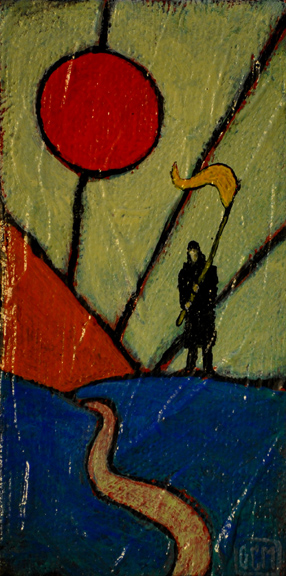
This is a group of tiny 2″ by 4″ canvas paintings that I frame in a slightly larger (just under 6″ by8″) shadow box frame that makes the piece seem a bit larger .  The petite canvas size creates a challenge and I like to include a few twists on my normal compositions, such as this piece to the right with the yellow flag and the divided sky.  But I often try to keep the work typical of my style and subject vocabulary.  This goes back to the thought in the last paragraph.  This might be the only piece of original art that is bought by the person who selects this painting and I would like to give them opportunity to have a piece that is obviously recognizable as my work.  That’s one of the reasons that I have always strived to paint these little pieces with all the effort and care that I use in much larger pieces.

This show, Little Gems, opens next Friday, February 4th, at the West End Gallery in Corning, NY.

Read Full Post »

Growing a Painting

Above is the tentatively finished version of the painting I started earlier this week, a 24″ by 48″ canvas that I am considering calling Escape Route. I showed the first few steps of the painting process on this blog two days ago, ending with the sky being near finished and the composition blocked in.  I’m not going to go into all the steps and decisions that went into completing this piece.  Instead, I put together a short film that shows the painting evolving to the finished product.

I will say that the final version is much different in many ways than I first envisioned with the first strokes of red oxide that went on the canvas.  Each subsequent bit of color, each line that appeared, altered the vision in my head just a bit, evolving the piece constantly until the very end of the process.  Even the last part, where I inserted the treeline that appears on the farthest ridge, was not seen in my mind until just before the decision to proceed with them was made.  I decided to go with this treeline to create a final barrier for the road to break past on its way upward toward the sky.  A final moment of escape.

This painting has given me a great sense of satisfaction after finishing it.  I spent much of the late afternoon yesterday just looking at it and taking it in.  I don’t know if it will translate as well on the computer screen but this piece has substantial size at 24″ by 48″ which gives great weight to the blocks of color from the buildings and the light from the sky.  There is a sense of completeness here that I could  only struggle to explain, but as I said, brings me great satisfaction.  I feel as though the evolved painting has exceeded what I imagined when I first started this piece.   While I can’t fully explain that, it is all I can hope for from my work.

I will spend some more time over the next several weeks looking at this painting, determining if anything should be tweaked or altered.  A highlight added here, a line crispened there.  But as it stands, I think it has taken on its own life and I will probably leave it alone as it is.

Here is the short film, Growing a Painting:

Read Full Post »

I wrote yesterday, while descibing the initial stages of my painting process for a new piece, about stepping back from the canvas at a distance to take in the piece as a whole.  During these early stages, when I’m blocking in the painting with red oxide, I give it what I call my snake-eyed look. This entails squinting the eyes and sort of unfocusing, taking in the shapes as sort of abstract forms that play off one another.  Without taking in great detail with this snake-eyed look I am also imagining ahead in the process, seeing the shapes taking on color and how they’ll react within the composition.  It’s hard to explain except to say that it is a sort of intuitive visualization.

I got the term, snake-eyed look, from a scene from the movie Little Big Man starring Dustin Hoffman as Jack Crabb, the son of westward bound settlers who are killed in an attack by the Pawnee tribe and is subsequently raised as a Cheyenne after being foundby them  in the wreckage of their family’s wagon.  The story tells of his misadventures in going back and forth between the worlds of the Native Americans and the white man , culminating in him being present at the Little Big Horn where Genral Custer (played brilliantly by Richard Mulligan) meets his death.  Great movie and a great tale based on Thomas Berger’s wonderful novel of the same name.

In one scene Jack is reunited with his sister who also survived the massacre but escaped from their rescuers, certain they would rape her.  The Cheyenne, however, thought she was a man.  She takes Jack out to teach him how to use a handgun.  She tells him to go snake-eyed and to visualize shooting a bottle before drawing his gun.  Kind of like the description I gave above.   It’s a scene that I always think of when I find myself standing back from a painting with my eyes in a snake-eyed squint and I often wonder if I adapted this because of the scene or if my squinting  just came naturally.  Whatever the case, it worked for Jack Crabb and it works for me.

I will show the progress of the piece I wrote of yesterday in tomorrow’s post.  For today, here’s that scene from Little Big Man with that snake-eyed look.  If you haven’t seen the whole film or read the book, I definitely recommend either.

Read Full Post »

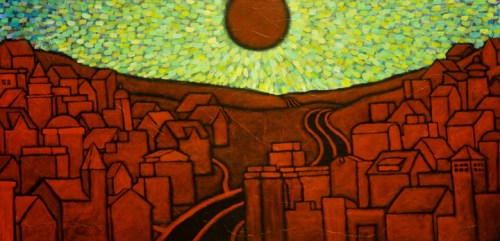
I worked on a new piece the last couple of days, a large canvas that is  2′ by 4′ .  I had already gessoed the canvas with a distinct texture and applied a layer of black paint.  I had vague ideas of where I thought the painting might go from a composition standpoint but knew that this was only a starting point in my mind.  Like most of my paintings, the finished product is often drastically different than what I imagined at the beginning.  As I paint, each bit of paint dictates the next move and if I don’t try to force in something that goes against these subtle directions given to me by the paint the piece usually has an organic feel, a natural rhythm in the way the different elements go together.  A cohesion of sorts.

Knowing I wanted to use a cityscape in this piece, I started in the bottom left, slowly building the city with geometric forms and rooflines in a red oxide paint that I use to block in my composition.  I like the red oxide because ti gives a warmth under the layers paint to come that comes through in small bits that are almost undetectable at a quick glance. 

At this point I still am unsure where the painting is going.  I have thoughts of filling the canvas completely with the cityscape with the smallest view of the sky through the buildings but am not married to this idea.  The paint isn’t telling me enough yet to know.  But it has told me that I want a path of some sort- a street or canal- through the composition.   I make room for one near the center before starting on the right side with the buildings there.  I go back and forth between the right and left sides as I build the city, constantly stepping back to give it a good look from a distance to assess its progress and direction. 

 At a point where the city is nearing the halfway point on filling the canvas, I decide I want this piece to be less about the cityscape and more about how it opens to the open sky beyond it.  I extend the road that started at the bottom and twist it upward, terminating it at a bend in what will be now a field beyond the city edge.  The sky, though still empty, is pushing me ahead, out of the city.  The piece has become about a sense of escape, taking the street from the cityscape and heading upward on it towards the open fields and sky.  Painting faster now, another field with a bit of the road appearing is finished beyond the first lower field.  I have created a cradle in the landscape for the sky to which I now turn my brush.

There’s a certain symetry at work here and I decide I want the central focus of a sun in this composition.  I roughly block in a round form, letting it break beyond the upper edge of the canvas.  I pay little attention to the size of this sun except in its relationship to the composition below it.  My suns and moons are often out of proportion to reality but it doesn’t matter to me so long as it translates properly in the context of the painting.  If  it works well,  it isn’t even noticed.

I finish blocking in the sky with the red oxide, radiating the strokes away from the sun,  and step back.  The piece has become to come alive for me and I can start to see where it is going.  The color is starting to fill in in my mind and I can see a final version there.  This is usually a very exciting time in the process for me, especially if a piece has a certain vitality.  I sense it here and am propelled forward now, quickly attacking the sky with many, many brushstrokes of mutiple colors. working from dark to light. 

There are layers of a violet color in different shades that are almost completely obscured by subsequent layers.  I could probably leave out these violet  layers but the tiny shards that do barely show add a great depth to the flavor of the painting for me and to leave them out would weaken the piece in a way. 

I ahve painted several hours on the sky now and still have a ways to go before it reaches where I see it in my mind.  There are no shortcuts now.  Just the process of getting to that final visualized point.  But it’s dinnertime and my day is now done.  I pick up and step back to give it one final look before I head out into the darkness.  This is where the painting is at this point, where I will start soon after I post this:
Read Full Post »
« Newer Posts - Older Posts »