Feeds:
Posts
Comments

Archive for the ‘Technique/History’ Category

The Struggle

Yesterday was the best day I’ve had painting in the past few weeks.  The holidays and the distractions they provide had really knocked me out of  rhythm and I’ve been struggling to get back on the path.  I think this has probably been evident in the writing on this blog.  Writing for this is a real chore when I fall out of my painting routine.  I find myself struggling for things to say and words to express anything.  The writing rhythm is definitely entwined with my painting rhythm.

But yesterday was good in the studio so I’m hoping to see some improvement here, even though I view this writing and my painting as very separate and different entities.  I’ve always viewed writing as being an expression of what the writer knows and sees.  On the other hand,  painting to me is about expressing what I feel but don’t know and am incapable of expressing otherwise.  Painting is more about intuition and the intangible for me. 

Not to say that intuition and intangibles don’t play an important role in writing.  But I can’t find them as effortlessly in writing as I can with a slash of color here or in the way a form plays off another in my painting.  I don’t have to fill in detail, don’t have to create a whole scenario for my work to communicate. 

I think that’s the distinction between the two forms.  With writing, I must know what I am trying to communicate.  With painting, I can communicate without knowing.  In fact, it is preferable that I don’t know.  The work that comes without trying to direct it is usually the best, graceful and filled with emotion.  I don’t see that happening with my writing.

So, I must get back to the paints and gain a bit more rhythm, let the momentum carry me ahead.  I’ll let you know how it goes.

Read Full Post »

A question asked of me this weekend inspired me to go back into my archives and pull out the images of a few pieces done several years back.  I was asked if I used this time of the year as a starting point for new work and I said that I often did,  using it as a time to begin new ideas that I want to try.  I explained that it was important for me to continue trying new things as it excited me in the studio and that this excitement was important to all of my work.  This new work provides a vibrancy that permeates all my work and helps me find the new in compositions that I have painted in the past.

I explained that I liked to try new concepts in series in most years and that some are more embraced than others and become part of my regular painting vocabulary for years.  The Red Roof series is such a series.  I have painted examples in this series for several years and it has become engrained.  The Archaeology series is another. 

Other series last but a season.  While they may be popular from a sales standpoint,  they soon exit my routine.  The In the Window series is an example of such a series.  Done in 2005, they were a series of paintings that featured simple interior scenes with large windows that were highlighted by examples of my typical landscapes.  The idea was that the interior scene acted as a setting to show the landscapes in a different manner, much like the setting for a piece of  jewelry dictates how a gem is seen.  The gem here was  my landscape.

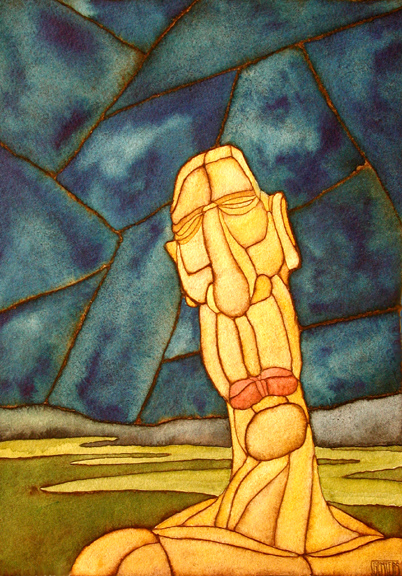
This painting shown on the left, In the Window: Dream Away, was the first piece.  It seemed to jump off the paper on which it was painted.  Very vibrant.  The setting of the window pushed the scene of the tree atop the mound overlooking the water out of the frame and seemed to intensify it.  I was immediately taken with the concept and a number of others soon followed, including the one at the top.  These pieces sold pretty well but they eventually lost steam for me from a creative standpoint.  While I still felt that they were vibrant , I sensed that I had done as much as I could with the concept and didn’t want it to become labored and tired.  My excitement was passing and I wanted to stop near a peak rather than at a low when the work was completely played out when I was viewing it as a toil rather than a joyous activity.

I still feel excitement personally when I see these pieces from this time and I know they are of a certain time for me.  I want them to stand as they are in my body of work.   As I described this this past weekend, I explained that the interesting thing about stopping a series is that it creates a finite number of pieces within it.  They become more distinctive over time, more representative of a certain time in my own artistic continuum.  So while these series, such as the In the Window series, are short-lived they have a longer viewpoint.

Read Full Post »

Now that we’re in December, I’m beginning to tie up the year’s work.  I’m tryiong to finish up a few obligations such as a couple of smaller commissioned pieces befor ebeginning to gear up for the coming new year.  I ‘ve been mulling over going ahead with some concepts that I’ve been pushing aside for years now and I’m getting pretty anxious to get at them. 

I have plans to doing a few larger paintings, including a couple that are very large.  I am also working on a series that relates to the Exiles series that I did back in the mid-1990’s, such as the piece shown here.  The newer pieces will not emulate this work as they were surely emotional products of that time in my life and, as such, cannot be simply replicated.  At least, I can’t do that.  So they will emerge with a different look and probably a different feel, which is exciting in itself.  One idea involves a large assemblage of small paintings in this theme.  I will reveal more as the work comes about.

This period of getting ready for the upcoming year is always exciting, for the most part.  I have had years where I struggled early on to find something to move me ahead, something that lit the fires under me.  Inevitably, the ignition came but it feels much better to start the year with a fire already ablaze.

There are also a couple of other things in the works that I will announce in the new few months that I am pretty excited about.  Hopefully, they will turn out as well as I hope.

And if not, we’ll make it work…

Read Full Post »

I recently finished a commissioned piece for a couple in NYC.  It was a little different and offered more challenges than many of my requested pieces. 

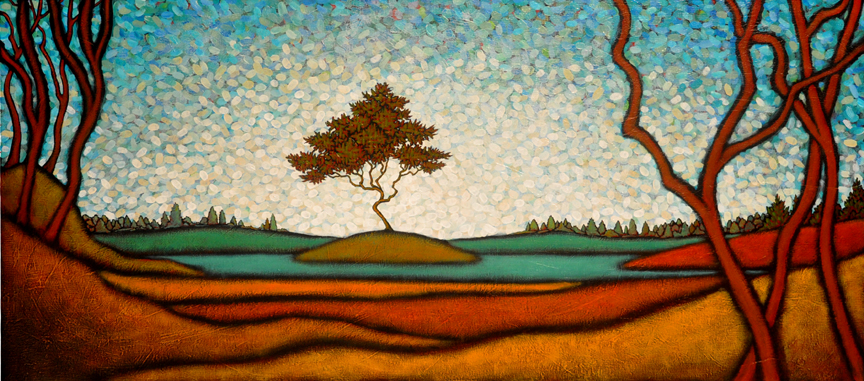
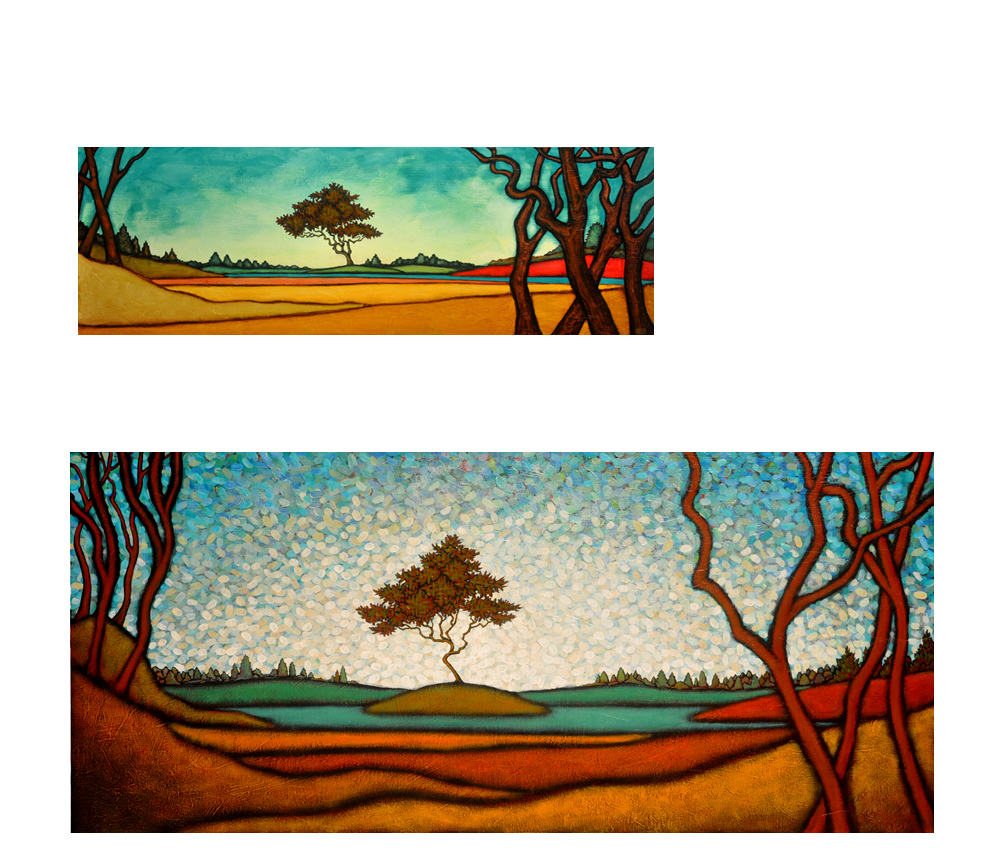
First,  it was a larger version of a smaller existing painting, Destination, which was a 12″ by 36″ canvas.  The requested piece is a 24″ by 54″ canvas.  So, while it is larger, it also has has a different ratio of height to width than the smaller painting, meaning it is less panoramic and changes the relationships of  all the elements in the painting to one another.

The second problem was that the original piece was painted in what I have referred to here as my reductive style.  It is a process that I use that places a lot of wet, liquid paint on a horizontal canvas (or paper) and takes away paint with brushes or rags until I have achieved the color and intensity I’m seeking.  I use transparent paints which allows the gessoed surface underneath to glow through.  

The other way I paint is an additive process.  By that I mean that paint is simply built up from the surface by adding stroke after stroke of paint, usually going from darker tones on the surface to lighter tones.  It is a more traditional method of painting.  My work tends to have a bit less refined appearance when I paint in this way as a result of generally using larger brushes and allowing the skies in my landscapes to be unblended color comprised of individual brushstrokes.  I also usually start these paintings with a layer of black paint over my normal gessoed surface.  This was the method that was requested for this new piece.

So, the request was for this smaller, more panoramic painting to be translated into a larger, somewhat boxier piece painted in a different method.  At first, I was skeptical that it could be achieved to either my satisfaction or their’s.  After a short bit of consternation, I decided to simply jump in and keep some of the elements the same and try to carry the tone of the colors through but let the painting take its own course.   I changed other elements and colors as I felt were needed in the context of the new painting.  For instance, the trees in the foreground are thinner and more expressive, as well as lighter in color.   I ended up with a piece that carries the influence of the original yet has become something of its own, complete with a different feel and attitude.  Just what I had hoped for when I started.  I was very pleased and, fortunately,  the folks who requested the painting were very happy as well. 

Here are how the two compare, when placed together in relative size.

Read Full Post »

I don’t normally show my paintings here with the framing, instead focusing on the image only.  But framing and presenting the work properly is a big deal.  A poor presentation can lessen the impact of a good piece, create a barrier that the viewer can’t get past.  A good presentation allows the work  to be seen in its best light, holding the piece  as though it were a gem and the frame was a fine setting.  You may notice it but the painting itself remains the focus.

I’ve had a certain look for many years now.  It’s a simple profile with a distinctive color that is built for me by a friend, Stephen.  For about the last 13 or so, he has provided me with sturdy raw frames built to my specs and I stain them to attain the color I desire which is normally a  warm yellowish tint with red undertones.  The edges are normally black. 

I tend to use the same frame for almost all my work.   It is simple and is immediately recognizable as my framing.  It also allows work from different years to hang easily together, giving them a sense of continuity and unity.  Plus, it allows me more time to paint by taking away the decision making process in choosing frames for individual pieces.  Early in my career, I learned that this process of choosing was very time consuming and wanted to come up with a way that took it away yet still gave me a distinctive and complementary frame.  Hence, the frame I’ve used for well over a decade came about.

But I still want to change things up periodically, if only to see my work in a different setting.  The piece above is a new one that I call Into the Mix which is a 10″ by 22″ image on paper.  It has a very distinct texture with raised ribs of gesso running chaotically through the background beneath the paint.  All in all, a very strong and individual piece. 

I really wanted to try something different with the presentation of this piece so I went with a frame that I’ve been experimenting with on a very limited basis.  This is only the third one of these I’ve produced.  It is a very simple flat frame with layers of gesso built up on top of it in the form of thin ribs, echoing those in the painting, then painted black.  The black gives the ribs visual depth and the gessoed ribs effectively cover the mitred corners, giving the frame a feel of unity and strength.  I like the look very much for certain pieces such as this, but don’t know if I will adapt it any way for wider use.  It’s just something I need to try to periodically see how the work looks in different settings.  Here, I think the new look works pretty well.

I’ll have to think on this…

Read Full Post »

This time of the year I often do a series of  small paintings to show in the galleries that represent my work.  It allows me to start moving towards new ideas that I may be working on in the upcoming year, as well as  revisiting themes from the past years in a smaller form. This gives me a chance to work on a small scale which allows for quicker alterations to the work while working out concepts as well as providing a lower priced entry point to those who might want to obtain a piece.  These are as close as I come to sketches or studies.  The difference is that unlike many studies, these are complete pieces  done in the same manner as all my paintings no matter the size. This is one such piece from this year, a small 3″ by 5″ canvas that I call Eyes on Time.

The idea of the tree piercing the large sun/moon behind it is one that I ‘ve played with in the past although having the strata beneath is new.  This has a great profile and would translate really well as a larger painting although sometimes it is hard to move a piece to a larger size without losing some of that feeling that makes it seem vital and alive.  The color relationships sometime change  over larger spaces, requiring alterations to the intensities that fundamentally change the way it is perceived. 

 Plus, committing in large scale to some of the elements that work well in a very small painting is sometimes difficult.  For instance, moving this painting to a larger scale might make the sun/moon seem too big as I hover over the canvas or paper.  I have to be fully committed to this idea, have to see it in my mind, or I might be tempted to scale it back in size which changes the whole composition.

It sounds like all of this is well thought out but actually this is a longer explanation of something that occurs in seconds, on the fly as the brush is in motion.  There are many, many decisions in the painting of a piece that are made like this, each one fundamentally changing the painting and sending it in a new direction that calls for more decsions. 

It’s a bit like driving a car.  Blind. There is constant adjustment to the steering wheel as you move forward, feeling the road and reading what it’s telling you as to how to next move.  Or not.  Whatever the case, this feeling along process produces a piece like Eyes on Time, which may be small but is very strong.

Read Full Post »

I received a very favorable review yesterday in the Erie newspaper for my show at the Kada Gallery in Erie.  I debated over writing about mentioning it at all this morning.  There seemed to be something just a bit too self-congratulatory in saying, “Hey, look! They wrote nice things about me!”  But unfortunately, that’s part of the business, this sometimes shameless self-promotion.

I’ve written about this before here.  One of the things an artist must do to succeed is to get their work and their name in front of as many people as possible.  An artist seldom succeeds in making a decent living without stepping forward and drawing some attention to their work and themselves, which is usually a very difficult thing for many artists, given that many artists tend to be observers rather than instigators of action.  Myself, I would certainly rather stay in my studio and paint  than have to go out and promote my work.

But it is part of the package, part of the job.  So I will mention this lovely review in the Erie Times-News from writer Karen Rene Merkle.  Visual art does not get a lot of press these days and unless your show is in a major metropolitan area reviews of any sort are rare.  Just getting press coverage beyond printing the details contained in press releases from the galleries is becoming more and more difficult, given the dwindling status of the print media.  So, as an artist, you can imagine my surprise and delight when I found that someone had taken the time to spend real time looking at the work and to write substantively on it.  And in an effective and well written manner, to boot.  Ms. Merkle, who I have not met, is a very fine writer and gives the fortunate people of the Erie area a much deeper examination into her subjects than most would expect from a newspaper of that size.

To you, Ms. Merkle, I extend my thanks for taking the time to look at my work and give your opinion.  It is most appreciated.

Read Full Post »

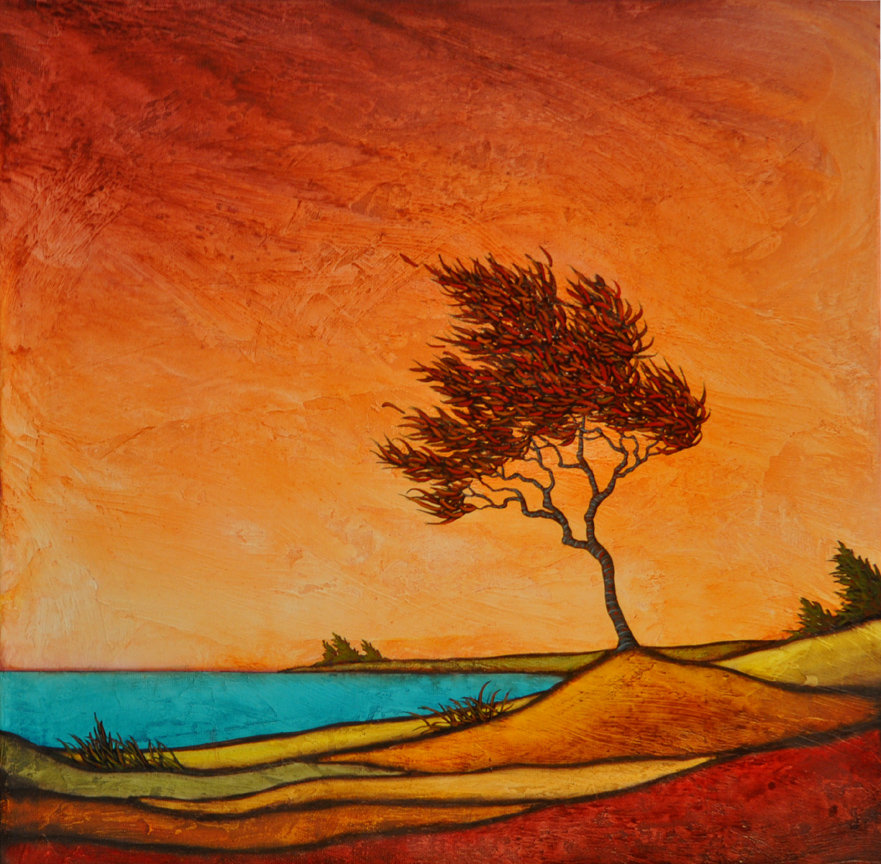
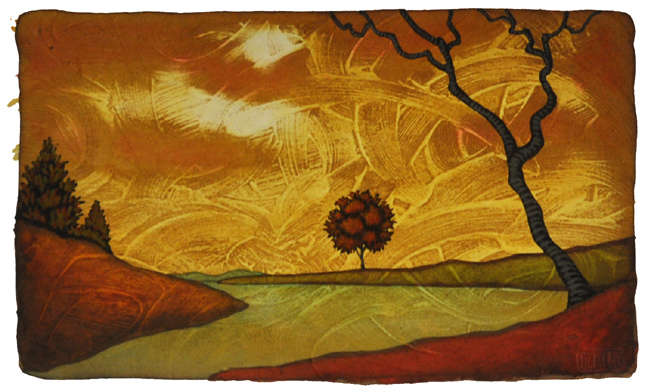
This is a painting, an 18″ square canvas,  I just completed yesterday that I’m calling  Answer Given.  I did it at the request of a collector who wanted a companion piece for an existing painting of mine.  It’s always tricky taking on this kind of request because I can never be quite sure how the person sees this painting matching up with the one they already possess.  I was given some parameters but you just never know for sure if they want something different than what you see as a companion.  The existing piece was composed very much like this painting, with a blowing tree and a watery horizon, except with a foreboding deep purple sky with tinges of red through it. 

I chose to make the color field of this piece different, going with very warm reds and yellows that give the sky a real presence.  This piece is very much about the sky and the interaction between it and the tree, as though there was a running dialogue between them.  This interplay is where I found the title, Answer Given.   Though the paintings are similar in composition there are differences in feel with this piece feeling more at ease with its world and its place in it, giving it more a sense of optimism than the piece with the ominous purple sky. 

I think the two pieces will sit well with one another, as though they are two sides of a coin- part of the same but with a different face.

Read Full Post »

Well, it’s the day before my opening tomorrow night at the Kada Gallery in Erie.  This time before the show is one that I’ve written about a number of times in this blog.  All the work is done, everything delivered and hung in the gallery and I’m left to sit and wait until I go and stand before my work.

As always, it’s a time for anxiety even though it’s much less than in earlier shows.  This something like my 29th solo exhibit and I suppose that  this experience teaches that things seldom reach the lower depths of our fears or the highest peaks of our hopes.  That’s sort of the mindset that I take in modulating my expectations for a show.

I really like this group of work.  I guess that is not a startling statement.  What kind of a moron would come out and publicly trash their own work the day before a show?  But I really do like this collection and for some time  have been eagerly waiting to see this group hanging together.  I’ve had them assembled together in the studio but it’s different than seeing them on the wall with space between to reset the eye as you look.  On the wall, they have a chnace to fully express themselves.

So today I will putter around the studio and get ready to get back to work in earnest after this opening.  I have commissions to finish in the next week that I want to get out of the way so that I can jump into some new things with both feet.  I will try to think about those things today so that I don’t dwell on my anxieties or hopes for this show.

I’ll let you know how it goes.

**************************************

The painting a the top is from this show, a small (4″ by 6.5″) piece on paper that is titled All Is Said… 

I’ll say no more.

Read Full Post »

There are particular types of paintings that I do that I sometimes paint expressly for certain galleries where they show more interest for that particular type than other galleries.  One such case is the long, thin sliver paintings such as the one shown here.  This piece, The Thin Shard, is an image measuring 4″ wide by 44″ tall on paper and was done specifically for my upcoming show at the Kada Gallery

I have done a number of these paintings over the years for all of my galleries but Kathy, the owner of the Kada Gallery along with her husbamd Joe,  has always had a personal preference for this tall, lean shape which comes across when she talks with her clients.  As a result, these paintings have always left the gallery fairly quickly.  Whenever Kathy asks what is new in the studio she almost always asks if I have been working on any of these this slices for her.

I started painting this shape early in my career, basically as a way to make use of all the scraps of paper left over from other more traditionally shaped paintings.  As I painted them, I realized that there was a certain pleasure that came from putting together this type of paintiing, from conquering the puzzle of how to create a scene that incorporates multiple elements into such a thin view while still maintaining a certain cohesiveness and natural feel, without the appearance of being contrived.  Creating depth into the piece was also an obstacle that had to be overcome without the benefit of a wide horizon and little room to convey much perspective. 

Then there was the problem of creating the balance in the painting that I’ve talked about in past posts.  It’s still there in each thin painting but it’s a tighter, more organized sort of thing that requires more precision in the placement of each element that makes up the painting.  A misplaced line or a sloppy juxtapostion of colors can be disastrous in such a such a small area with little room for compensating in other ways.  The shape of the painting seems to make the normal puzzles of painting seem larger.

But for me, these barriers create a wonderful environment for the paintings to grow.  The narrowness of the pieces creates its own visual excitement and is a wonderful carrier of color.   When successful, these pieces have an easy feel that allows them to be taken in at once.

I like this particular piece very much.  The color is rich and  and the weighting of the color and contrast, along with focus created by the placement of the moon,  make the eye take in the depth of the piece easily.  The tree breaks mildly out of the picture plane, giving it even a bit more feel of depth and an interesting silhouette.  On the wall, the size of the painting when framed (10″ wide and 50″ tall) gives the piece great visual impact.  It demands the eye, which is ultimately what I hope for all my work– that they have a force that is so vibrant and alive that they reach out from the wall.

I think The Thin Shard does that.

Read Full Post »

« Newer Posts - Older Posts »