Feeds:
Posts
Comments

Archive for the ‘Technique/History’ Category

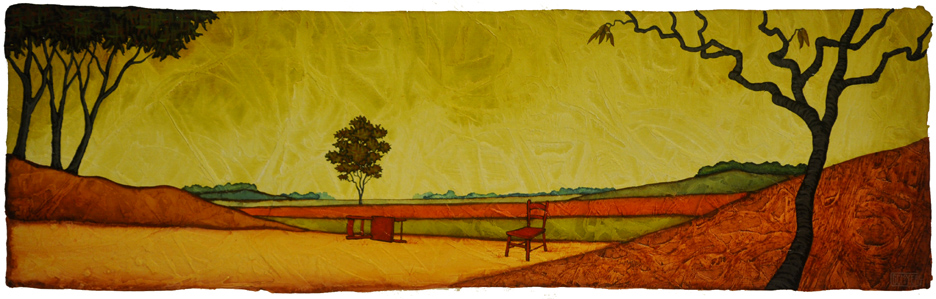
This is a painting I just completed yesterday, an 8″ by 26″ piece on paper, that I’m calling Edge of Light.  It’s another piece that I am showing at my upcoming show, Toward Possibility,that opens November 6 at the the Kada Gallery in Erie, PA.

There is a lot that I could talk about in this painting.  It has great underlying texture with swirls of chaotic fingerpaint-like slashes in the gesso.  It has great depth into the picture plane that gives one the feeling of being able to fully enter the landscape.  It has elements I seldom use in the stone walls of the short cliffs next to the water.  It has rich colors and a winding road that pulls the viewer along.

But the element that stands out for me is the balance in this piece between the light generated from the hazy sun that burns through on the right side of the painting and the darkness in the color and shade of the left.  When I look at a painting like this, one that is more horizontal, I always look at it as though there is a fulcrum underneath it, as though the painting were a teeter-totter and it rested on a support which allowed it to pivot upward or downward depending on which end had the greater weight.  What I am trying to do is make the painting on that fulcrum, balancing elements so that it seems to hover effortlessly level above this pivot point.

In this painting, this is all about balancing the light between the two opposing sides.  The greater the light coming from one side, the greater the darkness in the other side.  The darkness on the left makes the light coming from the other side appear brighter.  However, in a wide piece like this, if the the contrast is too great, the lighter side becomes too dominant, too heavy in a way,  and the balance on the fulcrum is broken.  I think this painting has that balance that I’m seeking.

I don’t know if this makes sense to anyone but myself.  Like a lot of things I do, this is a matter of feel and trying to describe how feel works often requires using analogies that may not always make sense.  In the end, I simply paint and if I’ve done all I can with the feel of which I talk, the viewer will easily take in the painting without considering things like balancing on a pivot point.
Read Full Post »

Triptych

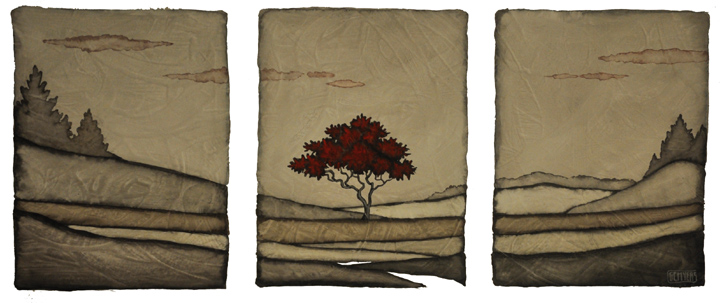
This is a small triptych that I recently completed.  I’ve done several triptychs over the years and really enjoy the challenge of composing the three separate panels into one cohesive piece.   There are obstacles to overcome in order to make the overall piece work well in attracting and holding the viewer’s attention over the width of the painting.

 This piece, done in the gray style with a dash of red that I’ve used a bit year, has panels that each measure approximately 4 1/2″ by 6″.  The smaller panels change the way I view each panel in composing this.  When doing a larger triptych, I try to make each panel completely autonomous, meaning that each panel has to stand alone as a painting.  Each has to have its own focal point and be complete as a self-contained scene.  However, with the smaller size of the panels I drop that criteria somewhat because the width of vision for the viewer is already condensed.  The side panels still are complete but they have little in the way of focal points in themself.

The overall feel for this piece has a real sense of completion.  The attention is all funneled to the central panel and while the side panels may not be exciting as individual paintings, they have a feeling of rightness in the whole. 

I’ll be working  on a larger triptych soon, perhaps with non-symetrical panels which changes again the way the composition comes together.  I will probably opt for color in the larger piece.  Maybe not.  Who knows?

Read Full Post »

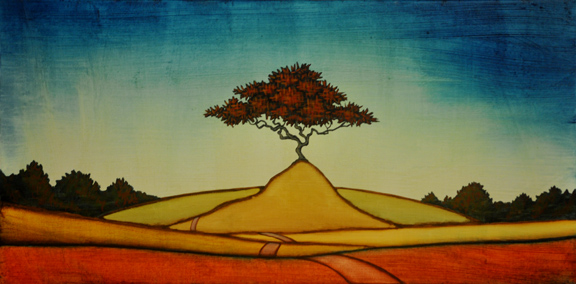
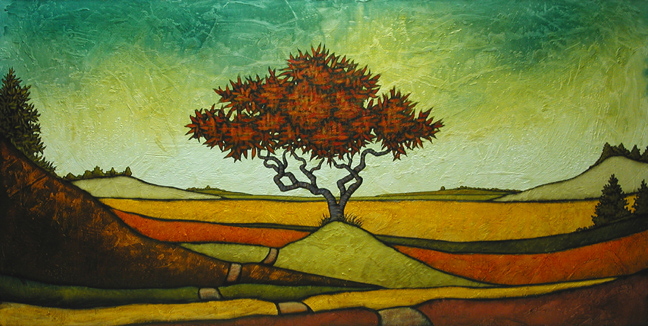
Well,  I am well into preparations for an upcoming show at the Kada Gallery in Erie, Pennsylvania.  The show opens October 16.  I have decided to call the show Toward Possibility which is the name of the painting above.  It is a 24″ by 48″ painting on canvas and has been a favorite of mine for some time.

The title of the show refers to the possibility offered in the paintings, the pure chance of existence and imagination.  These landscapes that I paint are not pure products of this world.  I can stop and step back to analyze them with a cool eye  and say this or that element in the painting doesn’t or couldn’t exist in the real world.  But my goal and hope is to make them possible in the eyes and minds of the viewers, to create a harmony in the elements that allows the viewer to comfortably assume the reality of the landscape.  To create a vocabulary of elements that speak of the possibility of this other world.  That is the possibility to which I refer in the title.

Hopefully, I am moving more and more toward that possibility.

Read Full Post »

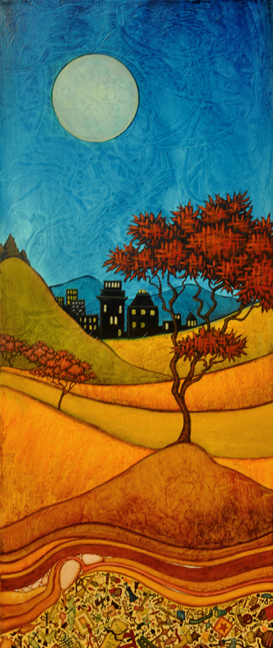
This is a new painting that I finished at the request of a collector in North Carolina.  It was an interesting request, one that piqued my imagination enough to accept the commission.  He wanted a very specific sized painting built on a hinged frame that would cover an unsightly circuit breaker box located in the middle of a wall in a well used room.

I found the idea that the painting would be part of a utilitarian object, something that had a real practical use,  intriguing.  But I didn’t want this purpose to outweigh the painting itself.  The painting had to be the dominant aspect of the whole, not a mere afterthought or pure decoration.

The client had specific requests that had to be addressed. First of all, it needed too be one size, which ended up being an 18″ wide by 42″ high canvas.  This size and proportion would dictate how the painting was composed.  He wanted it to be part of the Archaeology series as he had uncovered a number of old items in the ground around the old farmhouse he was renovating.  But he didn’t want to not have the below-the-surface area overwhelm the painting, desiring a smaller presence for the assorted items.  He liked my blue night skies and moons and red trees that were spindly like the pink mimosas in the yard of the old farmhouse.  The two red trees furthest away have touches of pink in them.

The part that I wrestled with the most was having a night skyline in the painting,  of which he had expressed an interest.  At first, I was hesitant as I had always seen the Archaeology pieces as being beyond the time of man, at a point when we’ve entered the realm of dinosaurs and exist only in the evidence we’ve left behind.  The idea of having evidence of man still existing rocked me at first but then I began to think that it might be interesting to see how it would play.  After all, we have certainly created a wealth of underground archaeology up to this point.  And maybe I was being a little too cynical in assuming that a time would come when we cease to walk the Earth.

After painting in the buildings, which vaguely represent the Asheville skyline especially with the far outline of the mountains behind, I was really pleased.  It gave me the feeling of two worlds, two histories, exisiting simultaneously, one above the ground and the other beneath it.  One history, the past, is already written and the other is being written in the present.  It really seemed to work,  filling out a new narrative and giving the piece a different depth.

I began to see that the painting had become one of my own paintings, beyond the desires of the collector, which was exactly what I wanted for it.  When people ask about commissions that is the point I try to get across– that I have to satisfy myself,  with the painting, have to feel that it has its own life,   before I would even consider showing it to them.  And this piece does just that.  It feels alive and vibrant to me.

Now it can move on to its new life.

Read Full Post »

I’m busy at work, putting the final touches on several paintings that are strewn around the studio.  The final bits of color and detail don’t take a long time to put on the surface but the transformation to the painting is remarkable.  Sometimes it takes a piece that seems stagnant and lifeless to my eye, that seems to have lost direction, and suddenly imbues it with spirit, making it seem vibrant and alive before my eyes.

For me, it’s the most exciting time in the process and the one that most often baffles me, leaving me wondering how such a change occurred in just a few strokes of the brush.

This is a new piece that is an example.  As I worked on this piece, a 12″ x 24″ canvas, and let the composition come together, there were things I really liked about it.  The symetry was strong and obvious and the color was sharp and rich.  I could see where it was going but it seemed to be lacking.

I thought that perhaps adding the tree would do it but seeing the silhouette did nothing to animate the surface.  As I built up the layers of color, I still wasn’t feeling it.  Then as I put on the final touches that highlighted the edges of the foliage, there was a huge change in the painting.  Those final touches gave added depth and in this depth, the whole surface seemed to unite, coming together as one entity.  It became alive and vibrant.  

I sat at my work table with it before me and shook my head.  I’ve done this many, many times yet I am still amazed when I see this tranformation take place.  Even though it’s a small event late in the process, it is that moment that gives me the ultimate gratification in what I do.  I don’t know if my words can describe the feeling I’m trying to describe.  It seems like such a nebulous thing, like trying to describe something that you didn’t quite see and don’t really recognize to someone who didn’t see it at all.

Well, that’s what I do, I guess.

Read Full Post »

One

I call this new painting, a 12″ by 24″ canvas,  One.

One path.

One tree.

One sun.

One person.

I’ve been working on paintings that are focused on rolling fields of color and how they relate to each other, as is seen in the foreground of this piece.  The rolls form a foundation for the painting as well as create depth into the painting, pulling the viewers eye further into the picture plane, allowing it to feel immersed.

Well, that’s the hope.  It’s also my translation of what I feel makes a painting of mine succeed on some level.  I feel that if I can easily allow the viewer deeper into the picture, they will get a greater sense of the color and emotion of the piece.

I have no proof that this is true but it helps me to think this, to fulfill the need for explanation.  The need to know the why of being drawn to it, even if it’s only for myself.

Just one reason.

One.

Read Full Post »

Yet another Sunday morning.  I don’t have a lot to say this morning, which is pretty normal when I’m very busy painting.  I become very focused on the task of painting when I’m in full painting rhythm.   It seems the spaces in my mind that might be filled with opinion and trivial thought become clogged with flashes of color and and other elements.  I tend to set my limited mental capacity towards solving the puzzles of painting–  how to make a piece that seems to be static at one stage come alive with the next or making a painting that says something with the fewest amount of detail.  Solving compositional conundrums that float in the ether of  my mind. 

 It’s an interesting state of mind, being in the painting rhythm.  Like being in a location that is far removed from the realities of everyday life.  Oh, I’m aware of them but my concentration is far from them.

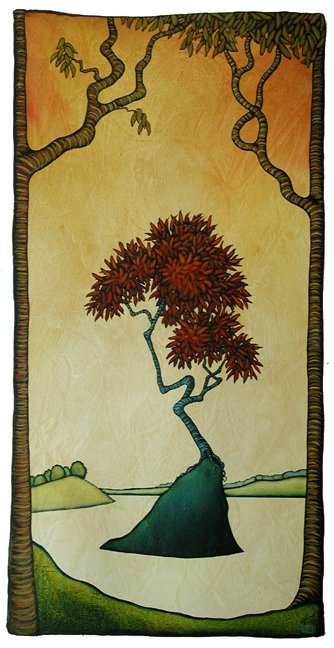
The painting shown here, Through the Portal, from back in 2004 kind of sums up how I feel about being in this rhythm.  It’s somewhat like passing through a gateway into a world comprised of my own little trees and landscapes, all easily pushed into place with a glance.  The real world with all its problems is behind me and feels a million miles away.  I know it sounds goofy but as I’ve stated before, if I could decribe it I wouldn’t have to paint.

So, I’ll stop trying to describe it this morning and focus on doing what I do.  Being in my own little world. 

Where I belong.

Read Full Post »

After the Talk

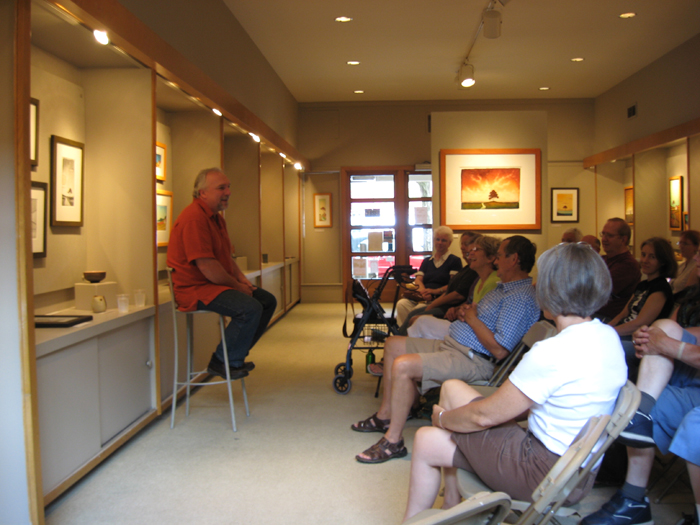
I had my Gallery Talk at the West End Gallery yesterday and it went well.  Very nice turnout with many new faces and lots of questions to answer which made the time go by quickly.  Which is a good thing because, at the end, I am sick to death of talking about myself and my work.  But it’s all part of the job of being an artist.

I’ve often said that the hardest part of this career is the constant self-promotion that one must maintain if one wants to succeed in the business of art (or just about any other business, for that matter), which goes against the very nature of many artists who are often either somewhat introverted or desirous of staying out of the spotlight so that they can simply observe.  I don’t know where I fall in these groups.

It would be lovely to only stay in the studio to paint and not have to talk (or write) about myself or my work.  To not have to seek out new outlets for my work, new avenues to reach a wider audience for my paintings.  To simply create.

But I’ve always seen my work as a vehicle for communicating something inside that I can’t explain to people I don’t know.  I don’t make it for myself.  If I didn’t think it would move others, I probably wouldn’t do it at all.  I have the feeling and imagery inside already.  No, for me to want to create it, it needs to be seen.  And that means I must do whatever I can to inform people of it.

It’s not something that many artists are well suited for and something that most art programs don’t teach.  I can only imagine how much truly great art has been lost through the ages due to an inability or unwillingness by the artist to speak up about their work.

But, as I said, it’s part of the bargain that comes with the job.  So while I would rather be alone in my studio, I talk…

Read Full Post »

Whenever I write about politics or an issue associated with it such as supply-side economics, as I have in the past week, I feel like I may be getting out of my depth in the pool.  So, today I’m back where i’m a bit more comfortable and my feet are planted solidly on the pool’s bottom.  Today, at 12 noon, I have my annual Gallery Talk at the West End Gallery in Corning.

I have done these all over and sometimes they go very well and sometimes less so.  Usually, at the West End, there is a certain degree of familiarity with many of the folks who come to listen which makes it a very comfortable setting for me.  One of the biggest challenges in doing these discussions at one gallery over a period of time is having new information to give to the listeners, who may have heard me a number of times.  They have heard the stories about how I fell from my ladder and started painting (not at the same time), have heard how I came to show at the West End, have heard how the Red Tree evolved, etc.  They want to hear something new.

So we usually talk about new things in my work.  In past years, it’s been the Archaeology series.  This year, it’s the gray work.  There are always a few artists who want to talk technique but I try to keep it away from going that way too much.  I think the motivations and stories behind the paintings are far more interesting than what hue of yellow I use. 

One piece I’m sure that I will be asked about is the painting above, Auld Lang Syne, with its Red Chairs and green-leafed central tree.  I am always asked about the chairs, either what meaning they hold or, in some pieces, how and why they came to be hanging in trees.  I try to remember to ask the questioner what they see in the piece before I answer.  Sometimes the answers open new windows for me in how I see my own work.

So, I’m off to talk today.  If you’re in Corning today, please stop in.  It could be an interesting hour…

Read Full Post »

Left of Center- GC Myers 2010

This is a piece from the show, New Days, at the West End Gallery.  Its one of the pieces that are being called gray paintings, a series of pieces I have been recently doing in shades of black, white and gray with small touches of color.  As I’m starting to prepare for my show in October at the Kada Gallery in Erie, I’ve began to ponder if and how I will incorporate this series into that show. 

As with anyhting new that clicks with me, I want to run it out to see if I can expand it beyond what it starts as.  For instance, I am really excited about the prospect of using this gray format in a much larger work comprised of a grid of many small individual cells each containing a simple landscape with perhaps one cell having a red tree.  It would have a great graphic quality and the size and austerity would make the small slash of red pop out of the gray. 

 I’m thinking something like a 30″ by 30″ image.  It would work on canvas or paper although I lean toward paper because with the graphic feel of the gray work I like having a mat forming a field of white around the image, something that makes the image stand out even more.  It would be have either 25 or 30 individual cells, 5 or 6 cells across and 5 or 6 down.  I’ve done a few, many years ago, that had 45 and 49 cells.  I haven’t done anything like that in the past several years.

World Shifts-- GC Myers 2003

The other consideration is whether the cells will be very uniform with straight lines, each very much like the next.  Or will it be more organic, with each cell very individual in shape and size.  Here on the right is an example from several years back that has that naturally grown look, with barely anything in it that resembles a straight line.  I like the look and feel of this but looking at it now, I think it is better suited to color. 

 But one never knows.  Maybe I will try a small organic piece in the gray to get a better feel.  Sometimes that first impression I form in my head is off a bit and when further examined, something that I didn’t foresee reveals itself.  Sometimes for the better.  Sometimes not.

This is as close to planning ahead as I often get with my work.  I have a somewhat well-formed idea of what I want to see on the canvas or paper, know how I plan on painting it, know the subject matter– pretty know everything I need to jump in.  The interesting thing is that something invariably happens that changes one of these factors and the piece transforms into something quite different that the one I have in my head now.  Usually, it changes for the better, provided I let these changes emerge in an organic fashion, not forced.  Occasionally the transformation doesn’t work and that is usually the result of a flaw in how I was seeing the painting in my head in the first place or if I try to resist obvious changes that are dictated by shifitng factors.

Hey, the worst thing I can do is think too much about this.  Said too much already. Just give it a direction and let it go.  That said, gotta run…

Read Full Post »

« Newer Posts - Older Posts »