Feeds:
Posts
Comments

Archive for the ‘Technique/History’ Category

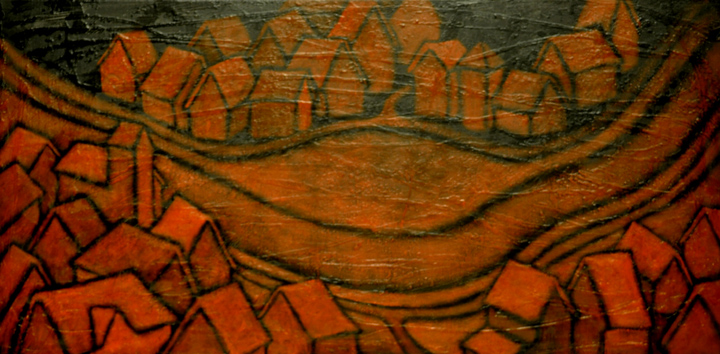
GC Myers 2009 Underpainting #@So I’m well into the underpainting of this large 42″ by 60″ canvas, a step that is perhaps the most important in my process.  This part of the process really builds the final composition and gives me guideposts as it grows to what the final product might be.  As I’m painting, I’m taking in parts of the painting that I will later enhance and highlight.

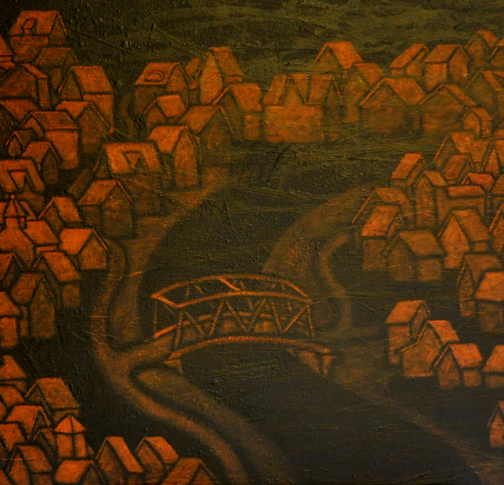
In this top photo I build three layers of landscape beyond the village with a path running through them.  This adds depth and distance into the picture plane and creates an atmosphere of sorts.  It changes what the focus of the painting might end up being.  This addition, in my mind, brings in the possibility that the path running farther into this landscape says something about what might be coming or what has gone.  It’s not all about the static existence of the structures.

GC Myers Underpainting DetailAfter finishing this bit of landscape, I turn my attention to building my sky.  Again using a red oxide, I start a rough cross-hatch and fill the area where the sky will be.  At this point in the process, I am not yet thinking about the way the light will emerge from this sky.  I am merely putting down a base from which the sky will grow .

GC Myers Underpainting SkyTo many painters, this may seem like needless work.  By that I mean there are quicker ways to proceed with this sky to reach a similar final product.  However, for me, this is the way I have adapted that best fits with the way my mind operates.  It is slower in process and forces my mind to be less reactive, allowing me to take in the whole  picture and adjust, bit by bit.  I t just works best for me.

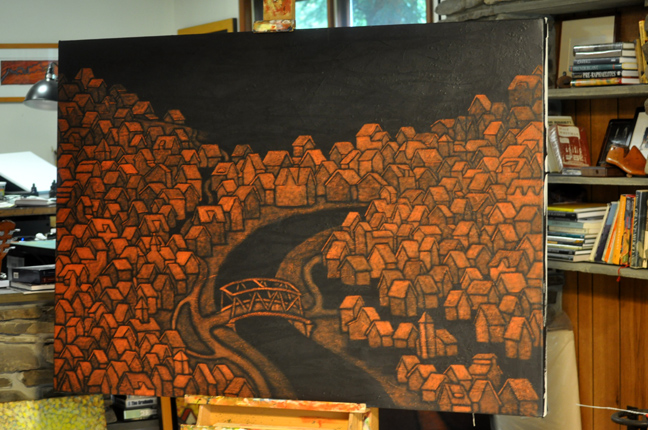
GC Myers 2009 Underpainting FinalMy next step is to finish the area on the right side of the waterway ,in the bottom right quarter of the painting.  I’ve decided I want to continue the road through the house and have some smaller roads off it.  I just felt that area needed a little more visual interest but don’t want it to be too fussy.  As I wrote before, I want the lower parts of the painting to enhance the whole, not dominate.  The only part of the painting that is left blank at this point is the waterway.  I sometimes also use a layer of red oxide in this situation but I’m leaving it blank for the time being to see how the areas above evolve.  They’ll dictate how I will proceed with the waterway.

So I’m basically done with the underpainting.  I have a really good idea at this point how the painting will grow although it can often change, especially in it’s emotional tone or feeling,  beyond this point in the process.  The next step is to start introducing more color and build.  I’ll let you know how it goes…

Read Full Post »

GC Myers 2009 UnderpaintingSo I’ve been working on this large painting, a 42″ by 60″ canvas, as I noted in Saturday’s post.  When I last wrote I had just blocked in the lower parts of both sides and had the bridge just sort of sitting alone in the middle.  Since then I have continued with the underpainting in the red oxide that I prefer to use.  Most of this is applied in an almost dry brush way, where I put my brush into paint then swab a lot of it off before applying it to the canvas.  It leaves a lighter layer of paint, allowing the black underneath come through.  It takes a bit longer but it suits the way I see the thing building and growing.

It also takes a lot more time than one might suspect in growing the village from the start, especially in a way that makes it feel organic and not just thrown together.  Each new element informs the next and there is a bit of time spent just looking at each piece to make sure that it plays off the form below and beside it.  This is even more crucial in such a large canvas because I’m trying to maintain a continuity of form throughout the whole piece so elements in different areas of the canvas still relate to one another.

As the village grows upward I begin to try to decide how I want it to transition into either a background or sky or if I want to simply have the structure fill the entire picture plane.  I decide here that I want to have sky so I start to think of how I will have the structures end near the top of the canvas.  As I’ve been looking here I have chosen to have the village move into a somewhat empty landscape and that  into the sky.  I want to create a saddle-like structure with the landscape so that the light I create in the sky will be cradled by the landscape below.  I often do this in my work and I think it has to do with this cradling effect holding the light in a way that brings the eye to the lowest point, creating a focal point off of which the rest of the painting plays.  It’s a funny feeling writing about this because when I’m making these decisions, it’s very seldom near the front of my mind.  They’re just done in stride, instinctually,  as I’m taking in what I’m seeing.

GC Myers Underpainting DetailI’m also at a point in the canvas where I have a bit of space at the lower center of the piece, around the bridge and banks of the waterway.  I start to fill in this area, adding detail although it’s not real fine detail.  I want this space to have interest and detail but not so much that it becomes the sole focus of the work.  I see the light that I will create where the sky meets the landscape in this painting as the more important area of focus, conveying more of the feeling that I’m hoping will emerge.

So I keep working upward and as I near where I feel I want to stop the structures I begin to start get a feel for how the landscape itself will continue.  Here’s where I am at this point and where I’ll leave it for now.

GC Myers 2009 Underpainting

Read Full Post »

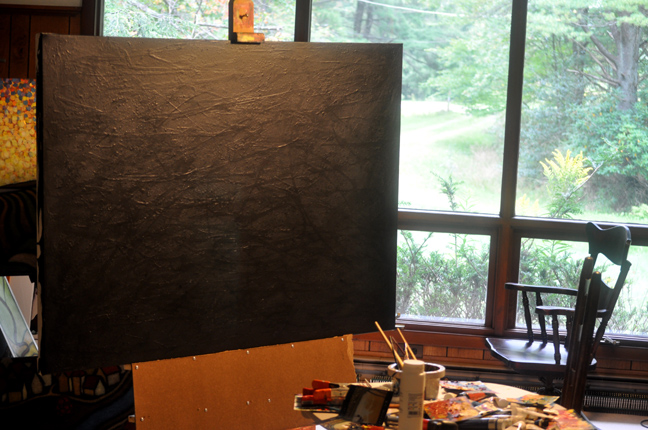
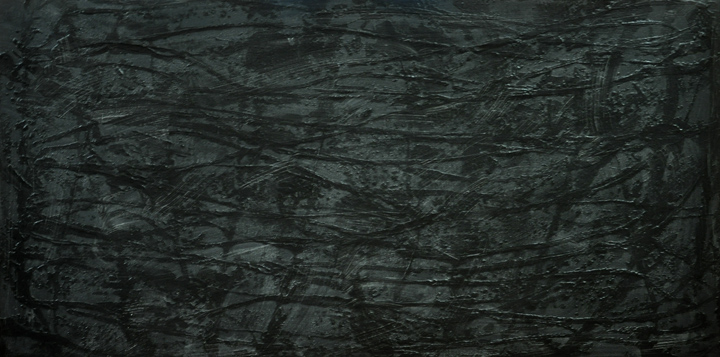
GC Myers 2009 Beginning PieceI started a new painting on Wednesday of this week, a 42″ high by 60″ wide canvas.  I first prepped the surface with layers of gesso and a layer of black paint.  I’m not sure if the texture of the surface will fully come through in this photo but it has an interesting surface with string-like bands running across it.

I’ve been working lately in my self-titled obsessionist style, work that is based on a dark ground with building color shapes on top.  It is the style I have used for much of my Red Roof work and is the type of work I have featured as of late in this blog.  I tend to work in surges, focusing on a certain style for an extended period, as though each piece, though self-contained and complete in itself,  is both rehearsal and an extension for the next piece.

By extension, I am referring to an extension of the thought process that forms my compositions.  For instance, I may take a concept that started in an earlier piece in the series and either expand upon it or take it in a different direction than the painting from which it stemmed, maybe in a direction that I recognized after the original had taken form.

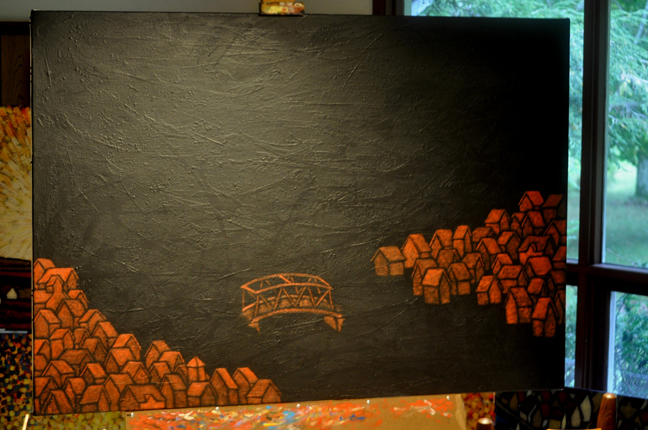
GC Myers 2009 UnderpaintingAs I have been doing a lot of Red Roof-like work I wanted to take something that I gleaned from a few of my recent pieces and move it to a larger canvas.  I wanted a large mass of structures building upward.  So I began working in the lower corners, blocking in the forms in a red oxide paint.  As I said before I have used other colors as an underpainting before, I prefer red oxide for the way it shows through and creates a warmth and depth in the whole piece.  My eye responds to the red breaking through the overlaying colors as the piece proceeds.  It’s something that  reminds me of the  bits of a vermillion color you often see braking through other colors in Paul Gauguin’s work, something I always look for in his work.

As I start bringing the corners toward each other, I start making decisions on how it will build upward.  Everything, except for the fact that I know I want masses of structures, is up in the air at this point and my forward vision is constantly shifting.  At this point on this piece, I have a feeling that I want to insert a canal or river, elements that I have used often as of late, and a bridge connecting the two sides.  I decide to start with the bridge and let the waterway build off of that.

Covering such a large canvas with small forms is time-consuming, more so than some of my other work which consists of large color fields and requires a different form of concentration because, as I said above, the piece is always shifting as each new element is added.  It requires me to stay fully engaged which is really the basis for obsessionism as I see it.  As a result, I often am thinking about my next move on the work even when I am not at the easel or when my day is done in the studio.

So, it’s time to get back at it…

Read Full Post »

Trance

GC Myers Trance 2002

I came across this piece from 2002 yesterday while looking through some old files.  It’s titled Trance and is a 20″ by 24″ canvas.  It sold very quickly back then so as a result didn’t live with me for a long time.  So when I come across it as I did it’s almost like seeing it for the first time.  Eventually the feelings that the piece initially triggered when I was painting it are recalled.

It’s a very simple composition, so the feeling and depth of the painting are dependent on being carried by color and strength of line.  The imagery, though simple, is strong with all detail pared away leaving the viewer to focus deeper into the scene.  Though there is subtlety in the color it’s not delicate which goes back to what I’ve said before about preferring bold lines and colors, that a strong, confident stroke is always preferable to fussy or wishy-washy, of which this piece is neither.

In other words, I like this piece’s strength and simplicity.

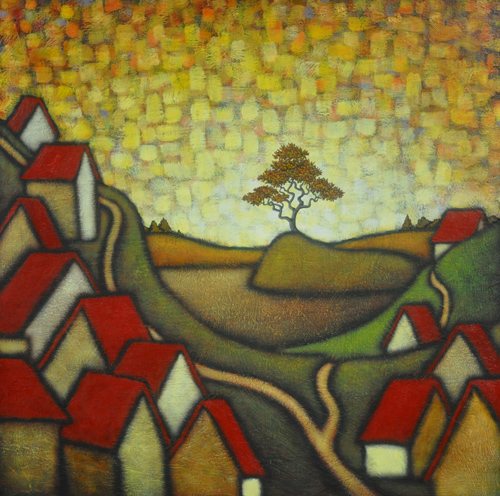
No Way HomeI’m currently in the midst of preparing a group of new work for later this autumn for the galleries that represent my work.  It’s a different atmosphere and pace than prepping for a solo show.  There is less direction and more opportunity to examine new avenues, new concepts.  I’ve been primarily working in the obsessionist style I’ve spoken of before, a style that I’ve shown in recent posts.  The painting shown here, Trance, is an early example of the style although the newer work is more dependent on layers of brushstrokes in the sky to achieve the color and depth I’m seeking, giving it a much different look.  You can see the difference in this new painting that I recently posted.

I have some other new ideas that I’ve been rolling around in my head for some time about which I will hopefully have something to post at a later date.  But for now it’s back to the easel…

Read Full Post »

GC Myers 2009This is a new painting, sized at 24″ by 24″ on canvas, that I finished last night.  It has a wonderful warmth in the studio and really nice depth into the picture plane.  There is a real feeling of completeness in this piece and I get a real sense of satisfaction when I look at this.  I have talked about a sense of rightness in the past, about an instinctual feeling of whether something works or not, and  this piece has this feeling for me.  It’s one of those pieces that, if it were not to find another home, I would gladly keep for myself, which is something I don’t say very often.

 Open Your Eyes I did something with this piece that I have never done in the past.  I painted over an existing piece, meaning that the image shown here on the right, no longer exists.  It was a piece I created last year and had planned to show at one of my fall exhibits.  It seemed to work, had a nice surface and good color.  But as it sat in the studio it just seemed lifeless.  It lacked a certain brilliance, appeared flat up close.  It was missing that sense of rightness.  It actually appears better on the screen or printed page, unlike much of my work.

So one piece is no longer and another lives on in its place.  Even though it’s a mere image, a simple composition at that, there is a slight sense of loss, as though a little bit of possibility has been erased.  This would actually bother me if the new painting didn’t far surpass for me the first.  And it does and I am pleased to look upon the new work but still have a feeling of the work beneath.

Read Full Post »

Inks

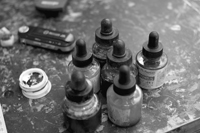
GCMyersInkBottlesBlumerSThis a photo that Barbara Hall Blumer took of ink bottles on the table where I paint a few years back for her book, In Their Studios, which documented artist studios in the Finger Lakes region. I’ve always liked this simple photo and am showing it to just talk for a bit about one of my favorite materials to use in my work, acrylic inks.

I started using acrylic inks about fifteen years back as an addition to the watercolors I was using at that time.  I had been told about Dr. Martin’s Hydrus inks and found them and some Daler Rowney FW Artists Inks at a local art supply.  I was immediately excited by the way the inks reacted in my work.  The colors were deep in intensity as the pigments were very finely ground and the transparent colors I chose mixed tremendously well.  I was also happy with their high level of light fastness which prevented the colors from fading from exposure as is the case with many watercolors.  I wanted to make my work as durable as possible.

Over the years, as my work evolved, several colors became staples in my paintbox, particularly those from Daler Rowney.  I was using several quarts a year of certain colors and they had become almost trademark colors in my work.  For instance, their Indian Yellow , which I use as a first layer of stain on my frames.  I was buying dozens of their 8 ounce bottles of ink every year.

I was thrown a curve last year when Daler Rowney, a British company, chose to stop selling the FW inks on which I so depended in large bottles, only selling one ounce bottles.  I panicked a bit, knowing I wouldn’t be able to keep up with my needs with the small bottles even if I could find them.  I started trying different brands of inks.  I was able to find comparable quality in certain colors but I couldn’t match other important colors.  I tried and tried, mixing different colors to try to achieve the same quality of color that I had become accustomed to with the Daler Rowney, but it always came up short and the inks reacted differently on the painting surface which altered how I painted.  It was discouraging and I felt that my work would change forever.

So earlier this year I contacted the Daler Rowney office in Britain,  desperately appealing for any help that could offer.  I really didn’t expect much in response but was surprised when they emailed back that they had a surplus quantity here in the States that they had made for a private firm and would gladly sell me whatever they could offer.  I was able to match colors with the help of their chemists and within a week I had 30 gallons of ink sitting in my studio.  Enough for several years.  At least long enough for my work to continue to evolve beyond the need for a single product.

I know I could have survived without the inks, necessity being the mother of invention that it is, but having the security of knowing that this paint will be available for a while eases a bit of the anxiety that would come from having to change immediately.  Now I can ease into it.

Read Full Post »

CLINICAL SIGNIFICANCE
● 62.1% of all bankruptcies have a medical
cause.
● Most medical debtors were well educated
and middle class; three quarters
had health insurance.
● The share of bankruptcies attributable
to medical problems rose by 50% between
2001 and 2007.

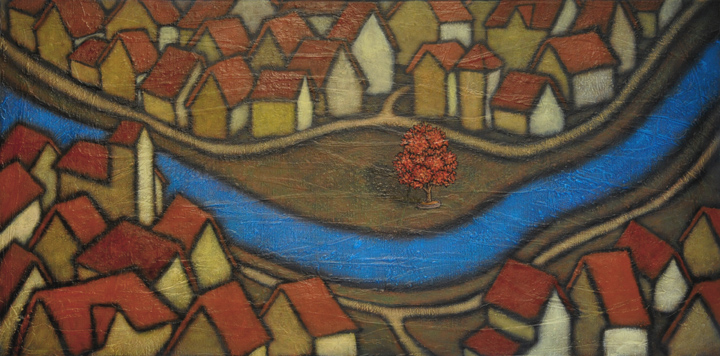
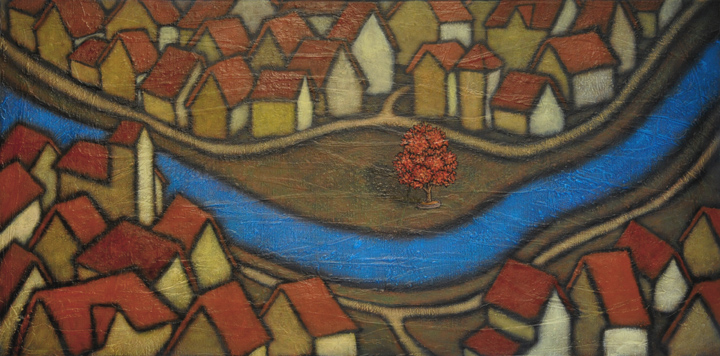
 Just the Other Side of Blue This is a new piece I’m working on that I’m calling Just the Other Side of Blue.  It’s on canvas and is 18″ high by 36″ wide.  This is not the final photography so I apologize for some glare spots and a little darkness in some areas.

This is painted in my obsessionist or additive style where paint is built up rather than taken away as I do in much if not most  of my work.  It has an overall darker feel than most of my work, probably due to the lack of transparency as well as the black underpaint.

DSC_0003 smallI start a piece with a blank canvas and add layers of gesso to create a distinct texture.  If I were  going to paint in my fluid, transparent style I would begin painting at this point but since I am planning to paint in the additive style I add a layer of black paint.

DSC_0004 smallI next start blocking in with red oxide paint, a color that I choose because I like the warmth it adds underneath.  I usually start in one of the bottom corners and just start building, letting my eye guide me.  In this case, I started at the bottom left and  reached a point where I felt there needed to be a change  and began to realize that I wanted a canal or river cutting across the entire width of the painting.  I wanted that slash of color separating the two sides of the town.  The little piece of ground with no buildings was left and I began to think on how I would later incorporate that into the composition.

GC MyersI finish blocking in the rest of the village then start to shade the buildings, starting with shades of yellow building up to the whites.  The roofs are done in reds with some left in red oxide, just deepened a bit in shade.  There’s a lot of time spent stepping away from the easel and just looking, trying to see where the focus of the piece should fall and how the colors of the buildings and roofs should play off that.

GC Myers 2009After this preliminary blocking in is done, I decide to add color to the canal.  I choose a bright, vibrant blue.  I don’t really care if there is any basis in reality for the color choice.  I’m going with this color because of its visual impact in the piece while still maintaining a certain harmony within it.  The painting begins to take on a life for me at this point and I realize that there is need for a central figure here.  I’ve left a hole that needs to be addressed, namely the park-like blank piece of ground.

 Just the Other Side of BlueI decide to go with the Red Tree and paint it into place.  But there is something else needed to balance it as it sits.  I decide that it needs a shadow, to give it depth and weight, atmosphere.  Like matching colors to reality, I normally don’t concern myself with naturalistic shadowing unless it adds to the impact of a composition, which I think it does in this case.  For me , the entire piece is transformed with the simple addition of a shadow beneath the tree.

So, this is where it sits for the time being.  I will study it more, probably add color here and there, enhance certain parts in small ways until it feels fully alive.  But it feels close now and I find myself sneaking peeks at it quite often.  I will post a final photo of it when I feel it has reached its endpoint.

Read Full Post »

DSC_0007 smI finished this piece the other day.  It’s an 8″ by 24″ canvas and is painted in what I have previously termed my obsessionist style.

Probably the thing that stands out most is the absence of a tree of any sort, particularly the Red Tree.  It still is there as a possibility as the painting sits in my view in the studio but I feel there is an equilibrium in the piece as it stands, as though there is a clear message and feeling already.  The focus is on the moon (or sun, depending on how you see it) and the sky and the atmosphere they cast over the landscape so the addition of the tree might alter the entire feel of the piece.  And I’m not sure I want to do that.

I like this piece.  There’s a calm and contemplative nature in it that really appeals to me.  A real sense of harmony.  I think of pieces with this feel as being in the moment between rest and motion, almost suspended in time.  Free from anxiety.  Focused on the light.

So for now, the painting is as it appears and will most likely stay that way.  I will live with it for a while.  Maybe a title will rise from it.

Any suggestions?

Read Full Post »

The New LabyrinthThis is a piece from early last year, titled The New Labyrinth.  I do several pieces of this nature every year and always count them among my favorites to perform.  They are done in a very free-form fashion, usually starting in one corner and allowed to build into the picture frame on its own accord, until I get the sense that I should stop.  As each new building is painted it creates new parameters for the next, new prompts for my eye.  As a result, the piece has a very organic feel for me. as though there has been a natural growth in the painting.

I particularly like this painting for this feel but maybe more so because of the use of similar, muted colors in the buildings.  There is almost a monochromatic feel to the piece that I find appealing especially in the context of the subject.  It harkens back to the days when I first started painting and would do exercises where I would paint scenes using only one color, only varying the shades of it to create depth and texture.  It was probably one of the most important lessons I learned and one that I urge all novice painters to try at least a few times.  Knowing how to create harmony within the confines of a single color is necessary if you ever hope to control a larger palette.

There is also a really nice natural rhythm that runs through this piece, giving me a sense of my normal landscapes.  This probably occurs because of the way I described how the painting is allowed to grow in an organic way.

It’s a piece that has visual interest in every bit of it which is something I strive for in all my work.  I would like to think that you could take a random fragment of any of my paintings and find something that catches your eye in it.

I keep a photo of The New Labyrinth on a bulletin board I keep in my studio and I look at it quite often, thinking that I really should paint in that way again soon.

Maybe I will…

Read Full Post »

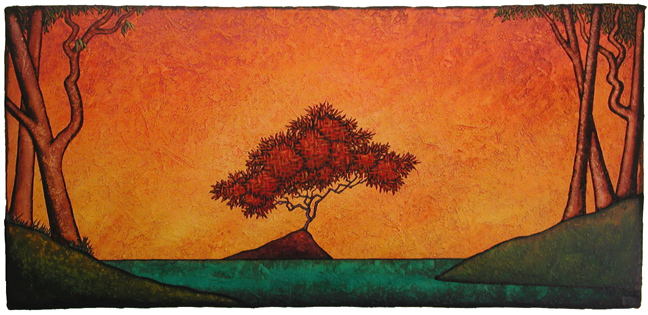
Quietheart I had my Gallery Talk yesterday at the West End Gallery in Corning and it went pretty well.  Really good group of people who asked insightful questions and seemed very open to the things about which I was talking.  I went quite a bit over the hour that was planned but I don’t think it dragged on.  Hopefully, they enjoyed it as much as I did.  They made it very easy for me.

One of the questions that came up was about whether I worked on more than one painting at a time or if I had paintings in varying degrees of completion.  I immediately spoke about this piece, Quietheart, which was the centerpiece of my 2007 show at the West End.

At the end of 2006 I prepped a large panel, 34″ by 60″, layering in multiple layers of gesso to create a visually interesting base to hold up the paint above.  I started the piece by painting a large block of color, consisting of varying reds and yellows that had quite a bit of intensity.  The orangish color of the sky is this color.  So I had this large block of color that I very much liked.  It had the intensity I mentioned and the surface had a great texture that seemed to be visually stimulating throughout.  It was right on the mark as far as I was concerned.

The problem was that I was now afraid to go any further with piece.

I so liked this first block of color, this base, that I felt I could only do harm to it by making another mark on it at this point.  I felt I couldn’t add to, could only diminish from it’s impact.  I gloried in the color and form but couldn’t see a next step at that point.

So I set it aside.  It sat, prominently displayed in my studio, for six months and I would look at it each day and think that someday that would truly be something I would be proud of if I could ever dare to step into it once more.  Finally, one day I pulled it down and said this is the day and with great trepidation, put a new brush of paint to it.

I was immediately engaged and the image as you see it above fell in place quickly.  I breathed easier.  I hadn’t diminished the original block, hadn’t made it secondary to the scene above it.  I felt that its strength bonded with what I had added.  I was pleased.

And that is the main criteria I have to meet.

So, yes I do have pieces at different points and most are just waiting for the right moment.  

Again, many thanks to those who came out yesterday.  It was most appreciated.

Read Full Post »

« Newer Posts - Older Posts »