I talk democracy to these men and women. I tell them that they have the vote, and that theirs is the kingdom and the power and the glory. I say to them “You are supreme: exercise your power.” They say, “That’s right: tell us what to do”; and I tell them. I say “Exercise your vote intelligently by voting for me.” And they do. That’s democracy; and a splendid thing it is too for putting the right men in the right place.
–George Bernard Shaw, The Apple Cart
Shaw’s dialogue above is both the best and worst of a democracy. It extols the power of the voter while at the same time acknowledging that much of the electorate wants to be told what to do. Blindly following any candidate certainly is not a surefire method of putting the right man in the right place. There is ample evidence of that.
My hope is that the voter understands their power and the responsibility that comes with it, which is to fully examine the issues with clear eyes and an open mind before voting for that which is best for the country as a whole.
Country over party or self-interest.
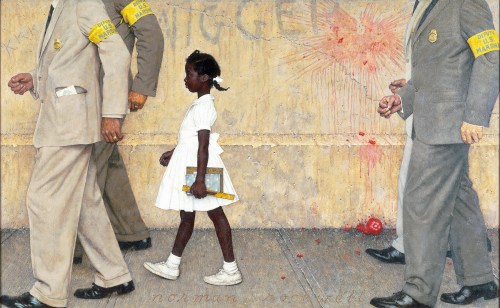
With that in mind, I thought I would show a couple of previously posted paintings concerning our election process from Norman Rockwell who chronicled this country for many, many decades and often seemed to get to the core of things in his work. At the bottom, I included a couple of his most famous paintings to show that our elections are something more than popularity contests. They do indeed have consequences. They do shape our view of and in the world.
Voting is our right, one that has long been battled over. People have bled and died for this right. But more than that, it is an obligation. We must play our part, to raise our singular voice in how our nation moves ahead in a way that is best for all its citizens.
Do not take this right and obligation lightly–VOTE.
I decline to accept the end of man.… I believe that man will not merely endure: he will prevail. He is immortal, not because he alone among creatures has an inexhaustible voice, but because he has a soul, a spirit capable of compassion and sacrifice and endurance.
–William Faulkner, Nobel Prize acceptance speech, December 1950
You’ve been inundated with enough sound and fury this week, including here. Let’s just have a song for this cold Sunday morning. This is from The Last Leaf on the Tree, the new album from Willie Nelson. It is his 76th album. This song, Last Leaf, was written and first recorded by Tom Waits.
I am generally moved by the work of aging artist, when they can somehow maintain their artistic power and relevance despite diminishing physical and vocal abilities. The last works of Johnny Cash comes to mind. It is a fitting song for Willie as he enters the sunset of his life and career.
Work is the order of the day, just as it was at one time, with our first starts and our best efforts. Do you remember? Therein lies its delight. It brings back the forgotten; one’s stores of energy, seemingly exhausted, come back to life.
—Boris Pasternak, as quoted in The New York Times (1 January 1978)
I was determined to write something lighter as a counterpoint to my last couple of diatribes here. But desperate times require a little more effort or at least a rousing call to action. I think the song at the bottom serves that purpose very well.
No time to relax now. Full effort required.
Pedal to the metal.
I played this song a couple of years back in the runup to the 2022 elections and what follows is from that blogpost.
I recently became aware of a new album from the Boston-based Celtic punk band, the Dropkick Murphys. The album is called This Machine Still Kills Fascists and is their take on a group of unrecorded songs written by Woody Guthrie.
This is not a new idea. One of my favorite albums is Mermaid Avenue from a collaboration of Wilco and Billy Bragg in which they did very much the same thing, setting music to Guthrie’s unpublished lyrics. In both cases, the Guthrie family approached these artists and invited them to take on the project of bringing these lyrics to life.
In the case of the Dropkick Murphys, this began about 20 years ago when Nora Guthrie, Woody’s daughter, made them the offer, saying that she thought her father would have felt like a kindred spirit with the band and what they were doing.
They took it on then and the result was their version of Woody’s Shipping Up to Boston. It is, by far, their most well-known song. It was used effectively in a pivotal scene in Martin Scorsese‘s film of Boston gangsters, The Departed. It is also considered the unofficial anthem of Boston. To be honest, though I was a fan of the song, I didn’t know Shipping Up to Boston was a Woody Guthrie song and only recently became aware that they had recorded that small group of his songs that were included in their 2005 album, The Warrior’s Code.
This new album is a more direct collaboration with Guthrie’s music, comprised only of his songs and borrowing its title from the message famously scrawled on Woody’s guitar, This Machine Kills Fascists. They also went out to Tulsa, Oklahoma, which is Woody’s hometown and home to the Woody Guthrie Center, to record the album at Leon Russell’s The Church Studio. Leon Russell was also a Tulsa native.
The result is stirring group of Guthrie’s pro-union/labor, anti-fascist songs infused with the Celtic fighting spirit of the Dropkick Murphys. The song below is titled Ten Times More which has Woody saying that in order to beat back those who would oppress you, you have to meet their effort with not equal effort but ten times more effort.
In short, you can’t take half measures with would-be fascists– you have to overwhelm them with the fire and energy of your resistance. Like the song says:
When the crooks they work, we gotta work Not once, not twice, but ten times more Where the robbers they walk, we gotta walk Not once, not twice, but ten times more
It is very comforting to believe that leaders who do terrible things are, in fact, mad. That way, all we have to do is make sure we don’t put psychotics in high places and we’ve got the problem solved.
—Tom Wolfe, Our Time (1980)
I wasn’t going to write about the election today, instead focusing on art or music or anything else. This election has been an overwhelming time for many people, me included. A break seemed in order.
But seeing the words that the GOP candidate spoke at one of his events last night made me shake with fury this morning. It needs to be seen and addressed by every single American today.
For those of you who were not aware, this is what he said at an event last night in Glendale, Arizona. He was in the midst of an unhinged tirade against his perceived enemies, calling them scum and other things throughout. These are the words he directed at Liz Cheney, the ultraconservative former GOP rep who has stood against his authoritarian march:
Let’s put her with a rifle standing there with nine barrels shooting at her, okay? Let’s see how she feels about it. You know, when the guns are trained on her face.
Nine barrels shooting at her face…
That is not political rhetoric. It is not hyperbole. It is not an offhand comment meant for comical effect. This is dangerous in every possible way. It borders on psychotic. This has to stopped now.
I know there are legions of gutless GOP politicians and operatives who are going to hit the airwaves trying to defuse the situation, claiming his words were misinterpreted in some way. And his cultish followers will accept it fully and even cheer it on even further.
We are about nine years of his madness and throughout he has always had an army of people who are constantly trying to explain away his crazy bullshit or divert the meaning to something altogether different. I have never seen a politician with so many minions willing to debase themselves by twisting words and meanings into illogical pretzels.
But throughout those nine years, he has always revealed himself clearly despite the best efforts of his minions. We know what he is and what he wants. You can’t cover that up with all explanations or makeup. There’s not enough bronzer in the whole goddamn world.
It has been evident to me since he began his first campaign that he wanted absolute power. The funny thing is that he had it in his hands but didn’t know what to do with it. The power that he had as president far exceeded the perceived power he so adored in foreign leaders. His ignorance kept him from recognizing that he held all the cards against the authoritarian leaders out there that he fawned over. With all due respect to the people of these countries, Hungary, Turkey, North Korea and Russia pale in magnitude alongside the strength of our nation. Yet, he often sees America as somehow lacking when compared to these countries as he speaks glowingly about these autocrats who hold tight grips on their countries. He just wants to be part of their little club, even if it means subjugating himself and this country.
It shows his weakness of character, both as a person and as a leader.
I think this stems from a dislike he holds for the principles of America– justice, equality, fairness, sacrifice, responsibility and accountability. To be honest, I don’t think he truly likes this country or its people. This just happens to be where he is at the moment, and we are just the rubes to be exploited.
He doesn’t hold a single drop of care or empathy for the plight of any one of us. Or this country. If he did, he wouldn’t try to hurt or destroy so many of us in his quest for power. He would sacrifice any or all of us to get what he wants. That is only form of sacrifice he understands. Never self-sacrifice.
If he has to, he will burn down the house with all of us in it. And unfortunately, he has convinced some of us to willingly stand in the fire he has set.
If he somehow gets back in power, expect the worst, just as his words imply. It is up to each of us to stand against him now with our votes and voices. Especially our votes.
I am sorry if this isn’t what you wanted to see this morning. I get that. I sure didn’t want to write it nor even have to feel the need to do so. But I had to post this, for myself, if only to get it out into the air. I felt that if I could somehow ignore such language and intentions, others will as well.
The psychosis then becomes the norm. And I don’t want to have any part in that. Just vote, okay?
Hope you got your things together Hope you are quite prepared to die Looks like we’re in for nasty weather One eye is taken for an eye
Well don’t go around tonight Well it’s bound to take your life There’s a bad moon on the rise
—Bad Moon Rising, Creedence Clearwater Revival
Another Halloween night.
Thinking this morning of Halloweens past brings back memories of the ghosts, goblins, zombies, vampires, werewolves and the many other monsters in the horror movies and stories I hungrily gulped down as a kid. They scared the bejesus out of me back then. Halloween was a festive celebration of the fear they induced, never feeling as frightening as sitting alone in the dark with a monster movie on the TV and a racing imagination in my mind.
But in all those Halloweens and all the films and stories that inspired the fear it represents; this might be the scariest Halloween of my life. I am sure there are more than a few of you out there who understand and share the fear to which I allude. If you don’t know, you are the fortunate few.
It’s like sensing an impending attack from an army of monsters, demons, Martians with ray guns or whatever horrific creature haunted your childhoods. You know there’s a chance it might be coming but there is little that can be done now except wait.
I’m not going to go into it any deeper this morning. Let’s just enjoy the idea of a day of innocent scares while we wait to see if a very real terror soon comes to our doors.
Though it might not be considered a classic Halloween song, here’s a scary song from CCR. Here’s their Bad Moon Rising.
I went out to the hazel wood, Because a fire was in my head, And cut and peeled a hazel wand, And hooked a berry to a thread; And when white moths were on the wing, And moth-like stars were flickering out, I dropped the berry in a stream And caught a little silver trout.
When I had laid it on the floor I went to blow the fire a-flame, But something rustled on the floor, And someone called me by my name: It had become a glimmering girl With apple blossom in her hair Who called me by my name and ran And faded through the brightening air.
Though I am old with wandering Through hollow lands and hilly lands, I will find out where she has gone, And kiss her lips and take her hands; And walk among long dappled grass, And pluck till time and times are done, The silver apples of the moon, The golden apples of the sun.
—William Butler Yeats, The Song of Wandering Aengus
The last Wednesday before a most important election here in the US. Let’s set politics aside for the day and focus on things of beauty, of mystery, of wonder. Those things that make this life more than tolerable. Things that deepen our existence here on this spinning rock we call home.
A fine example, in my mind, is the wonderful poem above from a favorite poet, William Butler Yeats. Perhaps we’re all a bit like Wandering Aengus, silently seeking something forever elusive.
Some of us might know what we seek. Some may not.
It probably doesn’t matter so long as we continue to seek whatever it might be that tugs at our soul. I think we all need that in some form or another. Until time and times are done…
Here’s Donovan with his version of the poem in the form of a song. Lovely.
Benteen: “I remember the Earth. I remember it as a place, a place of color. I remember, Jo-Jo, that in the autumn … the leaves changed, turned different colors: red, orange, gold. I remember streams of water that flowed down hillsides, and the water was sparkling and clear. I remember clouds in the sky: white, billowy things that floated like ships, like sails. You see, in ancient times that’s the way men moved their ships across the water. They unfurled large sections of canvas against the wind, and the wind moved them. And I remember night skies. Night skies. Like endless black velvet, with stars, sometimes a moon, hung as if suspended by wires, lit from inside.”
Jo-Jo: “What’s night, Captain?”
Benteen: “Night? Night is a quiet time, Jo-Jo, when the Earth went to sleep. Kind of like a cover that it pulled over itself. Not like here, where we have the two suns always shining, always burning. It was darkness, Jo-Jo, darkness that felt like … like a cool hand just brushed past tired eyes. And there was snow on the winter nights. Gossamer stuff. It floated down and covered the Earth, made it all white, cool. And in the mornings we could go out and build a snowman, see our breath in the air. And it was good then. It was right.”
Jo-Jo: “Captain, why did you leave there?”
Benteen: “Well, we thought we could find another place like Earth, but with different beauties, Jo-Jo. And we found this place. We thought we could escape war, we thought we could — well, we thought that we could build an even better place. And it took us thirty years to find out that we left our home a billion miles away to be only visitors here, transients, ’cause you can’t put down roots in this ground. But it was too late. So we spent thirty years watching a clock and a calendar.”
— Rod Serling, Twilight Zone episode, On Thursday We Leave for Home
This is a scene from a Twilight Zone episode about a group of people who have left the Earth and settled on a distant planet, V-9 Gamma. It is a harsh and barren place with two suns giving it an unending day on which the group has struggled to survive for thirty years. Some have only vague memories of Earth while children who have been born on the alien planet have no memory at all. James Whitmore plays the leader, Benteen, of the group who also tries to keep up their spirit.
I don’t know why I am sharing this today. Maybe it’s just a wonderful example of the lyricism of Rod Serling‘s writing. That would be enough in itself.
But maybe it has to do with the episode’s theme of opting for a radically different existence and leaving all that you know behind. We often don’t recognize the actual ramifications of such a decision until it is too late. We learn in that moment what has been lost. The absence of those lost things we all too often overlooked and took for granted weighs heavily on us.
What we may lose may never be regained. Those things lost turn out to be the things that enrich and define us as humans. What we think would be a better life ends up feeling like an alien existence with us longing for a way of being we have forever lost.
Oh, all you immigrants and visionaries, what do you hope to find here, who do you hope to become?
–Michael Cunningham, By Nightfall: A Novel
I love this line from Michael Cunningham, who won a Pulitzer Prize for his novel The Hours, which was later made into an Academy Award-winning film. It’s a line that seems to crystallize the appeal of America for the immigrant, in the voice of a destination that whispers that here you can follow your dreams and transform yourself.
Immigration is always in the news these days, especially as a tool of fear-mongers who often portray immigrants in sub-human terms. You have seen ample evidence of that in recent months of the current election. I will admit that there are problems with our system of immigration that need to be addressed in a clear-eyed and humane manner. That is obvious. But that is on us and not on the people who seek to make a home here.
Myself, I am personally heartened by the idea that people are still drawn to this nation, that they still see us as their last best hope. That, of course, echoes the words of Abraham Lincoln who in addressing Congress in 1862, during the Civil War, said:
In giving freedom to the slave, we assure freedom to the free – honorable alike in what we give, and what we preserve. We shall nobly save, or meanly lose, the last best hope of earth.
He saw this nation as the last best hope of earth and that has long been the perspective of the oppressed and hopeless around the globe. A place where there is still hope for a better life for their families and the opportunity to become something more than they were allowed to be in their own homeland.
A place they can envision themselves calling home.
I personally like that these people still see us that way and seek to make a home here even though we have often not lived up to our outward attractive appeal. That they still come means that we have not lost our way yet, that we still have the ability to welcome them and weave them into the everchanging fabric of our nation.
How many other nations can say that? Are people abandoning all they once knew so they might swim rivers and cross deserts, risking their lives, to get into Russia? China? Iran or Saudi Arabia?
You know the answer– no.
I don’t want to become a nation where people wouldn’t want to come here. That has been the one quality that has differentiated us, providing the basis for American Exceptionalism. That is a term that generally makes me cringe, mainly because the people who spout that term the most are America First nationalists and their ilk. They often cite it as justification for any behavior, abhorrent as it might be, that furthers their aims.
The point they don’t seem to understand is that it is our welcoming nature and the opportunity we offer to all that makes up our exceptionalism. The idea that we are the last best hope is our sole superpower.
To take that away, to close ourselves off while vilifying those who seek to make this land their home, also takes away that exceptionalism. There is nothing exceptional in rank hatred. It makes us smaller, mean-spirited and cruel.
It weakens– no, it rips apart– the fabric of our nation. It is important that we remain that last best hope, for the oppressed around the world and for ourselves as a nation, because once that is lost our own hope is lost with it.
“To love justice, to long for the right, to love mercy, to pity the suffering, to assist the weak, to forget wrongs and remember benefits, to love the truth, to be sincere, to utter honest words, to love liberty, to wage relentless war against slavery in all its forms, to love family and friend, to make a happy home, to love the beautiful in art, in nature, to cultivate the mind, to be familiar with the mighty thoughts that genius has expressed, the noble deeds of all the world; to cultivate courage and cheerfulness, to make others happy, to fill life with the splendor of generous acts, the warmth of loving words; to discard error, to destroy prejudice, to receive new truths with gladness, to cultivate hope, to see the calm beyond the storm, the dawn beyond the night, to do the best that can be done and then be resigned.
This is the religion of reason, the creed of science. This satisfies the brain and the heart.”
–Robert G. Ingersoll, Words To Live By
We are in the final week or so until our election here in the US. There has been some discussion about policy and such, the things that accompany any political race.
But this election is not normal in any way. This race is solely about character. It is about who and what we are as a nation. What we truly stand for and against.
Character creates policy. Character sets the course for our future.
And there couldn’t be a starker distinction in character between the two candidates.
I am not going into the differences. You know what they are and if you don’t, the shame is on you. You know where I stand on this. But I think it is important that we take this time to ponder our character, both as a nation and as individuals.
Do we have any idea how to define our character? Do we have a creed by which we can abide? I say that because a lot of folks talk a good game about character then act in ways that betray it.
I shared the post below about a year and a half back but felt that the creed of Robert Ingersoll was applicable to this moment. Here it is again followed by this week’s Sunday Morning Music selection which is a real on-the-nose choice, Teach Your Children from Crosby, Stills and Nash. We sometimes forget that character might be the most valuable thing we can pass on to our children.
I wrote about Robert Ingersolla few years back, noting that the now somewhat overlooked orator of the 19th century was once one of the most celebrated men in the world. He spoke to huge crowds, sometimes 50,000 or more, at a time without microphones and loudspeakers. He was praised and idolized by the great men of the time– Walt Whitman, Thomas Edison, Oscar Wilde, Mark Twain, Frederick Douglass and so on. Whitman called him the living epitome of the American ideal of his Leaves of Grassand Fredrick Douglass proclaimed that “of all the great men of his personal acquaintance, there had been only two in whose presence he could be without feeling that he was regarded as inferior to them — Abraham Lincoln and Robert Ingersoll.“
One might think that someone with such influence in that era might have been a religious or political figure. Ingersoll was neither. Far from it. He championed rationalism and free thought, railing against the slavery of the mind that he believed organized religion fostered and the corruption of character brought on by political power.
His words often ring as true today as they did 125 years ago. I came across the words above yesterday when it was pointed out that the great American writer and film director Garson Kanin kept this creed from Ingersoll on his desk at all times.
Reading these words made me realize why Ingersoll achieved such popularity. They were inspirational words, describing positive traits and a rational way of thinking that was independent from the dogma of organized religion.
A way of living that anyone could live. An honest life of decency and generosity without being told how to live. Goodness for the sake of goodness alone.
A way of being that satisfies the brain and heart.
Ingersoll also wrote another form of this creed:
Justice is the only worship.
Love is the only priest.
Ignorance is the only slavery.
Happiness is the only good.
The time to be happy is now,
The place to be happy is here,
The way to be happy is to make others so.
Either of his creeds are mighty fine words to keep on any desk. Or better yet, to live by.
Do I contradict myself? Very well then I contradict myself, (I am large, I contain multitudes.)
–Walt Whitman, Song of Myself, 1855
Niche— At Principle Gallery, Alexandria
I use the word favorite quite a bit on this blog. I list many songs, movies, poems, quotes, people, etc. as being favorites of mine. There are probably a thousand songs or more that I could list as favorites, songs that always jump out at me. These are songs that raise very distinct feelings on hearing them. It might not be the same feeling for any of them. In fact, it certainly is not. Just something unique in each that excites me in a very specific way.
It’s that way with my work, as well. I am almost always asked at shows which painting is my favorite. It’s a question I can never answer as nearly every piece has something unique in it that speaks to me. Each affects me in its own way.
Some make me happy. Some make me think on darker things. Some make me look back and some forward.
Some make me feel large and powerful while others make me feel small and insignificant. I number many of both of these among my favorites.
Some make me cry. The painting shown here is one such painting. Even now, seeing it only on the screen, makes me emotional. As I wrote in an earlier post about this painting, Niche, they are not sad nor are they happy tears. They are tears of recognition and acknowledgment of the human condition. Tears of catharsis on clearly recognizing a large part of myself in it.
How could I not see this as a favorite?
It might seem improbable that one should have so many favorites but that’s the way it is. How could I place one above another? And why would I want to?
They say life is a banquet. Or maybe they should say life is an endless buffet of favorite things.
Anway, here’s a favorite song from a favorite artist. This is Favorite from Neko Case. How could this not be a favorite of mine?







 Redtree Times