I Don’t Feel So Good–Darwin’s First Mardi Gras, 1994
Clever people seem not to feel the natural pleasure of bewilderment, and are always answering questions when the chief relish of a life is to go on asking them.
—Frank Moore Colby, The Colby Essays
Then:
Can’t get my mind organized this morning, can’t seem to want to focus on any one thing. Had a lot of ideas for the blog but just lacked the desire to follow through so I am just going to play a song this morning accompanied by an early painting from about 30 years back. It’s titled I Don’t Feel So Good- Darwin’s First Mardi Gras and was painted on August 1, 1994. It’s not much but it always makes me smile.
The song is a favorite of mine, Dead Flowers, from the Rolling Stones and their 1971 album, Sticky Fingers. But the version below is from the late Townes Van Zandt. I can’t say that it’s better or worse than the Stones version but it’s one that I like very much.
So give a listen and I’ll try to get my act together this morning…
Now:
Speaks to my own bewilderment when I run this edited and updated post from years ago that was just a filler even then. I did add the quote at the top from the early 20th century educator/author Frank Moore Colby and did switch out the image used in the original post. Maked me feel like I really did something.
Now I can move on to my real work. That’s where I feel a little more focused. And for as much as I enjoy my bewilderment at times, that’s a good thing.
The world is an illusion, but it is an illusion which we must take seriously, because it is real as far as it goes, and in those aspects of the reality which we are capable of apprehending. Our business is to wake up. We have to find ways in which to detect the whole of reality in the one illusory part which our self-centered consciousness permits us to see. We must not live thoughtlessly, taking our illusion for the complete reality, but at the same time we must not live too thoughtfully in the sense of trying to escape from the dream state. We must continually be on our watch for ways in which we may enlarge our consciousness. We must not attempt to live outside the world, which is given us, but we must somehow learn how to transform it and transfigure it. Too much “wisdom” is as bad as too little wisdom, and there must be no magic tricks. We must learn to come to reality without the enchanter’s wand and his book of the words. One must find a way of being in this world while not being of it. A way of living in time without being completely swallowed up in time.
—Aldous Huxley, Shakespeare and Religion
There’s a lot packed into this summarizing paragraph from an Aldous Huxley essay that discusses the religious implications of The Tempest from Shakespeare. Each line seems to hold some tidbit of advice that stands on its own while still reinforcing the whole.
As an artist– I guess that’s what I am calling myself these days– the line that spoke to me, besides Our business is to wake up, is this: We must not attempt to live outside the world, which is given us, but we must somehow learn how to transform it and transfigure it.
Artists live in this illusory world and create their own set of illusions within it in order to get along. For me, part of this is in my painting. It is my transformation of the world into something more palatable to my own tastes, my own beliefs and understandings.
I say artists but non-artists do much the same. Most of us interpret and remake the dream of this world that is set before us into forms with which we can live– a way of being in this world while not being of it.
Hmm. Don’t know if that adds anything to anything this morning. It’s certainly not a complete or well thought out essay. It’s more of a jumping off point. I might roll it around in my head a bit more today as I work.
Be not blind, but open-eyed, to the great wonders of Nature, familiar, everyday objects though they be to thee. But men are more wont to be astonished at the sun’s eclipse than at his unfailing rise.
—Orchot Tzaddikim
It’s Eclipse Day.
Here in western NY they are anticipating throngs of eclipse watchers from the nearby larger urban areas that are out of the zone of totality. Buffalo is expecting about an influx of about a million such folks with Rochester expecting somewhere in the 300,000 range. Niagara Falls is jammed from what I understand.
Our area is just out totality, somewhere in the 98% range but we are expecting big through traffic on the roads leading to the zone of totality which is about 40 minutes away. All those people have to get there and back somehow.
Of course, the weather is the question mark today. Though we had a spectacular sunny day yesterday, we are expecting cloud cover for the eclipse. Maybe there will be some sort of break in the clouds at some point. Who knows for sure?
We are heading to a nearby spot with about 2 minutes and 20 seconds in totality. I am interested in the phenomenon of this event but tend to agree with the thought above from the Orchot Tzaddikim, a German book on Jewish ethics that was anonymously written in the 15th century. This is a remarkable natural event but has little importance in historic terms nor does it rank above the natural beauty that surrounds us every day.
As for the conspiracies and superstitions attached to eclipses, I am not expecting anything other than the darkness of the eclipse and a lot of traffic. I don’t expect the dead to rise from their graves or anything like that. However, I would kind of like it if The Rapture took place. There would be a lot less traffic on the roads, shorter lines at the supermarket, fewer televangelists, and so on. And if all those people who believe they would be raptured away truly were suddenly gone, the world might well be a less contentious place without their moralizing, along with their judging and attempting to control the lives of others.
I don’t know about you, but I would gladly volunteer to be Left Behind if that means I am free of that.
Then we could enjoy the natural wonder of this place in relative peace and quiet.
Here’s some music for the eclipse, a tune from the Danish String Quartet, a group that deftly mixes folk and classical traditions. This song, Shine You No More, is derived from the work of a 16th century English composer.
It is very dangerous to go into eternity with possibilities which one has oneself prevented from becoming realities. A possibility is a hint from God. One must follow it. In every man there is latent the highest possibility, one must follow it. If God does not wish it then let him prevent it, but one must not hinder oneself. Trusting to God I have dared, but I was not successful; in that is to be found peace, calm and confidence in God. I have not dared: that is a woeful thought, a torment in eternity.
–Søren Kierkegaard
It is a shame to be afraid of trying to do big things, to fear putting big ideas in motion. To doubt and fear to venture beyond our comfort zones is a recipe for regret.
I know it in myself.
I dislike myself immensely when I fail to think bigger, when I have lost the confidence that I can overcome the failure that might come with risking much. I feel cowardly when I settle for being less than I know I can be. I feel weak when I rationalize away my own potentials for the sake of feeling safe, even though I know there is no satisfaction in that safety.
To stay the same, to deny possibility for the sake of the perception of security, is not a victory in any way.
The fear of risk outweighing the desire for what greater good might be attained and the contraction of one’s potential to be less than one knows is possible is a grave danger for any person.
And I believe I sense it in this country at this moment. [This was written in 2019 but the sentiment remains much the same]
Maybe that’s my own projection. What do I know?
Anyway, here is this Sunday’s musical selection. It’s from a favorite album of mine, Let It Be. No, not the one from the Beatles. It’s a 1984 album from The Replacements, a Minneapolis based band who was highly influential on bands such as Nirvana and Pearl Jam. This song is I Will Dare.
This post ran five years back. However, it says everything I was thinking this early morning and I am super busy working on a big piece that is staring me down even as I write this. Plus, I just needed to hear this song this morning.
The task is…not so much to see what no one has yet seen; but to think what nobody has yet thought, about that which everybody sees.
― Erwin Schrödinger
I came across this quote from physicist Erwin Schrodinger that deals with dimensional perception. I have to admit to not knowing much about the quantum physics to which he refers with these words but the sentiment behind it could be describing the driving force behind this painting and much of what I attempt to do as an artist. I have maintained for some time that art is not about clever ideas or extraordinary subjects but in changing our perceptions of the ordinary, in trying to reveal those dimensions of the visible world that remain unseen to us.
The example I often cite is of Van Gogh‘s painting of a pitcher filled with irises. It is an painting of an extremely ordinary subject, a vase filled with flowers. A common floral painting that has been the subject of perhaps a million or two painters over the ages. Yet seeing it, especially in person, one feels that unseen animating energy of nature and the force of Van Gogh’s perceptions of it. It vibrates with energy. It is no longer a simple pitcher of irises but has become a conduit to a new and deeper dimension, one that delivers us closer to the essence our being.
It becomes a symbol for the sacred ordinary.
This is an edited version of a post from about 10 years ago. In the original I used a painting of my own to illustrate but thought it would be better to use the Van Gogh painting referred to in the post. Thought I’d add a little music about perception, as well. Here’s a nice version of Doctor My Eyes from Jackson Browne performed with Playing For Change which brings musicians from around the world together online to perform classic songs.
How often have I found that wanting to use blue, I didn’t have it so I used a red instead of the blue.
–Pablo Picasso
Pablo Picasso is probably the most quoted of artists, though many things are mistakenly attributed to him. It’s a case that if it sounds interesting and you’re not sure who might have said it, you credit him or Shakespeare or Lincoln or some other iconic figure.
But I have a feeling that the quote I chose here today is actually his. I can’t see Lincoln saying it.
I certainly know the circumstance to which he refers.
Been there, done that.
In a pinch, you just make do with what you have because you can’t always wait until you have perfect conditions, all the materials you desire, and a moment of inspiration are in complete alignment. Sometimes inspiration is there and you don’t have what you would ideally want to use but you still want to make that mark.
A number of years back, I was having some real back problems. Up until then, I normally painted in a standing position but the pain forced me to sit. I found that there were points where I would reach for a color that I would normally use in certain instances and find it well out of reach. Instead of straining out of my seat and limping across the room to get it, I would take whatever was within my reach and try to either replicate the color or completely substitute another color.
In many ways, it was a good experience. Where I had used reds before, there were blues or greens. Turquoise tended to turn to purples and maroons.
Because my work doesn’t depend on accuracy in depicting natural color, it actually stretched the work a bit more and reinforced that idea that one must make do with what one has at hand. It’s something I have often tried to impress on young artists, that they should never use not having everything they think they need to start as an excuse to not start.
If they have a real creative urge, then they will make do, they will find a way.
The results may exceed what their mind had imagined.
I was recently reminded of this post which ran back in 2018. I’ve been working diligently on new work for my upcoming annual June show at the Principle Gallery.
I’m rough on my brushes and as I work, they often change a lot as I use them. They wear away the edges and bristles go astray. They then begin to perform in an individual manner, meaning that the mark they make at that point is unique to that brush and way different that the mark it made when I first began using it.
I find that adapting to this change in the brush gives the work a unique quality as well. It sometimes adds a roughness in places where I might not have desired it or even thought of before. It’s surprising at times and almost always adds something unique and of value to the piece in my eyes. I have found that a similarly composed piece painted at a different phase in the evolution of the brush being used has an altogether different feel in its surface.
And I like that. Not having the perfect brush and adapting to the change in a brush is a form of making do, which is an important aspect of the creative process. Making do often creates a uniqueness that differentiates work.
Now, excuse me I have work to do. Or should I say, make do?
Perhaps I am doomed to retrace my steps under the illusion that I am exploring, doomed to try and learn what I should simply recognize, learning a mere fraction of what I have forgotten.
–André Breton, Nadja (1928)
The words above from Andre Breton, widely renowned as being the founder of the Surrealist movement, have been lingering in my head lately.
I believe that’s mainly because I often refer to my work as being a search for some intangible thing– meaning or purpose. That sounds expansive, as though the search takes me to new and exciting places and planes of thought.
A real exploration for something new and remarkable.
But Breton’s words made me think that my search is, as he writes, an illusion and that much of what I do is revisiting themes, thoughts, and ideas that have been with me for a long time. I go over them time and time again trying to glean what might have went unrecognized when I first encountered them or were seen then forgotten.
It is not an expansive journey at all. It is likely more akin to a donkey endlessly walking the circular path around the grindstone it powers at a gristmill.
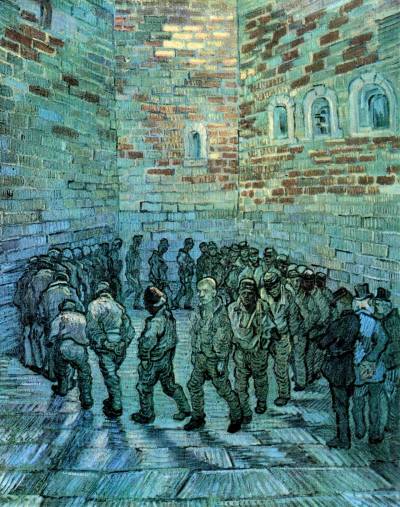
Or maybe to be more accurate, it is like the fevered circling by inmates Van Gogh portrayed in his 1890 painting shown at the top, which, by the way, was a copy of an earlier Gustave Doré print. The prisoners are no doubt dreaming of finding their way a better place or state of being. They probably go through a wide range of emotions as they are reflecting on their pasts, trying to figure out how they ended up there or where they will be in the future.
There is probably some pretty creative thinking going on there. Maybe the minds of those ever-circling inmates in prisons and asylums– or donkeys– are not far-removed from those of artists?
I can’t say. Nor can I say whether this endless circling masquerading as a search is good or bad. It is all I know so, for me, it feels appropriate. Built in.
Got to run. I have to try to find something new here this morning. Don’t know if it will feel more like a studio, prison or asylum. Doesn’t matter– it’s the same circle.
Here’s a song that feels appropriate this morning. This is Will It Go Round in Circlesfrom the late Billy Preston.
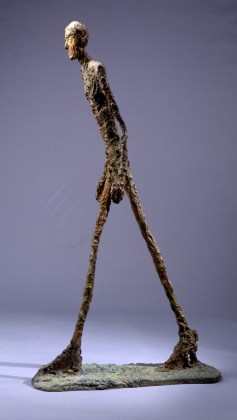
Artistically I am still a child with a whole life ahead of me to discover and create. I want something, but I won’t know what it is until I succeed in doing it.
–Alberto Giacometti
The short statement above from the late artist Alberto Giacometti perfectly captures a feeling that has been with me for a long time now.
Now well into middle age, I have been a professional painter now for over twenty-five years and have did okay with my career in art. I pretty much do what I want, earn a living, get some recognition here and there and have established my own little niche with my work.
It’s a decent place to be at this point in my career and a lot of young artists would love to be in my position.
But most days, even when I feel the tiredness from the wear and tear of the years weighing on me physically, I still feel new to this whole art thing, like I have just scratched the surface with my work. As Giacometti points out, I feel like there is a whole life, an endless horizon, ahead of me that is filled with all sorts of new possibilities.
New forms, new expressions, new inspirations, new voices and more– all yet unseen and unknown. Just something.
And again, like Giacometti, I feel a huge gnawing desire to find that something but don’t have a clue as to what it might yet be.
That was the same feeling that I had when I was first experimenting with painting years ago. I had a hazy vision in the recesses of my mind that I wanted to pull out but didn’t truly know what it was or what it might look like until it had emerged. When it did finally come out, I instantly recognized it for what it was and what it could mean for me. I ran with the inspiration from it for many years.
But at some point during these years, I began to sense that another vision of the same sort resides somewhere down there in my mind, one that had yet to be found. One that I won’t know until it comes out.
So, though I am a sometimes-tired middle-aged guy, I know that I am still a child artistically, one who still sees the whole wide world and all its potential before him.
I work and wait in anticipation that this child’s voice will someday be heard.
The post above ran a few years back. But it speaks to a thought I’ve had for a while.
At my Gallery Talk at the Principle Gallery last year, I joked that art is tough and not for weaklings, saying, “Look at what it’s done to me– I’m only 27 years old.” I don’t know that I followed up with a proper explanation of what I was trying to say with the joke which is that while my body may show the years, the creative part of my mind still feels young and vital. Everything often feels new, much like it felt when first started painting, back around 1994.
In a way, that time when I had the accident that started this whole thing feels like my second birthdate.
So, I was wrong with my joke. I’m not 27. I’m 30.
But I do still feel 27. Some days, even younger. Maybe 17.
And that’s a good thing because as the Frank Sinatra song below says: Fairytales can come true, they can happen to you, if you’re young at art.
Okay, I took a little liberty with the lyric. What do I know? After all, I’m just a kid…
As wave is driven by wave And each, pursued, pursues the wave ahead, So time flies on and follows, flies, and follows, Always, for ever and new. What was before Is left behind; what never was is now; And every passing moment is renewed.
–Ovid, Metamorphoses
It will come as no surprise to anyone who has reached a certain age that time seems to speed up as your life goes one. When you were a kid time seemed dense and infinite. Waiting a week or a month or, god forbid, a year for anything was excruciating as the minutes and hours seemed to move along like molasses in a frozen hourglass.
But as the years stack up behind you, the passage of time accelerates at an ever-increasing rate. Maybe it’s because we finally realize how limited and precious time is for any of us, after having whiled away so much of the time allotted to us.
I came to expect this speeding up of time as was aging. Could see it happening. But nothing prepared me for how much time has accelerated in these past few years. Maybe it’s because of the pandemic. I don’t know. But I bring up something that I think has occurred a year or two back and so often discover that it was five or six years in the past.
It seems so fresh, so recent– how could that time just slipped by unnoticed?
As always, I don’t really know. I guess it doesn’t matter outside of serving as a reminder of how rare and valuable our time in this world remains.
Perhaps it is our built-in memento mori.
Just an observation. And not an original one, at that. Just saying stuff this morning. That being said, here’s a song that sums it all up. It’s Funny How Time Slips Away, the classic song from Willie Nelson. I don’t know that anyone does it better than Willie but this performance from Leon Bridges is wonderful. It feels elegant in the way it treats every moment of the song as precious as time itself.
Whenever we encounter a human being in such a way that we feel absolutely certain of the infinity of that person’s worth and the eternity of his or her life, that is Easter.
–Eugen Drewermann, Dying We Live: Meditations for Lent and Easter
Can’t say that I am a religious person, religion never being much of a part of my upbringing. I never attended a single Easter service and pretty much thought of the day in terms of chocolate Easter bunnies and colored eggs in my youth. But I respected the traditions and stories of the Bible and of the other religions as I picked them up through the years and understood the solemnity and importance of faith, even if my own was sometimes lacking. Christ’s resurrection as a metaphor for change and rebirth in one’s own life always resonated with me, much like the sentiment expressed above from German theologian Eugen Drewermann.
That being said, I thought I might play a little music this morning that had to do with the fact that it is Easter Sunday.
I have always been drawn to and moved by the passion and conviction of the great gospel songs especially when performed by those blessed with the talent to elevate the material, such as Mahalia Jackson, Sister Rosetta Tharpe, and all so many others. Sam Cooke, one of the greatest pop and R & B stars of the 50’s and early 60’s, was also a great gospel singer. I loved his voice and could listen to him sing the phone book but when he sang the gospel, it was often magic. Here’s his version of Were You There (When They Crucified My Lord),which is an old plantation spiritual that fits in with the day and, performed by Sam Cooke is as I said, magic.
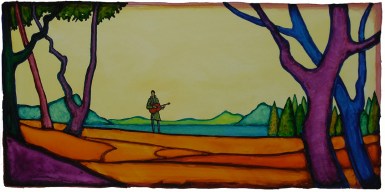
The post above is most a replay from back in 2014. I added the passage from Eugen Drewermann and added one of my early paintings from the 1995-96 series, Exiles.






 Redtree Times