Simplicity is the final achievement. After one has conquered all the difficulties, after one has played a vast quantity of notes and more notes, it is simplicity that emerges as the crowning reward of art.
–Frédéric Chopin
Simple isn’t as easy as it looks.
I’ve said this before here. But, as Chopin noted, it should be the ultimate goal. To say the most with the least. To pare away clutter then magnifying and strengthening what is left.
That was my starting point years ago when I first began painting. I believed that if I took the same amount of care with each square inch of a piece, regardless of what it was or where it fell in the picture plane, every bit of that painting would have its own visual impact, its own important role to play. Thus, the painting would come alive.
It was in the attention given–in the texture or the quality,richness, and complexity of the color, for example– not in the detail or subject.
That thought allowed many very simple compositions to come alive.
It seems easy enough, doesn’t it?
The problem is that it seems so self-evident that sometimes it gets lost in the shuffle. Clutter comes back in the form of extraneous detail that doesn’t add anything and, even worse, clouds what is meant to be heard or seen.
Why? I can’t say with any certainty. Maybe the same naive confidence that was the driving force has changed and one begins to doubt their abilities? Maybe one builds a fortress with detail as a shield.
Or maybe it’s because simplicity sometimes requires the artist to say all that needs to be said with only a few of the tools that they have worked so hard to acquire over the years. If you have these tools, why not use them?
Getting back to Chopin, that would be like an accomplished pianist feeling the need to play as many notes and chords that they could fit into every piece.
That just makes for clutter and disharmony.
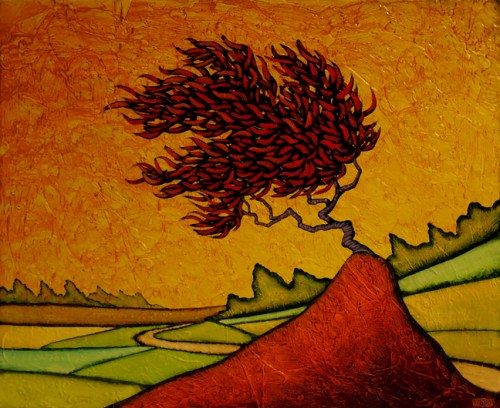
I am using a piece from 2014, Blaze, at the top to illustrate this post. It’s another one of those pieces that never found a home. For me, this might be the most frustrating of these pieces because it checks so many boxes for me, including the need for simplicity. In recent weeks, I have been spending some time looking at it, especially the parts of it that might seem less important to the casual viewer. I get so much delight in these parts of this painting because they have as much visual impact as the central figure of Red Tree.
Simplicity.
Let’s finish this off with some Chopin. You saw that coming, right? This is Vladimir Horowitz playing Chopin’s Polonaise in A flat major op.53. Not being a classical pianist, I can’t tell you if this adheres to Chopin’s thoughts on simplicity. But it is a good way to kick off a Thursday morning. We’ll leave it at that.
If your determination is fixed, I do not counsel you to despair. Few things are impossible to diligence and skill. Great works are performed not by strength, but perseverance.
—Samuel Johnson, The Prince of Abissinia, 1775
The painting shown here, Persevere (Face the Wind), is about 21 years old and has lived in my studio for most of that time. It was a conscious decision to keep it, Cheri having claimed it before it ever left the studio. It has remained a favorite for both of us over the years.
It’s a large piece, at 32″ wide by 52″ high. Being on paper, it matted and under glass which makes it seem even larger. It is formidable on the wall and, for me, in its meaning.
The idea of the singular tree willing to stand alone in the face of wind and weather, unwilling to conform, is, a powerful symbol for me as someone who never felt like nor wanted to be part of the crowd.
I wanted my thoughts and choices to be my own, not dictated by social or peer pressure. To stand alone, willing to hold tight against the winds of opinion or criticism. That might be as close to the true meaning of the Red Tree for myself as I have given.
Just thought I’d share this piece this morning as it is seldom seen and has such meaning for myself. It also makes me want to work large on paper again. I often worked in large scale on paper in the earlier part of my career but haven’t worked that way in years.
Also, the idea of perseverance in the face of what seems sometimes like an overwhelming wind of hate and crazy is something that reasonable people need to hold to these days. Hang on, folks.
Here’s a song in that vein from Brittany Howard and the Alabama Shakes that I have shared a couple of times over the years. It very much goes with the Red Tree here. Here’s Hold On.
Upon closer observation, it becomes apparent that every strong upsurge of power in the public sphere, be it of a political or of a religious nature, infects a large part of humankind with stupidity. It would even seem that this is virtually a sociological-psychological law. The power of the one needs the stupidity of the other.
–Dietrich Bonhoeffer, Letters and Papers from Prison
One of the most popular posts from this blog is one from 2017 called On Stupidity. It is about Dietrich Bonhoeffer and an essay he wrote from a German prison during World War II on the nature and danger of stupidity. I don’t know about you, but I often feel as though we are experiencing the Golden Age of Stupidity at this moment. It sometimes that there is almost a celebration or glorification of willful stupidity taking place, one that defies all reason.
It’s vexing, to say the least. And deadly dangerous, at its worst. It feels like this essay needs to be shared once more so that reasonable people can better understand what faces them. I have also added a video at the bottom that illustrates many of Bonhoeffer’s thoughts on the stupidity that drives movements. Worth a few minutes of your time.
From 2017:
I have written a number of times here about the events that are taking place in this country and my frustration at how little effect reasoning and factual evidence have on the followers of the current president [ note: this was the former twice impeached president in 2017]. Their stubborn stupidity seems impenetrable to even the most glaring truths. I am sure that there are many of them out there who still, faced with an ever-expanding list of acts of malfeasance, refuse to see anything other than a conspiracy against the leader of their cult.
It turns out that this phenomenon is nothing new. It is probably found in every major movement based on political power or religion. One of the most enlightening essays on the subject of the stupidity of the followers of movements came to us in a letter written in a German prison during World War II by theologian and anti-Nazi dissident Dietrich Bonhoeffer. The quote shown is from that essay.
Dietrich Bonhoeffer was a pastor and theological writer who stood in direct opposition to the Nazi regime and spoke out against its programs of euthanasia and genocide. He had an opportunity to stay in the US in the late 1930’s, safe from the reach of the Nazis, but he insisted on returning, believing that if he were to rebuild the German church in the war’s aftermath he must endure it with its people.
He was imprisoned in a German prison in 1943 and later transferred to a concentration camp. He was implicated in a plot to assassinate Hitler and he was hanged in the waning days of the war, in April of 1945.
Dietrich Bonhoeffer’s story is most interesting. His writings live on and have had great influence on the generations that followed his abbreviated life. One of the terms he also coined was cheap grace which also has great meaning today. I’ve included an apt description of this at the bottom of this page.
The following essay is taken from a letter written while in captivity. I urge you to read it. It may help you understand better your own frustration with what you see today. And if you are one of those who fail to see what seems so clearly evident to most people, perhaps you should read it then ask yourself how you allowed yourself to be swept up in this grand wave of stupidity.
Here is what Bonhoeffer wrote on stupidity from his prison cell:
‘Stupidity is a more dangerous enemy of the good than malice. One may protest against evil; it can be exposed and, if need be, prevented by use of force. Evil always carries within itself the germ of its own subversion in that it leaves behind in human beings at least a sense of unease. Against stupidity we are defenseless. Neither protests nor the use of force accomplish anything here; reasons fall on deaf ears; facts that contradict one’s prejudgment simply need not be believed- in such moments the stupid person even becomes critical – and when facts are irrefutable they are just pushed aside as inconsequential, as incidental. In all this the stupid person, in contrast to the malicious one, is utterly self-satisfied and, being easily irritated, becomes dangerous by going on the attack. For that reason, greater caution is called for than with a malicious one. Never again will we try to persuade the stupid person with reasons, for it is senseless and dangerous.
‘If we want to know how to get the better of stupidity, we must seek to understand its nature. This much is certain, that it is in essence not an intellectual defect but a human one. There are human beings who are of remarkably agile intellect yet stupid, and others who are intellectually quite dull yet anything but stupid. We discover this to our surprise in particular situations. The impression one gains is not so much that stupidity is a congenital defect, but that, under certain circumstances, people are made stupid or that they allow this to happen to them. We note further that people who have isolated themselves from others or who lives in solitude manifest this defect less frequently than individuals or groups of people inclined or condemned to sociability. And so it would seem that stupidity is perhaps less a psychological than a sociological problem. It is a particular form of the impact of historical circumstances on human beings, a psychological concomitant of certain external conditions. Upon closer observation, it becomes apparent that every strong upsurge of power in the public sphere, be it of a political or of a religious nature, infects a large part of humankind with stupidity. It would even seem that this is virtually a sociological-psychological law. The power of the one needs the stupidity of the other.The process at work here is not that particular human capacities, for instance, the intellect, suddenly atrophy or fail. Instead, it seems that under the overwhelming impact of rising power, humans are deprived of their inner independence, and, more or less consciously, give up establishing an autonomous position toward the emerging circumstances. The fact that the stupid person is often stubborn must not blind us to the fact that he is not independent. In conversation with him, one virtually feels that one is dealing not at all with a person, but with slogans, catchwords and the like that have taken possession of him. He is under a spell, blinded, misused, and abused in his very being. Having thus become a mindless tool, the stupid person will also be capable of any evil and at the same time incapable of seeing that it is evil. This is where the danger of diabolical misuse lurks, for it is this that can once and for all destroy human beings.
‘Yet at this very point it becomes quite clear that only an act of liberation, not instruction, can overcome stupidity. Here we must come to terms with the fact that in must cases a genuine internal liberation becomes possible only when external liberation has preceded it. Until then we must abandon all attempts to convince the stupid person. This state of affairs explains why in such circumstances our attempts to know what ‘the people’ really think are in vain and why, under these circumstances, this question is so irrelevant for the person who is thinking and acting responsibly. The word of the Bible that the fear of God is the beginning of wisdom declares that the internal liberation of human beings to live the responsible life before God is the only genuine way to overcome stupidity.
‘But these thoughts about stupidity also offer consolation in that they utterly forbid us to consider the majority of people to be stupid in every circumstance. It really will depend on whether those in power expect more from peoples’ stupidity. than from their inner independence and wisdom.’
-Dietrich Bonhoeffer, from ‘After Ten Years’ in Letters and Papers from Prison (Dietrich Bonhoeffer Works/English, vol. 8) Minneapolis, MN: Fortress Press, 2010
Cheap Grace-
“But there is another, uniquely religious aspect that also comes into play: the predilection of fundamentalist denominations to believe in practice, even if not entirely in theory, in the doctrine of “cheap grace,” a derisive term coined by the theologian Dietrich Bonhoeffer. By that he meant the inclination of some religious adherents to believe that once they had been “saved,” not only would all past sins be wiped away, but future ones, too—so one could pretty much behave as before. Cheap grace is a divine get-out-of-jail-free card. Hence, the tendency of the religious base of the Republican Party to cut some slack for the peccadilloes of candidates who claim to have been washed in the blood of the Lamb and reborn to a new and more Christian life. The religious right is willing to overlook a politician’s individual foibles, no matter how poor an example he or she may make, if they publicly identify with fundamentalist values.”
Restored, a bicycle fleshed With power, and tore off Up Highway 106, continually Drunk on the wind in my mouth, Wringing the handlebar for speed, Wild to be wreckage forever.
—James Dickey, Cherrylog Road
Looking around for a song to play this week’s Sunday Morning Music, I realized I wanted to hear 1952 Vincent Black Lightningfrom Richard Thompson. It’s a wonderfully written and performed song. Doing a quick search I found that I hadn’t played it here in well over a decade. Time to break it out again. Listening to it again reminded me of a post from back in 2009 about a childhood memory about a hill climb. Here’s that post followed by the song:
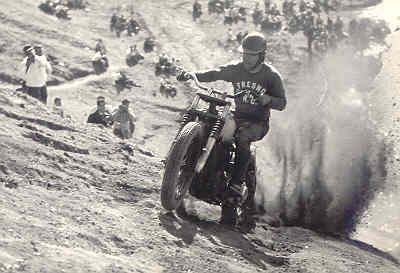
It was in the mid-60’s and I was no older than eight years old when I accompanied my uncles and father to a hill climb on a steep hillside outside of Corning. The whole idea of a hill climb is to see who could conquer the sharp rise of the hill while staying aboard their motorcycles without flying off and sliding (or rather, tumbling) back to the bottom of the hill. It seemed kind of crazy and dangerous, even to a kid.
It was a hot summer day filled with sun and the field at the base of the hill was littered with all sorts of bikes, mostly pared down iron monsters from the 50’s. There were Lincolns, Indians and BSA’s, all having that throaty sound like chainsaw noise filtered through a big cardboard tube, making it echo and somewhat rounder in sound. I don’t know if that description makes sense but the sound was so different that the high squeals of modern bikes racing down the highway.
It’s a sound that makes my skin crawl now but was pleasing to a kid enthralled by the sound and fury of the spectacle of that day.
One after another guys in leather pants and armless denim jackets, most without helmets, would get a running start at the bottom of the steep decline and fire upward, trying to find the line that would take them to the top. Dirt flying, undulating back and forth as their bikes belched fire, they climbed higher and higher above the crowd only to come to an even steeper point in the hill.
Gunning it, they would dive into the rise. Many would suddenly flip to one side or another, their bikes stalling out as they dug their legs into the ground trying to not start rolling down the hill. An unfortunate few didn’t get to do this instead flipping over backwards and tumbling a good portion of the way down the hill.
Believe me when I say that it was pretty cool thing, speaking as a kid.
But the part that remains with me most from that day were the motorcycle gangs that were all through the crowd watching. I was awestruck watching these people. They were unlike anything I had seen at this point in my life. The group next to us was gang out of Detroit, the name of which had evaded my memory over the many years. Scorpions? I can’t quite remember the image on their jacket backs.
Most were bearded and filthy, dressed in black leather or grimy denim covered with writing and patches. Some had bike chains worn like military braids. The thing that caught my eye were the animal paws that hung like medals from their jackets. Were those dog paws? One looked like a lion’s paw, for chrissakes!
This was in the days before pop-tops of any type on beer cans. To open a can you had to use a can opener that tore a triangular hole on the can top. They would open a can with can openers that hung from many of their jackets and would drink the beer by holding the can at arm’s length and let the beer sail through air to their waiting gobs. Nobody I knew drank beer that way so it caught my attention.
But perhaps the most vivid memory from that day was of a biker lady. She had hair that was bleached to a pale yellow-white, a color I had never seen before. She fascinated me as I stood staring at her from about eight feet away. She was wearing worn leather pants and a black and only a black bra with white polka dots as a top. She wore dark rimmed sunglasses and held a can of beer as she looked up at the hill. It was, again, a new look for me and I took advantage to register the memory.
There was no trouble that day and I didn’t leave with bad memories of those people, although I was still a little worried about those paws. Over the years whenever I’d see a biker wearing his colors I flash back to that summer day in ’66 or ’67 and that biker lady in her polka dot bra.
Fortune’s Smile— At Principle Gallery, Alexandria VA
Give fools their gold, and knaves their power; Let fortune’s bubbles rise and fall; Who sows a field, or trains a flower, Or plants a tree, is more than all.
For he who blesses most is blest; And God and man shall own his worth Who toils to leave as his bequest An added beauty to the earth.
— John Greenleaf Whittier, from A Song of Harvest
As one gets older, worries pop up about what becomes of those things we have accumulated once we are no more. They might have meaning or value for us but mean little, if anything, to others. Will they continue to have the same meaning and value once they are left behind?
Are they a legacy or a burden? A gift or garbage?
The thought made me think of the old Aesop’s Fable of the Old Man and the Three Young Men. It’s a parable that is present in similar forms in the stories of many cultures, one that points out that when we seed the future with flowers and trees, we do it as much for the future that exists without us as we do for ourselves in the near future.
It’s something to keep in mind. It’s never too late to work on that legacy.
Here’s the Aesop version of the tale followed by Pass It On from Bob Marley & The Wailers. Good stuff…
AS AN OLD MAN was planting a tree, three young men came along and began to make sport of him, saying: “It shows your foolishness to be planting a tree at your age. The tree cannot bear fruit for many years, while you must very soon die. What is the use of your wasting your time in providing pleasure to others to share long after you are dead?”
The old man stopped in his labor and replied: Others before me provided for my happiness, and it is my duty to provide for those who shall come after me. As for life, who is sure of it for a day? You may all die before me.
The old man’s words came true; one of the young men went on a voyage at sea and was drowned, another went to war and was shot, and the third fell from a tree and broke his neck.
Moral: We should not think wholly of ourselves, and we should remember that life is uncertain.
There are no rules. That is how art is born, how breakthroughs happen. Go against the rules or ignore the rules. That is what invention is about.
–Helen Frankenthaler
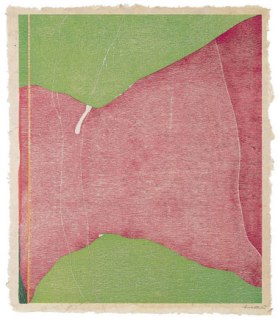
I remember reading about Helen Frankenthaler, the famed Abstract Expressionist, when I was first beginning to really paint with purpose. In an article that I read but can’t locate now, she spoke of how she came to her trademark stain paintings where very thinned oil paint is applied to unprimed canvas. She said it was almost by accident that she first experienced the absorbing of the paint by the raw cotton canvas and how that it caused a reaction, a breakthrough, in her thinking about how she wanted to express herself within her work.
Helen Frankenthaler -Sirocco
She felt that all artistic breakthroughs were the result of a change in the way one saw and used their materials. It could entail changing the type of material used or using them in a more unconventional manner, as her above quote stating there are no rules infers.
This immediately clicked with me at the time I read it. I had been trying to shape my way of thinking to fit the materials I was using at the time. Unsuccessfully. What I needed to do was change the materials to fit the way I was thinking. To allow my thought process greater free rein and not cater to the restraints of materials.
That may sound kind of abstract but it allowed me to start working with my paints and grounds in a much different way, forming my own process that worked well for my way of thinking and has become entrenched in my thought process. Even though it may be outside more traditional forms of using these same materials, this process has over time become as rigid in my use as the techniques used by the most steadfast adherent of the most traditional school of painting.
You reach a certain point, a mastery of your materials, where there are few accidents, few surprises in the materials’ reactions and, as a result, fewer surprises in your own reactions.
You have reached an endpoint, a culmination.
For most, this is the goal. But I want that surprise, that not knowing exactly how the materials will react and that need to solve the problem presented by the need to express with the limitations of the materials used.
So, I try to continually tweak, to create a little tension and uncertainty in how the materials react to my use of them, to create a sense of surprise.
Because that’s where the breakthroughs dwell…
This post first ran back in 2010. I ran it again a few years later when I had the honor of having my work hang alongside Frankenthaler’s work in an exhibit at the U.S. Embassy in Kuwait. Though my work didn’t echo hers in any way– her breakthroughs were hers alone as were mine–her words certainly shaped how I viewed my work.
Once in a blue moon Somethin’ good comes along Once in a blue moon Every thing’s not goin’ wrong
— Van Morrison, Once in a Blue Moon
Have lots on my plate this morning so wasn’t going to post anything today. But I thought I at least needed to note that today is February 29th.
Leap Day.
That odd extra day that pops up every four years, offering us hopes that it will inject some special oomph into the doldrums of winter. It usually doesn’t meet our expectations but the anticipation and hope it offers are its real thing. It’s up to us to take advantage of the opportunity given by this bonus day.
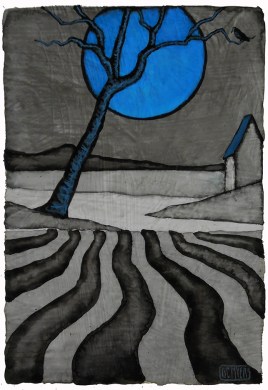
For some reason, I equated Leap Day with the idea of a Blue Moon. I guess it’s that both are relatively rare occurrences that offer us a chance for something new. Whatever the case, let’s listen to a Van Morrison tune, Once in a Blue Moon, from back in 2003. I am somewhat torn about Van Morrison. I have long heard accounts of him being an egomaniacal dick but his descent into the world of conspiracy theory in recent years had me wondering if I could indeed separate the art from the artist. Personal feelings aside on his conduct and opinions, his work has often been marvelous throughout a very long career.
Hitherto I have used the words imperfect and perfect merely to distinguish between work grossly unskillful, and work executed with average precision and science; and I have been pleading that any degree of unskillfulness should be admitted, so only that the labourer’s mind had room for expression. But, accurately speaking, no good work whatever can be perfect and the demand for perfection is always a sign of a misunderstanding of the ends of art.
This for two reasons, both based on everlasting laws. The first, that no great man ever stops working till he has reached his point of failure: that is to say, his mind is always far in advance of his powers of execution, and the latter will now and then give way in trying to follow it; besides that he will always give to the inferior portions of his work only such Inferior attention as they require; and according to his greatness he becomes so accustomed to the feeling of dissatisfaction with the best he can do, that in moments of lassitude or anger with himself he will not care though the beholder be dissatisfied also. I believe there has only been one man who would not acknowledge this necessity, and strove always to reach perfection, Leonardo; the end of his vain effort being merely that he would take ten years to a picture, and leave it unfinished. And therefore, if we are to have great men working at all, or less men doing their best, the work will be imperfect, however beautiful. Of human work none but what is bad can be perfect, in its own bad way.
The second reason is, that imperfection is in some sort essential to all that we know of life. It is the sign of life in a mortal body, that is to say, of a state of progress and change. Nothing that lives is, or can be, rigidly perfect; part of it is decaying, part nascent. The foxglove blossom, — a third part bud, a third part past, a third part in full bloom, — is a type of the life of this world. And in all things that live there are certain irregularities and deficiencies which are not only signs of life, but sources of beauty. No human face is exactly the same in its lines on each side, no leaf perfect in its lobes, no branch in its symmetry. All admit irregularity as they imply change; and to banish imperfection is to destroy expression, to check exertion, to paralyze vitality. All things are literally better, lovelier, and more beloved for the imperfections which have been divinely appointed, that the law of human life may be Effort, and the law of human judgment, Mercy.
–John Ruskin, On the Nature of Gothic Architecture: And Herein of the True Functions of the Workman in Art
I have written many times here about the importance of imperfection in my work, about how perfection is a false state of being as far as art is concerned. The wonderful passage above from John Ruskin very much summarizes many of my thoughts on the subject. There are a number of lines in these paragraphs that resonate with me, especially that imperfection in some sort is essential to all that we know of life. and the idea that every organism is in a transitory state of constant decay and rebirth.
The perfection is in the imperfection.
Don’t know if I have ever mentioned him here before but John Ruskin (1819-1900) was one of the most influential people of the 19th century. He was a writer, philosopher, art historian, art critic and polymath, as well as a highly talented painter. He wrote on subjects as varied as geology, architecture, myth, ornithology, literature, education, botany and political economy. His writings on art and architecture have resonated for generations, exerting great influence on artists, writers, aesthetic movements, architects, critics, etc.
Art historian Kenneth Clark summarized Ruskin’s writings on art and architecture into the streamlined list of eight features shown below. I always felt, based on the era in which he worked and from reading some of his earlier writings, that Ruskin’s thoughts on art might not fit in with my own views. But the more I read on and from Ruskin and the scope of the creators influenced by Ruskin, I was pleasantly surprised. Most of the items on this list very much align with my thoughts and he even describes, in a way, the need for the organic feel in a work, that idea that I often refer to as a ‘sense of rightness.‘
If you’re interested in art, it’s worth taking a few moments to read.
Art is not a matter of taste, but involves the whole man. Whether in making or perceiving a work of art, we bring to bear on it feeling, intellect, morals, knowledge, memory, and every other human capacity, all focused in a flash on a single point. Aesthetic man is a concept as false and dehumanising as economic man.
Even the most superior mind and the most powerful imagination must found itself on facts, which must be recognised for what they are. The imagination will often reshape them in a way which the prosaic mind cannot understand; but this recreation will be based on facts, not on formulas or illusions.
These facts must be perceived by the senses, or felt; not learnt.
The greatest artists and schools of art have believed it their duty to impart vital truths, not only about the facts of vision, but about religion and the conduct of life.
Beauty of form is revealed in organisms which have developed perfectly according to their laws of growth, and so give, in his own words, ‘the appearance of felicitous fulfilment of function.’
This fulfilment of function depends on all parts of an organism cohering and co-operating. This was what he called the ‘Law of Help,’ one of Ruskin’s fundamental beliefs, extending from nature and art to society.
Good art is done with enjoyment. The artist must feel that, within certain reasonable limits, he is free, that he is wanted by society, and that the ideas he is asked to express are true and important.
Great art is the expression of epochs where people are united by a common faith and a common purpose, accept their laws, believe in their leaders, and take aserious view of human destiny.
Whoso would be a man, must be a nonconformist. He who would gather immortal palms must not be hindered by the name of goodness, but must explore it if it be goodness. Nothing is at last sacred but the integrity of your own mind. Absolve you to yourself, and you shall have the suffrage of the world.
–Ralph Waldo Emerson, Self-Reliance
I came across an article that discussed the parallels between Ralph Waldo Emerson’s description of self-reliance and the music of Prince. As odd as it sounds, it was a convincing argument, stating that the freedom needed to create requires the type of non-conformity and self-reliance that Prince possessed.
And that probably holds true for any artist. The artist has to be willing to stand alone, eschewing the impositions of society and going where they need to go in order to reach their artistic vision. And, in doing so, not needing the affirmation or approval of others.
Emerson put it this way:
We are such lovers of self-reliance, that we excuse in a man many sins, if he will show us a complete satisfaction in his position, which asks no leave to be, of mine, or any man’s good opinion.
I am not going into this very deeply. Just a quick thought that made sense to me this morning. Let’s listen to a song from Prince that very much lines up with Emerson’s words. You see it in this verse:
Don’t talk if it’s against the rules Just walk away and be a fool That’s what they want ya to do So you got to walk like you want to make it Don’t walk like you just can’t take it Go on and walk on any side you like Don’t walk wherever they tell you to, psyche The sun will shine upon you one day If you’re always walkin’ your way
Give a listen if you’re so inclined. Not a bad way to kick off a Tuesday morning. Good stuff…
And if you can’t shape your life the way you want, at least try as much as you can not to degrade it by too much contact with the world, by too much activity and talk.
Try not to degrade it by dragging it along, taking it around and exposing it so often to the daily silliness of social events and parties, until it comes to seem a boring hanger-on.
— Constantine Cavafy, As Much as You Can
Constantine P. Cavafy (1863-1933) was a Greek poet who lived his entire life in Alexandria, Egypt. His work often captured the sensual and exotic cosmopolitan feel of that city and that time. Readers of Lawrence Durrell and his Alexandria Quartet, in which Cavafy appears as a character, will well know that feel of which he wrote.
Though Cavafy was known for his poetry among the Greek community in Alexandria he spent most of his life working as civil servant. He didn’t actively seek widespread acclaim, turning down opportunities to have his work published while often opting to print broadsheets of his poetry that were distributed to only a few friends. His work didn’t realize wider acclaim until later in his life (and afterwards) when his friend, novelist E.M.Forster, wrote about his work, describing him as a Greek gentleman in a straw hat, standing absolutely motionless at a slight angle to the universe.
I think that’s a marvelous description– standing absolutely motionless at a slight angle to the universe. It gives an image of one being slightly askew from the rest of the world. And that is what the poem at the top is somewhat about– in not contaminating the uniqueness of yourself are by overexposing it in meaningless ways.
As someone who often feels a bit askew, this sounds like sound advice to me. That being said, I will now leave before I become too much of a boring hanger-on.








 Redtree Times