Feeds:
Posts
Comments

Archive for the ‘Uncategorized’ Category

Wintry Wyeth

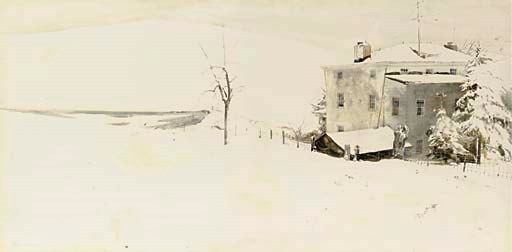
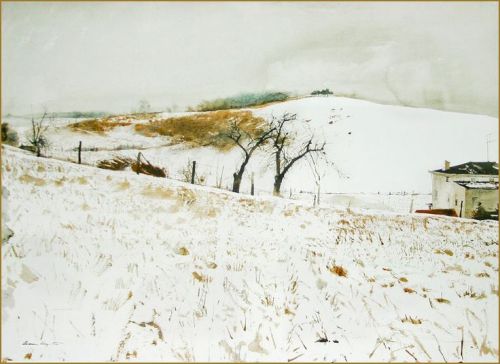
Andrew Wyeth Fence Line 1967

Andrew Wyeth – Fence Line 1967


I prefer winter and fall, when you feel the bone structure of the landscape – the loneliness of it, the dead feeling of winter. Something waits beneath it, the whole story doesn’t show.

Andrew Wyeth


This post ran several years ago. We have yet to feel the true blast of winter here which is fine. However, my feelings on the winter landscape are very much in line with those of Andrew Wyeth. I like that the cold of winter drives most others inside, taking their noise and busyness with them. The stillness and the dark exposed bones of the trees creates that dead feeling as Wyeth puts it.

It reminds me of why I like walking in cemeteries, especially empty ones. As in winter, there’s a peaceful hush over everything. It feels unhurried. And why not? Nobody there is going anywhere. Nor do they have appointments or deadlines.

But the mystery remains. Who were these people? What gave them joy? What stories are buried with them, never to be told again?

It adds a bit of a melancholic edge to the stones and trees.

That feeling certainly permeates Wyeth’s winter scenes. I thought it was worth looking at them again until the snow finally comes to my part of the world.


Andrew Wyeth – Over the Hill 1953

Andrew Wyeth- Heavy Snow

Andrew Wyeth- Not Plowed 1985

Andrew Wyeth- Farm Pond Study

Read Full Post »

Vivaldi’s Winter

GC Myers- Moonlight Quartet, 2023

Moonlight Quartet–At West End Gallery


Winter

Allegro non molto

To tremble from cold in the icy snow,
In the harsh breath of a horrid wind;
To run, stamping one’s feet every moment,
Our teeth chattering in the extreme cold

Largo

Before the fire to pass peaceful,
Contented days while the rain outside pours down.

Allegro

We tread the icy path slowly and cautiously,
for fear of tripping and falling.
Then turn abruptly, slip, crash on the ground and,
rising, hasten on across the ice lest it cracks up.
We feel the chill north winds course through the home
despite the locked and bolted doors…
this is winter, which nonetheless
brings its own delights.

— Antonio Vivaldi


Just want to share a little Vivaldi today. Here’s the Winter segment from his best-known work, the Four Seasons. Vivaldi also composed four separate sonnets for this work to give the listener a better idea of the feeling he was trying to evoke in each of the seasons. The sonnet for Winter is shown above.

This performance of the Winter portion is on instruments of the period in Vivaldi composed the piece. It is performed by renowned violinist Cynthia Miller Freivogel and the Baroque music group, Voices of Music. I played this piece here several years back but it felt right this morning.


Read Full Post »

Room to Breathe

GC Myers- Room to Breathe

Room to Breathe, 2010


Each for himself, we all sustain
The durance of our ghostly pain;
Then to Elysium we repair,
The few, and breathe this blissful air.

–Virgil, The Aeneid, ca 25 BC


Got a bunch of stuff to get to this morning but wanted to share a favorite piece from the studio. Room to Breathe, shown above, has been around since 2010, making the gallery rounds and somehow always coming back to me.

That it returned always surprised me since it was one of those pieces that felt very close to me in spirit. Maybe I shouldn’t be surprised. Maybe it was too narrow in its definition. I don’t know. I will never be able to fully describe why one painting appeals more than any other to anyone other than myself.

For me, it’s the feel of this painting that captures me. It is not joyful nor is it despairing in tone. It just is as it is, accepting of the present moment, freed from both the past and the future. The Red Tree here stands apart. I t symbolizes, for me, my mantra request to the universe: Just let me be. I don’t want to be bothered nor do I want to bother anyone. 

As a result, there is a placid calmness in this painting for me. I can’t tell you how many times I have stopped to take in this painting and felt as though I’d absorbed a healthy dose of that calmness as I looked. It helps me when things start to get hectic, when I feel hurried and out of sorts.

Like right this very moment. Got to run.

Anyway, thought I’d share it along with some words from old Virgil and an old song from The Hollies that seems to be the final piece in my little jigsaw puzzle this morning. Here’s The Air That I Breathe.


Read Full Post »


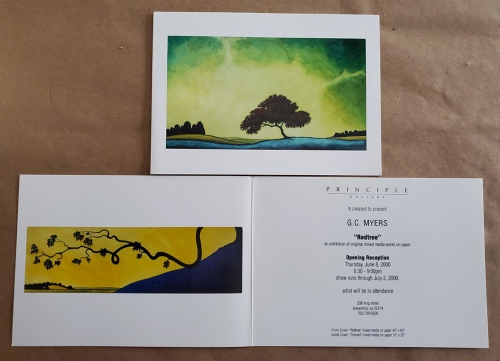
2000 Redtree show Inivte  GC Myers

Principle Gallery Redtree Invitation, 2000


Fogeydom is the last bastion of the bore and reminiscence is its anthem. It is futile to want the old days back, but that doesn’t mean one should ignore the lessons of the visitable past.

–Paul Theroux, Remember the Cicadas and the Stars?


Don’t mean to be an old fogey but the following does have a reminiscence. However, it does have a lesson. Or so I think. Let’s begin this way:

It’s that time of the year when I finally get to some home and studio repairs and maintenance. Much of my days are spent on the several projects on my list, some of which have been waiting for well over a decade. Maybe even two decades. Who’s counting at this point?

One of the projects was a small one, organizing a cupboard filed with old show invitations along with magazines and books that feature my work. It was a pleasant stroll down Memory Lane going through the many invitations, seeing both the differences and similarities down through the years. Some really jumped out at me and some were much more understated.

But one made me stop for a bit to consider it. It was an invitation from my first solo show at the Principle Gallery in Alexandria from June,2000. It was the show that formally introduced the Red Tree to the world and was simply titled Redtree. I was still using it as one word then though I don’t recall ever consciously changing it.

As I said, it made me stop for a few moments to let a wave of memories wash over me. It was an important show for me then and now. It was a nerve-wracking experience since it was my first real experience in carrying a solo show in a regular gallery and I saw it as possibly my one and only chance to exhibit on such a large stage. A bad show would have devastated me and I knew it. After all, I was only several years removed from the darkest period of my life, the memories of which were still fresh. I knew I was fortunate to have such an opportunity so soon and needed it to succeed more than I would ever admit at the time.

Fortunately, Lady Luck was on my side. I am not going to go into the details right now, but it was wildly successful night with a whirlwind of people for which I was totally unprepared. When the last person finally left the gallery and the door was locked, Michele and the rest of the gallery staff and I stopped and looked at each other for a ripe moment. I remember saying, “What the hell just happened?”

As I said, it was an important show for me. It gave me a degree of confidence that I was lacking and set the table for years ahead. More importantly, it tattooed the Red Tree on me and I have carried it ever since.

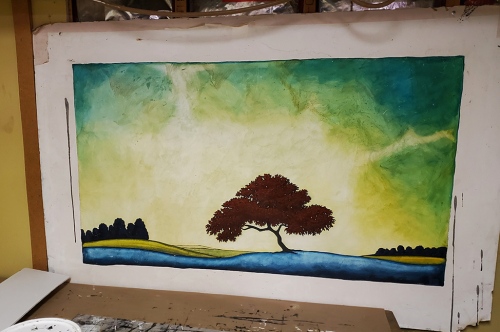
All this and more as I looked at the old invitation. The painting on its cover was titled Redtree, of course. Seeing this reminded me of its sad history. It was a large oil painting on mounted paper that framed out at 40″ high by 60″ wide under glass. It sold to a collector from Wisconsin and in shipment was severely damaged. When the painting came back to me, I could hear the mounds of shards of glass shifting in the crate. There were slashes and holes throughout the surface of painting. It was not repairable. Fortunately, it was insured but the loss of the painting that symbolized that show hurt a bit.

The painting still lives with me now. It was in a box in my old studio for years, even as the old studio began to fall down. I finally brought it down and pulled it out. It is a bit grimy and the red of the tree is less vibrant. It now hangs in a work area of my basement where I stain frames. It is attached to the wall at one end of the space, used to cover some exposed waste lines going out of the basement.

It might seem a sad end for a piece that has meant so much for me. I don’t see it that way. I see it as a lesson for a life. Though it had its day in the sun and was admired by many, it has taken a beating and has the scars to show for it. It exists now in much more humble surroundings than it was originally destined for.

But it serves a purpose and more than that, it endures. On good days, its strength and beauty still outshine its scratches, scars, and scuffs. And looking over at it now when I am working down there makes me smile, even if it is a bittersweet one at that.

I can relate to it and I believe it can relate to me. We’re pretty much alike.

It also reminds me that this coming year’s show at the Principle Gallery will be the 25th anniversary of that show. It’s hard for me to fathom because in a lot of ways I still feel like that untested guy with shaky nerves before that first show.  I am excited for this year’s show and am frantically running concepts and such through my head for the work that will be in it.

It’s pretty much the same feeling as it was back in 2000. Some things never change.

Like the Redtree, they endure.
Redtree 2000 sm

The Redtree as it is today.

Read Full Post »
GC Myers-- The Attuning

The Attuning– Part of Small Works at Principle Gallery


Hope is a diagnostic human trait, and this simple cortex symptom seems to be a prime factor in our inspection of our universe. For hope implies a change from a present bad condition to a future better one. The slave hopes for freedom, the weary man for rest, the hungry for food. And the feeders of hope, economic and religious, have from these simple strivings of dissatisfaction managed to create a world picture which is very hard to escape. Man grows toward perfection; animals grow toward man; bad grows toward good; and down toward up, until our little mechanism, hope, achieved in ourselves probably to cushion the shock of thought, manages to warp our whole world.

Probably when our species developed the trick of memory and with it the counterbalancing projection called “the future,” this shock-absorber, hope, had to be included in the series, else the species would have destroyed itself in despair. For if ever any man were deeply and unconsciously sure that his future would be no better than his past, he might deeply wish to cease to live.

In saying that hope cushions the shock of experience, that one trait balances the directionalism of another, a teleology is implied, unless one know or feel or think that we are here, and that without this balance, hope, our species in its blind mutation might have joined many, many others in extinction.

–John Steinbeck, Log From the Sea of Cortez


In 1940, John Steinbeck took part in a 6-week scientific marine expedition with his good friend and marine biologist, Ed Ricketts. The purpose was to collect and collect marine specimens from the Gulf of California, also known as the Sea of Cortez. The book is a journal of the trip along and much of it is gleaned from Rickett’s trip diaries. Ricketts, who died in a car/train crash in 1948, had a lot of influence on the thinking and philosophy of Steinbeck. Much of it shows up in this book.

I was struck by the passage above, with its representation of our lengthy memory as a mutation of our species. With the knowledge that we have a long history comes the realization that we have a future and with that, the hope for a chance to improve our condition.

Speaking from a scientific perspective, Steinbeck/Ricketts suggests that hope is an inborn survival mechanism of humans and has been the propelling force for all progress, as well as the one trait we possess that has kept us from going extinct. Our awareness of the past and our dissatisfaction with the present drive us to strive for betterment in the future.

Hope.

There is another section that describes how hope is also a strong indicator of our incompleteness as a species. Turns out, we are a far from final product. Who’da thunk?

We have made our mark on the world, but we have really done nothing that the trees and creeping plants, ice and erosion, cannot remove in a fairly short time… In spite of overwhelming evidence to the contrary, the trait of hope still controls the future… Man in his thinking or reverie status admires the progression toward extinction, but in the unthinking stimulus which really activates him he tends toward survival. Perhaps no other animal is so torn between alternatives. Man might be described fairly adequately, if simply, as a two-legged paradox. He has never become accustomed to the tragic miracle of consciousness. Perhaps… his species is not set, has not jelled, but is still in a state of becoming.

As one who often feels far from complete and still in a state of becoming, it gives one a lot of fuel for thought. Hope for the future and awareness of the past as counterbalances for survival are themes in much of my work. And thinking.

I have to point out that this is a very short and incomplete rehashing of a completer and more superior article from Maria Popova and her marvelous blog, The Marginalian. Please check it out and become a subscriber. Really good stuff. It will give you valuable knowledge along with a healthy dose of hope and awareness.

And we know that is already part of us, right?

Read Full Post »

Baldwin: Change the World

GC Myers- Three Sides to the Story- 2023

Three Sides to the Story— At West End Gallery


The bottom line is this: You write in order to change the world, knowing perfectly well that you probably can’t, but also knowing that literature is indispensable to the world. The world changes according to the way people see it, and if you alter, even by a millimeter, the way people look at reality, then you can change it…If there is no moral question, there is no reason to write. I’m an old-fashioned writer and, despite the odds, I want to change the world.

—James Baldwin, New York Times, September 23, 1979


Another one of those passages from someone who works in a creative field other than my own that pretty much translates to many other fields. I think that anyone who take a creative path in their life probably feels that they have something unique to offer the world.

But do many of these people think in terms of changing the world with their work?

That’s a tough question. I think anyone, given the choice between changing or not changing the world with their work, would choose to have it do so. To not change the world in any way means that you didn’t touch anyone with that part of you that you share.

And nobody wants that.

So, you go ahead with your work with the hope that you will somehow change the world, knowing that it probably will not cause a tidal wave of change. At best, any change will be like a small ripple in the ocean. As Baldwin says, almost immeasurable and imperceptible.

But changing even one person’s perception of their world is not a small thing. Change occurs in these small ripples, in incremental measures that push us in one way or another. It’s when we give up, when we decide to not add our tiny ripple to the enormity of the ocean, that we are adrift and subject to uncontrollable waves.

So, we keep doing what we do despite the seeming impossible nature of the task. Most likely we will fail but so long as we try the chance for change remains.

Got to read this one again. It’s 5:30 in the morning, after all. Not even sure if this is not one of those dreams where the logic seems impeccable until you wake up and ask yourself what the hell you were thinking.

While I decide, here’s a song about the uncertainty surrounding your ability to change the world. It’s a longtime favorite from Ten Years After, the British blues rock band from the 60’s & 70’s with singer/guitarist Alvin Lee at the helm. Though I love the sound and general message in this song, I have always been just a little put off by the last line of its chorus:

I’d love to change the worldBut I don’t know what to doSo I’ll leave it up to you

So I’ll leave it up to you… To me, that feels like giving up and allowing others to dictate what the future will be. I understand that so many of us, including the singer in this song, feel powerless to affect change. It can be a daunting task. But as Baldwin says, just changing the way people– even one– see the world can create change.

So do what you do. Try.

Okay, it’s 5:40 AM now– time to wake up…


Read Full Post »


GC Myers-  A Song For the Eye

A Song For the Eye— At West End Gallery

That’s the only song I wrote in one sitting. The melody I had worked on for some time. I didn’t really know what the song was. I remember that my mother had liked it.

Then I was in Edmonton, which is one of our largest northern cities, and there was a snowstorm and I found myself in a vestibule with two young hitch-hiking women who didn’t have a place to stay. I invited them back to my little hotel room and there was a big double bed and they went to sleep in it immediately. They were exhausted by the storm and cold. And I sat in this stuffed chair inside the window beside the Saskatchewan River. And while they were sleeping I wrote the lyrics. And that never happened to me before. And I think it must be wonderful to be that kind of writer. It must be wonderful.

–Leonard Cohen, on writing the song Sisters of Mercy


There’s a great website, Blank on Blank, with a blog and videos of bits of interviews with notable folks from the last 50 or 60 years that have been rediscovered. They present them in short and entertaining animated videos. I featured one here several years ago with Ray Bradbury.

I came across one of their videos this morning about Leonard Cohen telling the story of how he came to write his song, Sisters of Mercy, in Edmonton in 1966. There are conflicting accounts online of his time there but his telling of the song’s origin in a 1974 interview is entertaining, nonetheless. It begins with his reading of a poem, Two Went to Sleep, that he had composed twenty years before, sometime in the mid-1950s. The animation of the poem pairs well with his telling of the Sisters of Mercy.

Thought I’d share the Blank on Blank video along with his song, Sisters of Mercy. Take a look at the Blank on Blank site, if you get a chance. Sme interesting and diverse thinking there.


Read Full Post »


GC Myers- Placidarium sm

Placidarium— Now at Principle Gallery, Alexandria VA

Are you distracted by outward cares? Then allow yourself a space of quiet wherein you can add to your knowledge of the Good and learn to curb your restlessness. Nowhere can a man find a quieter or more untroubled retreat than in his own soul. Avail yourself often, then, of this retirement, and so continually renew yourself.

–Marcus Aurelius, Meditations


This painting, Placidarium, a 12″ by 12″ canvas, is currently at the Principle Gallery for its annual Small Works show.

The title came from the feeling it gave me as though the scene existed in some sort of terrarium or aquarium, separate and apart from the worries and troubles of the outside world. It’s a piece that has long been a favorite since it has lived with me and it has never failed to elicit that same feeling of placidity for me.

It has a secure and serene stillness that often evades us here in the outside of the placidarium.

Here’s this week’s Sunday Morning Music to go along with this painting and Marcus Aurelius‘ advice. It is the Rhiannon Giddens performance of the Dolly Parton classic first released in 1969, the beautifully written Don’t Let It Trouble Your Mind. It’s a lovely version and I could easily hear this song playing in my own placidarium.


Read Full Post »


Dreams come true; without that possibility, nature would not incite us to have them.

-John Updike, Self-Consciousness: Memoirs (1989)


It’s another Small Business Saturday, that Saturday after Thanksgiving when people are urged to go out into their communities and shop in locally owned small businesses. It’s one of the best ways to keep your local community vibrant and alive. The money spent for the most part stays local and multiplies many times as it radiates out into the community.

It can be a huge economic engine for the small businesspeople in your local area.

But it is also something more– it is the sustaining lifeblood for a multitude of dreams. Every local small business represents the fulfillment of a dream of someone in your area. It required that someone believed in an idea or ability that they possessed and then risked something– often everything– in putting themselves out there in front of their friends and neighbors.

It can be a gigantic gamble where failure can sometimes mean financial ruin, public humiliation, and lifelong dreams being forever crushed.

But you can look at that risk as the only chance you might get at following your dreams. A chance to finally be the person you once imagined yourself being. Even the humblest small business is the realization of a dream for someone.

And anyone’s dream is a big deal, in my opinion.

I am an artist and a small businessperson, as is every working artist and artisan. We don’t like to talk about it as a business, of course, but after the making of the art it is that thing that keeps our dreams alive. Our dreams and our livelihoods depend on people dealing with us or the local shops and galleries that carry our work– all small businesses.

Small but consequential.

Every gallery I work with provides income for at least 50-80 artists and artisans. That’s 50-80 dreams fulfilled in each gallery.

And, again, that’s a big deal.

I’ve been extremely fortunate to have my dream kept alive for the past 28 or so years. And I have those dream-enablers at the galleries that represent me as well as the many of you out there who have supported my work to thank for that. As much as I might like to think I achieved anything on my own, my dream has been dependent on so many people.

Like anyone with a dream of following their passion, it has meant the world to me. I would love to see many others achieve their own unique dreams in the same way.

So, help them out if you can. I am not asking you to buy locally as a charitable act. View it as more of an investment in your neighbors and your community and an act of humanity in that you are feeding someone’s dream. Whatever you might purchase from a small local business — be it a painting, a cup of coffee, a piece of clothing or pottery, a cupcake, or any of the many things made and sold in your area–is your first dividend on that investment. It is money well spent.

And to those of you out there with a dream who have yet to find the nerve to take the leap, I urge you to follow your dreams. Sure, it might be hard and you might fall on your face. That’s a given. But keep in mind that there is always the possibility of achieving your dream only if you take that leap.

You don’t want to be one of those people who go through life saying, “What if?” At least if you fail, you have the chance to chase another dream.

That is, of course, a perfect segue into a song from Bruce Springsteen. In the early 1980’s, Bruce often performed his take on the Elvis Presley title song from his 1962 movie, Follow That Dream. He slowed the tempo and it was barely discernible as the same song. A few years later, he altered it even more, changing the lyrics and chorus to the point that it basically a different song that he still performs occasionally. But in both, he still delivers the same message from the original in a potent way. The rendition below is from a live performance at Wembley Stadium in June of 1981.


FYI: The painting at the top is titled Endless Possiibility. I think it goes well with today’s subject of following your dreams. It is available at one of my favorite small businesses, the West End Gallery. If you’re in Corning on this Small Business Saturday, please stop in and take a look around.


Read Full Post »

Carnival


GC Myers- Carnival  2023

Carnival— Now at Principle Gallery Alexandria

Carnival is not a spectacle seen by the people; they live in it, and everyone participates because its very idea embraces all the people. While carnival lasts, there is no other life outside it. During carnival time life is subject only to its laws, that is, the laws of its own freedom. It has a universal spirit; it is a special condition of the entire world, of the world’s revival and renewal, in which all take part.

–Mikhail Bakhtin, Rabelais and His World (1965)


This is a new small painting, 4 by 6 inches on paper, that is now at the Principle Gallery in Alexandria, VA. It is included in the upcoming Small Works show, which opens next Saturday, December 2.

After I had finished this little guy, I struggled with its title a bit. It has a feel that can take you in a lot of different directions. I finally settled on highlighting the joy I saw in it, that feeling of simply celebrating one’s existence and unique place in the universe.

That brought me to Carnival.

Carnival is, as most of you know, the celebration of earthly pleasures that takes place before the abstention of such things during Lent. It is a time of revelry when social standing, profession, caste, age– any identifying title that separates us into narrower slices– is set aside. Masks and costumes are donned to maintain an anonymity that separates one’s regular life from one’s life in the Carnival. The unity of the crowd is part of Carnival.

We’ve applied the term Carnival to other non-religiously aligned celebrations. However, the traveling carnival with its midway filled with sideshows, games of chance, burlesque and plenty of food and drink is very much in the same spirit. One sheds their outside status once they enter the carnival grounds and they simply become part of the surging crowd.

I can see this applying to this painting. We stand on the mounds we build or find ourselves on. But there are moments of clarity and joy when we realize that, while we celebrate our individuality, we are forever an equal part of something far greater and more powerful than ourselves– a spiritual state of universality where all the titles, status, accumulated wealth and notoriety of this world are worthless.

I would like to think we need to maintain our individuality and uniqueness while still recognizing the meaning we find in shedding that identity to be part of the Carnival every so often.

That’s a lot of weight for a small and simple painting. But I think it can carry the weight.

Here’s a song from The Band, that seems to be ready-made for this painting. With lines like: We’re all in the same boat ready to float off the edge of the world, how can it not fit? Here’s their Life Is a Carnival.


Read Full Post »

« Newer Posts - Older Posts »