Feeds:
Posts
Comments

Archive for the ‘Uncategorized’ Category

Competition

Bradford County-  GC Myers ca 1994

Bradford County– GC Myers, 1994


When we are in competition with ourselves, and match our todays against our yesterdays, we derive encouragement from past misfortunes and blemishes. Moreover, the competition with ourselves leaves unimpaired our benevolence toward our fellow men.

–Eric Hoffer, The Passionate State of Mind (1955)


I love this passage from my favorite autodidact, Eric Hoffer.  As someone who I would consider a competitive person throughout much of my life, I can tell you that life is much simpler and easy when you begin competing only with yourself.

It’s true in life and especially true as an artist.

Early on in, when I first began showing my work and was still developing my artistic voice, everything was a competition. I was constantly comparing and judging my work against that of other artists. And since art is a forever thing, this meant that I was putting myself in competition with all artists. And not just the local, not just the person in the next town over who did lovely watercolors. No, it was a competition with artists everywhere, every corner of the globe

And not just the living contemporary artists. No, it was competition with every living and dead person who ever smeared something on a surface to express some emotion. It was a competition that went from every artist today going back to the first time that early man put his handprint on a cave wall.

I have mentioned here before that early on in my career I had read that author John Irving, when going into a bookstore, saw every book in there, as well as every book ever written, as being his competition. He viewed his task as a writer as being the equivalent of being an Olympic athlete competing against the very best the world has to offer. That meant, he would have to practice his craft with all the dedication and focus of an Olympian.

I took that to heart then and believed that If I worked long and hard, I could compete with anyone. That was probably a good thing at that point in that it gave me the focus and discipline that I needed, as well as a sense of urgency. Without these things, I doubt I would have developed much beyond what the level at which I began.

But while it was beneficial from that perspective, it was also often disheartening. Going to galleries and museums back then, while I usually left with some bit of inspiration, often left me discouraged. All I could see was what I couldn’t or didn’t do with my own work.

And never would.

As a result, I felt bad about my own work then. And I sometimes even resented the talents of those artists I was viewing, much to my chagrin. I found myself disappointed both as an artist and a human being.

And that feeling was hard to live with.

However, these feelings did make me push myself even a bit harder to refine my voice as an artist. It was both bad and good.

So, I worked while harboring these feelings until years when I began to understand that this perceived competition with others only existed in my mind. Yes, it had served a purpose for me at the time, but it was no longer needed.

I could now fully enjoy the works of others without comparing their work to mine. Getting rid of the competitive envy that I had carried for so long felt great. Liberating. 

However, I found that I was still competitive but now it was only a wrestling match with myself. It is much like Hoffer put it, a competition pitting my todays against my yesterdays. I can now look back at the failures and misfortunes, as Hoffer put it, of my earlier work and see where I have grown in many ways.

It is both encouraging and inspiring, even when I find myself cringing at some of those early pieces. More than that, it is a much healthier form of competition. I no longer feel that I am competing with anyone. Not with any contemporary artist, not the Modernists nor the Impressionists nor anyone going back to that prehistoric artist, Thag, in his cave admiring the bull he has just painted. He certainly was not worried about competition.

Plus, competing only with myself and not with all of history has an upside. It still provides enough competition that it spurs me to want to work harder, to delve deeper with my work.

To be better today than I was yesterday or twenty years ago.

That, I can live with…


The painting at the top is from before I began showing my work, one of those pieces I often revisit. I wrote about this piece, Bradford County, here on the blog back in 2011.

Read Full Post »

Testimony


GC Myers-Silent Eye of Night 2023

Silent Eye of Night– At West End Gallery

Testimony is an integral part of the Black religious tradition. It is the occasion where the believer stands before the community of faith in order to give account of the hope that is in him or her.

–James H. Cone, My Soul Looks Back (1986)


Wasn’t planning on writing today, only sharing some music. However, I came across the piece below, Testimony, from the Kronos Quartet and the passage above from Black theologian James H. Cone (1938-2018). Both made me think more than I was planning on this morning.

First, the composition Testimony was composed by Charlton Singleton, a wonderfully talented Grammy-winning trumpeter/composer/arranger whose home base is in and around Charleston, SC.

He was chosen to be part of the Fifty for the Future project from the Kronos Quartet/Kronos Performing Arts Association which establishes an online library of 50 commissioned works from 25 male and 25 female composers. These pieces will make up an online learning library that will have the scores and parts, recordings, and other learning materials for each composition. Developed for youth groups and schools, the site is free of charge and available to all.

While listening to Singleton’s piece I began to search for something related to the word testimony. I came across the words at the top from James H. Cone. I was struck by how he put the idea of religious testimony as being one’s public declaration of hope.

I saw this as being similar to the creation of a work of art. A piece of art is the result of a belief in the meaning and purpose of each of us as individual beings, as well as a belief that we all in some way echo into the future. Showing that work to others is indeed a public declaration of this belief.

Hmm. Got to mull that over for a while. While we are doing that, give a listen to Charlton Singleton’s Testimony as performed by the Kronos Quartet. Feels like the perfect fit for this week’s Sunday Morning Music.


Read Full Post »

No Man’s Land

meuse-argonne-american-cemetery-rows

Meuse-Argonne American Cemetery, France


Ah young Willie McBride, I can’t help wonder why
Do those that lie here know why did they die?
And did they believe when they answered the cause
Did they really believe that this war would end wars?
Well the sorrow, the suffering, the glory, the pain
The killing and dying, were all done in vain
For young Willie McBride, it all happened again
And again, and again, and again, and again

Eric Bogle, No Man’s Land (Green Fields of France)


Another Armistice Day.

We observe the day now as Veteran’s Day or Remembrance Day, as it’s known in some other countries. It is now a day that recognizes the service of all veterans, living and dead. But originally it was observed to commemorate the armistice signed on the “eleventh hour of the eleventh day of the eleventh month” of 1918 which marked the end of combat in World War I.

The end of The Great War.

The War to End All Wars.

If only.

Unfortunately, we humans have short memories and a poor grasp of history. The Great War was but a prelude to another World War and in the years since, there have been a multitude of other wars, invasions, genocides and ethnic cleansings.

They seem to always begin with an act of aggression based on greed, ego, or some kind of racial, religious, or ethnic hatred. One nation envies what another nation possesses. One leader desires more power and self-enrichment. People, spurred on by manipulative leaders, feel threatened by the existence of others, those who don’t share their race or religion or social beliefs.

It seems so long as we live in a world ruled by the greed, envy and fear of those who lead the nations of this world, war will always be near at hand.

It will remain a sometimes necessary evil until men stop exploiting other men.

And as such, the continued service and sacrifice of young men and women will be required.

Today is a day to honor those who serve and or have served their duty to this and other countries.

It is a day to remember how much has been given to us, the living, and how much has been taken from those who sacrificed their futures for the living.

A day to remind us all how fragile this world is and how each new war dishonors the veterans of the past and makes their sacrifice seem to have been made in vain.

Take a moment from your day and give it some thought. It is the least we can do.

The song featured today is from 1976 and was written by the Scottish Australian singer Eric Bogle. It is titled No Man’s Land and is also known as Green Fields of France. It tells the story of young soldier named Willie McBride who died in World War I. It was inspired by Bogle’s visits to the battlefield graveyards in Flanders and Northern France, such as the one shown at the top of the page. It is a song that has been recorded by numerous artists but I chose this version from the Dropkick Murphys. Just feels right.


This post ran several years back. With the current conflicts raging around the world, it seems appropriate for today.


Read Full Post »

In Still Wonder


GC Myers- In Still Wonder

In Still Wonder – At Principle Gallery, Alexandria

Philosophy, if it cannot answer so many questions as we could wish, has at least the power of asking questions which increase the interest of the world, and show the strangeness and wonder lying just below the surface even in the commonest things of daily life.

–Bertrand Russell, The Problems of Philosophy (1912)


I like this passage from Bertrand Russell. Though it deals with philosophy, I find myself applying it to art as well. For one thing, art often allows us to see the wonder that is present in the ordinary. Some of the most powerful and moving works of art revolve around common things, the artist imbuing them with a quality that enhances the wonder of their singularity.

I have also found that art, like philosophy, often provides more questions than answers. We often think of art as making declarative statements. And some does just that in a very straightforward way.

But there is also the work that stirs us a bit deeper. We see the apparent beauty but also see something beyond that surface appearance, something that brings forth emotions that belie what is in front of us. It sparks memories from our past experiences along with glimpses of our hopes and fears for the future. It transports us into the timeless world of wonder where it is always in the present moment.

The Now.

And in the stillness of The Now, questions arise that may have long simmered beneath our own surface, questions that we have not had time to even recognize in the past.

The answers to these questions may not be apparent in the work of art from which they sprung. There may not be an answer at all. But maybe just being made aware of the wonder of our existence by these questions is their sole purpose.

Art, like philosophy, leads to a deeper questioning which perhaps opens us up to finding that sense wonder that exists in the ordinary, transporting us to The Ever-present Now.

Sound good to me but what do I know?

Maybe sometimes a painting is just a painting and a cigar is just a cigar. The smoke is in the eyes of the beholder?

Read Full Post »

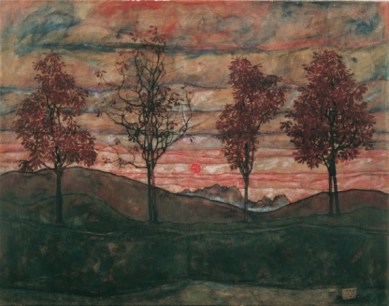
Schiele Vier Baume

Egon Schiele- Vier Baume ( Four Trees)


I must see new things and investigate them. I want to taste dark water and see crackling trees and wild winds.

–Egon Schiele


There was a John Mellencamp album from 1990, Big Daddy, that had a song with the line:” Henry sent a postcard from a better place…”  There’s something in that line that has stuck in my memory far more than the original song. In my head, the line transformed into a simple send me postcards from better place and always comes to mind when I receive a postcard from friends or family. I thought of it yesterday when I received this postcard from a friend that I know through my paintings who now lives in Slovakia.

It’s an image of the painting Vier Baume (shown above) from the great Austrian painter Egon Schiele whose work has always captivated me. He saw it while visiting the Belvedere Museum in Vienna and it reminded him of my paintings, joking that this Schiele guy must have been influenced by GC Myers. His mother, a lovely woman who I know and who was visiting with him there, added the line, “If only he’d thought to put a red chair in the tree!”  Gave me a chuckle.

One of the great perks of doing my job is having my work connect with people and have them tell me of how they are reminded of this at different times in their travels. I posted a photo here last year that was given to me at a gallery talk by a man who was on a boat off the coast of Venezuela when he spotted a tiny island with a single twisted tree atop it.  It reminded him of one of my paintings and he was kind enough to snap a photo of it for me. 

These little gestures mean an awful lot to me as small validations of the strength and voice of the work. When I’m painting in the solitude of my studio, I can only hope that the piece I’m at work on will have such an impact to make someone far removed think of it beyond the moment when they actually see it.  There’s something oddly comforting to me in this thought. 

Perhaps the postcards sent are because these folks view my painting as a sort of postcard from a better place?

Who knows?


I thought I’d revive this post from back in 2011 to share a couple of other “postcards from better places” that grace my studio courtesy of some friends who saw something out there in the world that reminded them of my work. They are my little treasures. I can’t tell you how often my eyes fall on these pieces, making me smile. The Red Tree on the left is courtesy of Stacy Spier and Jeff Snyder while the piece on the right with the bare tree with the furrowed rows in the foreground is from Stevan Knapp.

Don’t know that these images do them justice. Believe me when I say that they have great impact for me.

Below them is the song, Theo and Weird Henry, from John Mellencamp referred to in the original post.


Read Full Post »

GC Myers  Radiance and Shadow

Radiance and Shadow


And now here is my secret, a very simple secret: it is only with the heart that one can see rightly, what is essential is invisible to the eye.

Antoine de Saint-Exupery, The Little Prince


I have long held the belief that art is about revelation, about making the invisible visible.

Creating the intangibles such as hope and wonder. Or awe or a sense of belonging or of self-empowerment or so many other feelings and emotions. Revealing these unseen intangibles is what art can and should do.

It’s a lofty and often evasive goal. The harder one tries specifically to do just that, to create these intangibles, the further one moves from that goal.

In my experience, it only happens when you can release yourself into the work, letting your mind focus on each element in each moment. Finding the rhythm and voice, one individual moment at a time. One stroke, one line, leads to the next and if you allow yourself to follow the guidance being given by what is in front of you, slowly the gap between the visible and the invisible closes, that gap suddenly filled with an emotion, a feeling that gives voice to the work.

This particular painting, Radiance and Shadow, fits into that idea for me, filling me with the wonder I get from a full moon’s light on a snow-covered landscape. The way the light is cast on the reflective snow creates a sense of something new in the familiar. The scene you’ve witnessed day after day takes on a different feel, filled with a paradoxical sense of mystery and revelation that comes from new shadows and new light.

You can almost sense the quiet as all sound is hushed and absorbed by the snow. It’s a quiet that reminds you of the stillness that you imagine your ancestors knew well in earlier times when there was less extraneous sound in world with fewer people and machines. And from that quiet a feeling of peacefulness and security arises to accompany that initial sense of wonder.

And suddenly the simple arrangement of paint and lines and shapes becomes something more. Complete and a thing unto itself. The intangible made tangible.

And that in itself becomes a wonder to me…


This post first ran again about this time six years back. I changed out the painting at the top for one that now hangs in my studio. I am also adding a piece of music that fits the tone of this post and the painting. It is titled Quietude. It was written by harpist/composer Carlos Salzedo (1885-1961) and is performed here by Judy Loman.


Read Full Post »

GC Myers- Blaze  2014

GC Myers- Blaze, 2014


In everyone’s life, at some time, our inner fire goes out. It is then burst into flame by an encounter with another human being. We should all be thankful for those people who rekindle the inner spirit.

–Albert Schweitzer, Memoirs of Childhood and Youth (1925)


I was looking at the painting above, Blaze, here in the studio the other day. I do that quite often with this particular piece, probably more than any painting that has returned to me after spending time out in the galleries.

It has a life force that seems to speak to me as clearly and directly as any piece. I guess that shouldn’t come as a surprise since it is my painting.

It should speak clearly and directly to me, right?

Well, not necessarily. As I have pointed out before, every painting takes on its own spirit and even though they originate within me, they sometimes end up dwelling well beyond me. I don’t know that I can explain that in a coherent fashion. It’s more gut feeling than intellectual thought. Hard to explain one’s gut feelings.

I’ve shared this 2014 painting a couple of times here before and each time have included the words above from Albert Schweitzer. It occurred to me that this painting might in some way act as a surrogate for those people who have rekindled my own inner spirit, as Schweitzer put it.

Maybe that is the thing within it that so draws me to it?

Maybe. I don’t know.

I also came across another passage from Schweitzer that might apply here as well:

All art speaks in signs and symbols. No one can explain how it happens that the artist can waken to life in us the existence that he has seen and lives through. No artistic speech is the adequate expression of what it represents; its vital force comes from what is unspoken in it.

Hmm. Something to think about.

Here’s a song that might adequately fill out today’s triad of word, image and music. The song is way beyond adequate, a favorite that I’ve played a few times over the years. Here’s Higher Ground from the great Stevie Wonder.

It’s sure to rekindle your fire. How could it not, with a chorus like this:

I’m so darn glad He let me try it again‘Cause my last time on earth, I lived a whole world of sinI’m so glad that I know more than I knew thenGonna keep on tryin’‘Til I reach my highest ground

Now, get out of here. Go find your own higher ground…


Read Full Post »

Cleanup In Aisle 6

GC Myers- Imitatio

Imitatio – At the West End Gallery


“… Mr. Bankman-Fried said: “I’m very skeptical of books. I don’t want to say no book is ever worth reading, but I actually do believe something pretty close to that.” He didn’t like movies, either.

It’s impossible to read the sad saga of Mr. Bankman-Fried without thinking he, and many of those around him, would have been better off if they had spent less time at math camp and more time in English class. Sometimes in books, the characters find their moral compass; in the best books, the reader does, too.”

–David Streitfeld, NY Times, Sam Bankman-Fried’s Wild Rise and Abrupt Crash, Nov. 3, 2023


I had several questions come up yesterday that I thought deserved a couple of minutes this morning. A little Monday morning cleanup, if you will.

The first came from an article in the NY Times that gave an outline of the crash of crypto-criminal Sam Bankman-Fried. It was the paragraphs above that caught my eye and gave rise to a question. The writer of the article, David Streitfeld, noted Bankman-Fried’s skepticism of books and that perhaps a better grounding in literature might have established a higher level for his moral compass.

My first question was about Bankman-Fried’s use of the word skepticism. Does he simply not believe in the passing down biographies and stories and such things? Is he just not a fan of the written word?

It irked me enough to grab those paragraphs from the article. I certainly agreed that Bankman-Fried would have benefitted from more time with literature than with the video games that occupied much of his time. I established whatever my moral compass is now and learned many of the lessons of the world that I carry with me from my reading as a child and young adult. Without it, I would be a much different person.

But this article also made me wonder about one’s moral compass.

What is the driving force or objective behind any one person’s moral compass?

It seems that many people’s moral compasses today are driven by self-interest, whatever it takes to get what they want. It’s a very Machiavellian example with the ends justifying the means. I guess you could lump this in with money and power as the drivers of this moral compass.

Others are driven by expedience, in not taking a stance on anything of principle unless it is absolutely necessary. Keep your head down and try to simply ignore the greater outer world.

Some are driven by altruism, wanting to help others. Others by a love of family and friends. Others by a sense of justice. I am sure you or I can come up with a lot more if we take the time.

The question is: What drives your moral compass?

I would imagine that we all have some of each of those above at some given time and circumstance. Maybe that’s the healthy thing here, to have a moral compass with many diverse parts that serve the whole without one becoming too dominant.

For example, we need to have a bit that is self-serving in order to survive and an expedient bit that blocks out some of the things in this world that we cannot control. But we also need a bit of altruism so that we might care for and help others even though they might be unknown to us if only to make the world a bit better. And we need a moral compass based on family and friends so that we can serve as loyal caretakers for those relationships.

One final bit of cleanup, in reference to yesterday’s post, where I wrote about how people would resist a safe remedy for hatred because they have come to view their hatred as a treasured part of their being. It made me think about how those with great belief often have an equal amount of disbelief. The certainty with which they hold to each of these polar opposites leaves little room for any uncertainty or questioning. There is little gray area in which to explore or find new ground. Little nuance, dealing only in absolute terms.

It made me ask myself: What is greater, my sense of belief or disbelief?

I don’t know that there is a right answer. Maybe it varies based on whatever it applies to. Or maybe it can be equal so long as one’s belief/disbelief is based in evidence and facts. Not a belief/disbelief based on only what and how one wants things to be or a blind certainty devoid of facts and evidence.

Of course, I am just spouting now. Turning the clocks back this weekend has me up even earlier than normal and my mind is racing when it might be sleeping.

And this is what you get. Not much of a cleanup. Actually, it might be even more of a mess.

So sorry.

Ah, what else to do on an early Monday morning?

Read Full Post »

None of Us Are Free


GC Myers, Faces Off sm

Faces Off, 2019

“A sickness known as hate. Not a virus, not a microbe, not a germ — but a sickness nonetheless, highly contagious, deadly in its effects. Don’t look for it in the Twilight Zone — look for it in a mirror. Look for it before the light goes out altogether.”

–Rod Serling, Twilight Zone, I Am the Night, 1964


It’s hard to witness, let alone fathom, the level of hatred being displayed around the world at the moment. In every corner of the globe there seems to be a surge of deadly vitriol directed at whatever group represents The Other in that particular place.

It very much feels like the hatred that Rod Serling‘s narrator described as a contagious sickness of at the end of a 1964 Twilight Zone episode has become a true global epidemic.

A pandemic of hatred that makes the Covid virus pale in comparison.

What can be done to end it or even slow its spread?

I surely don’t know and if there is a person who can one day come up with a workable solution, they will be rightly celebrated as the greatest person to ever tread this earth. In my opinion, for what it’s worth, it won’t come from religious figures or politicians or billionaire industrialists or technocrats. They’ve already tried to shape the world to their designs for thousands of years and have little progress to show in the way of alleviating the hatred that engulfs us. In fact, they have seemed to have made the divisions between the various peoples of the planet even deeper and wider.

I think that if a consortium of scientists from around the world were to miraculously discover a single gene within all of us that controlled our hatred and were able to easily remove it without harming us in any way, I don’t believe we would even accept that solution. Too many of have come to covet this sickness, to view it as a treasure, the thing that brings meaning, however twisted and destructive it is, to their lives. These people would gladly keep the infection alive.

I wish I had the answer. I wish you had the answer. I wish anyone anywhere had a way of ridding of us of this sickness that is hatred. Because, like the horrible infection it is, it destroys all things it touches.

Nothing good is born of hatred nor has it ever been. Hatred’s only creation is more hatred. It is a purely destructive force that holds us all captive. So much time and effort is spent in both carrying out this hatred and in fighting against it that many efforts that might enrich the lives of all are swept aside and ignored altogether. Perhaps never to come to fruition.

Just another side effect of the illness.

Until we find an antidote of some sort, none of us are free from the reach of that sickness.

Let’s end it on that line. That brings us to this week’s Sunday Morning Music. The song is None of Us Are Free. It was written in 1993 by the renowned songwriting team of Barry Mann and Cynthia Weil along with Brenda Russell for Ray Charles. The song was later recorded in 2002 by Solomon Burke, a great version that I shared here a couple of years back. But the original below is wonderful, featuring a great horn section and backup vocals along with guitar work from Eric Clapton in a time when the sickness had not yet fully affected him.

Maybe art and music and literature will inoculate us? I don’t know but it can’t hurt…


Read Full Post »

Style Is Character, Again

Georgia O'Keeffe Sky Above Clouds IV

Georgia O’Keeffe- Sky Above Clouds IV, 1965


I recall an August afternoon in Chicago in 1973 when I took my daughter, then seven, to see what Georgia O’Keeffe had done with where she had been. One of the vast O’Keeffe ‘Sky Above Clouds’ canvases floated over the back stairs in the Chicago Art Institute that day, dominating what seemed to be several stories of empty light, and my daughter looked at it once, ran to the landing, and kept on looking. “Who drew it,” she whispered after a while. I told her. “I need to talk to her,” she said finally.

My daughter was making, that day in Chicago, an entirely unconscious but quite basic assumption about people and
the work they do. She was assuming that the glory she saw in the work reflected a glory in its maker, that the painting was the painter as the poem is the poet, that every choice one made alone– every word chosen or rejected, every brush stroke laid down or not laid down– betrayed one’s character. Style is character.

— Joan Didion, Georgia O’Keeffe


This anecdote opens the essay Georgia O’Keeffe that is included in author Joan Didion‘s 1979 book of essays, The White Album. I can only imagine the awe and wonder in the eyes of her daughter along with the many questions it inspired, on seeing O’Keeffe’s huge painting– it’s 8 feet high by 24 feet wide!– in a large open space.

It raises an interesting question: Is style character?

That’s a tough question. I am not positive it holds true for all artists across the spectrum of artistic disciplines but, for the most part, I would like to believe this is true if the style of the artist is genuine and true to their self.

Determining what is genuine and what is contrivance is another question.

I think the reaction of Didion’s daughter is one reliable indicator of authenticity. There is something about the reaction of a child to art that I trust implicitly. Their perception is still unclouded and intuitive and they usually don’t yet feel the need to categorize or rate everything that they come across. They have an ability to see things clearly that I sometimes think we lose in adulthood.

They just react on a gut level, quickly and decisively, to some inner intuitive cues.

In my experience, I generally am most pleased with my own work when it catches the eye or mind of a child. It’s perhaps the purest form of validation, letting me know that the work speaks on a visceral, emotional level.

But is this, the style that speaks to that child, character?

I can’t say for sure. I know a number of artists for which this holds true and I believe it is true in my own case.

Or at least I want to believe that. A person can’t attest to their own authenticity without some form of bias. That puts it out of my hands.

But I hope so. My intention for my work has always been to be transparent and open, for it to be an expression of my character, for better or worse. It is work that is meant to communicate. Or so I hope.

I don’t know that an artist’s work can ever fully mask the strengths or deficiencies contained in their character. Nor should they.

For myself, I am okay with that. I am willing to be judged because I know that few will be as critical of my work and my character as myself.

As Georgia O’Keeffe said:

To create one’s world in any of the arts takes courage.

And don’t we all aspire to have courage?


Running a little behind this morning and something led me to this post from just a couple of years back. Felt right this morning. I’ve added a Dan Fogelberg song, Bones in the Sky, which is about O’Keeffe and her work. It includes plenty images of her paintings as well as many photos of her taken by her husband, the influential photographer Alfred Stieglitz.


Read Full Post »

« Newer Posts - Older Posts »