Feeds:
Posts
Comments

Archive for the ‘Video’ Category

The Spotnicks!

It’s funny how your intent sometimes leads you to some interesting things.  Well, maybe not so much interesting as goofy or kitschy.  I was thinking this morning about a version of a song, the theme from the classic movie The Third Man (great film!), that I had posted on this blog a few years back.  It was from the early ’60’s from an Indonesian guitar band called The Crazy Rockers, a group of which  I was totally unaware. 

 Looking it up this morning, I began to notice all the different versions of this song from many different types of musicians.  There were Gypsybands, which seemed in character with the music.  Jose Feliciano did a guitar version and Herb Alpert and the Tijuana Brass did a horn version.  The Band did a chunky, lumbering version.  There were so many versions, so many takes on the same song.  I began to think this wouldbe an interesting subject to write on– how one composition can be tranlated in so many various ways.

But as I clicked on several versions of The Third Man theme I noticed  something on the side of the YouTube page I was on among the suggested videos.  Spacemen with guitars.  It looked like they were on some early ’60’s TV set.  The Spotnicks.  Looking them up quickly, I found that they were a Swedish band that started in 1961 , gaining popularity throughout Europe for their electric guitar sounds.  They have sold over 18 million records over the last half century and are still performing together. 

That was all interesting but I wondered how they sounded.  I clicked on this video and I was sold.  It’s their version of My Bonnie Lies Over the Ocean and it’s performed in full Spotnicks spaceman regalia.  They seem to be singing the song phonetically which adds to the charm of this wonderful early 60’s period piece. Take a look and behold The Spotnicks


Read Full Post »

I’ve always been drawn to the work of self-taught artists and the way they synthesize their experience into their work, finding forms for their need for expression.  There is a great freeness and rawness to much of the work of self-taught artists, an energy that is so electric that many well trained artists try to capture it in their own work.  Expressionism is pretty much based on this energy.

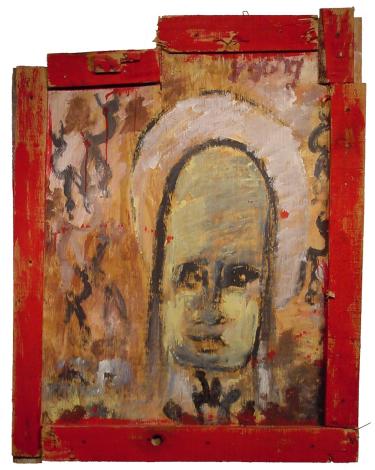
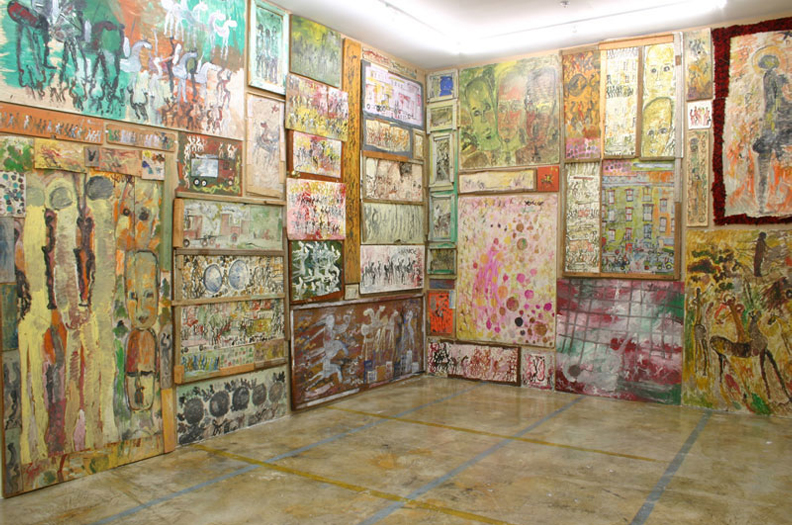
This point is well made in Purvis of Overtown,  a 2006 documentary made about outsider artist Purvis Young who lived his life in the Miami neighborhood called Overtown.  Being not well educated and poor, Young found trouble at an early age and spent time in prison before pursuing the art that led him to some pretty spectacular heights before his death in 2010 at the age of 67, from diabetic complications.  He has said that he was called to his art by a meeting with angels in a dream.

He basically lived much of his life in the warehouses where he painted, sleeping among the accumulated trash and eating junk food.  His whole existence seemed to be driven by his need to create and he produced what appears to be a huge body of work.  The work itself had that electric energy that I wrote of above, a blistering raw qualityand rhythm that marks it as authentic.  It was not a contrivance for Young, not the product of some intellectual exercise.  It was pure emotion and it can’t be replicated through style alone.

Here’s the trailer for the documentary Purvis of Overtown:


Read Full Post »

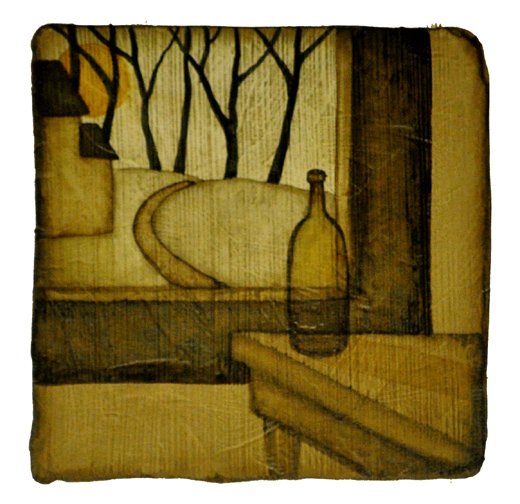
This is a painting I recently finished, a small piece, only 4″ square on paper.  It’s a mix of landscape and very uncomplicated still life with stark but distinct elements throughout.  There’s a simplicity that runs through this scene that covers a depth of feeling, a pang from the heart.

I sat this aside for a day or two after finishing it and found myself coming back to it.  There was a familiar tone to it that reminded me of something that I couldn’t quite identify until this morning when I walked into the studio.  I looked at it as I sat down and instantly said to myself, “Far From Me.”

It was the old John Prine song from his first album which came out forty years back, in 1971. There was something in this piece that filled me the feeling of Prine’s lyrics of gradual loss:

And the sky is black and still now

On the hill where the angels sing

Ain’t it funny how an old broken bottle

Looks just like a diamond ring

But it’s far, far from me

This piece will probably always be that song now for me, a personal avatar for a song buried deep inside and often forgotten.  Funny how things work…

Here’s Far From Me  done by Jamestown Ferry,  a Berlin, Germany based duo who performs Americana music as well as traditional Scotch and Irish music.  It’s a lovely and faithful version.

Read Full Post »

Watching the way the world is reacting to recent economic events brings to mind how connected we have become.  A significant movement in one location causes ripples that move quickly and often forcefully around the globe.  It makes me wonder if thought and consciousness moves in the same way, like a wave of energy that moves around the globe on some unseen grid that surrounds and connects us all.  The universal mind, if you will.

Well, there is a long-term study based at Princeton University called the Global Consciousness Project( also knowns as the EGG Project)  that may be beginning to discern such a thing.  They seek to find if there is a way to detect our collective consciusness, to discover if there is a force that connects our minds.  In 70 locations around the woprld, they have placed random number generators which basically produce high-speed versions of coin flips.  A heads on the coin, to illustrate the point, would show up as a zero and a tails would appear as the number one.  There should be total randomness in these flips. especially over long periods of time.  And especially between the results from the 70 different generators.

However, they have found that when large events occur the results veers from random and takes on an apparent pattern in these machines.  And this same departure doesn’t simply take place at the generator nearest the event but through the whole system, as though they are synchronized.  For example, on 9/11 the machines produced a remarkable synchronicity in their results in the hours before, during and after the event.  These results defied all odds.

Even though this has been going on for many years already, I still don’t think they’ve reached any concrete answers as to causation.  Perhaps they never will.  Perhaps they don’t even know the question to the answers they’re beginning to find.   But it makes you wonder.

Here’s a more in depth explanation fromproject participant Dean Radin:

Read Full Post »

The Giving Tree

Yesterday I received a copy of the classic children’s book The Giving Tree written by the great Shel Silverstein.  It was sent by a friend who had been at the recent gallery talk at the West End Gallery.  I had been asked during the talk if I had ever read the short tale and I said that while I had heard of it, I had never chanced across it .    I was moved when I found it in my mailbox and even more so after reading the simple story of a  boy and a tree and the loving sacrifices made by the tree.

It’s a lovely story and will have a spot of honor on my studio bookshelf.

I used a Shel Silverstein poem, Smart, a couple of years ago on a Father’s Day post and knew of some of his other books and his song A Boy Named Sue that was a favorite of mine growing up.  But I never knew that he wrote so many other well known songs.  For example, I didn’t know that he had written The Unicorn that is the signature song of the Irish Rovers  or The Cover of the Rolling Stone which became an instant classic for Dr. Hook.  He also wrote a couple of lesser known favorites of mine– 25 Minutes To Go for Johnny Cash and Tequila Sheila for Bobby Bare.  A great talent. 

Silverstein died in 1999.  If you’ haven’t read this lovely story, here’s a short film of Shel Silverstein from 1973 reading The Giving Tree with his animated illustrations.

Read Full Post »

Well, my shows are completed and hung but that doesn’t mean my work is done.  Already I am prepping for next year and starting new work, new images based on ideas that arose in the final days before this year’s shows.  On July 28th, I have a gallery talk at the West End and today I’m on the road, taking a swing over to Erie to see my friends at the Kada Gallery to deliver some new pieces and talk over plans for future shows there.  They have shown my work for 15 years now but it seems like it was only yesterday since I first met owners Kathy and Joe.  Great folks.

As I often do on such days, I leave you with a bit of travelling music.  Today, it’s once again Neko Case, a favorite of mine with This Tornado Loves You.  Have a great day!

Read Full Post »

I grew up reading the humor of Jean Shepherd, the man behind the movie, A Christmas Story, now a holiday staple around Christmas.  I remember seeing his books in the library when I was just a teen and being pulled in by the titles, like Wanda Hickey’s Night of Golden Memories and In God We Trust, All Others Pay Cash

Many of Shepherd’s stories about growing up in a small midwestern city were put together for a film in the early 1980’s.  Called The Great American Fourth of July (and Other Disasters), it was shown on PBS and starred Matt Dillon as Shepeherd’s alter ego, Ralphie.  If you’ve seen A Christmas Story the characters will be very familiar.  It opens with Shepherd driving down I-95 approaching that iconic tourist trap, South of the Border in South Carolina, as an introduction to his 4th of July saga.  Anyone who has ever made the trip north or south on 95 has witnessed the seemingly neverending barrage of billboards for Pedro’s paradise.

All in all, it was a very funny film and a great view of Americana but unfortunately is not on DVD and is seldom seen.  You can see it on Youtube in six 10 minute clips.  It’s not the greatest way to see something but if you enjoy the humor of Jean Shepherd it’s worth the effort.  Here’s the first part:

Read Full Post »

There’s a three day concert that starts today in Watkins Glen, not too far from where I live, featuring three shows from the band Phish.  They have a large and faithful following and they’re expecting around 40 -50,000  folks to hear their jams at the racetrack there.  Watkins Glen is used to serious influxes of people into their little village tucked into the glens at the base of Seneca Lake, the largest of the Finger Lakes.  The track has a rich history of hosting Grand Prix and NASCAR races, with crowds often reaching 150,000.  The narrow two-laned roads leading to Watkins Glen are packed tight at these times.

But none of these crowds rivaled the one that came to the Glen back in July of 1973.   Organizers put on a concert featuring the Allman Brothers Band, the Grateful Dead and The Band and sold about 150,000 tickets.  Little did they know but 600,000 fans turned out.  All roads were impassable and people were parking on Rt. 17, around 15 miles from the track, and heading out on foot.  My brother and a friend took bikes and were able to make their way to the show on two wheels.  It was considered the largest crowd for a concert for some time.  One stat showed that one out of every 350 US citizens at the time were in attendance.

Of course, the organizers were not prepared for such a crowd, almost four times their largest estimate.  Food was scarce as were bathrooms.  There were several overdoses and a skydiver was killed when the flares he was holding set his jumpsuit ablaze as he descended.  People  were trying to recapture the magic of  Woodstock that had taken place a few years before but never quite succeeded, this show never attaining anything near that same aura of myth.

But for a couple of days, our local hills were filled with music of these three iconic bands.  Here’s a little taste of the Allman Brothers to put you in the mood of the time:

Read Full Post »

Grieg Is a Headbanger

I came across this video from a band called Apocalyptica.   I had never heard of them before but soon discovered that it was a Finnish group that was formed in 1993 and consisted of four cellists who were all classically trained at the Sibelius Academy.  They are fairly popular in Europe and around the world. 

 And they play heavy metal with their cellos.

Okay.

I’m not a metal head so I wasn’t as intrigued as I had thought but I gave a listen.  Some was okay but could have been any metal group that had simply inserted cellos for guitars.  Interesting but not my cup of tea.

But a version they did of In the Hall of the Mountain King that Norwegian composer Edvard Grieg had written for Henrik Ibsen’s Peer Gynt caught my ear and made me think.  I wondered how someone like Grieg, who died in 1907,  would react to such a treatment of his music.  The more I listened the more that I thought he might have actually enjoyed it, might see that it captured some of the spirit of what he was offering in his original composition.  There is a cavelike quality to the arena setting.

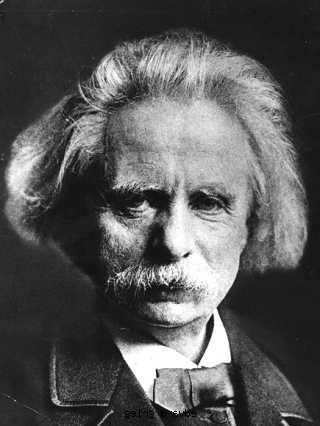
Plus, from looking at a few pictures of Grieg I thought he might appreciate the fact that his music was being performed by a hair band.  In all the photos, Grieg’s hair seems to be a point of pride with him and I could almost imagine him throwing his head forward like the heayy metal guys do so that their hair flies forward then back in rhythm to the music. 

Or maybe not.

Grieg was not all that happy with this composition at the time, saying,  “I have also written something for the scene in the hall of the mountain King – something that I literally can’t bear listening to because it absolutely reeks of cow-pies, exaggerated Norwegian nationalism, and trollish self-satisfaction! But I have a hunch that the irony will be discernible.”  Maybe this treatment of his music would have pleased him from an ironic standpoint.

Anyway, here’s the Apocalyptica version.  It will either  have you banging your head or have your head banging. 

Read Full Post »

This is a new piece that I just completed for my next show which opens in a scant three weeks at the West End Gallery in Corning.  This is a smaller painting, at just over 6″ by 14″ on paper that I’m calling Island of Memory.  It incorporates two of my icons, the Red Tree and the Red Chair, in a simple composition that recalls much of my earlier work.  It also is divided into two large blocks of color with a ribbon of white between the two parts, also like the earlier work.

I have mentioned the Red Chair signifying memory for me and in this painting it takes on that role.  It seems that often our memories become unique through time and  a memory of an event might only exist for one single person even though others might have witnessed the same event .   The event may not have etched itself as deeply in the minds of the others or may not have much significance.  Or they may remember it in a much different way, perhaps a differing aspect of whatver happened, if they remember it at all.  That is what I see here– the idea of a recollection exisiting in one small place.  I know I’m not doing this justice with this explanation.

It also reminds me of the classic Otis Redding song, (Sittin’ On) The Dock of the Bay, a song which fills my own island with memories.  I listened to that single hundreds, maybe thousands of times growing up yet I’ve avoided using it on this site.   I always felt a protective attachment to it and it’s always bothered me when other singers (and non-singers– I’m reminded of a hysterical George Hamilton version of it from the late 60’s) covered this song through the years.  It seems like these other versions somehow pulled from the special nature of Otis Redding’s version, making it less special.  The awful histrionics of Michael Bolton come to mind.  But all I have to do is hear the simple ease and strength of Otis’ rendition and those thoughts fade to nothing.

It is a special song.  And it seems to go along in tone with this small painting.  Give a listen…


Read Full Post »

« Newer Posts - Older Posts »