The time has moved ahead this morning and I awaken later than normal to a dark and gloomy morning. My world is layered in mud and I don’t feel like sharing this morning , wanting to keep my thoughts to myself and to take the time to think things out. There are a lot of problems in the world that I find distracting today including the crisis in Japan. My sense of empathy keeps bringing my thoughts back to what they must be enduring right now and the idea of talking about my work seems ridiculous this morning. And the problems that others, such as the Japanese, are experiencing make my little quibbles seems tiny and trite.
So, today I will stop right here and just let the day form on its own accord. That’s the way the world is and that’s the way the world goes ’round, which brings me to a nice version of John Prine’s song, That’s the Way the World Goes ‘Round, by Norah Jones. Hope your day is peaceful.
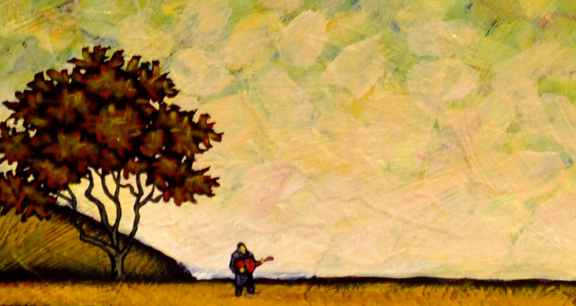
We’ve been spending a lot of time the past few days visiting our little dog, Jemma, in the hospital at Cornell where she is not doing so well. So I’ve been a bit distracted in my blog and my art, as well. This is a painting on paper that I finished last week that I’m calling A Thousand Miles From Nowhere, after the title of a favorite Dwight Yoakam song of mine. It’s about 10″ by 17″ in size and has a feeling of detachment that fits the title and my mood this morning.
Enough said. Here’s the song whose title I borrowed.
We’re deep in snow now, a couple of feet now built up over the ground outside my studio and coating the trees, making the evergreen limbs bow deeply . When I go outside there’s wonderful stillness, the blanket of whiteness muffling all sound. There’s a very meditative quality in big snowfalls as though time even trudges slower through the deep snow
‘Tis beautiful.
I don’t feel like writing today. Feel like painting. Here’s an atmospheric song from June Tabor, accompanied by one of my favorite guitarists, Martin Simpson. It’s called Scarecrow and is wonderfully understated. The quiet and the pauses give this song great weight. Like the morning after a big snow.
Earlier this week there were reports that the Northern Lights might be visible in our area, a fairly rare occurrence. Unfortunately, from our viewpoint it wasn’t visible. I’ve only seen these lights two times from where I live and I remember them being quite mesmerizing as a child, riding with my father in the car one evening with my eyes glued to the northern sky. Even now, when I see images of the lights I am immediately filled with the desire to pick up my brush and run dashes of color through other colors.
Here’s a pretty good video of the changing lights set to music played by a 7 year old Emily Bear. Quite nice.
Man versus machine. John Henry and his hammer versus the steam drill. Now Jeopardy.
I’ve watched with interest the first two nights of the exhibition on Jeopardy pitting the two top players in its long run, Ken Jennings and Brad Rutter against Watson, the IBM supercomputer that contains something like 15 trillion pieces of data. It’s been a pretty impressive display in these first two days for Watson as it racked up over $36,000 in winnings versus Jennings’ $4,800 and Rutter’s $10,400. In the Double Jeopardy round, Jennings and Rutter only managed 5 correct answers.
Maybe I’m rooting too much for the human mind to defeat a machine that takes a room of servers and a huge team of techs to operate but I found this whole thing pretty frustrating. It wasn’t that the machine defeated these two players in knowledge but that it seemed to have a definite mechanical advantage in ringing in first to answer. Outside of a couple of questions, which all the contestants, including Watson, missed, this was not an extremely difficult game. You could see that the two champions knew the answers but were simply defeated mechanically. It was irritating to watch and there seemed to be a bit of frustration on the two humans’ faces at the end.
When the machine missed, it missed wildly. For instance, the Final Jeopardy question was in the category U.S. Cities and asked which city had an airport named after a World War II hero and one named for a WW II battle. The answer, of course, was Chicago. Watson answered Toronto, which doesn’t even fall under the final category. With the thirty seconds given to answer, it seems there was breakdown in its comprehension.
I have some question as to how the machine is given the questions. I believe that Alex Trebek stated that the computer was digitally fed the questions simultaneously. So this was not voice recognition technology. It was, instead, just a very large computer pulling up data at a fast pace then beating its opponents to the buzzer with superior mechanical timing. Timing is vital in ringing in on Jeopardy so a tuned mechanical device would have a definite advantage against even the most adept human.
I sound like I’m a bit technophobic here. I do appreciate the advances of technology and am constantly amazed at how quickly our world changes with each new breakthrough. It’s mind-boggling how different our world is today when compared to even a mere thirty years back due to the changes in technology. And I’m sure that there are applications where Watson’s power and speed will greatly benefit us as a species in the future. But for now I find this whole thing a bit frustrating and secretly wish for a John Henry moment where Brad Rutter pulls out a sledge hammer and takes it to this irritating machine.
Here’s my favorite version of that great folk song, John Henry, sung by Johnny Cash:
I spent most of my time in the studio yesterday watching the situation in Egypt, watching Mubarak’s regime finally fall before the will of organized, unarmed protest. Even with the ever present cynicism concerning what the next step for that nation will be, I have to admit I was moved by the Egyptian people and their steadfast unity through these last few weeks. I was certain that Mubarak’s address Thursday evening would result in violent confrontations, his words goading the protesters into a frenzy that would be enough for him to send in his police squads or the military. But, to their credit, the pro-democracy protesters did not take the bait and instead came out in larger, louder numbers yesterday, all united by a theme of peaceful power.
At that point, it must have become obvious to the regime that these people were not simply going away. They had endured. They had withstood attacks from the regime’s goon squads, losing nearly 300 lives in the process, and had not retreated (oddly enough, there have been no reports of counter-protests since those obviously staged by the regime a week or so back). They had ignored veiled threats from the vice-president that they must go home. They held fast.
A report said that after Mubarak’s address on Thursday, the Army turned on him and that marked the beginning of the end for his regime.
Again, I have no idea what the next step for these folks will be. I don’t know if this is absolutely the best thing for them, that their lives will be appreciably better in the years to come. Whether they will continue down this road to a pure democracy or if they will fall prey to radical ideologues vying for control, I don’t think anyone knows for sure. That’s one of the qualities of freedom– uncertainty. But they at least have a chance now and to see them have their voices heard and to feel that their will is stronger than the usurped power of the corrupt ex-regime is a wonder to behold. It is a moment to cherish, a moment to inspire other oppressed peoples. There are few sweet moments like this in most people’s lives and though it is not my moment, I revel in it. Good for you, Egypt.
Power to the people.
In the coverage I heard an Egyptian reciting this phrase so here’s a little tune with that message to hum along to this morning:
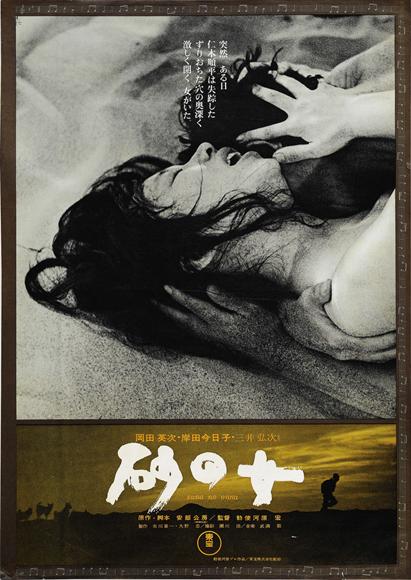
There’s a film starting in a few moments on TCM that really intrigued me, one I’d never heard of before. It’s a Japanese film from 1964 whose title translates to Woman in the Dunes. When I read the description I had to go back and read it several times to make sure I was understanding it fully. It said “A Japanese entomologist is trapped with widow in a sand pit.”
That was it.
My mid began to twirl into imaginations of what this story could be. It didn’t sound like any story I had heard before and that is pretty rare in a world where most narratives are simply variations on well worn tales. It turns out that the story is of a man who is collecting bugs for research stumbles upon village situated among the seaside dunes. Asking if there is a place to stay in the poor village, the locals tell him he can stay in a house that is located at the bottom of one of the large sand pits which apparently are used to produce sand for the concrete industry. The house is inhabited by a widow.
He descends into the pit and the next day discovers that the rope ladder leading down into the pit has been removed and that he is trapped. The widow it seems is a prisoner whose purpose is to constantly shovel the sand into baskets. She shovels to produce sand for the villagers and to keep her ramshackle home, and herself, from being buried. There’s an element of Sisyphus here.
The story becomes an existential tale of the entomologist struggling to escape then becoming accepting of his situation and living with the widow for many years, even after he realizes he could easily escape.
It sounds like such an absurd premise, especially to face at 6:30 in the morning, that I must take a look…
If any artist has stuck more closely to variations on a single theme than Chuck Close, I am not aware of him. Close has had a long and illustrious career painting portraits based on the grid system often associated with photographic pixels, taking the contents of each grid placed over a photo and transferring and expanding it in size to a corresponding grid on his canvas, to put it in simplistic terms. Beginning early on, Close created huge canvasses where he would capture every single detail and blemish in his subjects’ faces in an extreme photorealist manner. These have tremendous impact when seen in person, from the massive scale as well as the ultra-clarity provided in the detail.
But over the years he went beyond the photorealist aspect and created variations. Instead of replicating each pixel with absolute precision, Close would use the grid to create almost abstract mosaic tiles that captured some of the color and form of the referenced grid but had their own form as well. The self portrait shown above is such an example. He also used his thumbprints to create portraits in this manner, taking fingerpainting to new heights. Fanny/Fingerpainting 1985, shown here, is an example. Hard to believe that this very realistic image is built from thumbprints.
As an artist, I am most intrigued by Close’s dedication to his process and his ability to discover variation within it. Ultimately, subject matter is not the important part of his body of work. It is his unique process that makes his work special. That’s something that you hope young artists realize, that it is more vital to adapt a way of painting, a process, that meshes with the workings of your own mind than finding interesting subject matter.
There’s a lot more to say about Chuck Close than I’m saying at the moment. For instance, how he has adapted his process to his physical limitations that resulted from a spinal blood clot in the late 80’s. That’s a story in itself. There’s a wealth of info on the web about the artist for those who seek more detail.
Here’s a neat promo for a show from 2009 of Close’s printwork held at the San Jose Museum of Art.
Well, we’re into February and just about every corner of this country has been pounded lately with some form of winter wrath. But the sun is shining brightly here this morning and with the white blanket of snow combines to make everything glow. Gorgeous!
I’m working on a very large painting but am not ready to write about it at the moment. But I am eager to get at it so I’m going to play a little pick-me-up music. It’s a version of the classic Guitar Boogie from the super talented Australian guitarist Tommy Emmanuel. This will warm you up even if February is leaving you in shivers.
I am running way behind this morning, the internal stopwatch with which I compete with myself having not started on time . Having no one to answer to in the studio but myself, I can do what I do on my own time schedule but I have always been a stickler for trying to get as much done as possible early in the day so that when my natural indolence sets in I will have at least accomplished a few things for the day.
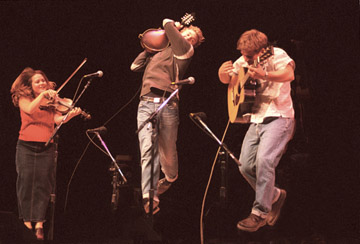
So, today I need a kick of energy, something to rev the engine. I think this might be a good morning to feature some upbeat music from the progressive bluegrass trio Nickel Creek featuring Chris Thile, the wunderkind on mandolin. This is a rousing version of The Fox that has a jam band feel and there’s a nice little piece of Dylan’s Subterranean Homesick Blues thrown in as well.
 The time has moved ahead this morning and I awaken later than normal to a dark and gloomy morning. My world is layered in mud and I don’t feel like sharing this morning , wanting to keep my thoughts to myself and to take the time to think things out. There are a lot of problems in the world that I find distracting today including the crisis in Japan. My sense of empathy keeps bringing my thoughts back to what they must be enduring right now and the idea of talking about my work seems ridiculous this morning. And the problems that others, such as the Japanese, are experiencing make my little quibbles seems tiny and trite.






 Redtree Times