The events in our lives happen in a sequence in time, but in their significance to ourselves they find their own order… it is the continuous thread of revelation.
–Eudora Welty, One Writer’s Beginnings, 1984
Things are going pretty well in the studio in recent days, at least as I see it at the moment. I am feverishly following a thread– or maybe it would be better to say riding a wave– and I am finding the work very much satisfying. It is doing what I hoped it might, at least in my eyes. For me, it serves, like the Eudora Welty phrasing above, as a continuous thread of revelation.
If it does the same for anyone else is still up in the air. Only time will tell.
And even then, time is relative. What seems like a long time for the impatient artist might be a tiny blip in the lifespan of the work. It often takes more time than expected for the true meaning or emotional value of a piece of art to reveal itself to others.
Time is always the revelator.
Okay, if you have read this blog with any sort of regularity over the years, you probably recognize that I am just treading water so that I can share one of my favorite songs, Time (The Revelator), from Gillian Welch. It’s a song that feels to me as though it meshes effortlessly with my work. It’s been a few years since I last played it here and I wanted to hear it this morning, so without further ado, here it is.
Time is the coin of your life. It is the only coin you have, and only you can determine how it will be spent. Be careful lest you let other people spend it for you.
–Carl Sandburg, On his 85th Birthday, Jan 6 1963
Time to spring ahead an hour on the clock. This is always a frantic day in this little world of mine that is dictated by my own sense of order. Anything that unduly intrudes or alters my schedule is cause for panic.
Well, maybe not panic. But I do see it as a pain in the butt, shifting my whole schedule forward. Actually, it’s not really shifting anything. I will simply get up an hour later and stay awake an hour later on the clock than I do now.
So, maybe it’s not as big a pain in the butt as I inferred.
It’s really just an adjustment. An hour later of sleep means I will get less done before breakfast, get to my blog a bit later, etc. On the flip side, it will be nice to stay wake past 9 PM.
I pretty much adhere to the advice at the top from poet Carl Sandburg, seeing time as the most valuable asset we have since, unlike other tangible assets like money or gold, it cannot be recovered once it is spent.
As a result, I am somewhat of a time miser. That doesn’t mean I don’t waste time though what might seem like wasting time to you is often vital to what I do. Idling around is a big part of the artistic life. It might even be an artform in itself.
That’s where today leaves me, as a master idler and time miser. And proud of it.
Now get out of here– I’ve spent all the time I have this morning on this foolishness!
For this Sunday Morning Music, here’s an on topic semi-classic from 1996, Time Won’t Let Me, by the Cleveland-based band, The Outsiders.
The past is a foreign country; they do things differently there.
— L. P. Hartley, The Go-Between (1953)
Ain’t that the truth?
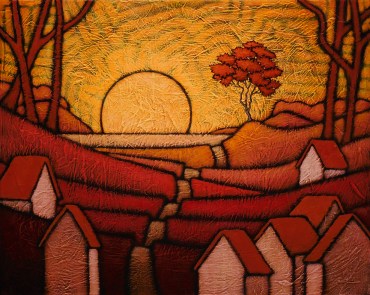
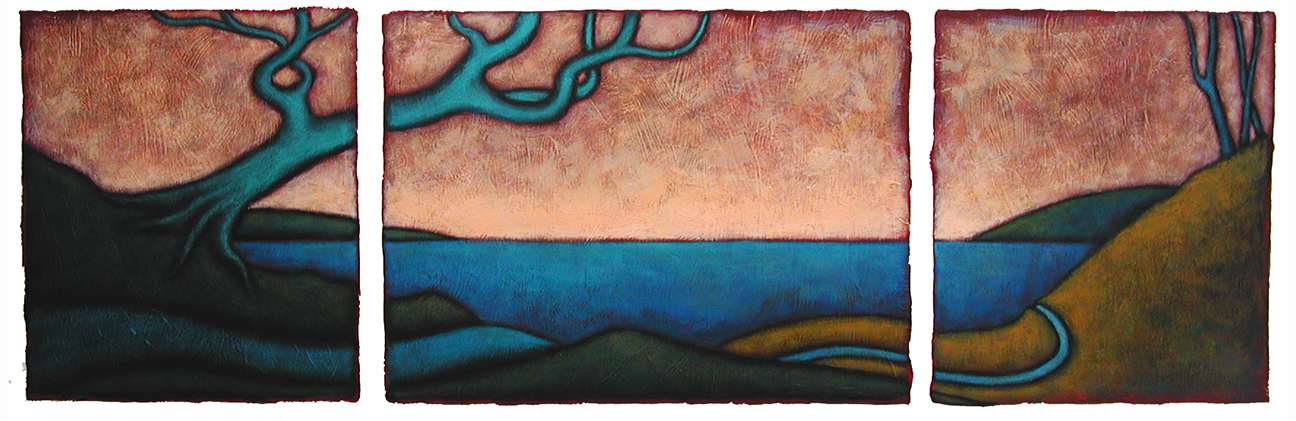
One of the interesting things about going back through my earlier work from 20 to 27 or 28 years back, is in seeing things I once did that I seldom if ever do now with the work. Take for instance the triptych at the top, painted in 2002.
I did quite a few triptychs at that time but for some unknown reason, this form has faded from my repertoire. It surprises me because I liked painting them and still enjoy seeing these pieces. I like the feel of the triptych on the wall. The segmenting seems to highlight the composition in an interesting way. Plus, painting them presents a different challenge, trying to balance what amounts to three different paintings, all balanced so that each could stand alone, into a cohesive unit that speaks with one voice.
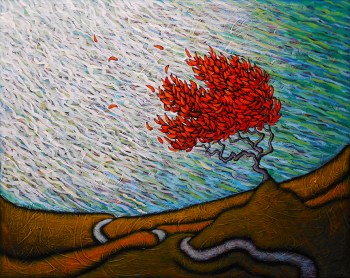
I have one such triptych (below) that hangs on my studio wall, near my painting table. Painted around the same time, it’s much smaller than the one at the top. It remains a favorite over these 20+ years which says something for it. It also seems pertinent with its pervasive reminder of the colors and fields of Ukraine.
Taking these little trips backward through the work reminds me of how things have changed in many ways and how some things remain the same. Perhaps it’s time to take a crack at another triptych. It’s been a while but maybe it should have never left.
Here’s song that somewhat pertains to today’s thought. It’s another longtime favorite– a lot longer than the twenty or so years since these triptychs– from Eric Burdon and the Animals, When I Was Young.
“To love justice, to long for the right, to love mercy, to pity the suffering, to assist the weak, to forget wrongs and remember benefits, to love the truth, to be sincere, to utter honest words, to love liberty, to wage relentless war against slavery in all its forms, to love family and friend, to make a happy home, to love the beautiful in art, in nature, to cultivate the mind, to be familiar with the mighty thoughts that genius has expressed, the noble deeds of all the world; to cultivate courage and cheerfulness, to make others happy, to fill life with the splendor of generous acts, the warmth of loving words; to discard error, to destroy prejudice, to receive new truths with gladness, to cultivate hope, to see the calm beyond the storm, the dawn beyond the night, to do the best that can be done and then be resigned.
This is the religion of reason, the creed of science. This satisfies the brain and the heart.”
–Robert G. Ingersoll, Words To Live By
I wrote about Robert Ingersolla few years back, noting that the now somewhat overlooked orator of the 19th century was once one of the most celebrated men in the world. He spoke to huge crowds, sometimes 50,000 or more, at a time without microphones and loudspeakers. He was praised and idolized by the great men of the time– Walt Whitman, Thomas Edison, Oscar Wilde, Mark Twain, Frederick Douglass and so on. Whitman called him the living epitome of the American ideal of his Leaves of Grassand Fredrick Douglass proclaimed that “of all the great men of his personal acquaintance, there had been only two in whose presence he could be without feeling that he was regarded as inferior to them — Abraham Lincoln and Robert Ingersoll.“
One might think that someone with such influence in that era might have been a religious or political figure. Ingersoll was neither. Far from it. He championed rationalism and free thought, railing against the slavery of the mind that he believed organized religion fostered and the corruption of character brought on by political power.
His words often ring as true today as they did 125 years ago. I came across the words above yesterday when it was pointed out that the great American writer and film director Garson Kanin kept this creed from Ingersoll on his desk at all times.
Reading these words made me realize why Ingersoll achieved such popularity. They were inspirational words, describing positive traits and a rational way of thinking that was independent of the shaming and oppressiveness of organized religion.
A way of living that anyone could live. An honest life of decency and generosity without being told how to live. Goodness for the sake of goodness alone.
A way of being that satisfies the brain and heart.
Ingersoll also wrote another form of this creed:
Justice is the only worship. Love is the only priest. Ignorance is the only slavery. Happiness is the only good. The time to be happy is now, The place to be happy is here, The way to be happy is to make others so.
Either of his creeds are mighty fine words to keep on any desk. Or better yet, to live by.
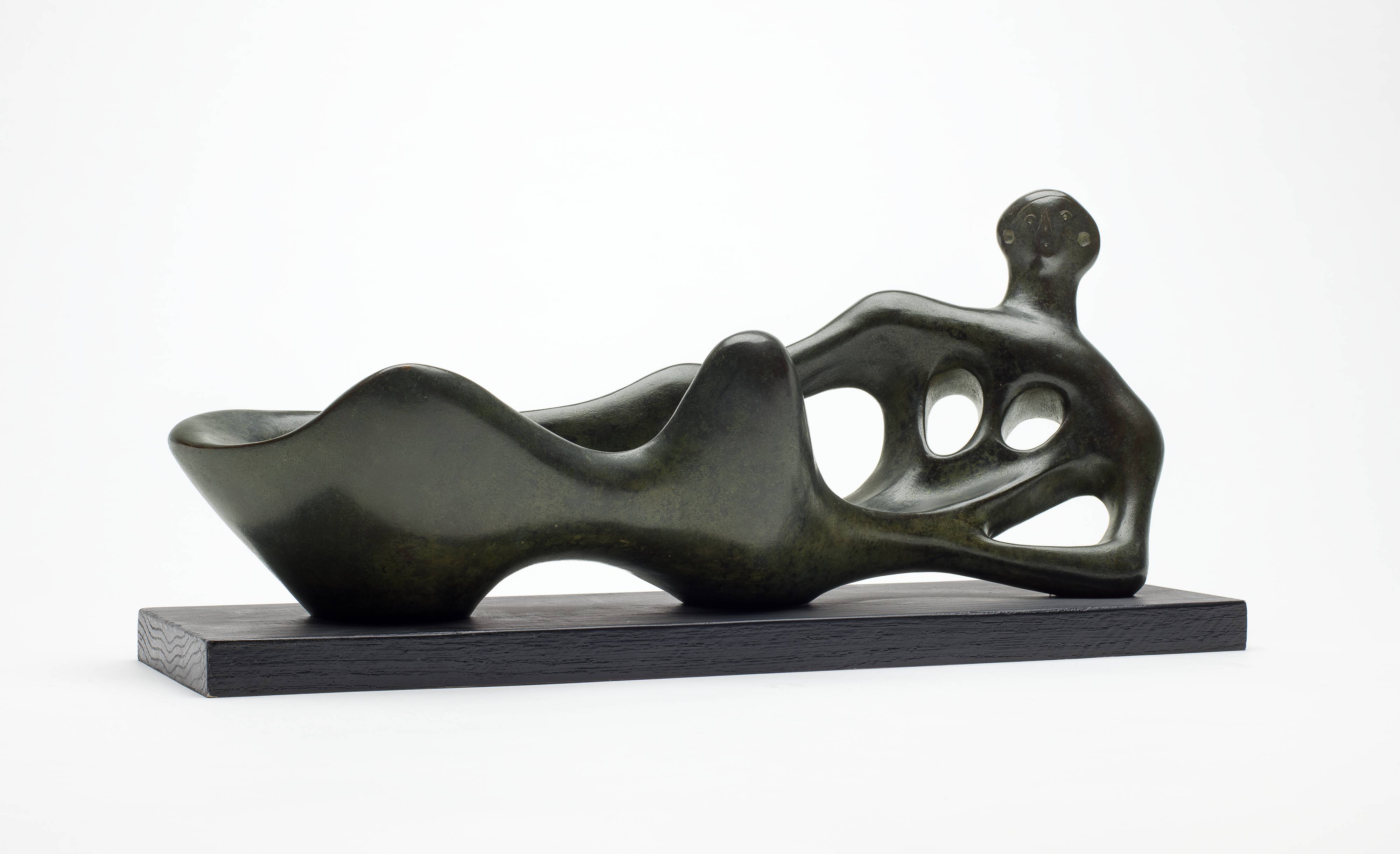
Because a work does not aim at reproducing natural appearances it is not, therefore, an escape from life — but may be a penetration into reality…as expression of the significance of life, a stimulation to greater effort in living.
–Henry Moore, Henry Moore: Sculpture and Drawings, 1957
This thought from the great sculptor Henry Moore echo that of many others through the years, that art provides a deeper penetration into our reality. This is not because it mirrors exactly what is visible to the naked eye. No, it is because of the perception of the artist and how the artist interprets that vision and adds to it, creating its own sense of reality.
It is in how the artist makes the common feel uncommon. How the artist makes the seemingly mundane resonate with deeper meanings of this life.
And as Moore points out, this recognition of that meaning of life sometimes found in art provides stimulation for one to more fully experience this life. To recognize the significance of all things, all experiences, all feelings. All people.
Art is not an escape route from life. It is an inroad.
I needed to hear this, or should I say, write this at this moment. Sometimes when I am working on a piece or series of work, I become too focused on little things in the process that I lose sight of the overall feeling that is moving the piece forward. Revisiting this thought brings me back to what I see and feel beyond the surface. It’s a hard thing to explain here without turning this into a treatise that I don’t want to write and you most likely don’t want to read at this time.
I think I will leave it right here this morning. I am stimulated enough by Moore’s word to make an effort. Here’s a classic from George Harrison, What Is Life. It is actually more of a love song but I guess finding the significance of life in art is a form of love in itself.
So, let’s just say it’s close enough. Give a listen and make sure the door is closed when you leave.
How sweet the moonlight sleeps upon this bank! Here will we sit, and let the sounds of music Creep in our ears; soft stillness and the night Become the touches of sweet harmony.
–William Shakespeare, The Merchant of Venice
Running late this morning. Well, late by my standards. There’s already daylight and I have plenty of things calling out for attention this morning. And that’s a good thing because it means things are sparking, work is beginning to flow with purpose. It’ might well be the best feeling I can achieve here in the studio.
I wish I could explain it better or wanted to spend the time trying to do so. But I would rather spend that time getting to the work that awaits.
So, let’s just listen to a favorite Rolling Stones song of mine from their classic 1971 album, Sticky Fingers. This is Moonlight Mile.
For those of you playing along on the home version of our game, this completes the three clues to today’s theme.
Three Rules of Work: Out of clutter find simplicity; From discord find harmony; In the middle of difficulty lies opportunity.
–Albert Einstein
This Einstein fellow is a pretty smart guy.
Simplification, harmony and opportunity could be ingredients for any recipe to success in any field but I think they apply particularly well to the creative arts. I know that I can easily apply these three rules to my own work.
For me, its strength lies in its ability to transmit through simplification and harmony. The forms are often simplified versions of reality, shedding details that don’t factor into what it is trying to express.
There is often an underlying texture in the work that is chaotic and discordant. The harmonies in color and form painted over these create a tension, a feeling of wholeness in the work. A feeling of finding a pattern in the chaos that makes it all seem sensible.
And the final rule–opportunity lying in the midst of difficulty– is perhaps the easiest to apply. The best work always seems to rise from the greatest depths, those times when the mind has to move from its normal trench of thought. Times when one has to expand beyond the known ways of doing things and find new solutions and methods to move the message ahead.
The difficulties of life are often great but there is almost always an opportunity or lesson to be found within them if only we are able to take a deep breath and see them. These lessons always find their way into the work in some way.
Thanks for the thought, Mr. Einstein. I hear good things about you.
This post has ran here a couple of times over the years. Needed a bit f a break today but thought I also needed a reminder of what I should be doing.
Ought I to say that the form of change is fixity, or more precisely, that change is an endless search for fixity? A nostalgia for inertia: indolence and its frozen paradises. Wisdom lies neither in fixity nor in change, but in the dialectic between the two. A constant coming and going: wisdom lies in the momentary. It is transition. But the moment I say transition, the spell is broken. Transition is not wisdom, but a simple going toward… Transition vanishes: only thus is it transition.
–Octavio Paz, The Monkey Grammarian (1974)
It’s that time of the year when I am in the midst of preparing for my two annual shows, with openings in June and July. The first show is at the Principle Gallery in Alexandria, VA and opens on Friday, June 9, 2023.
This will be my 24th consecutive annual show there which still surprises me when I say it. Would have thought I would have worn out my welcome a long time ago, that my time might come and gone.
But a lot of things have changed in the world– and in my work– over those years since that first Red Tree show back in 2000 and I am somehow still standing. This constant change we experience serves as the theme of this year’s show which I am calling Passages.
I agree very much with the words from Octavio Paz at the top, that we are in an endless search for fixity. A frozen paradise, he calls it. I call it that sweet spot where all possible conditions are lined up in a way that we think will satisfy us forever.
An ultimate endpoint or destination in our journey.
An impossibility because we are forever in a state of transition, of passage, from one state of being to the next. Conditions changes constantly and as a result we change as we adjust to those conditions. Each change transforms us into a different version of ourselves.
As a result, as Paz points out, wisdom lies in the momentary. For me, that translates as embracing this continuous evolution, of recognizing that we are never fully forever the same person that we were at the beginning of the journey or even at any point along the way.
Things are lost and things are gained.
We constantly are synthesizing what remains into something new. We may think at any one moment that we have achieved the version of ourselves we seek but that is but an eyeblink in time. We have already began changing again before the eyes are fully open.
In short, just when we reach the destination that we believed we are seeking, we are already beginning the next journey past that point.
Hello. Pleased to meet you. Gotta go!
And that’s okay provided we don’t hold too tightly to imagined pasts or improbable futures. We are creatures of change, always making that passage from the present us to the future us.
I think you could see this idea on full display if you were to take what might be representative examples of my work from each year from the past 24 years and putting them side by side. You can easily identify it as mine but there is always change, evolution of some sort. Sometimes subtle. Sometimes more pronounced.
It is the same but it is never the same same.
I don’t know that this fully describes the show. This is my first swing at talking about this show and it is still not yet 6:30 AM. I am sure how I see and describe it will change as I work through the show. It, like all of us, is also in a state of passage.
Here’s a song, Changes, about that these transitions from David Bowie. One line in particular stands out for me:
So I turned myself to face me But I’ve never caught a glimpse
Basically, he is saying that before he could turn to take a look at the new him in the mirror, he was already something different.
Good people are good because they’ve come to wisdom through failure. We get very little wisdom from success, you know. Success makes a fool of you, but failure can come only from great effort. One who doesn’t try cannot fail and become wise.
–William Saroyan, New York Journal-American, Aug. 23, 1961
I wish that I knew what I know now when I was younger...
You have probably heard this line above before. Maybe you recognize it from the old Faces’ song, Ooh La La. Or maybe you heard it from someone older than you. Or maybe you’ve said it yourself.
The words make sense. I guess you would almost always want to relive the past with greater knowledge than you had at the time. It would definitely help avoid the stumbles and setbacks you experienced along the way. To have that wisdom beforehand might be a wonderful thing.
But maybe it’s the acquiring of this wisdom that matters, the experience of trying and failing multiple times. Maybe you need to experience that blind and unfounded optimism that sets you off on misguided missions doomed to fall short. Maybe you need to learn how to claw your way up from the fall to the bottom.
Maybe wisdom has to be hard earned before it can be fully appreciated.
Or maybe not. Maybe I am making excuses to rationalize away my own past shortcomings and overall lack of wisdom. Maybe all my earlier mistakes and missteps could have been avoided altogether with the wisdom I have now.
But would having that wisdom at an earlier age lead me to this same point today?
I don’t think that can be known. But perhaps having greater wisdom, I might have realized I had more options, thus would not have made the same choices. I most likely would not followed the same path or met those same people who have helped me along the way. Circumstances and reactions would be different.
Would I even be a painter? And if so, would my work be the same as it has been? Or does the work I do require a past that includes my mistakes, disappointments and anxieties? Maybe those past failings are the darkness that provides the needed contrast.
I guess the ultimate question is: Would I be happier with my life, having gained what little wisdom I might have now at an earlier age?
I kind of doubt it. Wisdom is certainly not a guarantee for happiness or contentment. Sometimes it is even a hindrance to those things.
Guess I’ll play the hand I’ve been dealt. I am, after all is said and done, relatively content with my lot in life so I can happily abide with the choices and even the mistakes I have made. What little wisdom I have gained over the years tells me I would be no more content nor happier on the safer, stabler path I might have chosen with foreknowledge.
Ooh la la…
Most of the above is from several years back though I rewrote much of it, as well as adding the quote from the late William Styron and the painting from 2011 that hangs in my studio. For this Sunday morning’s music interlude, here’s the song from Faces featuring Ronnie Wood on vocals. Give a listen and have yourself a great day with no regrets. Ooh la la…
No game in the world is as tidy and dramatically neat as baseball, with cause and effect, crime and punishment, motive and result, so cleanly defined.
–Paul Gallico, Farewell to Sport
It’s that time of the year.
Catchers and pitchers are reporting to spring training. Baseball is in the air. Is there any better time of the year?
Baseball has always held a special place for me. Oh, I was no more than an average player at best– decent bat, lousy arm and a so-so glove– but there was pure magic in seeing the heroes of my youth and hearing the stories of the early legends of the game.
I remember my grandmother telling me of going with my grandfather to New York City on their honeymoon in 1921 and seeing Babe Ruth play with the Yankees. Ruth hit a double and a triple as she recalled.
I remember sitting with my grandfather, the mythological Shank, so called for the holds he would apply to his opponent’s legs during his time as a professional wrestler, watching the World Series in the afternoons of 1968. I had my tonsils out and was still recuperating and we watched the St. Louis Cardinals play the Detroit Tigers, who won the series. It was great watching with my grandfather plus I was introduced a player who became one of the heroes of my youth, Bob Gibson, the Cardinal’s pitching ace.
Gibby was it for me. I have always admired toughness in people and Gibby was the toughest guy out there, one whose competitive fire was, and is, legendary. [Bob Gibson died in 2020 at age 85]
He was so dominating as a pitcher that baseball changed the mound height because they felt the hitters needed help since he was practically unhittable. I read his early autobiography, From Ghetto to Glory, numerous times as a kid and that made him an even bigger hero to me. He was eloquent and college-educated, a rarity for ballplayers of that era, and his story was compelling, going from abject poverty onto college then a stint with the Harlem Globetrotters then on to baseball stardom.
If I am asked to name a childhood hero, his name always jumps into my mind first.
Baseball was always played at our house. My dad was a pretty fair pitcher who had promise as a youth. In subsequent years, I have uncovered numerous news stories in old newspapers about his exploits on the mound and in the field. But later, as a dad, he would occasionally play catch with me and my friends. Eventually, he would break out his knuckleball, a pitch he was known for in his younger days. It was practically uncatchable, having a spectacular drop that would appear to be entering your glove only to end up hitting you in the stomach. Or lower. I was never able to master the pitch but still appreciate the awkward grace and dance of a well thrown knuckler.
Other times, I would pitch to him and he would hit flies to my brother, Charlie, in the outfield who seemed to run down most anything hit out there. Periodically, he would hit line drives or hard grounders back at me. They would bang off me or make me dive out of the way and he would cackle. I would then try to drill him with the next pitch, which would make him laugh even more because he had gotten my goat.
I would calm myself and wait until he would pitch to me, waiting for the perfect pitch when I could send a hard line drive back at him, making him duck or dive. At such times, after having to jump out of the way or defend himself with his glove, he would yell out a Hey! and give me a harsh look. Then he would usually laugh because he knew that I was just paying him back for his earlier actions.
Payback was and is just part of the game. Baseball has its own karma.
Even my work has been somewhat affected by my experiences with the game. I remember the first time coming out of tunnel during a night game at Shea Stadium in the late 1960’s and seeing the field spread out before me. I was stunned by the colors that were so rich and lush under the warmth of the lights. It was a feeling that I think I wanted to replicate in some manner which ultimately led me to art. These memories of the game are most likely the reason that my baseball paintings remain some of my favorites to paint.
Over the years baseball has become my calendar for the passing of the year and is a comforting friend on the days when the world seems ready to implode or explode. I am energized with the beginning of Spring Training and am still captive to the statistics and stories of baseball, one of those romantics who see poetry in a game based in tradition.
I wrote this back in 2009 and have edited it just a bit and added a couple of things. The wonderful vintage baseball glove at the top painted with Take Me Out to the Ballgame is from artist Sean Kane who specializes in baseball related art such as these painted gloves. I featured a group of them here a few years back. I urge you to take a look at his website, especially the Archives section. Good stuff.
Now here’s a fun version of the classic Take Me Out to the Ballgame from Dr. John. Play ball!




 Redtree Times