You have nothing to trust to but your own energy and the sublime instinct of an ancient people. Go to your homes, and teach there these truths, which will soon be imprinted on the conscience of the land. Make each man feel how much rests on his own exertions… Act in this spirit, and you will succeed. You will maintain your country in its present position. But you will do more than that, you will deliver to your posterity a land of liberty, of prosperity, of power, and of glory.
— Benjamin Disraeli,Speech to the National Union of Conservative and Constitutional Associations in Crystal Palace, London, June 1872
I am running the whole of a quote taken from a speech 19th century British Prime Minister Benjamin Disraeli because, as a whole, it is good advice for any politician or government official. But there are two lines in it in which I am focusing:
You must act as if everything depended on your individual efforts. The secret of success is constancy of purpose.
That — total commitment of effort and constancy of purpose– is the secret to achieving any type of success, regardless of how you define success.
Of course, that’s easier said than done.
It is not a straight-forward or easy path. There are always distractions, obstacles, pitfalls and stumbles along the way. Discouraging things that will strain one’s resolve.
But if one can remain dedicated to a purpose, keep their eye on the prize as they say, progress will take place. It may not be the ultimate success sought but it will be a positive step forward in that direction. It will be a form of success on which other larger successes can be built.
After all, you can’t stand on top of the hill without climbing up it first.
That’s my pep talk for this morning. These are more for myself than anyone else but if someone takes anything from them, all the better. Plus, this ne gives me a chance to play a song I’ve been fixated on in recent days. It’s an old gospel song, On My Way (To Canaan Land), that has been performed by a multitude of singers. I don’t know that I’ve ever a bad version but this particular one from the several different performances of it by the great Mahalia Jackson is my favorite. It is elegantly simple, with nothing to distract from the power of the song. And a great rhythm. I get the feeling that Tom Waits spent a lot of time listening to this at some point.
Give a listen. I’d stay and listen with you but I have my own hill to climb.
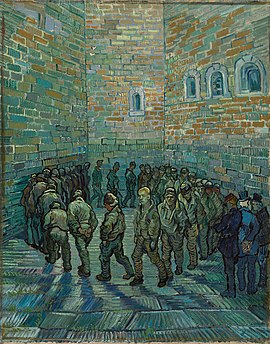
Vincent Van Gogh- Prisoners’ Round (after Gustave Dore) 1890
If one wants to be active, one must not be afraid of going wrong, one must not be afraid of making mistakes now and then. Many people think that they will become good just by doing no harm — but that’s a lie…. That way lies stagnation, mediocrity.
–Vincent van Gogh, The Letters of Vincent Van Gogh to His Brother, 1872-1886
I can only imagine that so much worthwhile art has not been produced because the people who had the capacity to create it were simply afraid. They didn’t want to venture outside their comfort zone or push themselves. They didn’t want to make a mistake, didn’t want to fail. They didn’t want to disappoint or offend others.
They wanted to remain safe. Doing no harm, as Van Gogh put it in a letter to his brother in late 1884.
He then warns: That way lies stagnation, mediocrity.
He’s right, of course.
It’s a constant fight to let go of the safety lines we build for ourselves. It’s like one is a trapeze artist and is deathly afraid to let go of the swinging bar so that they might soar and glide gracefully through the air to the next bar. So, they hang where they are and continue to swing back and forth until, at last, they lose all momentum. They come to a halt and are left just hanging there with nowhere to go but down.
That’s mediocrity.
Myself? Been there, done that. I guess that’s why I try to venture out regularly with new types of work, like the recent Ring of Fire or the Multitudes or Outlaws series of past years. They are my way of letting go of the bar and attempting to fly through the air.
Sometimes I make it to that next bar. Sometimes I don’t quite get there.
But when I fail, I only fall to the net below. I can get back up with only my ego bruised a bit. I may not be quite as eager to make the next leap but with reminders like this from Van Gogh, I know that sooner or later I will let go and try to fly again.
That same fear is often present when moving on to a new piece of work. All those fears come rushing back as you face putting that first mark on that blank canvas. I am looking right now at three large, fully prepped canvases who have been intimidating me for months. I have been terrified of even getting near them with a brush filled with paint for all the reasons above.
But I know that the answer is to just take a deep breath and let go, try to fly to that next bar.
Just make that first mark– any mark– and let it tell me what to do and where to go with it. Trust that I have the ability make it across and set aside any concerns about what might come or if it will be good enough.
Just dare to make the leap and let instinct carry me.
Van Gogh knew this and wrote about it in the same letter, saying in the next paragraphs following the one shown at the top:
Just slap anything on when you see a blank canvas staring at you like some imbecile. You don’t know how paralysing that is, that stare of a blank canvas, which says to the painter: you can’t do a thing.
The canvas has an idiotic stare and mesmerises some painters so much that they turn into idiots themselves. Many painters are afraid in front of the blank canvas, but the blank canvas is afraid of the real, passionate painter who dares and who has broken the spell of “you can’t” once and for all.
This attitude of letting go of the bar (along with all the fears that are also holding onto it) and just soaring ahead without trying to remain safe might be the most important thing we learn from Van Gogh It’s a good reminder for any artist in any medium– and maybe for any human being.
Here’s a song that a little different for this blog with a slightly different circus analogy but with a message similar to today’s post. Plus, the song and video are energetic and a lot of fun. A good way to kick off the day. This is Janelle Monáe and Tightrope.
Misanthropy don’t pay—thare aint no man living whoze hate the world cares one cuss for.
–Josh Billings, Josh Billings: His Works, Complete (1873)
On social media, I follow Susie Dent who is an English lexicographer and etymologist who is well known on British television as the Word Wizard. I don’t think such a thing– an etymologist/media personality– could happen here but that’s another story.
Anyway, Susie Dent posts obscure and archaic words on a regular basis. Yesterday, she posted the word apanthropy which originated in the 18th century and is defined by her as the desire to be away from other people. Looking up the word further, most define it as an aversion to the company of men; a love of solitude.
I’ve often labeled my desire to be alone as being misanthropy which is an outright dislike or even hatred of humankind. While there are times (quite a few, actually) when I am not thrilled about humankind, I am generally bothered by the idea of hating it. There is so much to like about much of it and so many people who are wonderful specimens of it, though I imagine they might be made a little uneasy by being called specimens.
It made me happy to find a word that better described my desire to be alone. Aversion, rather than hate, to humans much better describes my attitude. A misanthrope sounds like someone who goes out of their way to grind their axe against humanity whereas an apanthrope just wants to be left alone.
I found my people. I would say, “Apanthropes of the world, unite!” but that wouldn’t make much sense, given our attitude.
I certainly won’t be joining the club though I do proudly now call myself an Apanthrope.
The American Humorists
Down the rabbit hole again. The quote at the top is from someone who is new to me, Josh Billings, which was the pen name of 19th-century American humorist HenryWheeler Shaw. He was a famous humor writer and lecturer in the United States, perhaps second only to Mark Twain, during the latter half of the 19th century. He wrote in the vernacular of the time, using semi-literate spelling to capture his characters. To the right, He is shown on the left in a popular trading card of the era ( there were trading cards then of famous orators, actors, etc. which could be the subject of a future blog) along with Mark Twain and Petroleum V. Nasby, a pen name which opened up yet another rabbit hole since he was from the area in which I live.
Josh Billings died in 1885 at the age of 67 in Monterey, California. His death and subsequent burial are described in the John Steinbeck novel, Cannery Row.
Here are a few of his other sayings:
There are two kinds of fools: those who can’t change their opinions and those who won’t.
and:
I have lived in this world just long enough to look carefully the second time into things that I am most certainof the first time.
and:
There is no revenge so complete as forgiveness.
From what I have read, he sounds like a fine specimen of an apanthrope. Might have to find some of his writings…
There is nothing more harmful to you than improving only your material, animal side of life. There is nothing more beneficial, both for you and for others, than activity directed to the improvement of your soul.
–Leo Tolstoy
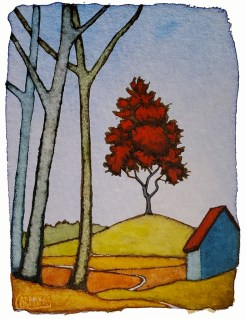
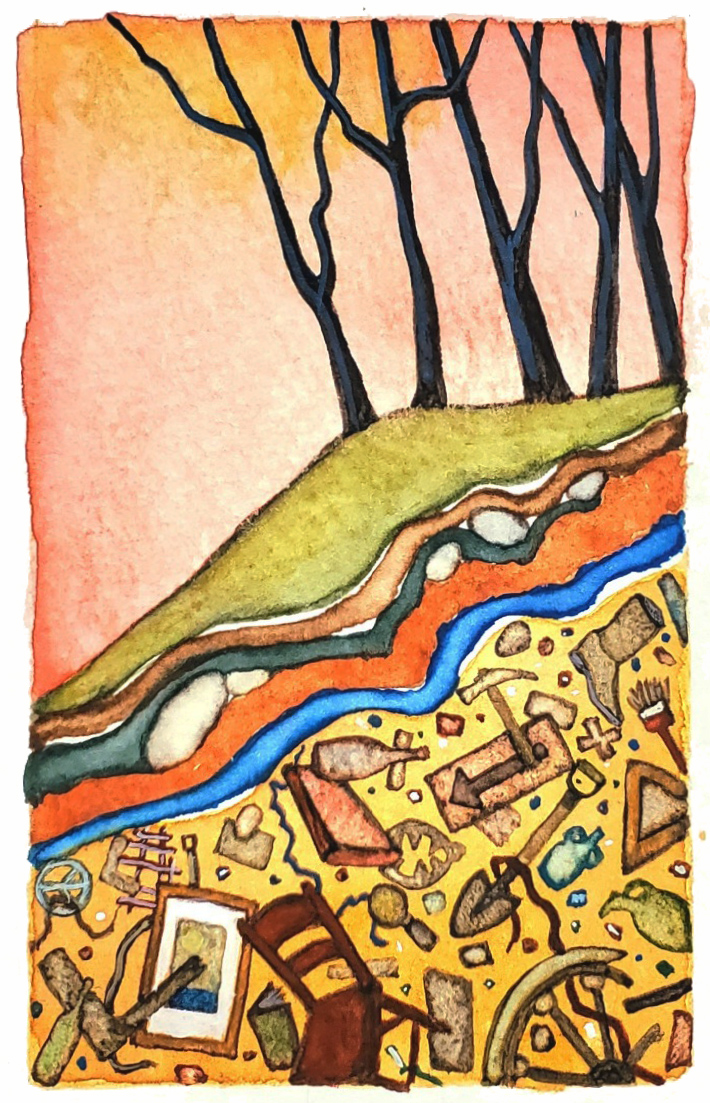
This new small painting, Improving Outlook, is part of the Little Gems show now on display at the West EndGallery. It’s a little under 3″ by 4″ in size but there’s a lot in it that has meaning for me.
First, it’s a return to style of my early work, done in watercolor on untreated paper. The process is one that I often refer to as reductive, one that has me first putting on segments of wet watercolor then flooding these segments. This allows me to remove much of the pigment from the inner segment, pushing the darker parts to the outer edges where it forms lines. I can then adjust the inner color to my liking, creating what I refer to as more complex colors.
It’s the way I first taught myself to paint and has remained with me over the years though it has played a smaller part in recent years. Revisiting this style rekindles a lot of my painting nerves, usually bringing along a sense of new possibility. Sparks a lot of ideas.
And that’s a good thing.
Another thing that draws me to this little piece is its simplicity and the iconic feel of the Red Tree on the small hillock. For me, this is a symbol of elevated thought or feeling. Rising above the material world in a way that Tolstoy writes of above. From its elevated position though the Red Tree could look down on those below it but instead, it gazes upward. This sense of elevation, of course, referred to in the title.
It is a small and simple piece, almost a meditation more than painting. Quiet and self-sufficient, without need. Without worry or anger.
A small reminder of something to be emulated.
Here’s song that I play every couple of years. I have played versions from other artists and they’re very good. But the original cannot be touched. Here is StevieWonder and his classic Higher Ground.
I’m so darn glad he let me try it again Cause my last time on earth I lived a whole world of sin I’m so glad that I know more than I knew then Gonna keep on tryin’ Till I reach my highest ground
The word sadness originally meant “fullness,” from the same Latin root, satis, that also gave us sated and satisfaction. Not so long ago, to be sad meant you were filled to the brim with some intensity of experience. It wasn’t just a malfunction in the joy machine. It was a state of awareness– setting the focus to infinity and taking it all in, joy and grief all at once. When we speak of sadness these days, most of the time what we really mean is despair, which is literally defined as the absence of hope. But true sadness is actually the opposite, an exuberant upwelling that reminds you how fleeting and mysterious and open-ended life can be. That’s why you’ll find traces of the blues all over this book, but you might find yourself feeling strangely joyful at the end of it. And if you are lucky enough to feel sad, well, savor it while it lasts– if only because it means that you care about something in this world enough to let it under your skin.
― John Koenig, introduction to The Dictionary of Obscure Sorrows
I watched part of a YouTube video of a presentation by the late James Kavanagh the other day. His Wikipedia entry says that Kavanagh (1928-2009) was an American Catholic priest, author, and poet best remembered for his 1967 book, A Modern Priest Looks at His Outdated Church. It was a call for the church to move from its antiquated past become a church of compassion and love. It was a controversial bestseller at the time and Kavanagh soon after left the priesthood.
That wasn’t how I knew him. I knew him from the books of poetry he wrote that were not mentioned on his Wikipedia page. One, There Are Men Too Gentle to Live Among Wolves, was first published in 1970 and has went though 50+ printings and has sold over a million copies, making it one of the most popular books of poetry ever published. I don’t know that it will ever rival the verse or longevity of the immortal poets but it is effective popular, straightforward poetry that wears its emotion on its sleeve, meant to be easily absorbed. Simple verses for complex feelings. I knew this book and its title poem well in my teens. It served a great purpose for me, helping form a lot of my goals and ideals at the time.
But in this video Kavanagh spoke about his embrace of the sadness that was always with him, how it was an essential part of who he was as human being. It wasn’t something to be hidden or avoided.
I understood immediately what he meant by this. I often experience a sense of sadness that is far different from despair. It is not joy or elation either. It is hard to describe but it almost seems like a form of pleasure that comes in being moved by the extremes of the human condition, as though it validates our own humanity, our own place in the world. A recognition of those common experiences– good and bad– that we all share in our time here.
Reading the words at the top from the introduction to the John Koenig book, The Dictionary of Obscure Sorrows, brought it into better perspective. The sadness that I know is, indeed, a fullness — an exuberant upwelling that reminds you how fleeting and mysterious and open-ended life can be.
One can’t fully appreciate the human condition without knowing at least a little bit of that sadness.
I no longer try to stifle this sadness in myself and am easily moved by displays of human emotion that involve feelings of empathy, concern, courage, and tenderness.
The despair I feel most often comes from witnessing the acts of those who feel little of these same feelings. People without empathy. The selfish and the greedy. The hateful and the spiteful.
The unfeeling and the unloving.
I don’t know what this means this morning or why I am sharing this. Maybe you’ve felt a sadness that you don’t understand. But it somehow makes you feel a bit more human, a bit more alive. Maybe it’s just that you’re aware of the fullness of this human life.
Hmm…
It also helps explain the joy and fullness of feeling that often comes in listening to the blues. About as human a form of expression that there is. Here’s the great Elmore James with It Hurts Me Too.
What if I’m wrong? What if I’ve lied? What if I’ve dragged you here to my own dark night? And what if I know? What if I see? There is a crack run right down the front of me
What if they’re right? What if we’re wrong? What if I’ve lured you here with a siren song? But if I be wrong, if I be right Let me be here with you tonight
—If I Be Wrong, Wolf Larsen
Fumbled and stumbled across a song early this morning, something to which I am prone. I didn’t know the song or the artist but liked the title immediately– If I Be Wrong from Wolf Larsen. It reminded me of the uncertainty that comes with self-expression, from putting yourself out there for all to see.
In whatever way one puts themselves out there– art, music, public speaking, politics or just yelling out opinions on a street corner– there is always the possibility of rejection, ridicule, or of being proven wrong. Actually, it’s more than a possibility. It’s a certainty because nobody has achieved perfection or is without fault.
Being wrong is a very human thing. Recognizing this and admitting our missteps makes us even more human.
But it can be a scary proposition and can keep a lot of people from expressing themselves fully.
Nobody wants to be wrong nor does anyone enjoys that feeling that comes with rejection of any sort. Owning up to our failures, shortcomings or errors in judgement is not something to be thrilled about.
But there is also something cleansing in it. It brings a sense of honesty and truth to oneself. It creates an uncertainty that questions and seeks answers, allowing for the possibility of new boundaries of thought and knowledge beyond that which we think and know now.
Certainty and denial of our mistakes and flaws is self-limiting, bounded in by the fences of the known and popular opinion. And in an endless universe, one that extends from the deepest parts inside each of us to the furthest reaches at the end of all matter, here is too much to learn and know to be limited by our own certainty.
Whew, didn’t see that coming when I came into the studio this morning.
All from a song. If I Be Wrong, I didn’t know when I walked acoss the path to the studio in the dark this morning. Wolf Larsen is the stage name of writer/musicianSarah Ramey. She is the author of a well-received memoir, The Lady’s Handbook for Her Mysterious Illness, that documents her struggle with a mysterious chronic ailment that plagued her for nearly the past two decades, keeping her from most live performances of her music. In 2008, she was the personal blogger for the Obama campaign, doing much of her writing from her bed.
This is one of those songs that rings the bell for me. Maybe you’ll think the same. Maybe not. No right or wrong here.
If we are not prepared to defend a tolerant society against the onslaught of the intolerant, then the tolerant will be destroyed, and tolerance with them.
–Karl Popper, The Open Society and Its Enemies, 1945
If you haven’t been paying attention to the growing number of incidents of racial and religious hatred taking place, please begin. Law enforcement and groups like the Anti-Defamation League are warning that today has been targeted as a National Day of Hate by white supremacist and neo-Nazi groups, marked with rallies designed to draw attention.
There are some who say that we should just ignore them and they will fade away without the spotlight. Unfortunately, that will most likely only move the point of normalcy, allowing them to move on to even more drastic actions.
We’re already seeing a normalization of harassment and violence from neo-Nazi groups who have been emboldened by the relative lack of response against their actions as they openly taunt and threaten people.
Social media is filled with more and more of these gatherings and confrontations, often filmed by the neo-Nazis themselves. The theatre in NYC at the premiere of Parade, a play based on the story of Leo Frank, who, in 1913, was accused of raping and murdering a 13 year old. He was kidnapped and lynched by a mob spurred on by antisemitic propaganda. At synagogues in Florida and elsewhere. Signs hung from highway overpasses.
This week Scott Adams, the cartoonist behind Dilbert, released a video spewing racial hatred against blacks, advising whites to stay as far as possible from blacks. He tries to rationalize it with anecdote and misguided social myth but his racial animus is undeniable.
And it goes on and on.
They’re not trying to be secretive or hide their actions. They want the attention. Their hatred is a rage that blinds them to reality, allowing them to believe that most people support their actions. That they are in the right.
I don’t get it myself. I look at these people and wonder what is in them that drives to hate so much. You can almost see the toll that hatred takes on their faces. Not to mention their psyches, spirits, and souls, if indeed they have them. I also wonder, with how little time we get to spend in this world, why they choose to devote so much time to hating others. I certainly don’t have time to spend on hating or attacking any group of people.
Maybe not understanding that level of hatred allows us to dismiss it, to try to shrug it off. To think that there will always be hatred and there’s little that can be done. an That’s understandable position. But it’s also a foolishly dangerous one.
At some point, you have to take notice and take action against this level of hatred and intolerance, or it cascades and grows into a greater threat to society as a whole. We may be past that point. I wrote about Karl Popper’s Paradox of Tolerance back in 2017 and, as predicted, the situation has only grown more dire over the intervening years. Hate groups have grown unchecked and have continually learned to better use the tolerance of our society against it.
Here’s a longer excerpt from Popper’s book:
“Less well known is the Paradox of Tolerance: Unlimited tolerance must lead to the disappearance of tolerance. If we extend unlimited tolerance even to those who are intolerant, if we are not prepared to defend a tolerant society against the onslaught of the intolerant, then the tolerant will be destroyed, and tolerance with them. — In this formulation, I do not imply, for instance, that we should always suppress the utterance of intolerant philosophies; as long as we can counter them by rational argument and keep them in check by public opinion, suppression would certainly be unwise. But we should claim the right to suppress them if necessary even by force; for it may easily turn out that they are not prepared to meet us on the level of rational argument, but begin by denouncing all argument; they may forbid their followers to listen to rational argument, because it is deceptive, and teach them to answer arguments by the use of their fists or pistols. We should therefore claim, in the name of tolerance, the right not to tolerate the intolerant. We should claim that any movement preaching intolerance places itself outside the law, and we should consider incitement to intolerance and persecution as criminal, in the same way as we should consider incitement to murder, or to kidnapping, or to the revival of the slave trade, as criminal.”
No rational argument will have a rational effect on a man who does not want to adopt a rational attitude.
So, please don’t turn away or dismiss it as just a fact of life when you hear that there is National Day of Hate or some other act of hatred taking place. It will not stop from its own inertia– it has to be stopped from without.
And it’s up to all of us to do that.
Remember: Silence is Compliance. Silence is Complicity.
Here’s a brand new song from Ian Hunter, best known for his work with Mott the Hoople. This is a song called I Hate Hate.
Solitary Song— At the Principle Gallery, Alexandria, VA
With all due respect for the wondrous ways people have invented to amuse themselves and one another on paved surfaces, I find that this exodus from the land makes me unspeakably sad. I think of the children who will never know, intuitively, that a flower is a plant’s way of making love, or what silence sounds like, or that trees breathe out what we breathe in.
—Barbara Kingsolver, Small Wonder
It’s been warmer than usual here and with the recent precipitation, light as it has been, we are back to being Mud People. It’s one of the things that come with living in the woods. You can look at it as a bad, good, or indifferent thing. For the longest time, I decried the wet times of the year that left my boots always caked with mud and my studio floor forever in need of a good vacuuming to pick up the dried flecks of mud and leaf matter that somehow made their way into my space.
But as the years passed, I have come to look at it as a good thing, an earthy reminder that we live close in with the elements. The trees around and above. The mud and pine needles underfoot. The water running in the creek and the companionship of critters that live within our sight– the many birds, deer, raccoons, skunks, possum, squirrels and on and on.
Thinking of those things, the mud doesn’t feel like a hardship at all. If anything, when I do think of it now when the treads of my boots are caked with mud, it is more as a badge of honor, a symbol of the good fortune I have to be living in close proximity to the natural world, close to our beginnings and our endings.
To not have mud or paint on my clothes would feel strange anymore. And I am glad of it.
Here’s a 1970 performance from Joni Mitchell of her song Woodstock. I was going to include the wonderful version from CSN&Y but the sheer simplicity of Joni’s version really accentuates the lyrics for me.
And maybe it’s the time of year Yes, and maybe it’s the time of man And I don’t know who I am But life is for learning
We are stardust, we are golden We are billion-year-old carbon And we got to get ourselves Back to the garden
Thought alone holds the tradition of the bygone life. The endless legacy of the past to the present is the secret source of human genius.
–Honoré de Balzac, Seraphita, 1834
If time were a pyramid, we here in the present sit at the very highest point of that pyramid.
For the time being.
Eventually, time overtakes us and builds around us, leaving us to maintain ever lower positions on that pyramid. New, shinier, and supposedly improved versions of ourselves now sit atop the pyramid and we are lost in the rubble below. We become part of an artifact field held in secret until the archaeologists from future generations that then sit atop the pyramid either seek us out or stumble upon us.
I wonder why they might seek us out. What will be the legacy they might find in their digging? What shall we have added to the continuing and ever expanding (hopefully) continuum of human genius and knowledge?
The easy answer is that we added much in the way of invention and technology. Even in the length of one existing lifetime, technology has changed the world perhaps more than at any other lifetime in known history.
But have these changes improved us as human beings? Are we any better, as we perch temporarily atop that pyramid of time, than those who occupied that space in past generations? Do we love more? Do we trust and cooperate more? Do we respect and accept others more than those in the past? Do we have less hatred, greed and prejudice?
Take away the technical leaps forward and what have we added? Do we have greater understanding?
Don’t take this in the wrong way. This is not rant against technology’s progress. It is a plea to be more pro-human, to use our brief time at the top of time’s pyramid to show that we have made behavioral progress as a species, that we recognize our place in time and plan to make the best of it.
We are, after all, the sum and total of all that has come before us. We have the benefit of all known thought and invention, the legacy of ancestors going back an unknowable number of generations. We have often dug into that past and can see the mistakes that have plagued the past
Can we learn from those mistakes? Can we improve our behaviors and be less awful? Because, even with the benefit of all the technical improvements from the beginning of time to now, an awful person now is no better or more improved than an awful person living in a cave eons ago.
The question is: Do we have the will to be better now?
I don’t have any answers. You know that. And my asking questions without answers probably bugs some folks. It’s just what I do, my own little crusade every early morning against the hubris that comes with being at the top of that pyramid.
Here’s the late John Prine with a song I haven’t played here in a while, Living in the Future.
I wish I loved the Human Race; I wish I loved its silly face; I wish I liked the way it walks; I wish I liked the way it talks; And when I’m introduced to one, I wish I thought “What Jolly Fun!
― Sir Walter Alexander Raleigh
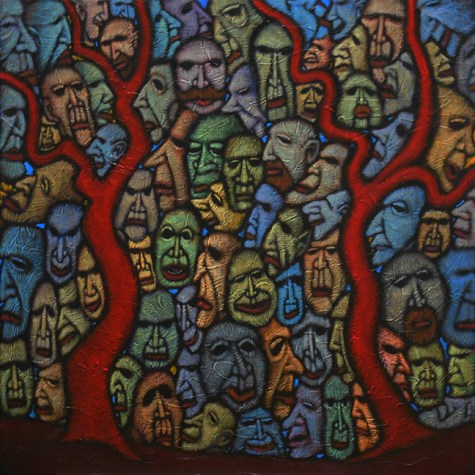
I have been looking at the painting shown above, Faces From the Wood, this morning which is kind of a weird thing to be doing at 5:30 AM. But something made me want to really examine it closely so here I am. Made me realize that the photo above doesn’t fully capture everything in the painting which is often the case with my work. The colors are deeper and darker which gives it a much more intriguing patina, adding a level of depth to the faces.
I used to sometimes gauge my newly finished work by imagining that I come upon it in some distant future garage sale. Would I look at this and think that I had stumbled on a unappreciated hidden treasure or just another piece that would forever pass hands in garage sales? It might seem a strange way to judge one’s work, I don’t employ it much any more but it was effective for quite a while. But holding this painting this morning, I once again pretended to be at some future yard sale. All I could think was how excited I would be to find this piece, if only for the working of the surface. I would think I had found a hidden treasure. As I said, the image above does not do it justice.
It also made me think of posting it this morning with an old Jethro Tull album from around 1977 and its title song, Songs From the Wood. I borrowed a bit of the title for the painting above and I can see many songs in it. Looking up when I last showed this painting, I found that it was less than two years back on a morning when I was not too happy with mankind as a whole– like most mornings.
I normally wouldn’t replay such a current post but it made me chuckle. So, needing a chuckle, here it is again along with the Jethro Tull song below it.
On a morning when I am feeling more than a bit misanthropic, I thought I’d express it in the lightest manner I could muster. I guess the verse above from English poet Sir Walter Alexander Raleigh (1861-1922) might do the trick.
I don’t know much about this particular Raleigh and, feeling as I do this morning, don’t really care. Don’t know if he was descended from the more famous Walter Raleigh, the one I best knew from seeing his face on my one aunt’s cigarette packs as a kid. I would imagine so but what does it really matter?
For those of you more interested, this particular Walter Raleigh was a professor of literature at Oxford and that bit of light verse was titled Wishes of an Elderly Man, Wished at a Garden Party, June 1914.
It might be titled Wishes of a Near Elderly Man, Wished in an Art Studio, August 2021.
I thought of going with a different piece of verse this morning, like this short bit from Ape and Essence, the lesser known dystopian novel from Aldous Huxley:
The leech’s kiss, the squid’s embrace, The prurient ape’s defiling touch: And do you like the human race? No, not much.
Or I guess I could have went with this simple quote from the great German painter Caspar David Friedrich (1774-1840) which might best describe my feelings:
You call me a misanthrope because I avoid society. You err; I love society. Yet in order not to hate people, I must avoid their company.
It’s not verse but maybe it gets closer to the bone. Perhaps even closer is this passage from Sinclair Lewis, as laid out it in his It Can’t Happen Here:
… he loved the people just as much as he feared and detested persons…
That might best describe my misanthropic urge this morning. And every other morning.
I like and love people individually but on the whole very much dislike persons in the collective sense.
I am not talking about you guys. No, you’re okay.
Really.
I hope you will excuse my curmudgeonly behavior this morning. Now get out of here.



 If we are not prepared to defend a tolerant society against the onslaught of the intolerant, then the tolerant will be destroyed, and tolerance with them.
 Redtree Times