Feeds:
Posts
Comments

The Wander-Light

GC Myers- The Allure 2022

The Allure— At the West End Gallery


For my ways are strange ways and new ways and old ways,
And deep ways and steep ways and high ways and low;
I’m at home and at ease on a track that I know not,
And restless and lost on a road that I know.

The Wander-Light, Henry Lawson, 1902


One of the great pleasures of writing this blog has been stumbling on to people– writers and artists and thinkers and all other sorts– I had never known before. Just this morning, the word restless lingered in my mind as I began thinking about what the subject would be today. I went to a favorite site for quotes and punched in the word and started scanning through the quotes. Most did nothing for me, raised no response in me.

Then I came across the verse shown at the top with just the name Henry Lawson attached. It wasn’t even shown as a verse, but as a paragraph. I had never heard of Lawson so immediately began a search.

Turns out that Henry Lawson was born in Australia in 1867 and died there in 1922. He wrote poetry and short stories about the people of the bush or outback of Australia. He is considered as perhaps the country’s greatest short story writer and bush poet. I am not sure what the difference is between bush and outback but one source said for a rough rule of thumb, the bush in Australia means green, and the outback means red or brown. His prose style has been described as an earlier version of Hemingway or Carver with short, sharp sentences and raw language.

Unfortunately, Lawson struggled with alcoholism and mental illness for much of his short life, dying from a cerebral hemorrhage at the age of 55.

Doing a little more research I discovered that the lines above were the last verse in a longer poem titled The Wander-Light I read that the poem, written in 1902, comes from a period when Lawson became convinced that his mother was descended from Gypsies. This poem reflects this belief. I found the whole poem which I will post at the bottom. I like it very much mainly because it doesn’t have the maudlin feel, the sentimentality, that you often find in popular poetry from this era.

I next checked to see if there was reading of this poem available but found that there had been a musical show in Australia that was a tribute to the writer called Looking For Lawson and that The Wander-Light had been transformed into a song. As I wrote only yesterday, I enjoy seeing how other artists of one medium translate the work of artists of other mediums in their own. They do a great job with this piece, creating the feel that one might get from a Kurt Weill or Stephen Sondheim piece. Worth a listen.

Glad I stumbled across Henry Lawson this morning. Hope to read more soon.


The Wander-Light

And they heard the tent-poles clatter,
And the fly in twain was torn —
Tis the soiled rag of a tatter
Of the tent where I was born.
And what matters it, I wonder?
Brick or stone or calico —
Or a bush you were born under,
When it happened long ago?

And my beds were camp beds and tramp beds and damp beds,
And my beds were dry beds on drought-stricken ground,
Hard beds and soft beds, and wide beds and narrow —
For my beds were strange beds the wide world round.

And the old hag seemed to ponder
(‘Twas my mother told me so),
And she said that I would wander
Where but few would think to go.
‘He will fly the haunts of tailors,
‘He will cross the ocean wide,
‘For his fathers, they were sailors
‘All on his good father’s side.’

Behind me, before me, Oh! my roads are stormy —
The thunder of skies and the sea’s sullen sound,
The coaster or liner, the English or foreign,
The state-room or steerage the wide world round.

And the old hag she seemed troubled
As she bent above the bed,
‘He will dream things and he’ll see things
‘To come true when he is dead.
‘He will see things all too plainly,
‘And his fellows will deride,
‘For his mothers they were gipsies
‘All on his good mother’s side.’

And my dreams are strange dreams, are day dreams, are grey dreams,
And my dreams are wild dreams, and old dreams and new;
They haunt me and daunt me with fears of the morrow —
My brothers they doubt me — but my dreams come true.

And so I was born of fathers
From where ice-bound harbours are —
Men whose strong limbs never rested
And whose blue eyes saw afar.
Till, for gold, one left the ocean,
Seeking over plain and hill;
And so I was born of mothers
Whose deep minds were never still.

I rest not, ’tis best not, the world is a wide one —
And, caged for an hour, I pace to and fro;
I see things and dree things and plan while I’m sleeping,
I wander for ever and dream as I go.

I have stood by Table Mountain,
On the Lion at Capetown,
And I watched the sunset fading
From the roads that I marked down;
And I looked out with my brothers
From the heights behind Bombay,
Gazing north and west and eastward,
Over roads I’ll tread some day.

For my ways are strange ways and new ways and old ways,
And deep ways and steep ways and high ways and low;
I’m at home and at ease on a track that I know not,
And restless and lost on a road that I know.

–Henry Lawson, 1902


Lawren-Harris-Isolation-Peak-1930

Lawren Harris- Isolation Peak, 1930


Every work of art which really moves us is in some degree a revelation: it changes us.

–Lawren Harris


Need to get right to work this morning so thought I’d share something from a favorite of mine, the late painter Lawren Harris. I am including a piece of music inspired by his paintings, Lawren S. Harris Suite for Piano Quintet, from composer Stephen Chatman. It is performed by pianist Sara Davis Buechner. This particular piece is inspired by the painting above, Isolation Peak. which is a distant view of Mont des Poilus in Yoho National Park, Alberta.

It’s always interesting to see how the work of artists is inspired by the work of those who work in other mediums. How many paintings have been inspired by pieces of music or how many pieces of music risen from seeing a film or dance?  I think this goes back to the Harris quote at the top. We are changed by art that moves us and that inevitably change shows up somehow in our own world and work.

And that’s a good thing…


Urge For Going

GC Myers- The Song That Brought Me Here

The Song That Brought Me Here– At West End Gallery


I awoke today and found the frost perched on the townIt hovered in a frozen sky, then it gobbled summer downWhen the sun turns traitor coldAnd all trees are shivering in a naked rowI get the urge for going but I never seem to goI get the urge for goingWhen the meadow grass is turning brown

–Joni Mitchell, Urge For Going


Felt like listening to some Joni Mitchell this morning. Something reminded me of a short film I saw many years ago which reminded me of her. I think it was on HBO in their earliest days when they would often play short films between their offerings. I remember quite a few of them much better than the movies they were sandwiched between.

This one was, as I remember it, from the Canadian Film Board. It was set in the rural western plains of Canada and was about a young girl, maybe 13 years old, being raised there in the 1950’s. The details are vague in my memory after 40 years or so, but I remember that it concerned a wild horse that was finally captured and broken. She saw the horse’s wildness in herself and quietly vowed at the end that they might have broken the wild horse, they would never break her.

I’ve looked casually for years for this film but can’t locate it. But that young girl’s sense of defiance at being forced into conformity stuck with me. It also reminded me of some of the performers that came out of the plains of Canada, like Joni Mitchell and KD Laing. I can imagine they felt that same urge to run free as the wild horses.

The urge for going, I guess, which brings us to this week’s Sunday Morning Music. It’s a video that ran here about seven years ago. It’s a very early version of Urge For Going from Joni Mitchell. This is taken from a Canadian television program, Let’s Sing Out, that ran from 1963-1967. It was broadcast from various Canadian college campuses and featured many folk performers of the day. Joni Mitchell first appeared on the show in 1965 using her maiden name, Joni Anderson. This particular performance using the more familiar Mitchell is from October of 1966 at Laurentian University in Sudbury, Ontario. You can see how special her talent was in the faces of the other performers watching her. I think it’s a beautiful rendition of the song.


Unintended Consquences

Be Careful What You Wish For- GC Myers 1996

Be Careful What You Wish For — 1996


Fear makes come true that which one is afraid of.

― Viktor E. Frankl, Man’s Search for Meaning


I came across the line above from a favorite book, Man’s Search For Meaning, from Viktor Frankl. It made me stop and think for a bit.

I have long believed that if we can give name to our desires, our psyche sets it as a goal and does all that it can, most often in ways of which we are not aware, to make those desires come to be. It gives you in situations that make the desire possible, makes you begin to believe in the possibility and then behave and think as though it were inevitable.

Of course, there has always been a caveat to this. Kurt Vonnegut put it plainly in the introduction to his novel, Mother Night:

We are what we pretend to be, so we must be careful about what we pretend to be.

We can never fully anticipate what may come from our quest to make our desires a reality. There are always unintended consequences, both good and bad.

But Frankl made me think about how the same concept applies to not just our desires but our fears as well. Too strong a fear in us becomes much like a strong desire, with our psyche unconsciously pushing us toward that which we desire/fear. And whatever side of that desire/fear coin turns up for us, we often find ourselves at the mercy of unintended consequences.

Before you slam me for spouting psychobabble BS, let me note that I am just thinking aloud here at 5:30 AM. Later today or tomorrow, I may read this and wonder what the hell I was thinking. But I think it might be possible that by fearing too much, by trying to completely avoid those things we dread, we do create an environment in which they might come to be. Maybe that’s the results of physics, where every action has an equal and opposite reaction.

I don’t know but now that it’s a little after 6, it sounds good enough to believe.

That’s all I go this morning. Think what you will.

But be careful, you never know what might come from it…

Here’s song from Bonnie Raitt from just a few years back that is kind on subject. This is Unintended Consquence of Love.


out of darkness


9921042 Dispersing Darkness sm

Dispersing Darkness– At the Principle Gallery

Man must have light. He must live in the fierce full constant glare of light, where all shadow will be defined and sharp and unique and personal: the shadow of his own singular rectitude or baseness. All human evils have to come out of obscurity and darkness, where there is nothing to dog man constantly with the shape of his own deformity.

–William Faulkner, The Mansion (1959)


I read yesterday that newly elected Sen. John Fetterman of Pennsylvania had entered a hospital to be treated for clinical depression. It reported that he had suffered from this for much of his life.. I am sure that the great stress inflicted on him by the stroke he suffered during his campaign played a big part in this latest bout with his affliction.

I also wouldn’t be surprised that his time in the current DC political climate might have played a role as well. While the potential for meaningful progress and change that is always near at hand there might be inspiring, there is an abundance of the obscurity and darkness to which Faulkner alluded in the excerpt above.

To peer firsthand into the opaque shadows of the darkness there, to see the levers of government manipulated by the force of money and power might well be disillusioning for someone with ideals and ethics, someone dedicated to elevating those with neither money nor power. There’s a darkness there of the quality that, like Faulkner also points out, keeps those in it from seeing the shadow of their own deformity, their own afflictions. It’s a darkness that spawns the rampant shamelessness and selfishness we are seeing now.

I hope that the Senator moves past his darkness. Being the forthright speaker he is, my other hope is that he might make mental health a cause he can champion. It might be a great opportunity to bring attention to a subject, mental health, that is often forced into the background, especially by those in politics, where it is usually portrayed as a sign of weakness or instability. A flaw to be exploited and stigmatized.

Maybe he can shine a light into the darkness.

As someone who has struggled with depression for much of my life, I would love to see a greater safety net for the many who struggle with mental health issues.

And it is many.

Who doesn’t have a family member or friend who has struggled and suffered? Or who struggles now and simply suffers, accepting it as the normal state of being? I know that’s how it was for me in the early part of my life. Many people in my youth scoffed at the word depression even though, looking back now, their own actions and behaviors gave all the indications of that condition. They just accepted the behaviors from it –alcoholism, addictions, suicides, etc.– as being the normal state of being.

With all the years of stigmatization, it’s still a hard thing to talk about. But like any problem, it can’t be improved on until it is named and confronted. I know this well. My life would be vastly different– if I still were even alive– if I hadn’t become aware that darkness in which I was struggling was not the normal state of being. It’s an important subject in this and every other country. It deserves to be moved away from the darkness, where you can see the shadow it casts on our lives in the brightest of light.

I’ve said a lot more than I intended when I started this morning. Maybe too much. Like I said, there is still that stigma present. But it is out there in the light and that can be a good thing. I have work to get to– the work that takes away a lot of my darkness– so we’ll have to talk about this later.

Kind of the same subject, here’s one of my favorites, Killing the Blues, written by Rowland Salley and performed by the late John Prine.


And Warmth Arrives

GC Myers- And Warmth Arrives  2023

And Warmth Arrives– At West End Gallery


As flowerlets drooped and puckered in the night turn up to the returning sun and spread their petals wide on his new warmth and light-just so my wilted spirits rose again and such a heat of zeal surged through my veins that I was born anew.

–Dante Alighieri, The Inferno ( John Ciardi translation, 1954)


Been working on a couple of long delayed maintenance projects around here in recent days. Wanting to get a bit more done while I am still running strong on the energy from first light of the new day and the possibility contained in it, I am leaving this short post with you. A new Little Gem, a line from Dante and a great old song from The Rascals to get your day off and running.

Now, I have things that need to be done. As they say–got to make hay while the sun shines.


Forever Young

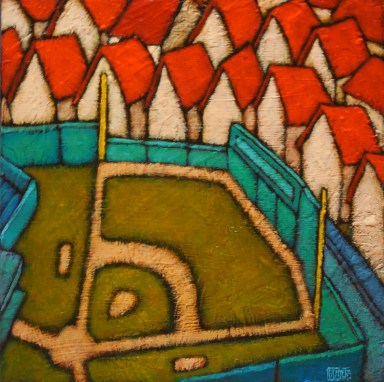
GC Myers- Neighborhood Heart sm

Neighborhood Heart— At the Principle Gallery, Alexandria


Since baseball time is measured only in outs, all you have to do is succeed utterly; keep hitting, keep the rally alive, and you have defeated time. You remain forever young.

–Roger Angell, Once More Around the Park: A Baseball Reader


Temperatures are supposed to be in the mid 60’s here today. While I am concerned about the reasons and ramifications of our temps being 30+ degrees above the norm, I am happy to enjoy the warmth. It feels springlike and adds to the sensation of pleasure I feel now that baseball’s Spring Training has begun.

And that means that another season of the game is not far away.

Another long season of highs and lows. Another season of exciting victories and crushing losses, of sparkling plays and dreadful errors in the field. The thrill of the long arc of the home run or the wall-climbing catch that robs the batter of his homer. Another season of the cat-and-mouse game that is played out between the pitcher and the batter.

Another year of daily checking of the stats for each player, trying to find traces of an accomplishment that will put their names in the record book alongside those well-worn names from past eras– the Babe Ruths and Hank Aarons, the Cy Youngs and the Bob Gibsons.

And another season of daily checking of the standings, trying to gauge whether your team still has a chance to defeat time, as the great baseball writer Roger Angell put it at the top. While writing about how the time in baseball is what differentiates from other games, Angell also speaks to its connection to the history, players, and rhythm of the past.

Baseball’s time is seamless and invisible, a bubble within which players move at exactly the same pace and rhythms as all their predecessors. This is the way the game was played in our youth and in our fathers’ youth, and even back then… there must have been the same feeling that time could be stopped.


Another season of trying to stay forever young. At a time when the world constantly reminds me of slowly diminishing physical abilities, that’s an idea I can embrace.

Here’s a lovely performance of the Bob Dylan song, Forever Young, from Joan Baez.


GC Myers- Everlasting Bond sm

Everlasting Bond– At the West End Gallery


Although I conquer all the earth,

Yet for me there is only one city.

In that city there is for me only one house;

And in that house, one room only;

And in that room, a bed.

And one woman sleeps there,

The shining joy and jewel of all my kingdom.

—Anonymous, Ancient Sanskrit Poem


This ia a kind mash-up of past Valentine’s Day posts, with a Baucis and Philemon painting and a favorite love poem to accompany a blog entry that features a great tune from Otis Redding. Here’s that blog entry from five years ago:


Another Valentine’s Day. We often think of it as a day to express your fondness for the one you love. But at its heart, there is an element of yearning and loneliness in the day.

To give someone a Valentine as a kid– or maybe even when you’re a little older–is not only an offering up of your feelings for that other person but also a plea for their attention and affection. It is an admission of need and vulnerability that is very human, as is the need to know that you are indeed loved by another.

This song, These Arms of Mine, is from Otis Redding. For me, Otis can do no wrong and few can better express the yearning that I am describing here than Otis.

Have a good day. And if you love someone, let them know every day, not just on this day.


Wishin’ and Hopin’


GC Myers- Secret Garden

Secret Garden— At the Principle Gallery

“Of course, there must be lots of Magic in the world,” he said wisely one day, “but people don’t know what it is like or how to make it. Perhaps the beginning is just to say nice things are going to happen until you make them happen. I am going to try and experiment.”

–Frances Hodgson Burnett, The Secret Garden, 1911


…until you make them happen.

A lot of us wish and hope for better things and a change from those parts of our lives that disappoint us. But until we act on those wishes and hopes, nothing usually happens.

Things stay the way they are.

Of course, wishing and hoping can be viewed as the primary stages of making a plan of action or setting a course and goal for the future. And that’s important.

Action without a goal can be as fruitless as wishing and hoping without action.

But the two– the wish and the action– put together can produce a sort of Magic, much as Colin the bedridden boy discovered in The Secret Garden. It’s a Magic that is within our grasp once we realize this fact.

I am going to give a really basic example. Many years ago, when I was in the early stages of my art life, I wished and hoped for a solo exhibit. I had only been showing my work publicly for a very short time, less than two years, so I didn’t have a reputation or name to pave the way. It would have been easy to shrug it off and do nothing, but I decided to act on my wish. I had been working on my Exiles series, work that was very personal. I put together a proposal for show of these paintings and introduced myself to the director of the Gmeiner Art Center in Wellsboro, PA, about an hour from my home. She was impressed by the work and the presentation and gave me a solo show that winter featuring the Exiles paintings.

One thing that struck me about this was when a couple of other artists approached me at a local gallery opening around the time the show at the Gmeiner ran. Both were established artists who had been working much longer than I and had actual bodies of work. They seemed kind of envious that I was having this show and asked how I got this show.

My answer was simple.

I asked for it.

I could see on their faces that this was a revelation, that this simple action was something they had never thought to do.

You can’t wait for your hopes and wishes to come to you. Sometimes, you have to take the step towards them, to put things in motion and to make Magic happen.

Unfortunately, a lot of us don’t ever get the connection between wishes and actions. And that’s a shame.

Make something happen today. Make some Magic.

Of course, if you read this blog regularly, you probably know that this is all just a setup for playing a song. I thought that today’s words and image would match up nicely with a hit song, Wishin’ and Hopin’, from Burt Bacharach, who died this past week. This is the 1964 hit version from Dusty Springfield. Though it seems a little dated and she seems a little needy in this song about getting a guy, the premise that it takes action to achieve wishes and hopes is correct : You won’t get him/ Thinkin’ and a-prayin’, wishin’ and a-hopin’


Calling Me Home, Again

GC Myers- At Land's End

At Land’s End— At West End Gallery


“Everyone must leave something behind when he dies, my grandfather said. A child or a book or a painting or a house or a wall built or a pair of shoes made. Or a garden planted. Something your hand touched some way so your soul has somewhere to go when you die, and when people look at that tree or that flower you planted, you’re there.

It doesn’t matter what you do, he said, so long as you change something from the way it was before you touched it into something that’s like you after you take your hands away. The difference between the man who just cuts lawns and a real gardener is in the touching, he said. The lawn-cutter might just as well not have been there at all; the gardener will be there a lifetime.”

― Ray Bradbury, Fahrenheit 451


This is kind of a reconstructed replay of a post from a couple of years back. It just felt right this morning, sitting here in the studio

It features a song for this week’s Sunday Morning Music, Calling Me Home, from one of my big favorites, Rhiannon Giddens. There’s a line in the song that always jumps out at me:

Remember my stories, remember my songs/ I leave them on earth, sweet traces of gold

It makes me think of that existential question: What is it we leave behind?

That immediately brought to mind a favorite excerpt, shown at the top, from Ray Bradbury in his sci-fi/ dystopian classic Fahrenheit 451. It’s those things to which we devote or full effort, our mind and time, that have lasting effect. Often, things that are done with no real expectation of anyone recognizing your thought or effort in doing them.

It makes me think of my pond. I can see its top now in the winter since the leaves have fallen from the trees.

I built it back in the summer of 1998 during a week spent relentlessly pounding against the hard pan soil beneath the clay of my property on a rented Cat D9 dozer. Still wondering if my brain has stopped reverberating form the beating that Cat gave me. But that was a small price to pay. The thrill of seeing that empty pit fill in the rains later that summer and fall along with the many life forms that soon made it their home were as satisfying as anything I have painted.

I often look at it– as I am this moment– and think that it will be here long after I am gone, supporting lives of creatures that will have no knowledge of my efforts.

And that pleases me greatly. Even as much as any legacy, if any, my work here in the studio will have.

It always comes down to those things we do with love and the people that we touch and affect that outlast the lives we have here on this planet. As Mr. Bradbury put it: Something your hand touched some way so your soul has somewhere to go when you die.

Here’s the song from Ms. Giddens.